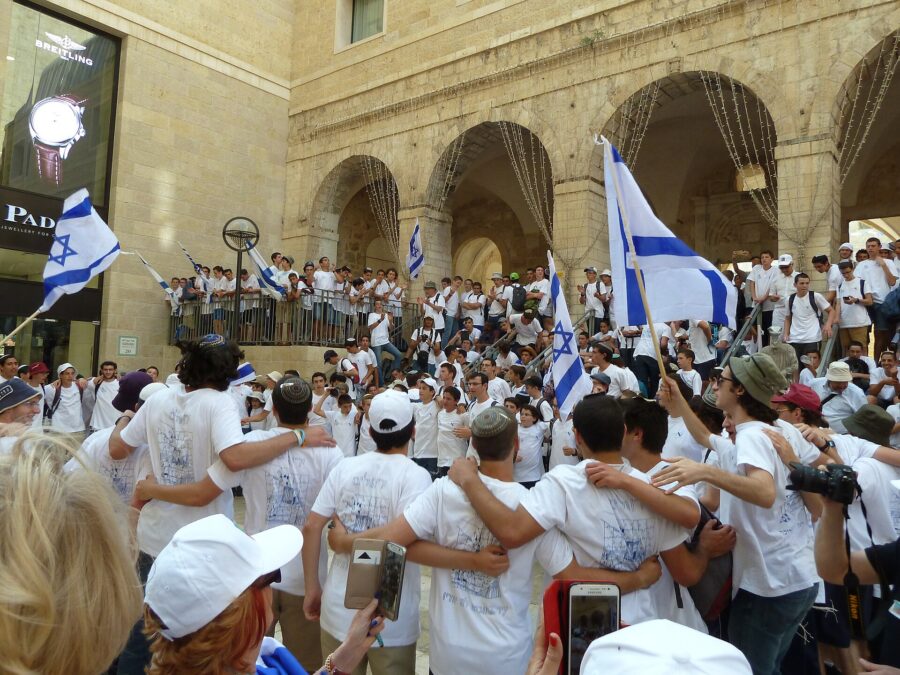
At about half past two on Palm Sunday afternoon, the road down from Bethphage stops being a road. Scout bands from Beit Jala and Nazareth start drumming, several thousand people lift olive branches at once, and the whole thing begins to move — slowly, because it always takes more than two hours to cover a walk that would take you twenty minutes alone. Somewhere behind you a Nigerian choir is singing over a Polish one. That is the moment most people mean when they talk about Easter in Jerusalem: not a service, but a city-sized procession that has been walking the same hill for sixteen hundred years.
This guide covers Holy Week specifically — the programme, the timings, where to stand, what needs booking and what cannot be booked at all, and the genuinely confusing business of Jerusalem keeping two Easters five weeks apart in 2027. For the route itself outside Holy Week, and the fourteen Stations as a year-round walk, see our guide to the Via Dolorosa. Everything here was checked in September 2026. Liturgical times shift by an hour or two from year to year and the patriarchates publish their final schedules only a few weeks ahead, so confirm the specific hours once you arrive.

Two Easters, Five Weeks Apart
The single most important planning fact: Jerusalem does Easter twice. The Catholic and Protestant churches calculate the date on the Gregorian calendar. The Greek Orthodox, Armenian, Syriac, Coptic and Ethiopian churches still use the Julian one. Most years they land a week or several apart; in 2025 they coincided exactly, which will not happen again until 2028.
| Day | Western 2027 | Orthodox / Julian 2027 |
|---|---|---|
| Palm Sunday | 21 March | 25 April |
| Holy Thursday | 25 March | 29 April |
| Good Friday | 26 March | 30 April |
| Holy Saturday (Holy Fire) | 27 March | 1 May |
| Easter Sunday / Pascha | 28 March | 2 May |
Practically, this means a five-week window in spring 2027 in which the Old City is busy twice over, and it means you should be very careful reading anything online that says only “Easter in Jerusalem” without saying whose. It also means an opportunity: if the Western week is sold out or over budget, the Orthodox one is nearly as full liturgically, considerably less scrummed by tour groups, and cheaper.
One further wrinkle. The Holy Fire ceremony belongs to Orthodox Holy Saturday only — 1 May in 2027 — and is a genuinely separate planning problem from the rest of the week, covered in its own section below.
The Western Holy Week, Day by Day
Palm Sunday
The great procession is the one event of the week that anyone can simply turn up to, and the one most worth doing. It gathers from early afternoon at the Church of Bethphage on the eastern slope of the Mount of Olives and traditionally sets off around 14:30, descending past the Church of Dominus Flevit and Gethsemane, crossing the Kidron Valley, entering through the Lions’ Gate and finishing in the courtyard of St Anne’s Church.
- Getting there: take a bus or taxi to the top of the Mount of Olives and walk down to Bethphage, or start from Gethsemane and join as the procession passes. Do not drive — the road is closed and the parking situation on the ridge is hopeless at the best of times.
- What to bring: a hat, water, and a palm or olive branch, sold by vendors along the route for a few shekels. Wear shoes you can walk downhill in for two hours on uneven tarmac.
- Where to stand if you are not walking: the wall above the Seven Arches viewpoint, or the terrace at Dominus Flevit, both of which give you the procession snaking down with the Old City behind it. This is the photograph of the week.
- The Greek Orthodox version on 25 April is smaller, starts later in the afternoon and is, in many people’s view, more atmospheric for exactly that reason.
Note that the Palm Sunday procession is not the same as the Sunday liturgy: the Latin Patriarch celebrates Mass at the Holy Sepulchre that morning, hours before the walk. If you want both, plan a very long day.
Holy Monday to Wednesday
The quiet middle of the week, and the smartest time to actually see things. The Holy Sepulchre still has queues but they are hours shorter than they will be by Friday. Chrism Mass, at which the oils for the coming year are blessed, is usually on the Thursday morning but sometimes moves; the Franciscan Way of the Cross runs its regular Friday-afternoon walk on the Via Dolorosa year-round, so you can rehearse the route in relative calm. Use these days for the Church of the Holy Sepulchre itself, the Tower of David and anything on your list that is not liturgical, because from Thursday afternoon the Old City is effectively one large crowd.
Holy Thursday
Two things matter. In the morning, the Latin Patriarch celebrates the Chrism Mass at the Holy Sepulchre. In the afternoon there is a Washing of the Feet ceremony in the parvis — the courtyard outside the church — followed in the evening by a Holy Hour at Gethsemane, and then a night vigil there. The walk from the Old City down to Gethsemane after dark, in a slow river of candles, is one of the most affecting hours of the week and is much less photographed than Good Friday. The Greek Orthodox Washing of the Feet in the parvis on their Holy Thursday draws a very large crowd and is worth arriving two hours early for.
Good Friday
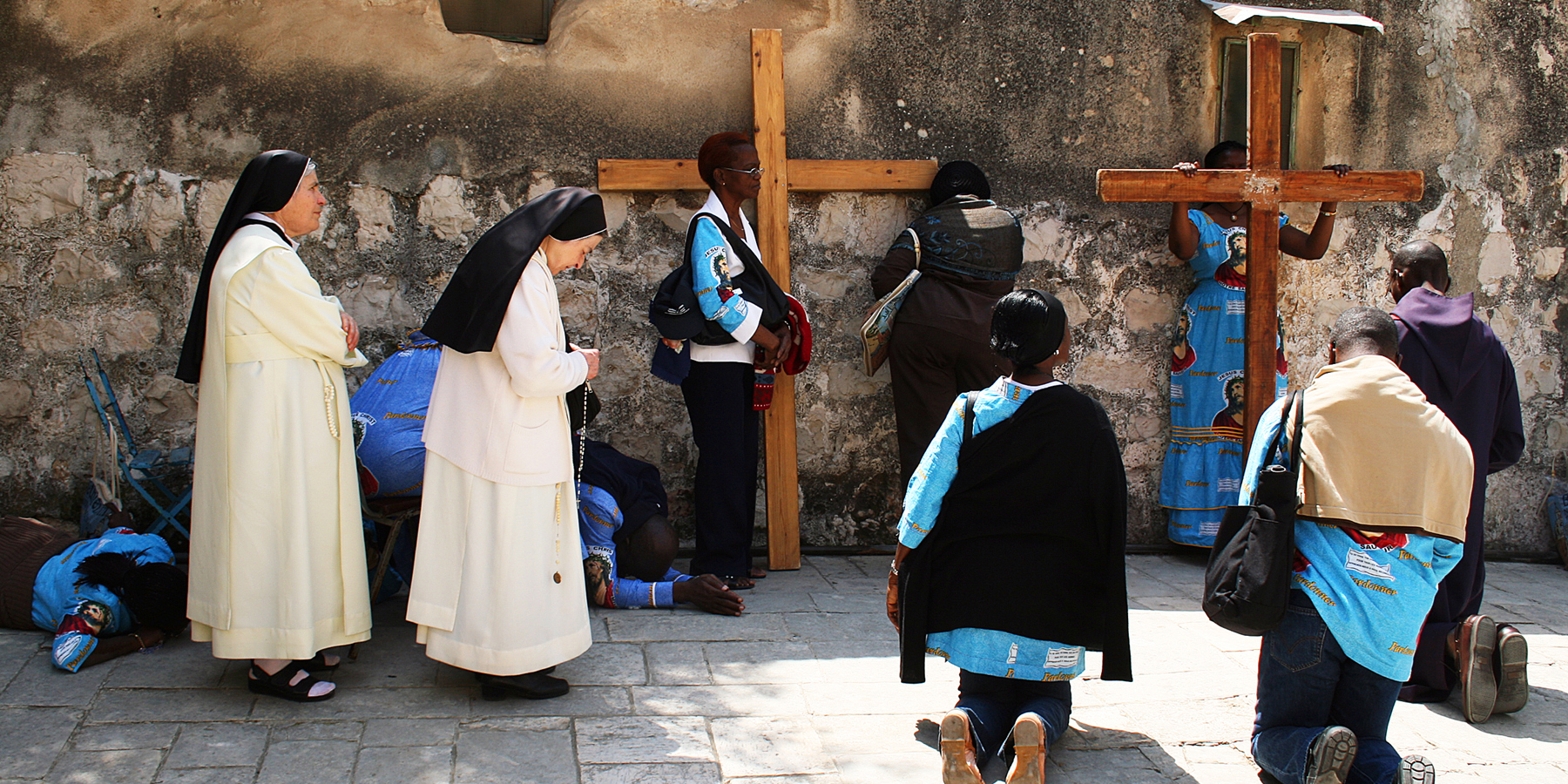
The busiest day of the Christian year in the Old City, and the one that needs the most planning. Processions run along the Via Dolorosa from before dawn until well into the evening — dozens of them, in a dozen languages, from parishes and pilgrimage groups all over the world. The Franciscan Way of the Cross, the main official procession, typically starts from the Umariya School near the First Station in the late morning.
- Arrive early. Not “in good time” — early. The lanes between the Fourth and Ninth Stations are impassable by mid-morning, and once you are in the crowd you are going where it goes.
- Enter by Lions’ Gate or Herod’s Gate, not Damascus Gate or Jaffa Gate, which is where the police funnel everyone.
- Expect bag checks and closed lanes. Israeli police manage access to the route and close side alleys without notice. Give yourself an hour more than the map suggests.
- The Holy Sepulchre itself is effectively unvisitable as a sightseer on Good Friday afternoon. If you want to be inside for the liturgy, be there in the morning and stay.
- Do not plan anything else that day. Not the Israel Museum, not lunch anywhere with a table booking, not a bus.
Holy Saturday and Easter Sunday
For Western Christians, Holy Saturday is quiet during the day and builds to the Easter Vigil at the Holy Sepulchre in the evening — a long, beautiful liturgy that begins in near-darkness. Easter Sunday morning brings the Latin Patriarch’s Mass at the Holy Sepulchre and a great many parish services elsewhere; the Garden Tomb, north of Damascus Gate, holds Protestant sunrise services that need booking through the participating churches and fill months ahead.
For the Julian churches, Holy Saturday is the Holy Fire, and the day works completely differently. See below.
The Holy Fire, in Brief
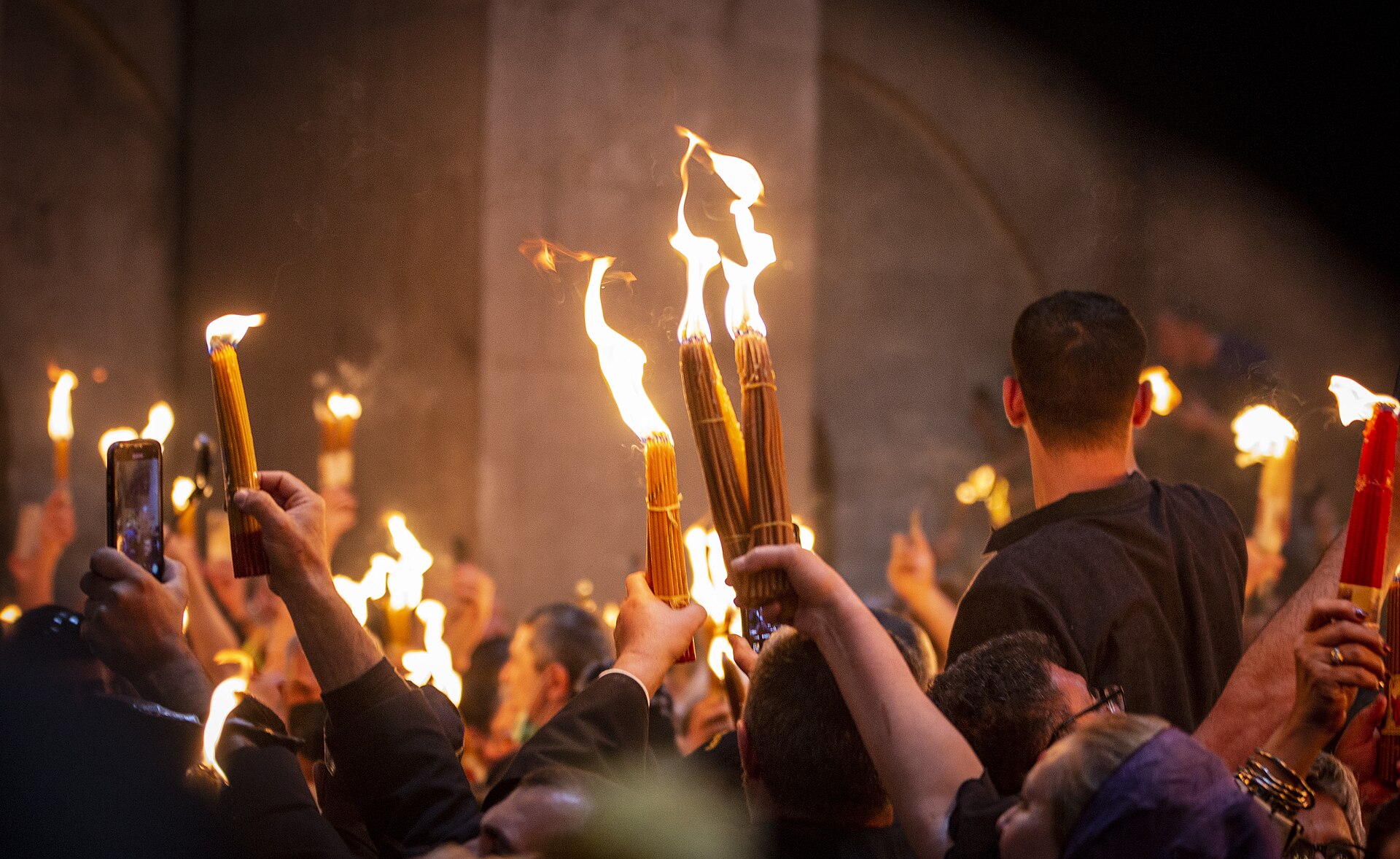
On Orthodox Holy Saturday — 1 May 2027 — the Greek Orthodox Patriarch enters the Edicule and emerges with lit candles, and the flame passes hand to hand through a church packed since dawn. It is the most intense hour in the Jerusalem calendar. It is also the hardest thing in this guide to actually attend: the church fills before sunrise, the Christian Quarter is cordoned, access is controlled by the police with numbers strictly capped since the crowd-safety review of recent years, and a very large proportion of people who travel specifically for it end up watching a screen in a courtyard or on the roof of a nearby building.
That is not a reason to skip it, but it is a reason to arrive with the right expectation. If the Holy Fire is the reason you are travelling, budget an entire day for it, be at a Christian Quarter gate before first light, and have a fallback position in mind — the rooftops around the Muristan and the courtyard screens are where most of the crowd actually ends up, and the flame reaches them within the hour.

The Orthodox Holy Week, and Why It May Suit You Better
The Julian week — 25 April to 2 May in 2027 — follows a different rhythm, and a great many people who have done both prefer it. It is fuller of local Christians and thinner of coach parties. The liturgies are longer, largely in Greek and Arabic, and they run at hours that assume you have nothing else to do.
- Palm Sunday (25 April). The Greek Orthodox procession descends the Mount of Olives in the late afternoon, smaller than the Latin one but with the same route and a fraction of the crowd. There is also a morning procession three times around the Edicule inside the Holy Sepulchre.
- Holy Monday to Wednesday (26–28 April). The Bridegroom services each evening at the Holy Sepulchre, and the Holy Unction on the Wednesday. Quiet, long, extraordinary if you have the patience.
- Holy Thursday (29 April). The Washing of the Feet in the parvis, performed by the Patriarch on a raised platform, mid-morning. This is a genuinely large crowd — arrive by 07:00 for a view. In the evening, the Twelve Gospels service.
- Good Friday (30 April). The Apokathelosis, the taking-down from the cross, in the afternoon, followed by the Epitaphios procession around the Edicule in the evening with the flower-decked bier. Fewer people than the Latin Good Friday and, to many eyes, more moving.
- Holy Saturday (1 May). The Holy Fire. Everything else in the city stops mattering.
- Pascha (2 May). The midnight liturgy and the Sunday of Love in the afternoon, when the Patriarch and clergy exchange the Paschal greeting in the parvis.
The smaller communities are the real find
Six churches share the Holy Sepulchre under the Status Quo, the arrangement frozen in the nineteenth century that fixes to the minute who may process where, and for how long. Its most famous artefact is the immovable ladder under a window on the facade, unmoved since the eighteenth century because nobody can agree who has the right to move it. During Holy Week the Status Quo stops being an anecdote and becomes visible: you will watch one community wait, silently and precisely, for another to finish.
- The Ethiopian Orthodox hold their Searching for the Body of Christ ceremony on the roof of the Holy Sepulchre, in the little village of monastic cells at Deir es-Sultan, on the Saturday night. Drums, umbrellas, chanting, perhaps two hundred people, and no tour groups at all. For a lot of visitors it is the best hour of the week.
- The Armenian Patriarchate processes from the Armenian Quarter to the Holy Sepulchre through the week; the St James Cathedral services are open to visitors and almost nobody goes.
- The Syriac Orthodox keep their chapel behind the Edicule, containing rock-cut tombs of the first century — the oldest thing in the building — and their Palm Sunday liturgy at St Mark’s is small, sung and completely unvisited.
- The Copts maintain the small chapel at the back of the Edicule and hold their own Holy Week services alongside everyone else’s.
None of these needs a ticket or an introduction. Turn up, stand at the back, and be quiet. The Christian Quarter guide covers the geography of who is based where.
A Realistic Holy Week Plan
If you have a week and you want both the liturgy and some of the city, this shape works better than most:
| Day | Morning | Afternoon and evening |
|---|---|---|
| Wednesday before | Arrive, settle, walk the ramparts | Old City at dusk, dinner in West Jerusalem |
| Thursday before | Holy Sepulchre early, before the crowds | Mount of Olives, Gethsemane, walk the route you will process on Sunday |
| Friday before | Israel Museum or Yad Vashem | Mahane Yehuda before Shabbat; watch the city close |
| Saturday before | Day trip out — Bethlehem or the Dead Sea | Rest. You will need it. |
| Palm Sunday | Mass at the Holy Sepulchre, or a lie-in | Bethphage by 13:00, procession, St Anne’s |
| Mon–Wed | Sightseeing: Western Wall Tunnels, City of David, museums | Evening liturgies, or an early night |
| Holy Thursday | Chrism Mass | Washing of the Feet, then the candlelit walk to Gethsemane |
| Good Friday | In the Old City by 07:00. Stay there. | Processions all day. Nothing else. |
| Holy Saturday | Rest, or the Ethiopian roof ceremony | Easter Vigil at the Holy Sepulchre |
| Easter Sunday | Easter Mass, or the Garden Tomb sunrise service | Lunch, and a very long sleep |
If you have only three or four days, cut the sightseeing rather than the liturgy — the museums will be there next time, and our three-day itinerary works perfectly well in an ordinary week.
Where to Stay, and When to Book
Holy Week is the tightest accommodation market of the Jerusalem year, tighter than Passover because it concentrates on a smaller area. Rooms inside the Old City and immediately around Jaffa Gate go first, and the pilgrim guesthouses go earliest of all.
- Book eight to nine months ahead for the Western week. Six is usually enough for the Orthodox one.
- The church guesthouses — Austrian Hospice, Notre Dame, the Lutheran and Armenian houses — are the best value and the best located for a pilgrimage week, and they are also the first to fill. See our guide to Christian guesthouses in Jerusalem.
- Staying in the Old City means you can walk out of your door into the procession, and it also means you may be inside a police cordon at inconvenient times. Old City hotels covers the trade-off; where to stay in Jerusalem covers the wider map.
- Expect Holy Week rates well above a normal spring week, with the budget end disappearing first. Our page on what a Jerusalem trip costs gives the arithmetic.
Practicalities for the Week
Getting around
The Old City is closed to vehicles during processions and much of East Jerusalem is congested from mid-morning on the big days. Walk, or use the light rail to Damascus Gate or City Hall and walk from there. Note that in a year like 2027, Western Holy Week runs directly into the Jewish festival calendar in places — check both. Fares and networks are covered in getting around Jerusalem, and the wider religious calendar in our Jerusalem religious holidays guide.
What to wear
Shoulders and knees covered, for men and women, at every church you will enter this week — and you will enter a lot of them. Add proper walking shoes, a sun hat and a light layer for evening: Jerusalem in late March sits around 18–20°C by day and drops sharply after dark, and you may be standing outdoors for hours. Full detail in our Jerusalem dress code guide and, for the season, what to pack.
Eating
Christian Quarter restaurants stay open through the week but are overwhelmed on Friday. The Muslim Quarter souq trades normally throughout unless the week coincides with Ramadan. West Jerusalem is entirely unaffected by Holy Week and is where to go for a proper dinner — see the best restaurants in Jerusalem. If Passover falls in the same window, bread disappears from Jewish West Jerusalem for the week, which catches out a great many pilgrims.
Photography and behaviour
Nobody minds cameras at the outdoor processions; a great many participants are filming too. Inside the churches, and particularly during a liturgy, put the phone away and watch. Do not stand in the path of a procession to get the shot — step into a doorway and let it come to you. And if a group asks you to move so they can carry a cross past, move. Our photography guide has the best vantage points for the week.
Is Holy Week Actually the Right Time to Come?
Here is the honest answer, which most sites will not give you. If you are coming as a pilgrim, or if the liturgy is genuinely the point of the trip, then yes — nothing else in the Christian world resembles it, and you will remember it for the rest of your life. If you are coming as a traveller who would also quite like to see the Israel Museum, walk the ramparts, get into Hezekiah’s Tunnel and eat well, Holy Week is close to the worst week of the year to attempt it. The sites are crowded, the lanes are cordoned, the prices are at their peak, and you will spend a great deal of the week standing still.
The best compromise, if you can manage it: come for the second half of the Orthodox week rather than the Western one, or arrive the Wednesday before Palm Sunday and get your ordinary sightseeing done before the city fills. A first visit to Jerusalem that is really about the Old City is generally better served by an ordinary week — see our best time to visit guide for the quiet windows.
The Holy Fire needs more space than a section can give it, because attending is a logistical problem rather than a liturgical one: cordons from four in the morning, capacity caps enforced by the police, and a very real chance that you spend the day at a screen in a side lane. Our dedicated guide to the Holy Fire ceremony works through the hour-by-hour shape of Orthodox Holy Saturday, your honest odds at each stage, and the fallback positions worth taking.
Many pilgrims build a longer journey around Holy Week, spending the days before Palm Sunday in the Galilee and arriving in Jerusalem for the liturgies. Our Holy Land pilgrimage itinerary shows how to rearrange ten days so that the Mount of Olives, the Upper Room and the Via Dolorosa fall on the right days.
Final Word on Easter in Jerusalem
Holy Week here is not a spectacle staged for visitors, and that is precisely what makes it worth the discomfort. The processions have been walking these lanes since the fourth century; the arrangements between the churches are older than most nations; the crowd around you has come from Kerala and Kraków and Ramallah and is not, on the whole, taking photographs. Come with low expectations about how much you will see and high ones about what it will feel like, arrive earlier than you think you need to every single day, and give yourself one afternoon out of the walls to recover. Then use our Christian pilgrimage guide to fill the days either side, the holy sites round-up for what else to fit in, and the full Jerusalem religious holidays calendar to see what the rest of the city is doing while you walk.
Photo Credits
Palm Sunday procession crowd on the Mount of Olives: Palm procession 2019 in Jerusalem (05) by Bahnfrend, CC BY-SA 4.0, via Wikimedia Commons.
Catholicon dome inside the Church of the Holy Sepulchre: Catholicon, Church of the Holy Sepulchre, Jerusalem by Diego Delso, CC BY-SA 3.0, via Wikimedia Commons.
Candles lit from the Holy Fire in the Church of the Holy Sepulchre on Orthodox Holy Saturday: Огонь. ХГГ by Alexander Khanin, CC BY-SA 4.0, via Wikimedia Commons.
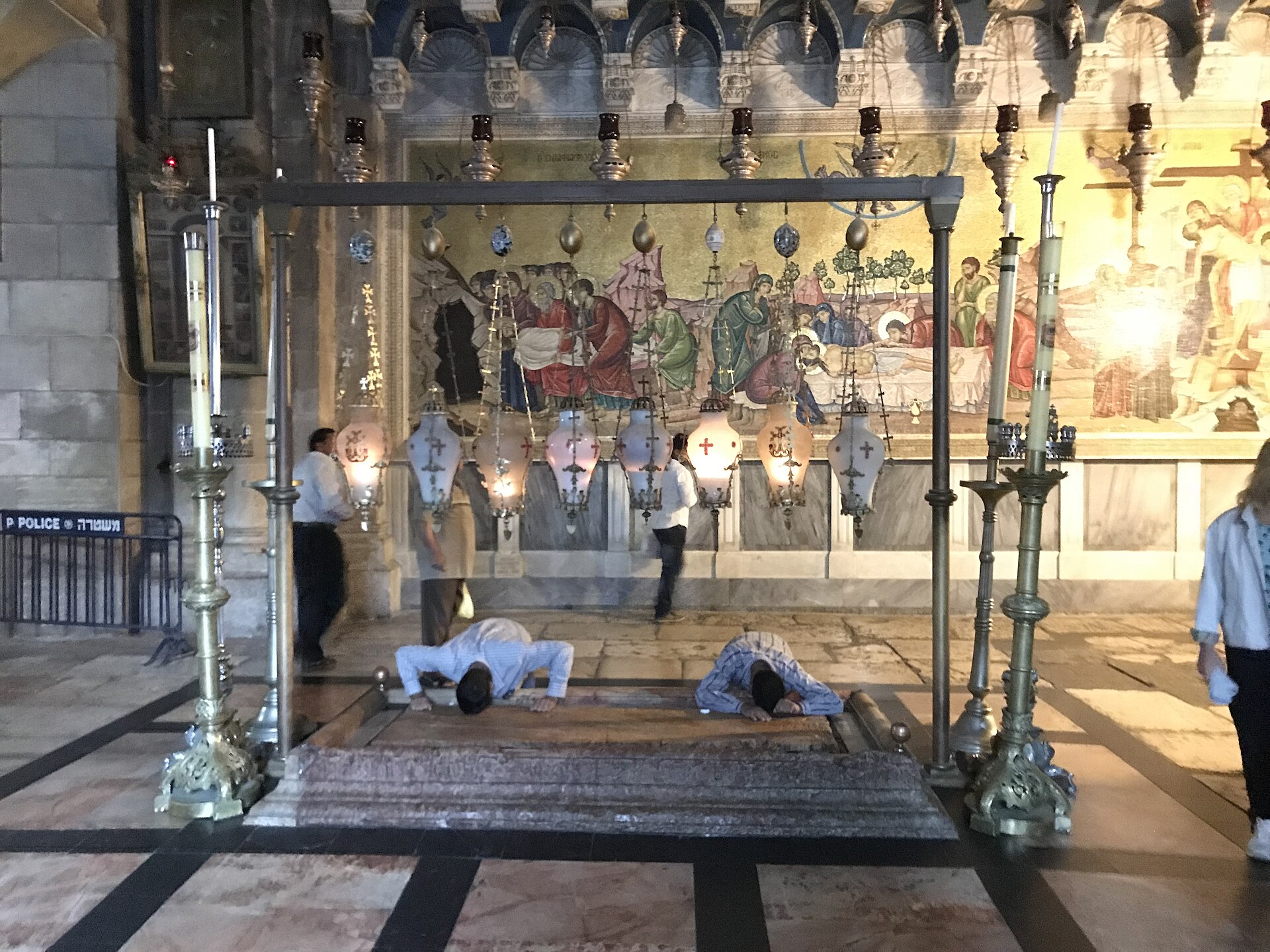
The Stone of Anointing and its mosaic in the Church of the Holy Sepulchre: Holy Land Pilgrimage 2017 P044 the Stone of Anointing by Fallaner, CC BY-SA 4.0, via Wikimedia Commons.
Nuns and pilgrims praying beside wooden crosses on the Via Dolorosa on Good Friday: Christians praying on the Via Dolorosa in Jerusalem by Dr. Ondřej Havelka (cestovatel), CC BY 4.0, via Wikimedia Commons.