Jerusalem transportation is straightforward once you understand the city’s compact geography and a few practical systems. The Old City and central neighborhoods are best on foot. A modern light rail network — two lines since August 2026 — connects the city center to outer attractions like Yad Vashem and Mahane Yehuda Market. Buses cover everything the tram does not. Taxis are reliable and easy to summon through the Gett and Yango apps. The one thing every visitor has to plan around is Shabbat, when public transit shuts down completely from Friday afternoon to Saturday nightfall.
This complete guide to Jerusalem transportation covers walking, the light rail, buses, taxis, the Rav-Kav card, airport transfers, and exactly how Shabbat affects each one. Fares below are given in shekels (ILS) and are approximate for 2026; the public-transport network periodically adjusts prices, so treat them as a close guide rather than the cent. Pair this with our Jerusalem travel tips guide.

Walking — Your Primary Mode
Jerusalem’s tourist core is small, and most of the time your own two feet are the fastest, cheapest option. The Old City fits inside roughly one square kilometer, and the modern center, Mamilla, and the markets are all within a comfortable stroll of each other. Approximate walking times between the places you are most likely to go:
- Across the Old City — about 20 minutes gate to gate on foot.
- Jaffa Gate to the Western Wall — roughly 10 minutes through the lanes.
- Mamilla to Jaffa Gate — 2 to 3 minutes; the promenade leads straight to it.
- Mamilla to Mahane Yehuda Market — about 15 minutes, or three light-rail stops.
- City center to the German Colony — around 25 minutes downhill.
- Jaffa Gate to Mount Zion — about 10 minutes.
Two practical notes. First, comfortable, closed walking shoes are essential: the Old City is worn Ottoman-era stone, slick when wet and uneven everywhere, and the modern city is genuinely hilly. Second, the city sits at altitude and the summer sun is fierce, so plan your longest walks for the morning and late afternoon and carry water — see our seasonal weather guide for what to expect.
The Light Rail (Red and Green Lines)
Since 21 August 2026 Jerusalem has had a light rail network rather than a single line. The Red Line is still the backbone of public transport and the single most useful thing for tourists. Extended at both ends in February 2025, it now runs from Hadassah Ein Kerem in the southwest, past Mount Herzl — the stop for Yad Vashem and the Herzl Museum — and the Central Station stop for the bus station and airport train, through the Mahane Yehuda Market stop, along Jaffa Road past the City Center stop, out to Damascus Gate beside the Old City, and on through Pisgat Ze’ev to Neve Ya’akov in the north.
The new Green Line runs about 7 km with 13 stations, from HaTurim on Jaffa Road near Mahane Yehuda, where it meets the Red Line, south through Hebrew University’s Givat Ram campus and past the Botanical Gardens to Teddy Stadium, Pais Arena and Malha Mall. Extensions towards Gilo and Mount Scopus are due from late 2026 into 2027. Our Jerusalem light rail guide covers both lines stop by stop.
| Detail | What to expect |
|---|---|
| Single ride | Around 6 shekels (roughly US$1.60), with 90 minutes of free transfers |
| Frequency | Every 6–12 minutes on weekdays; less often in the evening |
| Hours | Roughly 5:30am to around midnight Sunday–Thursday; Friday it stops in the afternoon before Shabbat; closed Saturday |
| Payment | Rav-Kav card, the operator’s app, or a contactless bank card on the platform validator |
| Operator | The line is now run by Cfir (the former CityPass concession has ended) |
You buy and validate before boarding — there are no gates, but inspectors do check, and riding without a valid fare brings a fine. Ticket machines and a top-up point sit at every stop. The most useful single stop to memorize is City Center (Jaffa Road at King George Street), which puts you minutes from the main cafe and shopping district.
Buses
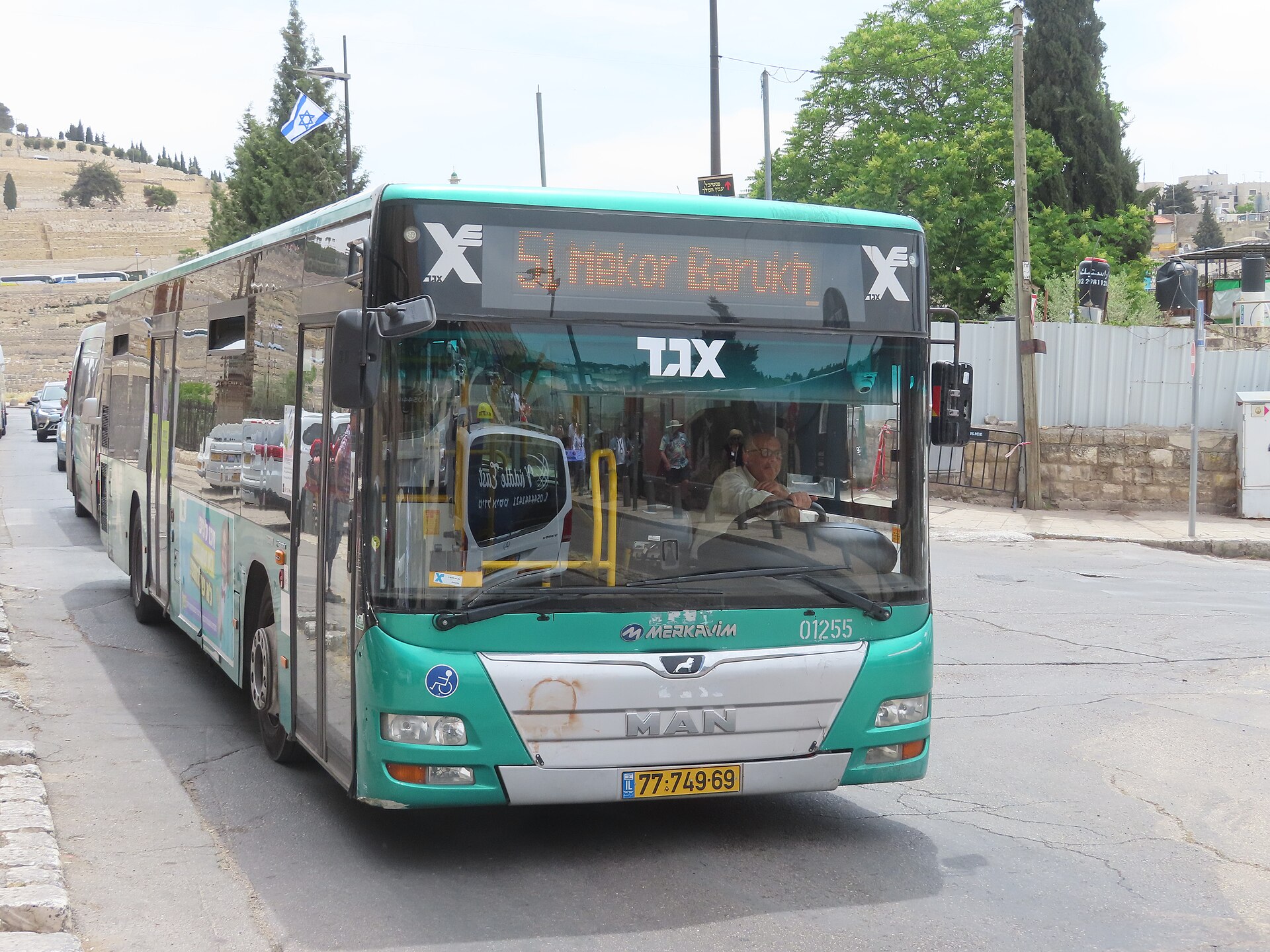
Buses fill in everywhere the tram does not reach, and the fare is the same as the light rail — around 6 shekels, with the same 90-minute free-transfer window when you pay with a Rav-Kav card or contactless card. Egged operates most West Jerusalem routes; separate Arab-operated lines serve East Jerusalem and depart from near Damascus Gate. A few routes are genuinely handy for visitors:
- To the Haas Promenade (Armon HaNatziv) for the classic panorama of the Old City.
- To Ein Karem, the village neighborhood of churches and cafes in the southwest.
- To the Dead Sea, Ein Gedi, and Masada via long-distance Egged buses (often the 444 or 486) from the Central Bus Station.
- East Jerusalem buses toward Bethlehem, which leave from the stops near Damascus Gate.
Route numbers change from time to time, so confirm the current one in a journey app such as Moovit before you set off. For day trips beyond the city, our day trips from Jerusalem guide covers which excursions are realistic by bus and which are better by tour or car.
Taxis
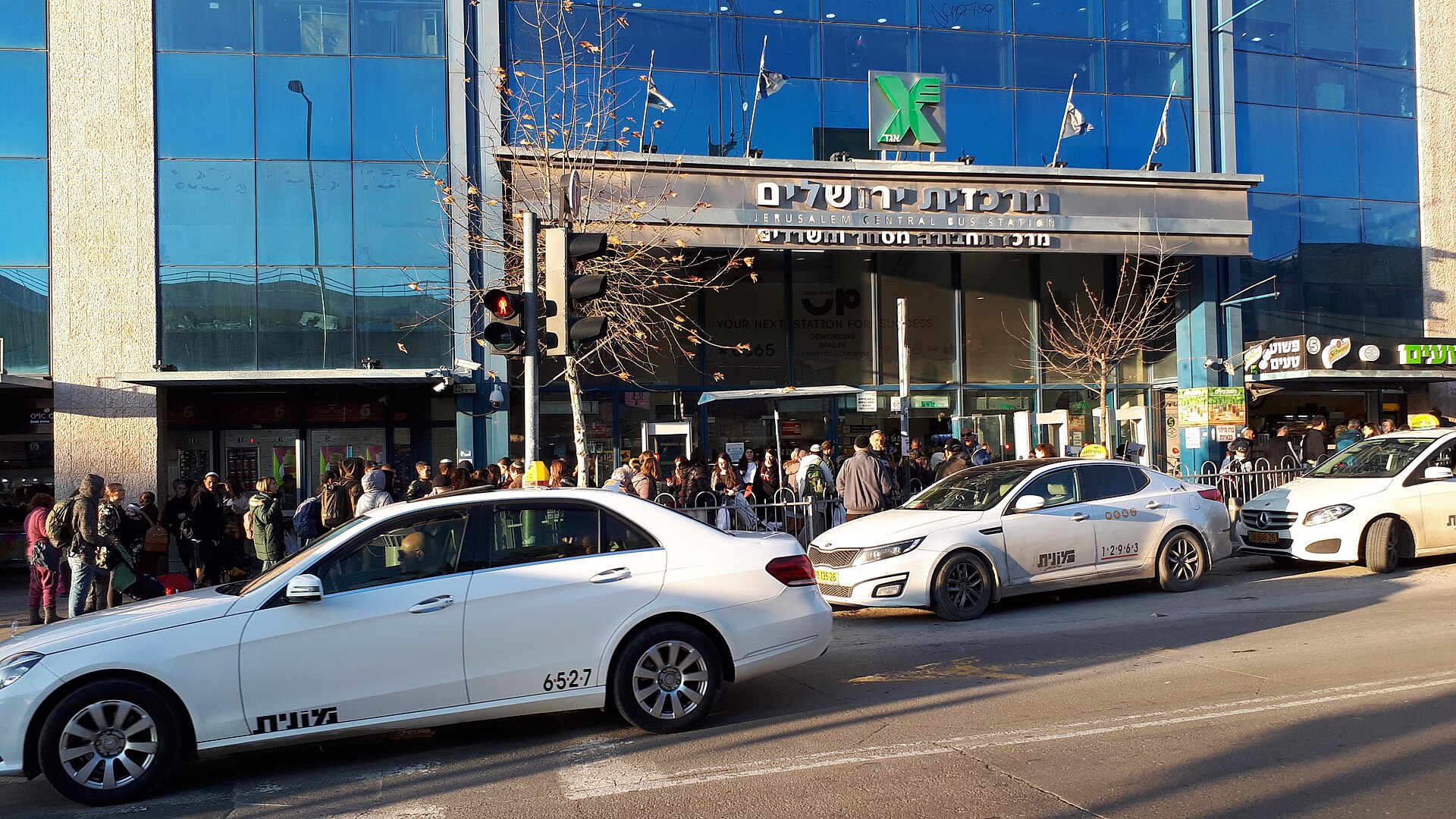
Taxis are plentiful and the easiest way to cross town quickly or move at night. The two apps locals use are Gett and Yango; both have English interfaces, show the fare or estimate up front, and remove any argument about price. You can also hail the yellow cabs on the street in central areas — if you do, insist the driver runs the meter (it is the law) rather than quoting a flat figure, which is usually higher.
- Short hops within the center: commonly in the region of 25–45 shekels.
- City center to the Mount of Olives or Yad Vashem: typically around 40–65 shekels depending on traffic.
- To Ben Gurion Airport: a fixed long-distance fare, often roughly 280–350 shekels, with surcharges late at night and on Shabbat.
- Tipping: not obligatory; rounding up or about 10% on a longer ride is normal.
Uber operates only in a limited form here, so do not rely on it — Gett and Yango are the defaults. On Shabbat, app cars still run but are fewer and can be slower to arrive, so book ahead if you have a time-sensitive trip.
The Rav-Kav Card and How to Pay
The Rav-Kav is Israel’s rechargeable transit smart card, and it works on the light rail and all buses nationwide. You can buy one at any light-rail ticket machine, the Central Bus Station, or staffed kiosks, then load credit (called “stored value”) or a period pass onto it. The single most traveler-friendly feature is the 90-minute free transfer: pay once, and you can change between bus and tram, or bus and bus, within that window at no extra cost.
- Pay-as-you-go: each ride deducts around 6 shekels from your stored value.
- Weekly and monthly passes exist for longer stays and are loaded onto the same card; a weekly Jerusalem-area pass is the better deal once you are riding several times a day.
- Contactless bank cards are now accepted directly on the light rail and many buses, which is the simplest option for a short visit if you would rather skip the Rav-Kav entirely.
Note that, unlike Tel Aviv, Jerusalem does not sell a citywide single-day unlimited pass, so for a one- or two-day visit the easiest approach is simply to tap a contactless card or load a little stored value and rely on the free transfers.
Getting To and From Ben Gurion Airport
Ben Gurion Airport sits between Tel Aviv and Jerusalem, and you have a few good ways to cover the last stretch. Our dedicated guide to the last stretch from Ben Gurion goes into full detail; here is the quick comparison.
| Option | Approx. cost | Time | Notes |
|---|---|---|---|
| Train to Jerusalem–Yitzhak Navon | About 18–21 shekels | ~35 min | Cheapest and fast; does not run on Shabbat or holidays |
| Shared taxi (sherut) | Around 70–90 shekels per person | Door to door | Operators and availability have changed recently; confirm at the airport |
| Private taxi | Roughly 280–350 shekels | ~45–60 min | Fixed long-distance fare; surcharges late and on Shabbat |
| Rental car | ~150–280 shekels/day plus fees | — | Useful for day trips, not for the city itself |
Because the train does not run on Shabbat, if you land between Friday afternoon and Saturday night your realistic choices are a private taxi or a pre-booked transfer. Shared-taxi services on this route have been in flux recently, so do not count on a specific company being there — check signage in the arrivals hall or pre-arrange a transfer for peace of mind.
Transportation on Shabbat
This is the part of Jerusalem transportation tourists most often get wrong, so it is worth being clear. From roughly an hour before sunset on Friday until nightfall on Saturday, the light rail and the Egged bus network stop entirely. The same applies on major Jewish holidays. Plan any Friday-afternoon journeys before everything winds down.
- App taxis (Gett, Yango) keep running but are fewer; book ahead for anything time-sensitive.
- Shared and private sheruts and East Jerusalem (Arab-operated) buses continue to run, giving you options the West Jerusalem system does not.
- Walking remains the most reliable way to get around central Jerusalem, and the Old City is fully accessible on foot the whole time.
For what to actually do during this quiet, atmospheric window — what stays open, where to eat, and how Friday-night dinner works — see our Shabbat in Jerusalem guide.
Should You Rent a Car?
For Jerusalem itself, no. Parking is scarce and expensive, the historic center is largely off-limits to cars, and everything central is faster on foot or by tram. A rental makes sense only if you plan multiple independent day trips — say, to the Dead Sea, the Galilee, or wine country — where having your own wheels beats bus timetables.
- Cost: roughly 150–280 shekels a day plus fuel, with airport pickup the most convenient option.
- West Bank rule: standard Israeli rental cars are generally not insured to enter Palestinian Area A, which includes Bethlehem, Jericho, and Hebron, so those are better done by tour or local driver.
- Driving conditions: traffic drives on the right, and road signs appear in Hebrew, Arabic, and English.
Bikes and E-Scooters
Shared e-scooters from operators such as Bird appear around the modern city and can be handy for a flat hop, but Jerusalem’s hills and the Old City’s cobbled, stepped lanes make two wheels less practical here than in flatter Tel Aviv. Helmets are required by law for scooters and e-bikes, and riding inside the Old City is neither allowed nor sensible. Treat these as an occasional convenience rather than a main mode.
Practical Transport Tips
- Sort out payment on day one — tap a contactless card or pick up a Rav-Kav and load some value.
- Download Gett or Yango before you arrive so taxis are one tap away.
- Wear proper walking shoes; you will cover more ground on foot than you expect.
- Front-load Friday: finish any transit-dependent plans before Shabbat closes the network.
- Anchor on the City Center light-rail stop for orientation in the modern town.
- Use a journey app (Moovit) for live routes and times, since numbers and schedules shift.
The Bottom Line
Jerusalem transportation is simpler than most big cities: walk the center, take the light rail along its spine, and use the Gett or Yango apps for everything else. Set up your payment on arrival, plan around the Shabbat shutdown, and the city’s compact size does the rest. Pair this with our Jerusalem travel tips, first time visiting Jerusalem guide, and Jerusalem on a budget guide.
Photo Credits
Taxis outside the Jerusalem Central Bus Station: 20200212 154140 February 2020 in Jerusalem by Rakoon, CC0, via Wikimedia Commons.
An Egged city bus in Jerusalem: Holy Land 2022 (1) P431 Jerusalem Merkavim Pioneer bus by Fallaner, CC BY-SA 4.0, via Wikimedia Commons.