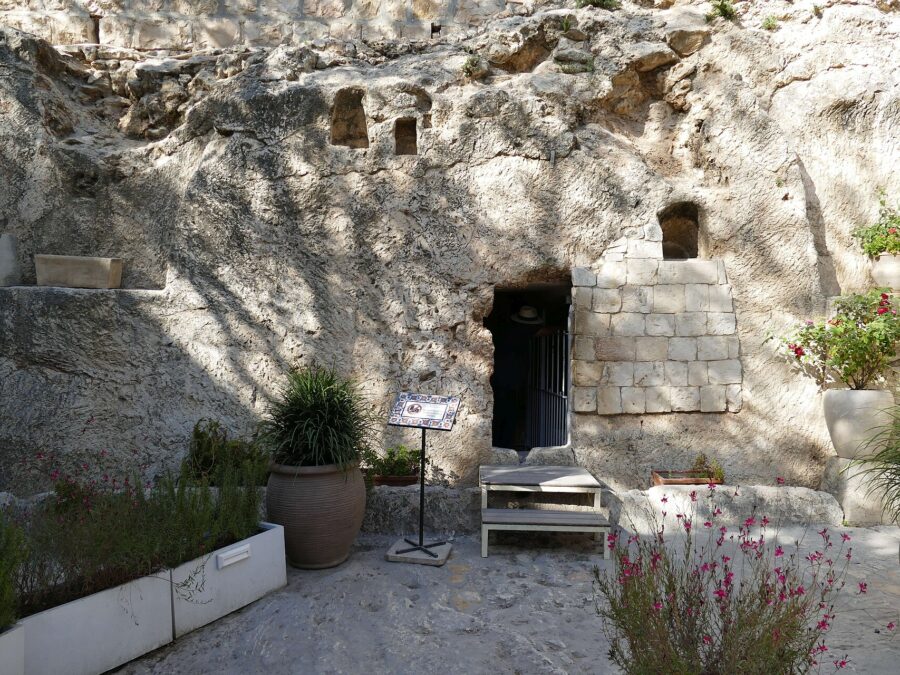
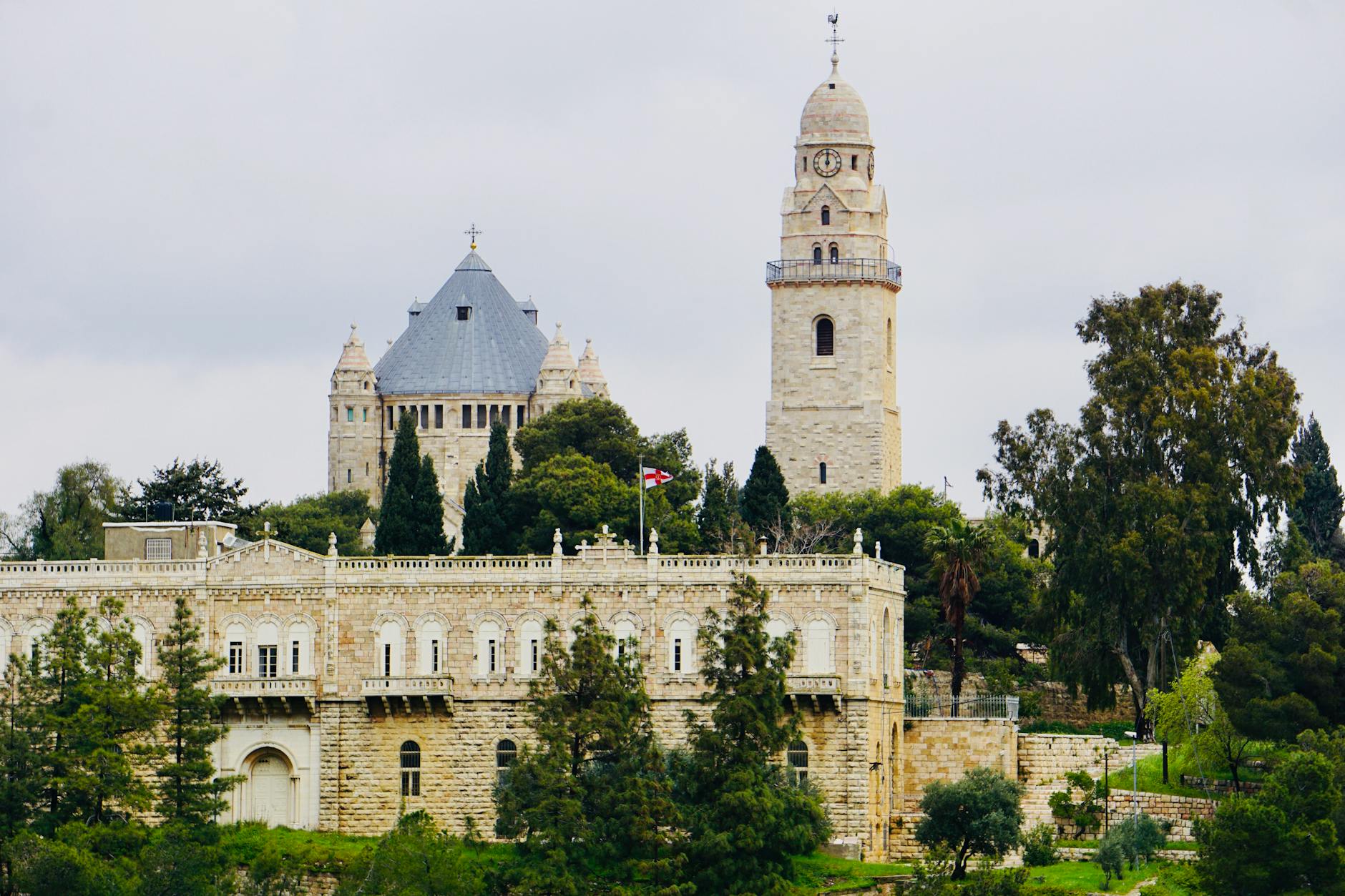
The Garden of Gethsemane at the foot of the Mount of Olives is one of the most spiritually significant sites in Christianity — the place where, according to the Gospels, Jesus prayed in agony the night before his crucifixion and was arrested. The ancient olive trees that fill the small garden today have been radiocarbon-dated to 900+ years old, with root systems possibly far older. Combined with the adjoining Church of All Nations, Gethsemane offers a quiet, contemplative pilgrimage experience that pairs beautifully with sunrise on the Mount of Olives.
This complete guide to the Garden of Gethsemane for 2026 covers history, what to see, opening hours, dress code, the Church of All Nations interior, and the best way to combine your visit with the surrounding Mount of Olives sites. Pair this with our Mount of Olives guide and guide to Jerusalem holy sites.

What Is the Garden of Gethsemane?
The Garden of Gethsemane (from the Aramaic Gat-Šmānê, meaning “oil press”) is a small walled garden at the base of the Mount of Olives, just across the Kidron Valley from the Old City. The Gospels describe Jesus going to a place called Gethsemane after the Last Supper to pray, where he was subsequently arrested. The garden has been a Christian pilgrimage site since at least the 4th century.
Adjacent to the garden stands the Church of All Nations (also known as the Basilica of the Agony), built over the rock where, by tradition, Jesus prayed in agony.
Gethsemane in the Gospels
All four Gospels put the last night of Jesus’s freedom here. Matthew 26 and Mark 14 name the place — “a place called Gethsemane” — where he asked the disciples to keep watch while he prayed, and returned three times to find them sleeping. Luke 22 adds the detail every pilgrim remembers: his sweat falling “like drops of blood.” John 18 never uses the name but describes a garden across the Kidron Valley where Judas, who “knew the place,” arrived with soldiers and torches. Stand at the garden fence and the geography simply works: the Kidron below you, the Old City wall opposite, Lions’ Gate visible up the slope.
The name itself is workmanlike — Gat-Shmanim, “oil press.” This hillside was a working olive farm, and presses were typically set up in caves like the grotto that still exists a minute’s walk north of the garden. Reading the passion accounts on a bench here, with all of that in view, is the real reason to come.
Hours and Admission
- Garden hours: 8:00 AM – 12:00 PM and 2:00 PM – 6:00 PM (summer); 8:00 AM – 12:00 PM and 2:00 PM – 5:00 PM (winter).
- Church of All Nations: Same hours.
- Admission: Free. Donations appreciated.
Underline that midday break: the gate genuinely shuts from 12:00 to 2:00, and arriving at 12:15 means two hours outside it. It catches visitors out every single day.
The Ancient Olive Trees
The garden contains eight gnarled, ancient olive trees. Radiocarbon dating in 2012 by an international team confirmed that three of the trees date to between 1092 and 1198 CE — roughly 900 years old. Olive root systems can survive for thousands of years even when above-ground portions die and regenerate, so the actual root systems may be far older.
The trees are protected behind a low fence; visitors view them from the surrounding paths.
The 2012 study, led by Italy’s National Research Council, also produced a stranger finding: all eight trees share an identical DNA profile. They are clones — cuttings taken from a single parent tree — which points to deliberate replanting, quite possibly when the Crusaders rebuilt the church here in the 12th century. And because olives regenerate from their root systems, the roots below could descend from far older trees; there is simply no way to date them without destroying them.
The Franciscan custodians still harvest the trees each autumn. The oil feeds the sanctuary lamps, and small bottles are pressed for benefactors. One honest note: the garden is smaller than most first-timers expect — a fenced plot you can circle in five minutes. Its power is in the trees, not the acreage, so budget your time for standing still rather than walking.
Church of All Nations
Built between 1919 and 1924 by Italian architect Antonio Barluzzi with donations from 12 different countries (hence the name “All Nations”), the church stands over the rock where, by tradition, Jesus prayed in agony.
Key features:
- Violet stained glass darkens the interior to evoke nighttime.
- Mosaic ceilings with motifs from the 12 donor countries.
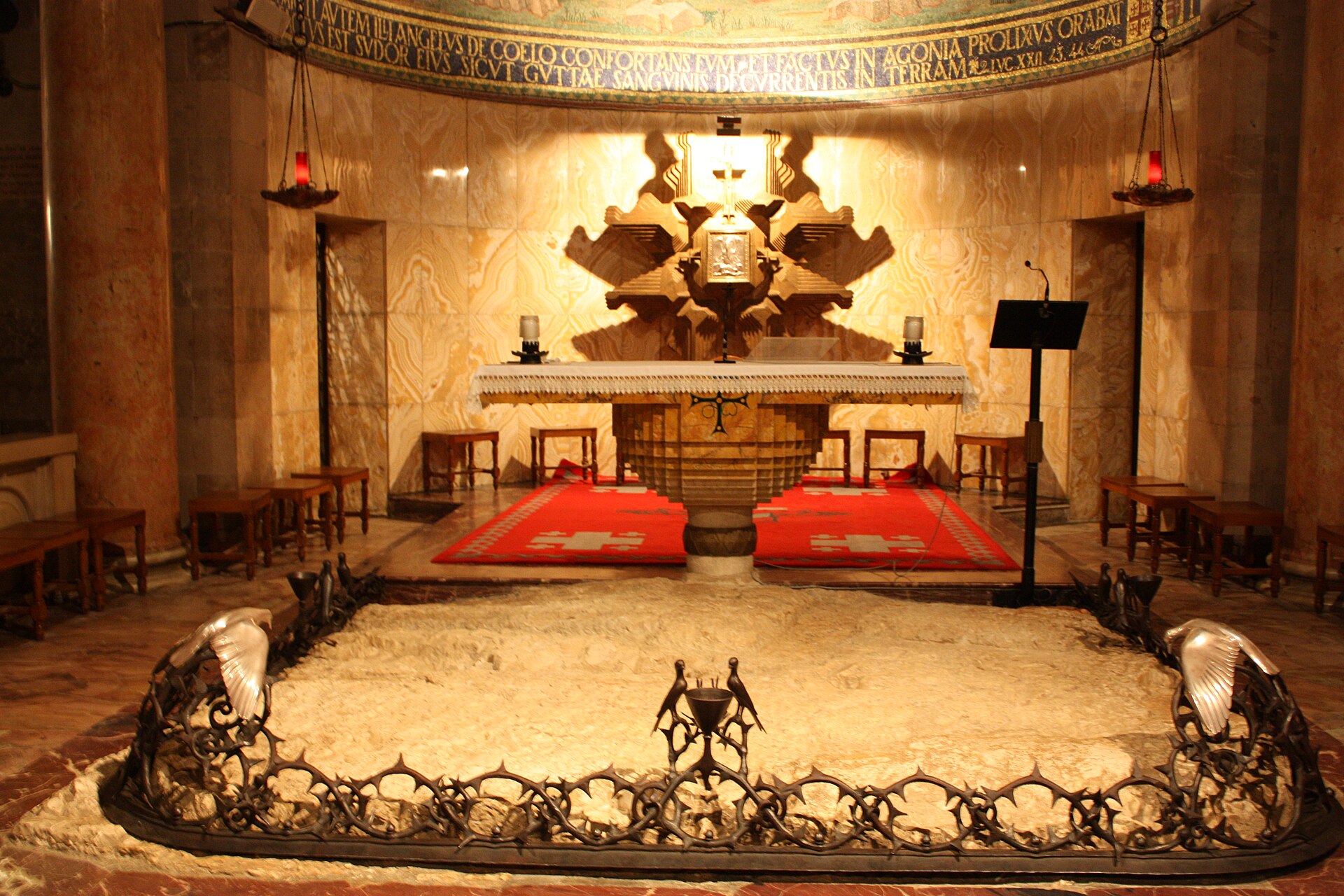
- The Rock of Agony exposed in front of the main altar — pilgrims kneel and touch it.
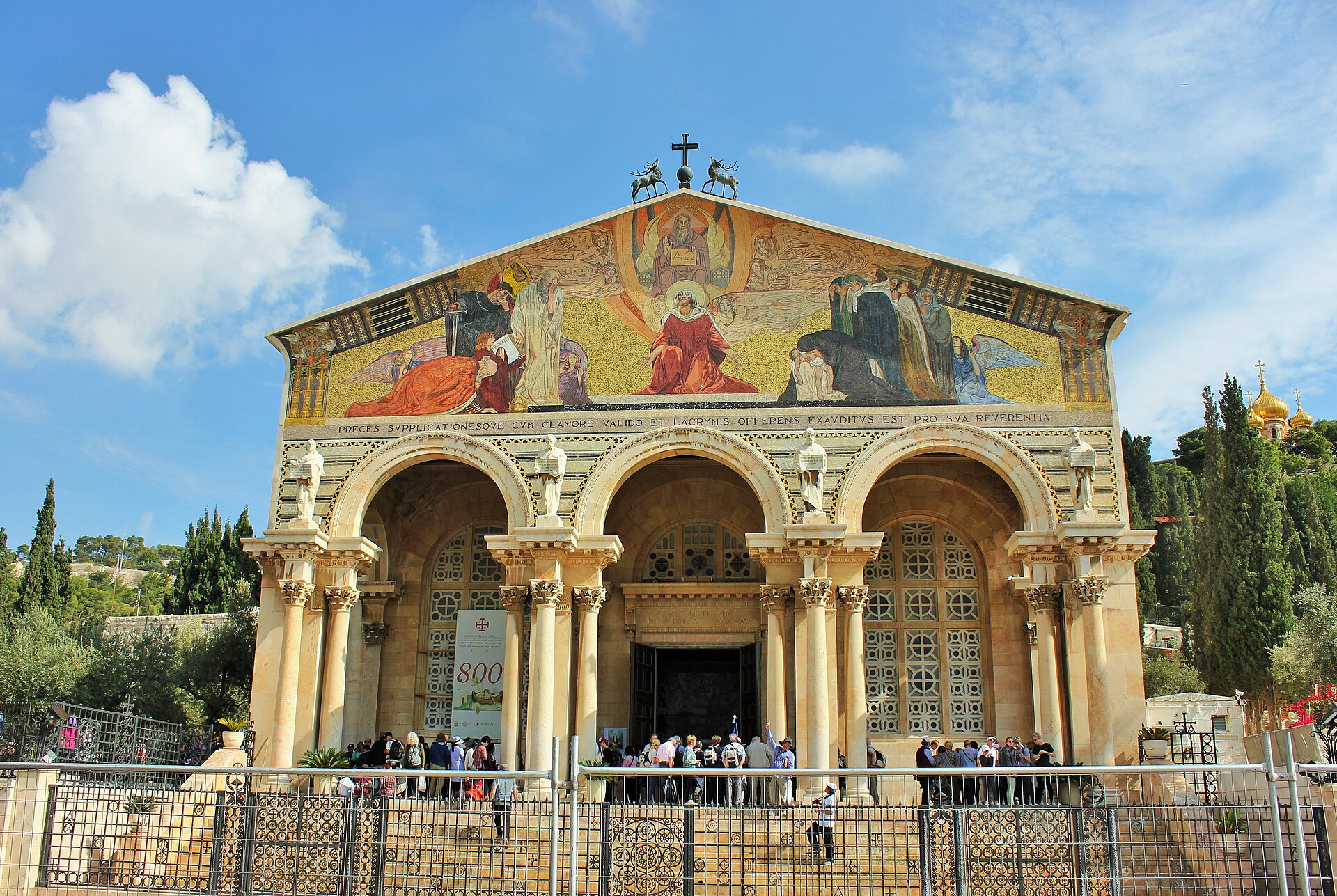
- Beautifully painted golden mosaic façade visible from across the Kidron Valley.
Reading the Basilica: Twelve Domes, Two Stones, One Night
Barluzzi designed the church to reproduce a single hour rather than to impress. The window panels are alabaster dyed violet, not conventional stained glass, and they let in almost no usable light; the ceiling is painted a deep blue scattered with stars. Step in from the glare of the forecourt at noon and you are standing in a permanent, artificial night — the night of Thursday in Holy Week. Give your eyes two or three minutes before you decide the interior is disappointing, because most visitors turn round and leave before it resolves.
The twelve small domes overhead each carry the coat of arms of a nation that paid for the building, which is where the popular name comes from. Working from the altar towards the door they are Argentina, Brazil, Chile and Mexico; then Italy, France, Spain and the United Kingdom; then Belgium, Canada, Germany and the United States. The apse mosaics were given by Ireland, Hungary and Poland, and the metal crown of thorns encircling the exposed bedrock in front of the altar was a gift from Australia. Look up before you look down: nobody points the domes out, and half of visitors never notice them.
The fabric is deliberately local. Interior stone came from the quarries at Lifta, north-west of the city; the exterior is rose-coloured Bethlehem stone, which is why the facade warms so dramatically in late afternoon light. Six columns divide the hall into three aisles with no clerestory, so the space reads as one room. Outside, Corinthian columns carry statues of the four evangelists beneath Giulio Bargellini’s gold mosaic, with Luke holding the verse about sweat like drops of blood. The church was consecrated in June 1924 and is properly called the Basilica of the Agony; the Franciscan Custody of the Holy Land has held it ever since.
What to See at Gethsemane
- The Garden itself — 8 ancient olive trees, well-maintained paths.
- The Rock of Agony inside the Church of All Nations.
- The mosaic façade of the church (best photographed from across the road).
- The Tomb of the Virgin Mary — a separate underground church directly across the road, traditional burial place of Mary. Free.
- Russian Orthodox Mary Magdalene Church just up the hill — golden onion domes, limited visiting hours.
The Tomb of the Virgin Mary
Directly across the forecourt, down in a sunken courtyard, is one of Jerusalem’s most atmospheric and least-queued holy places: the Church of the Assumption, the traditional burial place of Mary. From the 12th-century Crusader facade, a broad stone staircase of about 47 steps descends into a rock-cut crypt that is substantially Byzantine. Halfway down on the right is the tomb chapel of Queen Melisende, the 12th-century Crusader ruler of Jerusalem, traditionally honored as the chapel of Mary’s parents.
At the bottom, dozens of hanging oil lamps light a small shrine over the rock-cut tomb itself. The church is shared by the Greek Orthodox and Armenian churches under the same Status Quo system that governs the Holy Sepulchre, with Coptic and Syriac rights; there is also a mihrab, because the site is venerated in Islam as well. Hours run roughly 6:00 AM–12:00 PM and 2:30–5:00 PM, and mornings are the safe bet. Entry is free — carry a few shekels for candles, and give your eyes a minute to adjust, because after the bright garden the crypt is genuinely cave-dark.
The Grotto of Gethsemane
To the right of the Tomb of Mary courtyard, a narrow passage leads to a natural cave the Franciscans have held since the 14th century. Tradition places the disciples here, sleeping among the olive presses, while Jesus prayed in the garden — and some traditions put the arrest itself at the cave mouth. Remains of an ancient press and cisterns back up the working-farm picture. Mass is still said inside, and it is routinely the emptiest spot at Gethsemane; if the garden fence frustrates you, ten quiet minutes in the grotto are the corrective. Hours track the garden’s, with the same midday closure.
What Archaeologists Have Found Under the Church
The basilica exists in its present form because of an accident. In 1920, while foundations were being dug, workers struck a column about two metres below the floor of the medieval Crusader chapel, along with fragments of a fine mosaic. Barluzzi stopped the build, had the earlier church excavated, and redrew his plans around what emerged: a fourth-century Byzantine basilica brought down by the earthquake of 746, and a twelfth-century Crusader chapel abandoned in 1345. Construction restarted in April 1922 and finished in 1924. Sections of the older pavement survive beneath the present floor, which is why the modern church sits at the angle it does.
The more interesting find is recent. In December 2020, during work on a tunnel for a new visitor route, the Israel Antiquities Authority and the Studium Biblicum Franciscanum uncovered a ritual bath — a mikveh — dating to the Second Temple period, together with the remains of a Byzantine church whose Greek floor inscription asks that the offering of the donors be accepted and their sins remitted. The mikveh is the first archaeological evidence of first-century activity at Gethsemane itself.
It is worth being precise about what that does and does not prove. It does not confirm any Gospel scene. What it does show is that people were working here in Jesus’s lifetime under Jewish purity law, which, as the excavation’s director noted, is exactly what oil and wine production required — and which fits the name Gat Shemanim, the oil press. A working press on this slope in the first century is now an archaeological fact rather than an inference from the name. The reporting on the 2020 excavation sets out the finds in full, and our survey of the city’s sacred sites covers how similar evidence is weighed elsewhere in Jerusalem.
Dress Code and Etiquette
- Shoulders and knees covered for the Church of All Nations.
- Quiet voices — the church is a place of prayer.
- No flash photography inside the church.
- Do not touch the ancient olive trees — they are protected.
- Modest dress appropriate throughout.
Scripture, Tradition and the Other Gethsemanes
The Gospels are sparing. Matthew and Mark name “a place called Gethsemane”; Luke says only that Jesus went “as usual” to the Mount of Olives; John describes a garden across the Kidron valley that Judas knew because the group met there often. None of them gives a boundary, a gate or a tree. The precise spot venerated today is a tradition, fixed when Byzantine Christians built the first church here in the fourth century and maintained by every rebuilding since. That is a long and serious chain of memory — pilgrims were being shown this hillside within three centuries of the events — but it is memory, not survey.
Which is why there is more than one Gethsemane on the slope. The Franciscan garden beside the Basilica of the Agony is the one most visitors mean. A short walk north, the Greek Orthodox have their own walled garden and church of Gethsemane with ancient olives of their own, and further up the hill the Russian convent at the Church of Mary Magdalene keeps another olive grove. Each community has held its ground for centuries; none is a fake, and the differences are about custody rather than authenticity.
Say it plainly and the site gets better rather than worse. You are standing on the right hillside, in the right valley, opposite the right wall, among trees whose roots may descend from the grove that stood here — and the exact metre is not the point. Pilgrims who come expecting a documented crime scene leave disappointed; those who come for the geography and the silence do not. Our guide to planning a Christian pilgrimage in Jerusalem takes the same approach to the other sites where tradition and evidence sit at different depths.
Best Time to Visit
- Just after opening (8:00-9:30 AM): Quietest. Tour buses arrive ~10 AM.
- Late afternoon (3:00-5:00 PM): Beautiful golden light on the church mosaic.
- Lent and Holy Week: Most spiritually meaningful but expect crowds.
- Holy Thursday night: Special liturgies recall the events of that night.
Visiting Respectfully When the Groups Arrive
Gethsemane is not a museum. Mass is said daily in the basilica, pilgrim groups from every continent book time at the rock, and for many of the people around you this is the most significant hour of a journey years in the planning. Between roughly 09:30 and 11:30 the forecourt can hold several coachloads at once, with guides talking over one another and a queue forming at the door. Coaches set down on the Jericho road below the church, so the crush is at its worst on the forecourt rather than on the walk up from the walled city; our notes on getting around Jerusalem cover taxi fares and the East Jerusalem buses, which run on Saturdays when Israeli services stop.
The practical answer is patience rather than avoidance. Groups move through in fifteen or twenty minute blocks, so if the basilica is full, walk the garden perimeter first, or drop down to the grotto, and come back. Inside, voices carry hard under the low ceiling; guides should be using whisper sets, and the Franciscans will ask a loud group to quieten. Do not step over kneeling pilgrims to photograph the rock, and do not photograph faces at prayer — wait, or shoot the domes and the mosaics instead. Flash is not permitted.
The garden itself is fenced. You follow a path around the outside of the planted plot rather than walking among the trees, and touching or taking cuttings is not allowed — a rule enforced politely but consistently, since the trees are irreplaceable. Shoulders and knees stay covered for the church, and that includes the walk between sites, because you will pass Muslim and Jewish holy ground on the same hillside. If a service starts while you are inside, either stay quietly at the back or step out; wandering the aisles during Mass is the one thing that reliably causes offence. The same courtesies apply along the Via Dolorosa and inside the Church of the Holy Sepulchre, where the crowds are worse.
How to Get There
- From the Old City: Exit through Lions’ Gate, cross the Kidron Valley, and walk to the church (~10 minutes downhill).
- From the Mount of Olives viewpoint: Walk down the path through the cemetery (~25 minutes).
- By taxi: 5-8 minutes from any central location, ~$10.
Eating Near Gethsemane
There is nothing at the site beyond a couple of juice and souvenir carts at the forecourt, and prices there reflect a captive audience. The sensible move is to finish your visit, climb to Lions’ Gate, and eat in the Old City: Abu Shukri on Al-Wad Street does a 25–35 ILS hummus plate that has anchored pilgrim lunches for decades (it features in our best hummus in Jerusalem list), and the Austrian Hospice garden café is the calm alternative. Carry water for the hill itself, especially May through September.
Combine With
- Mount of Olives viewpoint at sunrise before descending.
- Tomb of the Virgin Mary across the road.
- Lions’ Gate + Pool of Bethesda + St. Anne’s Church entering the Old City.
- Church of the Holy Sepulchre the same day.
Fitting Gethsemane Into a Mount of Olives Morning
Gethsemane sits at the bottom of the Mount of Olives, which makes the logic of the morning obvious: start at the top and walk down. Take a taxi to the summit for sunrise — about 30–50 ILS from the Jaffa Gate area, a ten-minute ride — and watch first light hit the Dome of the Rock from the panorama terrace, the single best view in the city. It leads our Jerusalem viewpoints ranking, and photographers should be in position 30 minutes early; our photography spots guide has the details.
Then descend the steep path toward the city, collecting sites as you go: the Pater Noster Church with the Lord’s Prayer tiled in more than 140 languages (small entry fee, around 10–12 ILS), Dominus Flevit — Barluzzi again, a teardrop-shaped chapel whose altar window frames the Old City (free, closed midday) — and, on Tuesday and Thursday mornings only, the gold-domed Russian Church of Mary Magdalene (typically 10:00 AM–12:00 PM). You arrive at Gethsemane with the whole hill behind you and your knees intact. The full route is mapped in our Mount of Olives guide.
Mind the clock: the garden closes from noon to 2:00 PM, so either be at the gate by 11:00 AM or flip the plan and do the hill in late afternoon. From Gethsemane it is a ten-minute uphill walk through Lions’ Gate to the start of the Via Dolorosa, which ends at the Church of the Holy Sepulchre — the natural full-day pilgrimage sequence.
Historical Context
- 1st century CE: Gospels describe events at Gethsemane.
- 4th century: Byzantines build the first church.
- 614 CE: Persian invasion damages the structure.
- 12th century: Crusaders rebuild.
- 1187 CE: Saladin defeats Crusaders; site falls into ruin.
- 1666 CE: Franciscans gain custody.
- 1919-1924: Current Church of All Nations built by Antonio Barluzzi.
Final Word: A Quiet Moment Among Ancient Trees
The Garden of Gethsemane rewards visitors who arrive early, walk slowly, and pause for prayer or reflection inside the Church of All Nations. Pair this with our Mount of Olives guide, guide to Jerusalem holy sites, and Christian Pilgrimage Jerusalem guide.
Photo Credits
The mosaic facade of the Church of All Nations at Gethsemane: Frontal view of the Church of all Nations by Beko, CC BY-SA 4.0, via Wikimedia Commons.
The Rock of Agony in the Church of All Nations: Church of All Nations, Jerusalem 2010 6 by Wknight94, CC BY-SA 3.0, via Wikimedia Commons.
{"@context": "https://schema.org", "@type": "FAQPage", "mainEntity": [{"@type": "Question", "name": "Are the olive trees in the Garden of Gethsemane really 2,000 years old?", "acceptedAnswer": {"@type": "Answer", "text": "The above-ground trees were radiocarbon-dated in 2012 to ~900 years old. Olive root systems can survive much longer, so it's possible the roots descend from trees that stood there 2,000 years ago, but the visible trunks are medieval."}}, {"@type": "Question", "name": "Is admission to the Garden of Gethsemane free?", "acceptedAnswer": {"@type": "Answer", "text": "Yes — free, donation-based."}}, {"@type": "Question", "name": "How long do I need at Gethsemane?", "acceptedAnswer": {"@type": "Answer", "text": "30-60 minutes for the garden and Church of All Nations. Add 30 minutes for the Tomb of the Virgin Mary across the road."}}, {"@type": "Question", "name": "Can I enter the garden itself?", "acceptedAnswer": {"@type": "Answer", "text": "You can walk the paths inside the garden but not touch the ancient olive trees themselves, which are protected."}}, {"@type": "Question", "name": "Is the Church of All Nations Catholic?", "acceptedAnswer": {"@type": "Answer", "text": "Yes — Roman Catholic, administered by the Franciscan Custody of the Holy Land."}}, {"@type": "Question", "name": "Are services held there?", "acceptedAnswer": {"@type": "Answer", "text": "Yes — daily Catholic Mass and pilgrim services. Holy Week services are especially meaningful."}}, {"@type": "Question", "name": "Is the area safe?", "acceptedAnswer": {"@type": "Answer", "text": "Yes, during opening hours. The site is well-trafficked. Avoid the isolated paths on the Mount of Olives after dark."}}, {"@type": "Question", "name": "Can I combine Gethsemane with the Mount of Olives in one morning?", "acceptedAnswer": {"@type": "Answer", "text": "Yes — taxi to the summit for sunrise, walk down via Pater Noster and Dominus Flevit, and reach the garden before the midday closure. Allow about three hours at an unhurried pace."}}, {"@type": "Question", "name": "Is the Garden of Gethsemane the exact place Jesus prayed?", "acceptedAnswer": {"@type": "Answer", "text": "It is the place Christians have venerated since the fourth century, when the first church was built here, and the topography matches the Gospel accounts of a garden across the Kidron valley from the city. The exact metre is tradition rather than archaeology, and the Greek Orthodox and Russian communities maintain nearby gardens of their own. Our guide to the Mount of Olives locates all three on the slope."}}, {"@type": "Question", "name": "What was found under the Church of All Nations in 2020?", "acceptedAnswer": {"@type": "Answer", "text": "A Second Temple-period ritual bath and the remains of a Byzantine church with a Greek dedicatory inscription, uncovered during tunnelling work by the Israel Antiquities Authority and the Studium Biblicum Franciscanum. The bath is the first evidence of first-century activity on the site and fits the purity requirements of producing olive oil, which is what the name Gethsemane means."}}, {"@type": "Question", "name": "Why is the Church of All Nations so dark inside?", "acceptedAnswer": {"@type": "Answer", "text": "Deliberately. Barluzzi glazed the windows with violet-dyed alabaster and painted the ceiling as a night sky so that the interior reproduces the night of the agony whatever the hour outside. Let your eyes adjust for a couple of minutes before judging it."}}, {"@type": "Question", "name": "Can my group celebrate Mass at Gethsemane?", "acceptedAnswer": {"@type": "Answer", "text": "Yes, but it must be arranged in advance through the Franciscan Custody of the Holy Land, which allocates the side chapels and the open-air altar in the garden to visiting groups; that altar is used by Catholic, Orthodox, Anglican and Protestant pilgrims alike. Independent visitors are welcome at the daily Mass in the basilica."}}]}