The Via Dolorosa in Jerusalem — Latin for “Way of Sorrows” — is the traditional route Jesus is believed to have walked carrying the cross from Pilate’s judgment to Golgotha. Today the route comprises 14 Stations of the Cross, with the first nine in the Old City’s Muslim and Christian Quarters and the final five inside the Church of the Holy Sepulchre. Walking it slowly, especially with the Friday afternoon Franciscan procession, is one of the most moving experiences a Christian pilgrim can have in Jerusalem.
This complete guide to the Via Dolorosa in Jerusalem covers all 14 stations, the historical development of the route, how to walk it self-guided, when to join the Franciscan procession, dress code and etiquette, and how to plan your pilgrimage. Pair this with our Church of the Holy Sepulchre guide and guide to Jerusalem holy sites.
What Is the Via Dolorosa?
The Via Dolorosa winds approximately 600 meters through the Old City of Jerusalem from El-Omariyeh School (near Lions’ Gate) to the Church of the Holy Sepulchre. The current 14-station route was largely codified by Franciscan friars in the 14th-16th centuries and revised in the 18th-19th centuries.
The route passes through the Muslim and Christian Quarters, crosses several centuries of architecture, and culminates inside Christianity’s holiest site. Walking it takes 45-90 minutes depending on how long you pause at each station; a full reflective pilgrimage with prayer at each station may take 2-3 hours.
Scripture or Tradition? What the Stations Are Based On
Nine of the fourteen stations come straight from the Gospel accounts. Five do not: the three falls (III, VII, IX), the meeting with Mary (IV), and Veronica wiping Jesus’s face (VI) grew out of medieval devotion rather than any biblical verse. The Franciscans who walk the route weekly are open about this, and it troubles pilgrims far less than first-timers expect — the stations are a structure for prayer, not an evidence file.
The starting point is debated too. The Gospels place the trial at Pilate’s praetorium, which 19th-century tradition fixed at the Antonia Fortress beside Lions’ Gate. Many archaeologists now argue Pilate would have lodged at Herod’s palace on the western side of the city, near today’s Tower of David — which would put the historical route somewhere else entirely. Walk it anyway. What you are tracing is seven centuries of devotion worn into these particular stones, and that carries a weight of its own.
The 14 Stations of the Cross
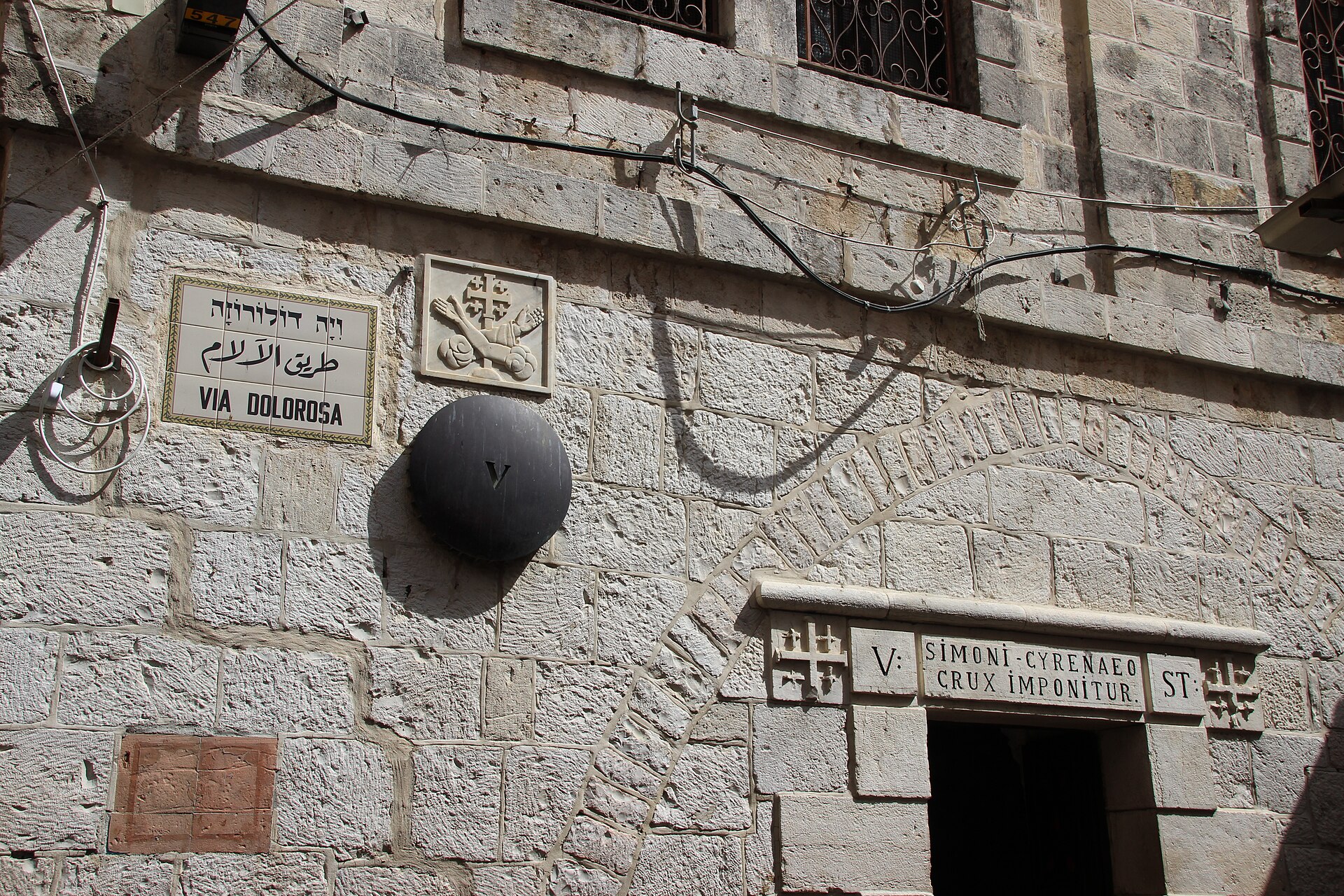
Stations I through IX are out in the streets, each marked by a small round plaque with a Roman numeral — mounted at eye level or above, and easy to walk straight past in the market crush. Stations X through XIV are inside the Church of the Holy Sepulchre. Here is each one, with its exact location.
Station I — Jesus Is Condemned to Death
Location: El-Omariyeh School (Madrasa al-Omariyeh), former site of the Roman Antonia Fortress. Pilate’s judgment seat is traditionally located here.
Station II — Jesus Receives the Cross
Location: Church of the Flagellation and Church of the Condemnation, just across from Station I. Beautiful Crusader-era architecture; the courtyard is one of the most peaceful spots on the route.
Station III — Jesus Falls the First Time
Location: Polish Catholic Chapel, at the corner where the Via Dolorosa turns left onto El-Wad Street.
Station IV — Jesus Meets His Mother Mary
Location: Armenian Catholic Patriarchate (Our Lady of Sorrows Church) on El-Wad Street.
Station V — Simon of Cyrene Helps Carry the Cross
Location: Franciscan Chapel at the corner of El-Wad Street and Via Dolorosa, where the route turns west and begins to climb. A handprint in the stone is traditionally associated with Jesus leaning against the wall.
Station VI — Veronica Wipes the Face of Jesus
Location: Church of the Holy Face. Tradition holds that Veronica wiped Jesus’s face with a cloth, leaving his image imprinted on it.
Station VII — Jesus Falls the Second Time
Location: Small Franciscan chapel at the intersection where the Via Dolorosa crosses Khan al-Zeit (Spice Market) Street.
Station VIII — Jesus Speaks to the Daughters of Jerusalem
Location: Greek Orthodox monastery wall with a stone cross. Jesus addresses weeping women: “Daughters of Jerusalem, do not weep for me but weep for yourselves and for your children.”
Station IX — Jesus Falls the Third Time
Location: Coptic Chapel near the Holy Sepulchre. A column marks the station. Close to the Ethiopian monastery on the Holy Sepulchre rooftop.
Stations X–XIV — Inside the Church of the Holy Sepulchre
- Station X — Jesus is stripped of his garments: At the top of the Calvary staircase, Roman Catholic chapel.
- Station XI — Jesus is nailed to the cross: Latin Calvary altar.
- Station XII — Jesus dies on the cross: Greek Orthodox Calvary altar. You can touch the rock through a silver disc beneath the altar.
- Station XIII — Jesus is taken down from the cross: Between the two Calvary chapels, with a small statue of Mary.
- Station XIV — Jesus is laid in the tomb: The Aedicule shrine in the Rotunda.
See our complete Church of the Holy Sepulchre guide.
How to Actually Find Each Station
The Via Dolorosa is not signposted the way a walking trail is. No painted line, no arrows, no numbered posts at eye level. The markers are a school gate, a monastery courtyard, a ceramic disc with a Roman numeral fixed two or three meters up a wall, a broken column in a doorframe. Groups miss stations constantly, and it is usually the same three.
What the Markers Look Like
Most street stations carry a round plaque with a Roman numeral, pale lettering on a dark ground, mounted well above head height so it survives the traffic below. Some sit beside a chapel door; others are on bare wall with nothing else to mark the spot. The single most useful habit on this walk is to look up rather than ahead.
Street names help more than the plaques do. The blue Old City signs really do read Via Dolorosa for the first stretch in from Lions’ Gate, and again after the route turns west at Station V. Between those two stretches you are on El-Wad Street, signed variously as El-Wad, Al-Wad and HaGai; beyond Station VII you are on Khan al-Zeit. Keep those three names straight and you can find every street station without a guide. Our orientation guide to the Old City explains how the wider street grid fits together.
Stations I to IV: Lions’ Gate to El-Wad Street
From Lions’ Gate walk west for about 250 meters, passing St. Anne’s Church on your left. Station I is the gateway of the El-Omariyeh school on the left-hand side. It is a working school, so the courtyard is not reliably open and most groups pray in the street outside. Station II is almost directly opposite, through an arched doorway into the Flagellation courtyard — a walled garden with two chapels, and the easiest station on the route to find.
Continue west. The lane passes beneath the Ecce Homo arch, which spans the street at first-floor height, then drops downhill to a T-junction with El-Wad Street. Turn left. Station III is twenty meters along on the right, a small Polish Catholic chapel with a carved relief above the door. Station IV is barely thirty meters beyond it on the same side, at the Armenian Catholic church. Both are easy to overshoot, because here the stalls of the Muslim Quarter close in and the doorways sit back behind racks of merchandise.
Stations V to IX: The Climb and the Souk
Station V is the corner where the route leaves El-Wad Street and turns right, uphill, into a lane signed Via Dolorosa again. The chapel is tiny and the doorway low; the worn hollow in the right-hand jamb that pilgrims touch as they pass sits at about hip height. Treat this corner as your checkpoint. If you have walked past it without turning right, you are off the route and will not notice for another five minutes.
From here the lane climbs by shallow, irregular steps. Station VI is on the left about eighty meters up, a low doorway more often shut than open, with the numeral above it. At the top the lane ends at a crossroads with Khan al-Zeit, the main north-south market street, and Station VII is directly across that junction — a chapel doorway that souvenir displays sometimes half-cover at busy hours. It is the noisiest and most missed station on the route.
Station VIII needs a deliberate detour. Cross Khan al-Zeit, carry straight on up Aqabat al-Khanqah for about twenty-five meters, and look on your left for a Latin cross carved into the Greek Orthodox monastery wall at roughly shoulder height, with the Greek letters IC XC NIKA around it. No plaque, no chapel, no crowd. Then come back the way you came.
Station IX is the one most groups skip outright. Return to Khan al-Zeit, turn right, walk roughly eighty meters and watch on your right for a broad stone staircase climbing away from the market — it looks like a private entrance. Go up, follow the passage as it bends left, and you reach the Coptic Patriarchate door with a shaft of Roman column set into the frame. That column is the station, and it has no plaque.
Stations X to XIV: Navigating Inside the Church
From Station IX there are two ways down. The traditional route continues through the Ethiopian rooftop monastery and descends a dark stair through two small chapels into the church courtyard — atmospheric, and only possible while the monastery is open. The dependable alternative is to walk back down to Khan al-Zeit, continue south, then turn right onto Souq al-Dabbagha.
Inside, the final five stations are compressed into an area smaller than a tennis court, and none is labelled in English. Immediately through the entrance, the steep stone staircase on your right leads up to Calvary. At the top the space divides: the Roman Catholic chapel on the right holds Stations X and XI, the Greek Orthodox chapel on the left holds Station XII, and the statue of Our Lady of Sorrows between them is Station XIII. Station XIV is back at ground level — the Aedicule beneath the Rotunda dome, with the queue forming in front of it.
That queue is the one part of the route you cannot plan around; it runs from a few minutes at dawn to well over two hours on a spring morning, so finish the stations first and decide about it afterwards. Our full guide to the Holy Sepulchre covers the interior chapel by chapel.
A Realistic Walking Plan
Here is how we would run it. Enter through Lions’ Gate before 8:00 AM, and start with a short detour: St. Anne’s Church and the Pool of Bethesda sit just inside the gate (open from 8:00 AM, entry around 10–12 ILS). The Crusader church has the finest acoustics in Jerusalem — pilgrim groups take turns singing inside, and it is worth ten minutes of anyone’s morning.
Stations I and II sit 150 meters further in, facing each other across the lane. Their courtyards stay calm until the first big groups land around 9:30, so this is where to do your slowest praying. The route then drops to the junction with El-Wad (HaGai) Street — Station III is just past the corner, Station IV a few doors along — before turning right and uphill at Station V, where the real climb begins.
From Station V the Via Dolorosa is a stepped market lane. Stalls open around 9:00 AM and the walk turns from contemplative to elbow-to-elbow; keep your group tight and your valuables zipped. Station VII hides at the crossing with Khan al-Zeit, the busiest junction on the whole route — the chapel door is on your right and most people miss it. Station VIII needs a 30-meter detour up Aqabat el-Khanqa to a carved cross on the monastery wall; return the same way. For Station IX, climb the stone ramp off Khan al-Zeit toward the Coptic Patriarchate, where a column beside the doorway marks the spot. While you are up there, cross the Ethiopian monastery on the Holy Sepulchre roof — one of the strangest, calmest corners of the Old City — and descend through its two small chapels directly into the church courtyard for Stations X–XIV.
The distance is only about 600 meters, but budget 90 minutes for the street stations and another hour inside the church. Walking it backwards — church first, then uphill to Lions’ Gate — saves nothing and scrambles the narrative; resist the temptation.
How Pilgrims Actually Pray the Route
The traditional Way of the Cross is short and deliberately repetitive. At each station the group stops, a leader says a versicle and the group answers — usually “We adore you, O Christ, and we bless you,” answered with “Because by your holy cross you have redeemed the world.” A one-paragraph meditation follows, then a prayer, often a verse of the Stabat Mater sung while walking on. Fourteen repetitions of two or three minutes each, plus the walking and the reassembling, is exactly why a devotional Way of the Cross runs to about two hours while a brisk walk of the same 600 meters takes forty minutes.
Printed booklets with the fourteen meditations are the normal way to do this and most parish groups bring their own. If you arrive without one, the Christian Information Centre just inside Jaffa Gate, run by the Franciscans, hands out a simple route map and stocks Way of the Cross material in several languages.
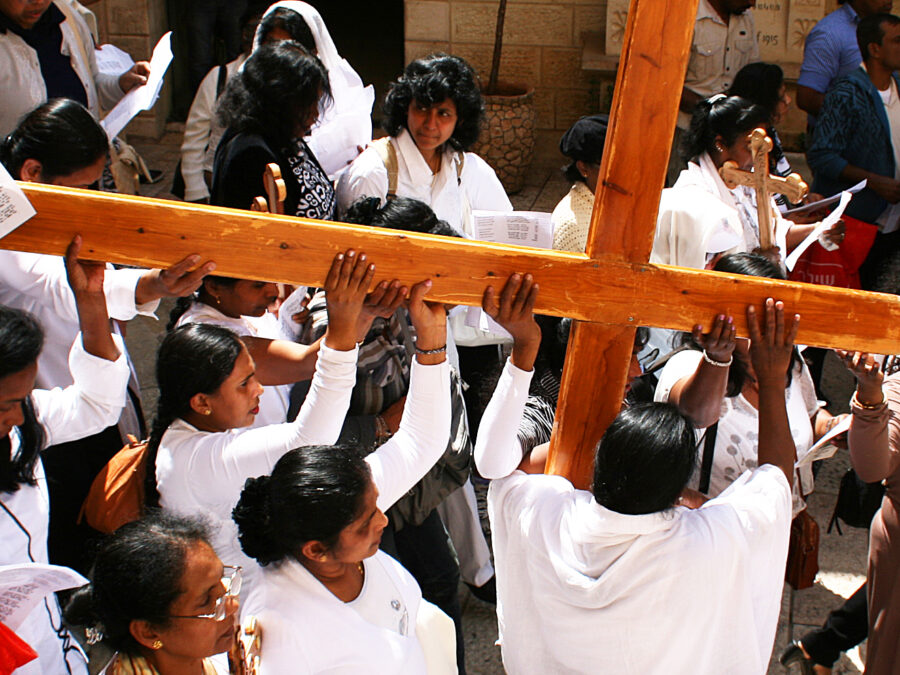
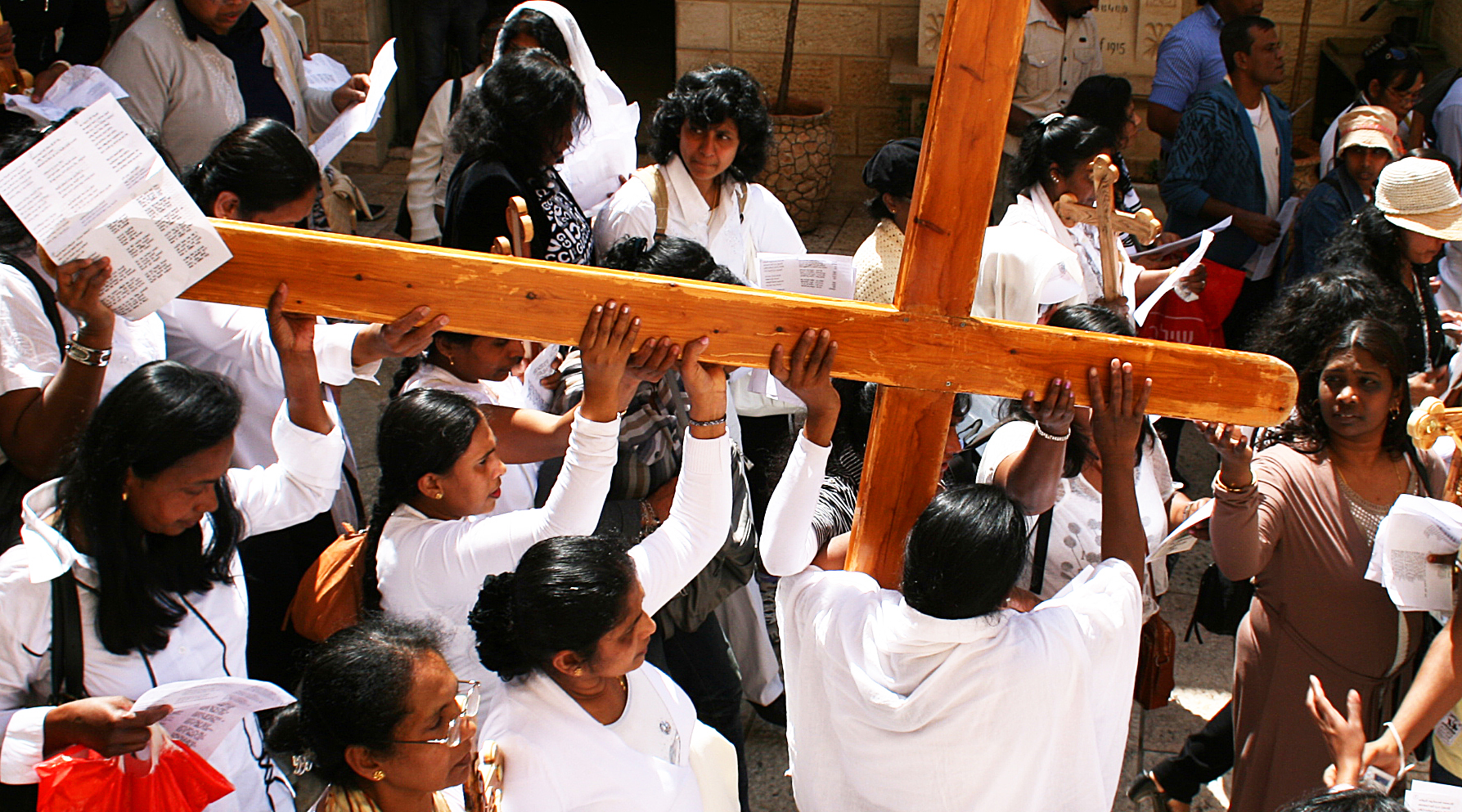
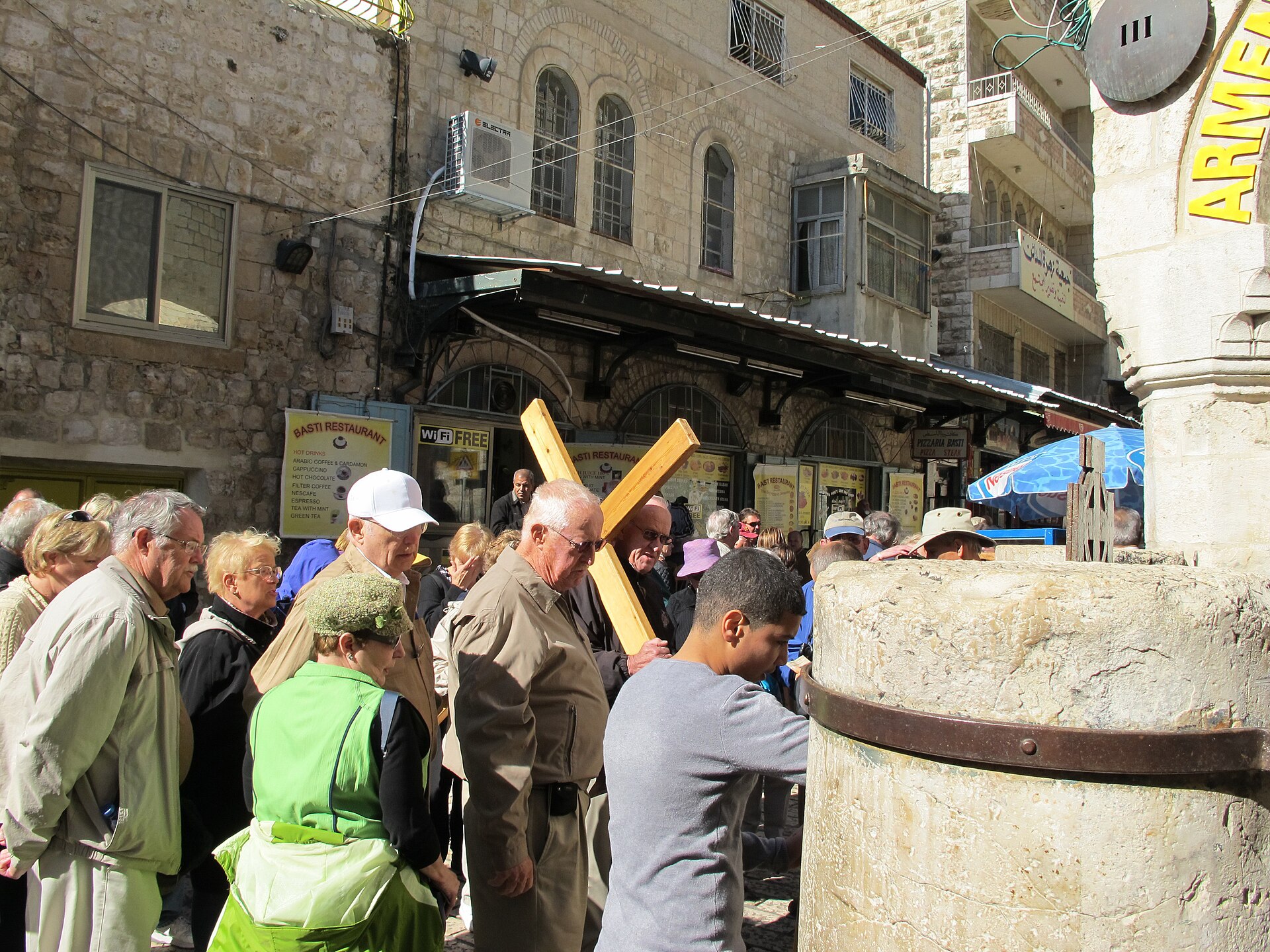
Groups carrying a wooden cross are a common sight, and the crosses are hired locally rather than provided by any church. Stalls near the start of the route rent them, some fitted with a small wheel at the foot. There is no fixed rate and no central operator, so agree the price and the return arrangement before you set off. Be realistic about the weight: a full-size cross on the stepped climb between Stations V and VII is hard work, and most groups rotate it at each station. A small hand cross passed around does the same devotional job.
For solo pilgrims, the multimedia room at the Terra Sancta Museum inside the Monastery of the Flagellation is the one formal introduction on the route itself — fifteen minutes on the history of the city, in ten languages, at 15 ILS regular and 10 ILS reduced as of August 2026. Beyond that there are various self-guided audio walks sold through app stores; none is official, and a printed booklet plus a phone torch for the dark stairwells is often the better combination. Our guide to pilgrimage in Jerusalem sets out how the walk fits alongside the other sites most groups cover.
One point of etiquette matters more than any of this: stopping to pray in a market lane means blocking a working street. Keep to one side, keep the group compact, and accept that people will walk straight through the middle of you carrying boxes. It is their street.
The Friday Franciscan Procession
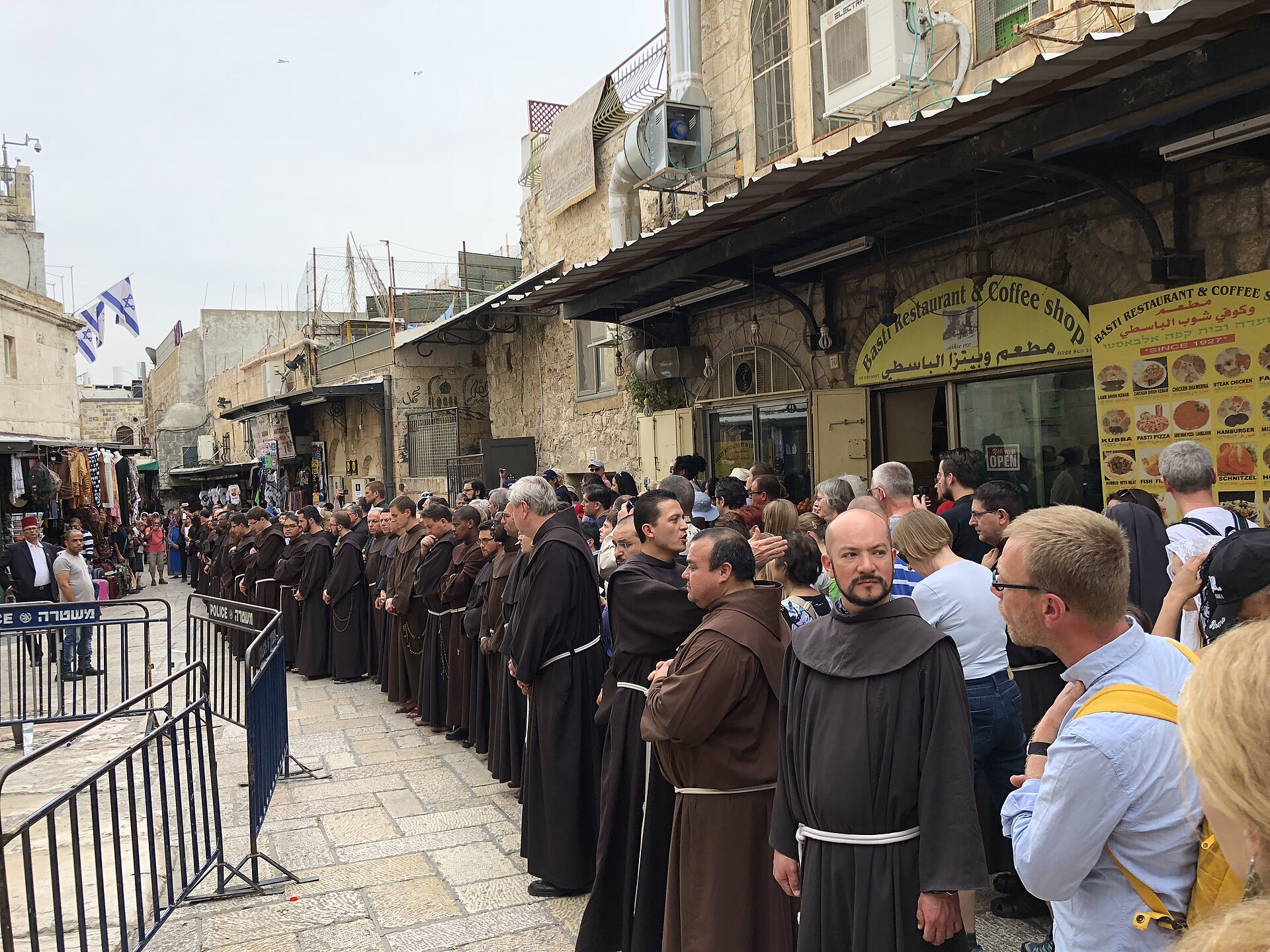
Every Friday afternoon, Franciscan friars lead a public procession through all 14 stations — at 3:00 PM in winter and 4:00 PM during daylight-saving months (roughly late March through late October; the friars move with the clock, so double-check in transition weeks). Pilgrims of all backgrounds are welcome to join. The procession is conducted in multiple languages; you can carry a small printed prayer booklet or follow along silently.
- Start: Pilate’s Praetorium courtyard (Station I).
- Duration: ~2 hours.
- Free, no booking required.
- Particularly powerful during Lent and Holy Week.
The Route Runs Through a Working Market
This is what first-time pilgrims are least prepared for, so it is worth saying plainly. From roughly Station III to Station IX, the Via Dolorosa is not a pilgrimage precinct set aside for prayer. It is the main commercial artery of the Muslim Quarter, doing its ordinary job of selling vegetables, plastic buckets, spices and phone cases while you walk through it.
In practice that means delivery carts pushed at speed down the middle of the lane, shopkeepers calling from both sides, tour groups moving in opposite directions at once, and a noise level that makes a spoken meditation hard to hear past the third row of your group. Station VII sits at the busiest junction on the route; Station IV is behind a rack of scarves. It is simply what a living Old City market is like, and the traders were here first.
The practical consequences are simple. Keep bags in front of you and zipped. Do not stop in the narrowest sections; move to a doorway first. Expect repeated invitations into shops, and know that a polite refusal without breaking stride causes no offence here.
It is also worth reframing rather than resenting it. Jerusalem at the time of the crucifixion was a crowded, noisy provincial city crammed with Passover pilgrims, not a quiet chapel, and many pilgrims come away feeling the indifference of the street was the most honest part of the morning. If that is not where you are, walk it at dawn. The western end, once you cross into the Christian Quarter, is calmer at any hour.
Historical Development of the Route
- 4th century: Early Christian pilgrims begin retracing Jesus’s path; informal route emerges.
- Byzantine era: Liturgical processions develop.
- Crusader period (12th-13th century): Stations begin to be formally marked.
- 14th-16th century: Franciscans codify the route after taking custody of Christian holy sites.
- 18th century: Devotion to the Stations of the Cross is formalized worldwide.
- 19th century: Modern 14-station route finalized.
Dress Code
- Shoulders and knees covered throughout — especially when entering chapels and the Holy Sepulchre.
- Modest dress for all genders.
- Hat or head covering optional but appreciated at religious moments.
When to Walk the Via Dolorosa
- Friday at 3:00 PM (winter) / 4:00 PM (summer): Join the Franciscan procession (recommended).
- Early morning (7:00-9:00 AM): Quietest, most contemplative.
- Late afternoon: Beautiful golden light on the stone walls.
- Avoid noon-2:00 PM: Tour buses and heat.
- Holy Week / Good Friday: Most emotionally intense; expect huge crowds.
Which Stations Are Open When
Walking the route and getting inside every station are two different things. Six of the nine street stations sit behind doors, some locked for large parts of the week, and there is no single place where all the hours are published. If entering the chapels matters, a weekday morning is the only timing that reliably works.
Station II is the most dependable. The Flagellation courtyard is Franciscan-run and open through most of the day, with the midday break standard for Old City religious houses. The Terra Sancta Museum in the same monastery gives its hours as 09:00 to 17:00 in winter and 09:00 to 18:00 in summer, daily, and notes these can be flexible; entry is 15 ILS regular, 10 ILS reduced, or a 20 ILS combined ticket, as of August 2026. Expect the churches themselves to shut for an hour or two around lunchtime.
Station I is a functioning school, so courtyard access depends on the school day and is often simply not possible. Stations III and IV belong to small Polish Catholic and Armenian Catholic communities that keep short and somewhat irregular hours. Station VI is closed more often than it is open. Station VII is a small Franciscan chapel frequently locked outside service times. Station IX, being a column in a doorway, is always reachable, though the buildings around it are not.
Two windows to avoid if you want doors open: Sunday, when the small communities are occupied with their own liturgies and chapel access is the least predictable of any day; and late afternoon, when several doors shut well before the light goes. Neither stops you walking the route — every street station is visible from outside — but a Sunday-afternoon walk will be a walk past closed doors.
The Church of the Holy Sepulchre is the exception, and the reason the timing usually works out anyway. It opens at roughly 05:00 in summer and 04:00 in winter, seven days a week including Shabbat, though the exact hours are set by the communities that share the building and do shift. Stations X to XIV are therefore available far earlier and later than anything else on the route, as at most of the other major Christian sites in the city.
Coffee, Bathrooms, and Food Along the Route
The Austrian Hospice at Via Dolorosa 37 — practically on top of Station III — is the standard mid-route stop: Viennese coffee and apple strudel in a walled garden for around 50–60 ILS, plus a rooftop view over the exact street you have been walking. Abu Shukri, a few steps from Station V on Al-Wad Street, has served hummus since the 1940s; a plate with ful or pine nuts costs about 25–35 ILS, and it is the right reward for finishing the climb (we rank it in our best hummus in Jerusalem list). Public toilets sit near the Holy Sepulchre courtyard off the souk; the Austrian Hospice keeps cleaner ones for customers. Drinks kiosks appear every fifty meters — expect 6–10 ILS for water, more for fresh pomegranate juice.
Walking the Via Dolorosa With Limited Mobility
The honest position is that this is a hard route for anyone with restricted mobility — partially possible rather than impossible. The surface is Ottoman-era stone polished smooth by centuries of feet, the first half runs downhill and the second climbs by irregular shallow steps, and the lane is two to four meters wide with a market operating in it.
There has been real improvement. A Jerusalem Development Authority programme begun in 2010 spent around 20 million shekels over nine years on ramping and resurfacing Old City lanes, and by its completion roughly 60 percent of the byways in the Christian, Muslim and Armenian Quarters were wheelchair accessible, as reported by The Times of Israel. In places a ramp now runs alongside a flight of steps, and the Holy Sepulchre has a ramp at the courtyard entrance plus a portable one on request for the step in the doorway.
What remains genuinely hard is specific. The stepped climb from Station V to Station VII is the worst stretch for wheels and for anyone unsteady on their feet. The staircase up to Calvary inside the church, which carries Stations X to XIII, is steep, narrow, worn and has no lift or alternative route. The Ethiopian rooftop descent is not an option at all. Station XIV, the Aedicule, is at ground level and reachable, as is most of the main floor.
Groups including someone who cannot manage the Calvary stair commonly pray Stations X to XIII together at the foot of the staircase, then move to the Aedicule for Station XIV. It is a normal accommodation and nobody will think it odd. If you are pushing a wheelchair, bring a second person and allow double the time.
Practical Tips
- Comfortable walking shoes. Uneven Ottoman stone.
- Bring water.
- Start at Lions’ Gate (eastern Old City entrance) — Station I is just inside.
- Carry a small Bible or prayer booklet if you want to read meditations at each station.
- Allow at least 90 minutes; 2-3 hours for a reflective pilgrimage.
- Plan to spend an extra hour at Stations X-XIV inside the Holy Sepulchre.
- Look for the small Roman numeral plaques at each station — easy to miss in the crowded souks.
- Dress for chapel entries — shoulders and knees covered. Full notes in our Jerusalem packing guide.
- Prefer a longer day on foot? Our self-guided Old City walking tour folds the Via Dolorosa into a full loop.
Quieter Ways to Walk the Route
The shops on Khan al-Zeit open somewhere around 08:30 to 09:00, so a 06:45 start from Lions’ Gate gets you through Stations III to IX before the shutters go up. The stone is empty, the light is low on the walls, and the only company is people going to work. The trade-off is that every chapel door will be shut, so this is a walk for praying the stations from the street rather than visiting them.
Splitting the route across two mornings solves that — street stations at dawn one day, the Holy Sepulchre on another when you can give the last five stations the time they need. Seasonally, a weekday in November, January or February is far quieter than any date between Palm Sunday and the end of May; rain is the price, and the stone is slippery when wet.
The counterintuitive option is the Friday afternoon procession. It is the busiest the route gets after Holy Week, and it is still what most pilgrims describe afterwards as the best version of the walk, because the crowd around you is a praying crowd rather than a shopping one.
And if what you want is stillness rather than this route specifically, take it elsewhere in the same morning. The Garden of Gethsemane at 07:30, before the coaches arrive, and the ridge paths on the Mount of Olives above it are the quietest places connected to the Passion narrative anywhere in Jerusalem, and they sit fifteen minutes’ walk downhill from Station I.
Combine Your Pilgrimage With
- Mount of Olives + Garden of Gethsemane earlier the same day — sunrise on the ridge, then down to the garden and through Lions’ Gate to Station I.
- Church of the Holy Sepulchre at the end.
- Pool of Bethesda + St. Anne’s Church near Lions’ Gate.
- Austrian Hospice rooftop café between stations.
All of the above describes the route on an ordinary day. In Holy Week it becomes something else entirely: processions from before dawn until late in the evening, dozens of them overlapping in a dozen languages, with the lanes between the Fourth and Ninth Stations impassable by mid-morning on Good Friday. If you are planning to be here for it, our guide to Easter in Jerusalem sets out the Holy Week programme day by day, along with the five-week gap between the Western and Orthodox dates in 2027.
Cruise passengers usually walk the Via Dolorosa as part of a tightly timed day, and there is rarely time to stop at all fourteen stations. The most efficient approach is to enter by the Lions’ Gate after the Mount of Olives and Gethsemane, walk the route downhill to the Church of the Holy Sepulchre, and let a guide choose four or five stations. Our Jerusalem shore excursion guide sets out the full timed route.
Final Word: A Walk Through 2,000 Years
For Christian pilgrims, walking the Via Dolorosa in Jerusalem is the central physical act of the trip. Take it slowly, time it for a Friday procession if possible, and let the small details — a single column, a Roman numeral, the worn stone underfoot — connect you to centuries of devotion. Pair this with our Holy Sepulchre guide, Christian Pilgrimage Jerusalem guide, and guide to Jerusalem holy sites.
Photo Credits
Franciscan friars on the weekly Friday procession along the Via Dolorosa: Holy Land 2018 (1) P017 Via Dolorosa Third Station Franciscan procession by Fallaner, CC BY-SA 4.0, via Wikimedia Commons.
The Fifth Station of the Cross on the Via Dolorosa: Jerusalem Old City Via Dolorosa Station of the Cross (42459488014) by Gary Todd from Xinzheng, China, CC0, via Wikimedia Commons.
Pilgrims carrying a wooden cross along the Via Dolorosa on Good Friday: Via Dolorosa, Jerusalem by Dr. Ondřej Havelka (cestovatel), CC BY-SA 4.0, via Wikimedia Commons.
A pilgrim group with a wooden cross at the Third Station of the Via Dolorosa: Jerusalem (108852) by IrinaUzv, CC0, via Wikimedia Commons.
{"@context": "https://schema.org", "@type": "FAQPage", "mainEntity": [{"@type": "Question", "name": "How long does the Via Dolorosa in Jerusalem take to walk?", "acceptedAnswer": {"@type": "Answer", "text": "45-90 minutes for a basic walk. 2-3 hours for a reflective pilgrimage with prayer at each station. The Franciscan procession takes about 2 hours."}}, {"@type": "Question", "name": "Where does the Via Dolorosa start?", "acceptedAnswer": {"@type": "Answer", "text": "Station I is at El-Omariyeh School near Lions' Gate (eastern Old City entrance). The path ends at the Aedicule (Station XIV) inside the Church of the Holy Sepulchre."}}, {"@type": "Question", "name": "Is the Via Dolorosa really where Jesus walked?", "acceptedAnswer": {"@type": "Answer", "text": "The current route is the traditional one developed over centuries. The exact historical path is uncertain — Pilate's praetorium location is debated. The route represents centuries of Christian devotion rather than archaeological certainty."}}, {"@type": "Question", "name": "Can non-Christians walk the Via Dolorosa?", "acceptedAnswer": {"@type": "Answer", "text": "Yes — anyone can walk the route. The Franciscan procession welcomes observers of all faiths."}}, {"@type": "Question", "name": "Are the stations clearly marked?", "acceptedAnswer": {"@type": "Answer", "text": "Yes — small Roman numeral plaques (I through IX) are mounted on walls and church entrances. Stations X-XIV are inside the Holy Sepulchre."}}, {"@type": "Question", "name": "Is there a guided tour of the Via Dolorosa?", "acceptedAnswer": {"@type": "Answer", "text": "Yes. Many Christian pilgrimage tours include the Via Dolorosa as a half-day component. See our Best Jerusalem Tours guide."}}, {"@type": "Question", "name": "Can I walk the Via Dolorosa on Shabbat or Sunday?", "acceptedAnswer": {"@type": "Answer", "text": "Yes — the route is in the Old City Christian and Muslim Quarters, which remain open on Shabbat. The Church of the Holy Sepulchre is open 7 days a week."}}, {"@type": "Question", "name": "Are the chapels along the Via Dolorosa always open?", "acceptedAnswer": {"@type": "Answer", "text": "No. Several stations sit behind doors locked for much of the week, particularly Stations I, VI and VII, and Sunday mornings and late afternoons are the least reliable times of all. A weekday morning between about 09:00 and 11:30 gives the best chance of finding the Flagellation courtyard at Station II and the small chapels at Stations III and IV open."}}, {"@type": "Question", "name": "Does it cost anything to walk the Via Dolorosa?", "acceptedAnswer": {"@type": "Answer", "text": "Walking the route is free and needs no booking, as is entry to the Church of the Holy Sepulchre at the end of it. The only charges are optional: the Terra Sancta Museum multimedia room at the Monastery of the Flagellation is 15 ILS regular and 10 ILS reduced as of August 2026, St. Anne’s Church near Lions’ Gate charges a small entry fee, and hired wooden crosses are priced by the stall."}}, {"@type": "Question", "name": "Can you walk the Via Dolorosa in a wheelchair?", "acceptedAnswer": {"@type": "Answer", "text": "Partly. Old City accessibility work completed in 2019 made around 60 percent of the lanes in the Christian, Muslim and Armenian Quarters wheelchair accessible, and the main floor of the Holy Sepulchre including Station XIV can be reached with a ramp at the entrance. But the stepped climb from Station V to Station VII is very hard going, and Stations X to XIII on Calvary are reachable only by a steep narrow staircase with no alternative."}}, {"@type": "Question", "name": "Where can I get a wooden cross to carry?", "acceptedAnswer": {"@type": "Answer", "text": "Stalls near the start of the route hire out wooden crosses, some with a small wheel at the foot. There is no official provider and no fixed rate, so agree the price and the return arrangement before you set off — and be aware that a full-size cross on the steps between Stations V and VII is heavier work than it looks."}}]}