The Church of the Holy Sepulchre is Christianity’s holiest site — the traditional location of both the Crucifixion (Golgotha) and the Resurrection of Jesus Christ. Built originally by Emperor Constantine in 335 CE and reconstructed multiple times across nearly 1,700 years, the church today is shared by six Christian denominations under a delicate “Status Quo” arrangement that has remained essentially unchanged since 1757. For most Christian pilgrims, this is the single most important destination in Jerusalem.
This complete visitor’s guide to the Church of the Holy Sepulchre for 2026 covers history, what to see inside, how to plan your visit, dress code, opening hours by season, and the unique experience of visiting a site shared by Roman Catholic, Greek Orthodox, Armenian Apostolic, Coptic, Syriac, and Ethiopian Christians. Pair this with our guide to Jerusalem holy sites and Old City Quarters guide.
What Is the Church of the Holy Sepulchre?
The Church of the Holy Sepulchre (Latin: Ecclesia Sancti Sepulchri; Greek: Naos tis Anastaseos, “Church of the Resurrection”) stands in the Christian Quarter of Jerusalem’s Old City. According to tradition since the 4th century, it contains both Calvary (Golgotha), where Jesus was crucified, and the Aedicule, the small shrine that encloses the tomb where he was buried and rose again.
The current building incorporates Constantinian, Crusader, Byzantine, and Ottoman elements. The 12th-century rebuild is the layer you see most clearly, and our guide to medieval Crusader Jerusalem traces the same Romanesque hand through the city’s other surviving churches. Six Christian denominations share property over different parts: Roman Catholic (Latin), Greek Orthodox, Armenian Apostolic, Coptic Orthodox, Syriac Orthodox, and Ethiopian Orthodox. The Status Quo agreement of 1757 froze the arrangement; even an immovable ladder under one window has remained in place since.
The Status Quo and the Immovable Ladder
Six churches, one building, and a rulebook nobody may amend. The Status Quo began as an Ottoman decree in 1757, was reaffirmed by imperial firman in 1852, and still governs the church down to absurd specifics: who sweeps which step, whose lamps hang where, which community uses the Aedicule at which hour. The Greek Orthodox, Roman Catholic (Latin), and Armenian Apostolic churches hold the major rights. The Coptic, Syriac, and Ethiopian Orthodox churches keep smaller footholds, defended with equal determination.
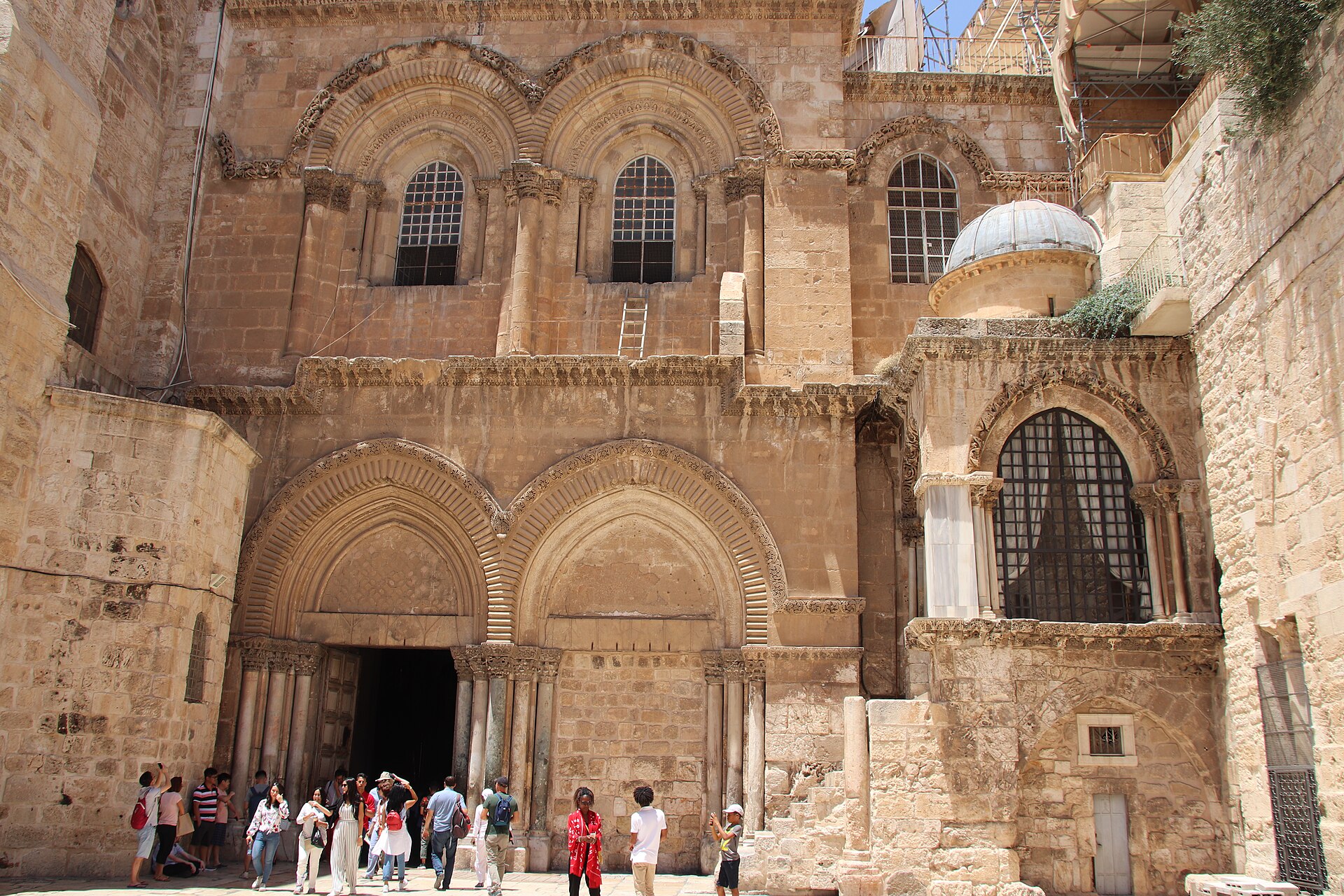
Before you go in, look up at the facade. On the cornice beneath the upper-right window rests a short cedar ladder. It appears in engravings from the mid-18th century and it has not moved since, because moving it would require the agreement of all six communities — and agreement has never come. Guides call it the immovable ladder. It is the best one-glance summary of how this church operates.
The front door belongs to none of the six. Since the Ottoman era — local tradition pushes the arrangement back to Saladin’s day — two Muslim families have controlled it: the Joudeh family keeps the heavy iron key, and a member of the Nuseibeh family unlocks the door each dawn and seals it again at night. Arrive for opening and you can watch the ritual: a wooden ladder is passed out through a hatch in the door, the bolts come off in a fixed sequence, and the day begins.
Does the system creak? Constantly. Repairs have stalled for decades over questions of precedence, and monks have occasionally come to blows over a moved chair. Yet the joint Greek-Latin-Armenian restoration of the Aedicule in 2016–2017 showed the communities can cooperate when the building demands it. For visitors the practical lesson is simple: every rope, rug, and candlestick is where it is for a reason. Step around, never over.
The Two Muslim Families Who Hold the Keys
The most quietly remarkable thing in the building is not inside it at all. It is the door, and the fact that no Christian community controls it. By long-standing arrangement the Joudeh family — also written Judeh al-Husseini — keeps the church key, and the Nuseibeh family carries out the opening and closing. Both are Muslim Jerusalemite families, and both describe the role as a trust handed down through generations rather than a job. Tradition traces the arrangement to Saladin after 1187, and some accounts push the Nuseibeh connection back to the seventh century; what is documented beyond argument is that the families have performed the duty continuously through the Ottoman centuries and into the present.
The ceremony itself takes about five minutes and is completely free to watch. Shortly before opening, sacristans of the Greek Orthodox, Franciscan and Armenian communities draw the bolts from inside. A wooden ladder is then passed out through a small hatch cut into the right-hand door. The Nuseibeh keyholder receives the key from the Joudeh representative, climbs the ladder to reach the upper lock, turns the long iron key, comes down for the lower lock, and the doors swing back. At night the sequence runs in reverse, with clergy sealed inside until dawn.
If you want to see it, be in the courtyard fifteen minutes before opening — around 04:45 from April to October and 03:45 in the winter months — and stand back from the doors rather than pressing against them. There is no barrier and no ticket; there is also no announcement, so newcomers often miss it entirely while looking at the facade. Photography is tolerated, flash is not appreciated, and the people involved are performing a duty, not a reenactment. Watch, then let the clergy in first.
Practically, the ceremony is also the cleanest way to be first in the tomb queue. You are already at the door when it opens, the Old City lanes are empty at that hour, and you will have the Rotunda close to yourself for twenty minutes before the first groups arrive. The catch is the walk in: the Old City streets before dawn are dark and shuttered, so use a lit route from Jaffa Gate or New Gate rather than cutting through the empty souk.
The Six Communities and Who Controls What
Nothing about the interior makes sense until you understand that you are walking through six churches at once. Three communities hold the major rights — the Greek Orthodox Patriarchate, the Roman Catholic Church through the Franciscan Custody of the Holy Land, and the Armenian Apostolic Patriarchate. Three more hold smaller but fiercely protected footholds: the Coptic Orthodox, the Syriac Orthodox and the Ethiopian Orthodox. Rights are not evenly divided, and they are not simply about ownership. They cover who may celebrate at which altar, at which hour, who hangs which lamp, and who is responsible for sweeping which patch of stone.
Here is the rough map, which is the single most useful thing you can carry through the door:
- Greek Orthodox — the Catholicon, the great domed church at the centre of the building; the Greek altar over the rock of Calvary; the Chapel of Adam directly beneath it; and most of the small chapels around the ambulatory, including the Prison of Christ and the Chapel of Saint Longinus.
- Roman Catholic (Franciscan Custody) — the Chapel of the Apparition on the north side, which holds the Blessed Sacrament and a fragment venerated as the Column of the Flagellation; the Latin altar on Calvary marking the nailing to the cross; and the lowest chapel of all, the Chapel of the Finding of the Cross.
- Armenian Apostolic — the Chapel of Saint Helena, reached down a long stair and known to Armenians as the Chapel of Saint Gregory the Illuminator; the Chapel of the Division of the Robes; and a gallery above the Rotunda.
- Coptic Orthodox — the small chapel clamped to the western end of the Aedicule, plus a monastery immediately outside the church.
- Syriac Orthodox — the bare, fire-blackened Chapel of Saint Nicodemus behind the Rotunda, opened mainly for Sunday liturgy. First-century rock-cut burial shafts open off the back of it, which is why archaeologists take it seriously as evidence that this ground was a cemetery outside the city wall.
- Ethiopian Orthodox — Deir es-Sultan, the rooftop monastery over the Chapel of Saint Helena, with two chapels on the stair that drops back down into the courtyard.
Then there are the common spaces, which belong to everyone and therefore to no one: the courtyard, the main door, the Stone of Unction, the floor of the Rotunda, and the tomb chamber inside the Aedicule, which each community uses in turn on a fixed timetable. Common ground is where the Status Quo does its hardest work, because in this building maintenance implies possession. A community that repairs, cleans or repaints a surface can be understood to be claiming it, so disputed corners are sometimes left conspicuously untouched. The soot and the peeling paint you notice in places are not neglect so much as diplomacy.
It also explains the atmosphere. Greek chant from the Catholicon overlaps with a Franciscan organ and an Armenian bell, and none of it is coordinated, because coordinating it would mean renegotiating rights nobody wants to reopen. Approach it as six living traditions sharing one roof rather than as a single church behaving oddly, and the whole place becomes legible. The wider Christian Quarter around the church works the same way — patriarchates, convents and hospices packed into a few hundred metres — and the Armenian Quarter to the south holds the community whose clergy you will see here every single day.
Opening Hours
- April–August: 5:00 AM – 8:45 PM
- September: 5:00 AM – 8:30 PM
- October: 5:00 AM – 8:00 PM
- November–March: 4:00 AM – 7:00 PM
- Admission: Free (donations welcome).
Best Time to Visit
- Just after opening (5-6 AM): Quietest. Best for solitude and to see the morning processions of the Greek Orthodox, Armenian, and Franciscan monks.
- Early evening before closing: Second-best time. Crowds thin.
- Avoid 9 AM-3 PM when tour buses fill the courtyard.
- Holy Week (Easter): Spectacular but extremely crowded. Plan for hours of waiting.
- Saturday morning before Easter (Holy Fire ceremony): The most dramatic annual event; book travel a year ahead.
What to See Inside
The Stone of Anointing (Stone of Unction)
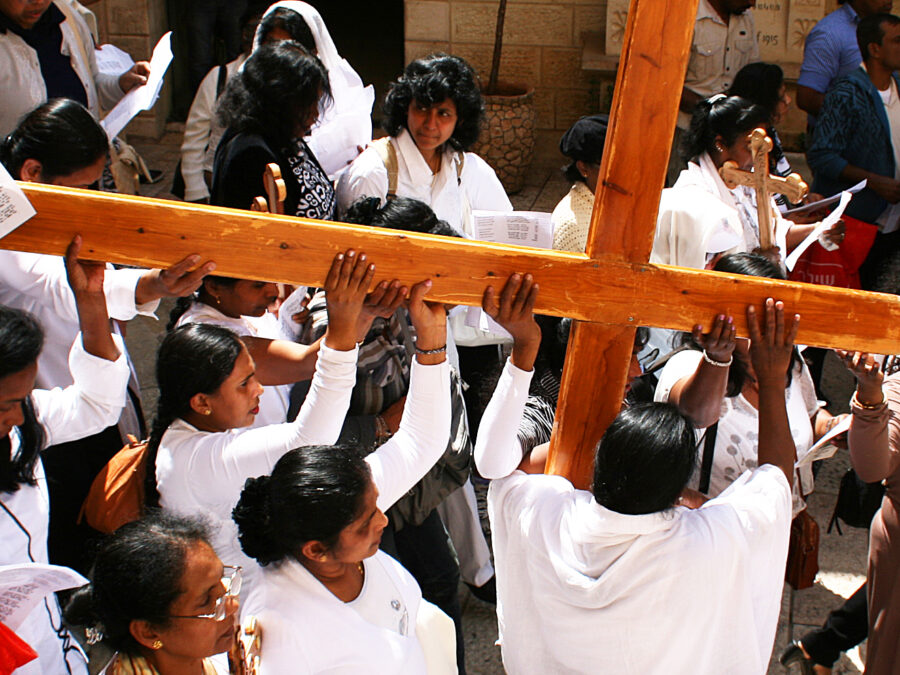
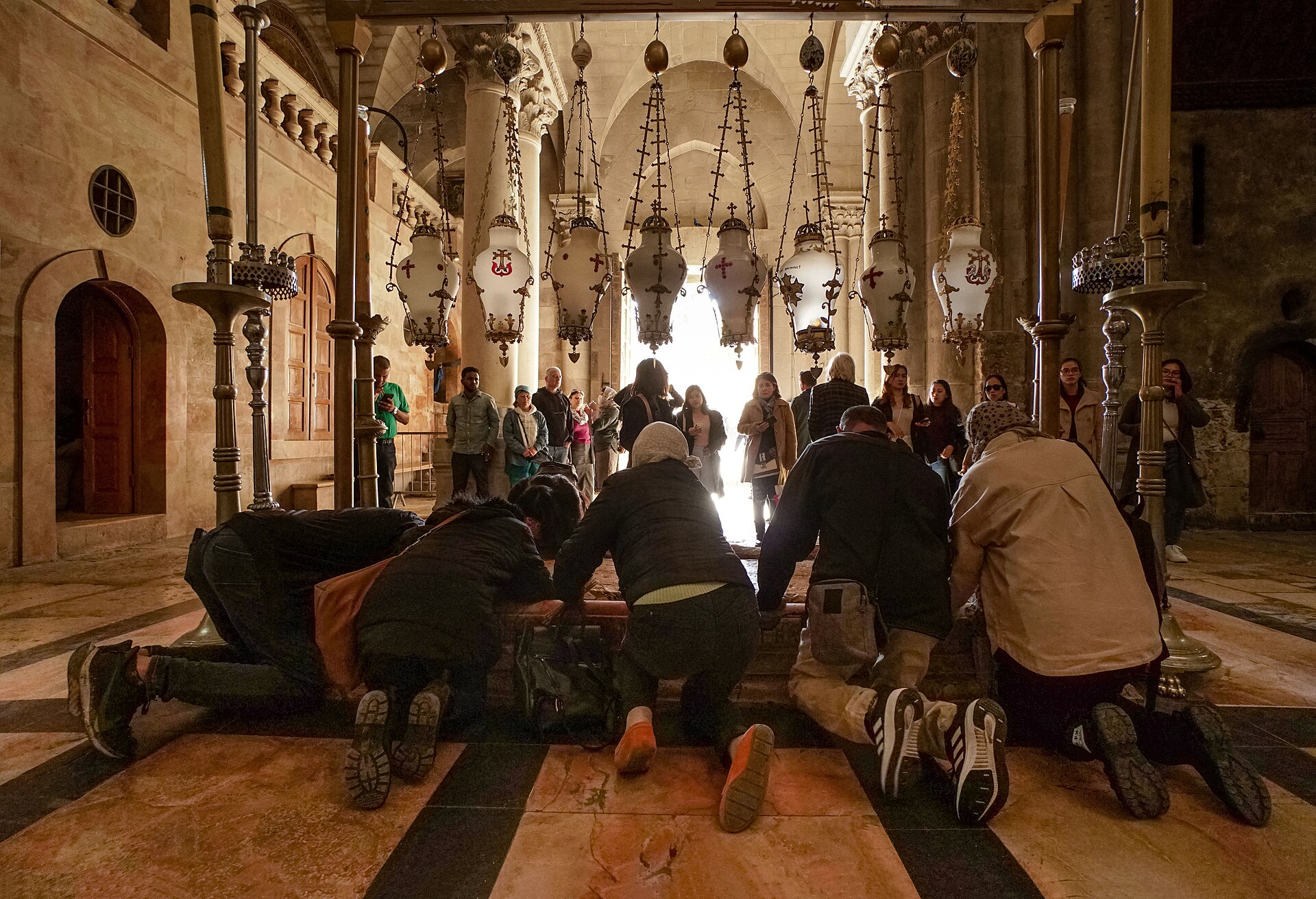
Just inside the main entrance is a polished pink limestone slab where, by tradition, Jesus’s body was anointed for burial. Pilgrims kneel, touch their forehead to the stone, and rub objects (rosaries, prayer shawls, photographs of loved ones) on it for blessing.
Calvary / Golgotha (Site of the Crucifixion)
Climb the steep stairs immediately to the right of the entrance to reach Golgotha, the rock outcropping traditionally identified as the place of the Crucifixion. Two side-by-side chapels — Roman Catholic and Greek Orthodox — mark the 11th, 12th, and 13th Stations of the Cross. Beneath the Greek Orthodox altar you can touch the rock through a silver disc with a hole at its center.
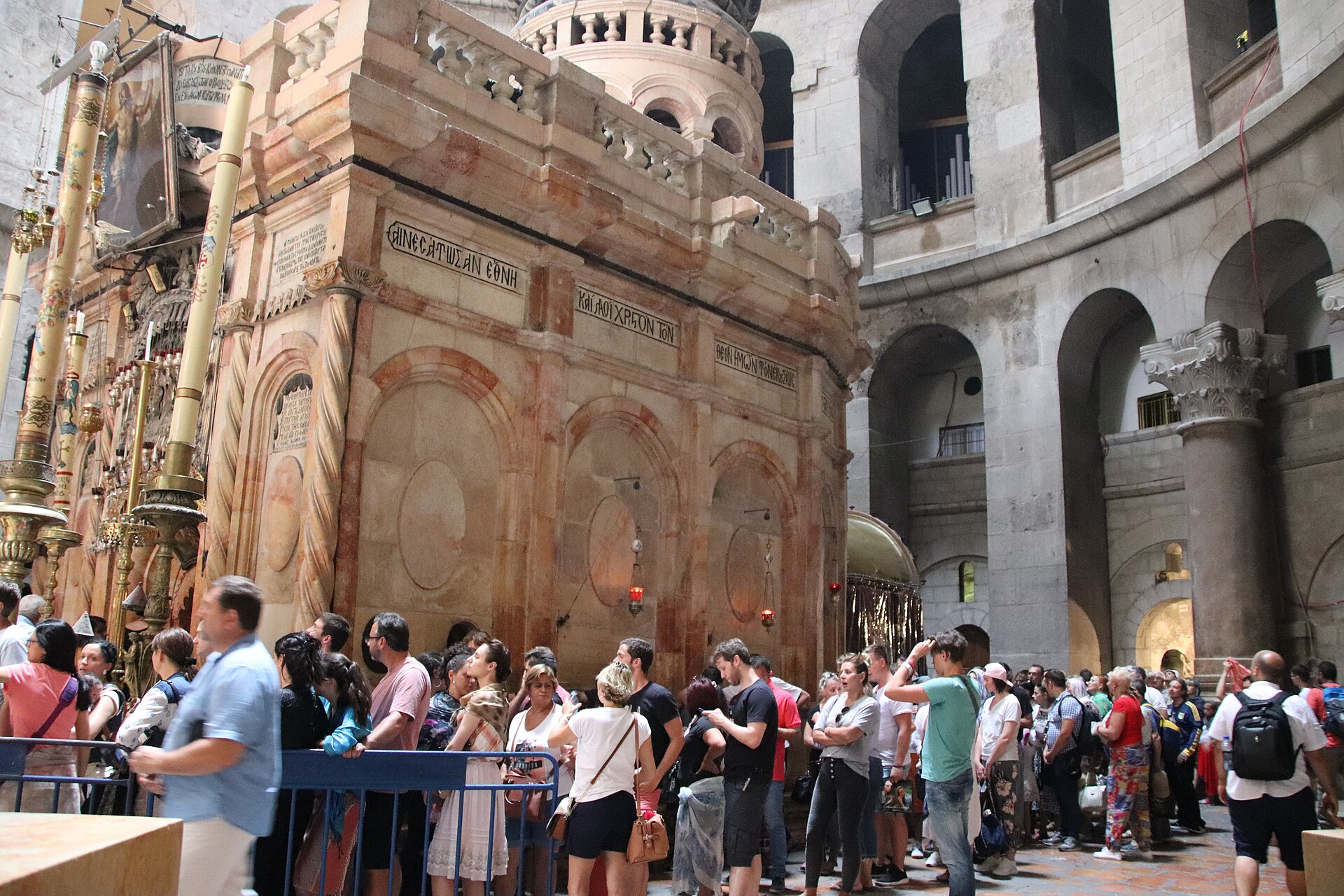
The Aedicule (Tomb of Christ)
The 19th-century shrine in the center of the Rotunda contains the traditional empty tomb of Christ. Inside is the Chapel of the Angel (vestibule, with a fragment of the stone that was rolled away) and the inner Burial Chamber. Recently restored (2016-2017), the marble slab inside the burial chamber was briefly opened, revealing earlier limestone original surfaces.
Expect a queue — typically 30-60 minutes, sometimes 1-2 hours during peak. Each visitor gets perhaps 30 seconds inside.
The Catholicon (Greek Orthodox Main Church)
Directly opposite the Aedicule. The center of the floor marks “the navel of the world” (omphalos) in Greek Orthodox tradition.
The Chapel of Saint Helena
Descend stairs from the main church to reach this Armenian Orthodox chapel, then descend further to the Chapel of the Finding of the Cross, where Saint Helena (mother of Constantine) is said to have discovered the True Cross in 326 CE.
Other Important Spaces
- Chapel of Adam directly beneath Golgotha — where, by tradition, Adam’s skull was buried.
- The Stone of the Three Marys.
- The Latin Calvary altar (Crusader-era).
- Ethiopian Monastery — Deir es-Sultan on the rooftop, accessible from a small staircase in the courtyard. Continuous Ethiopian Orthodox presence since at least the 4th century.
- Coptic Chapel on the back of the Aedicule.
That last entry deserves more attention than it gets. The Coptic chapel is a tiny shrine clamped to the western end of the Aedicule, directly behind the burial chamber. A Coptic monk is usually on duty and will lift the hanging to show a section of the tomb rock, which you may touch. Most tour groups stride straight past it. Leave a few shekels in the box; this is the quietest moment of veneration available anywhere in the building.
The Aedicule Restoration and the Archaeology Under the Floor
The shrine you queue for was rebuilt in 1810 after a fire, and by the twentieth century it was in serious trouble. British Mandate engineers strapped it in an iron cage in 1947 to stop it collapsing, and the cage stayed on for nearly seventy years while the communities failed to agree on what to do next. Agreement finally came in 2016. The Greek Orthodox, Latin and Armenian communities jointly commissioned a team from the National Technical University of Athens, led by Professor Antonia Moropoulou, and the shrine was dismantled in part, cleaned, grouted, pinned with titanium and put back together over about ten months.
The moment that made news came on 26 October 2016, when the marble slab covering the burial bed was lifted for the first time in centuries. Beneath it the team found rubble fill, a second broken marble slab incised with a cross, and below that the original limestone shelf cut from the wall of the tomb chamber. Mortar samples taken during the work were later dated to around 345 CE, which is consistent with the church Constantine built here and pushes the archaeological record of the venerated tomb back to the fourth century. It does not, and cannot, prove whose tomb it was — what it establishes is that the shrine Christians venerate today sits on the tomb Christians were venerating in late antiquity, which is a meaningful finding in its own right.
The work did not stop there. Preparatory studies for the floor began in 2019, and in March 2022 the three communities lifted the first paving slab together to open the largest archaeological investigation the church has ever seen, carried out by a team from Sapienza University of Rome under Professor Francesca Romana Stasolla. More than a thousand square metres of paving was numbered, lifted, conserved and relaid, with new stone cut to match where slabs were past saving, and archaeologists, geologists and archaeobotanists worked in the trenches underneath around the clock.
What they found reads like the site’s own biography. The bedrock is a worked limestone quarry. Above that came agricultural ground — dry-stone terrace walls and botanical traces of olive and vine cultivation, which the team noted matches the garden described in John’s gospel. Above that again are the footings of the fourth-century monument: a small circular structure around the tomb with steps, surrounding columns and a portico, open to the sky until the Rotunda was roofed later in the same century, along with marble fragments, coins and Roman water pipes.
For visitors the practical point is simple. The church has stayed open throughout, admission has stayed free, and nothing has been closed for long — but you should expect the building to look like a working site in places. Plywood hoardings, temporary walkways, roped-off bays and the occasional chapel shut at a few hours’ notice have all been normal since 2022. The final paving phase was announced in August 2025 and ran into 2026, so by the time of writing in August 2026 most of the floor is back down and the interior looks close to itself again. If a specific chapel matters to you, ask at the sacristy on the day rather than trusting any published schedule, including this one.
Walking the Church in Order: A Route That Actually Works
The church is not laid out in narrative order, and most first-time visitors drift in, get swallowed by the tomb queue, and leave having missed half the building. This sequence takes about 90 minutes at a steady pace and puts the two bottlenecks — Calvary and the Aedicule — where the crowds are thinnest.
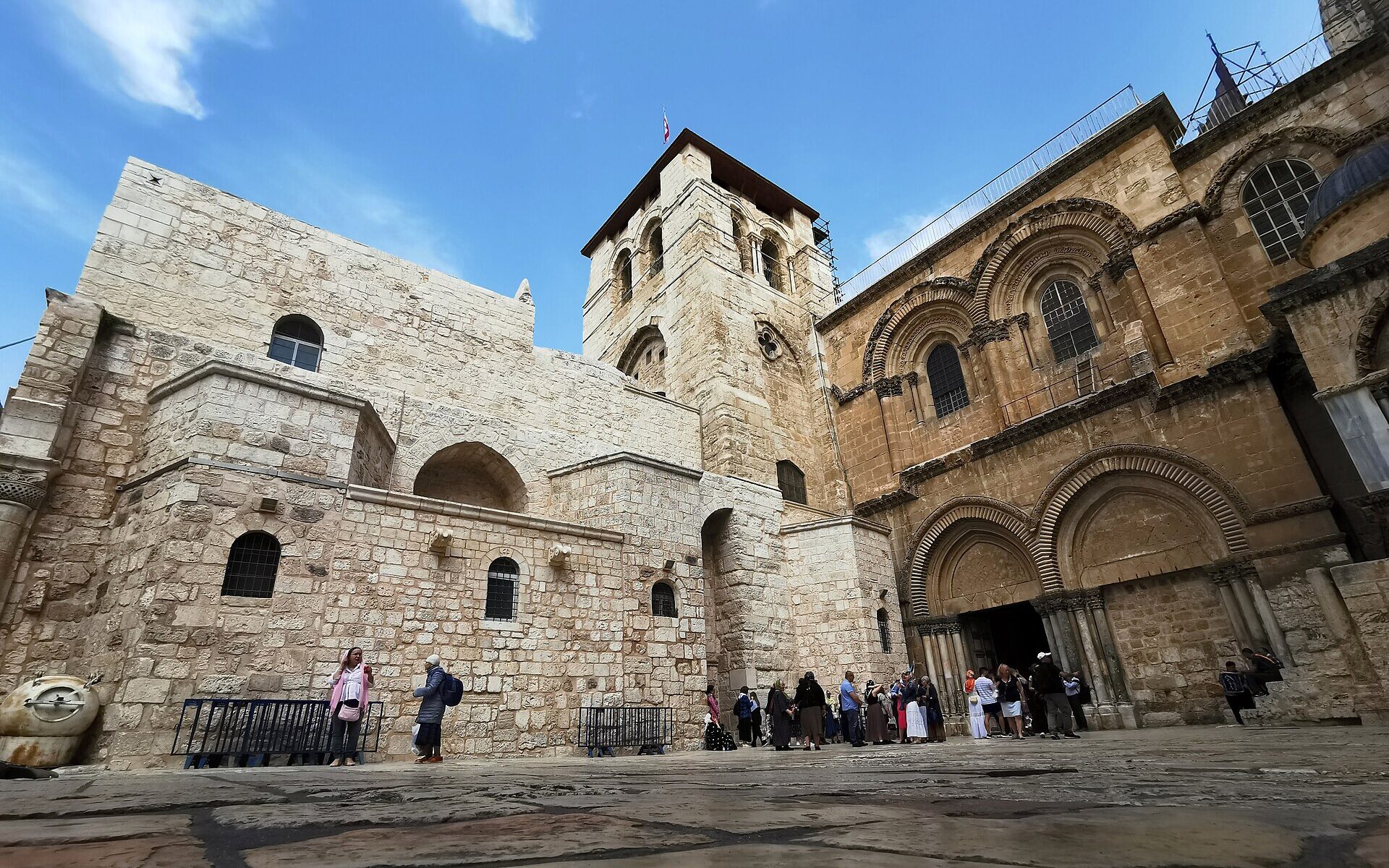
Start in the courtyard. Before you go in, look at the facade: the immovable ladder on the cornice, the right-hand doorway bricked up since the medieval period, and the bell tower shortened after an earthquake. Two minutes here saves confusion later.
Go right and up first. Immediately inside the door, a steep, worn stone stair on your right climbs to Calvary. It is roughly twenty high steps with a handrail, and it becomes a scrum by mid-morning, which is why you do it before anything else. At the top, the Latin altar marks the eleventh station and the Greek altar the twelfth, with the rock of Golgotha visible under glass and touchable through the silver disc beneath the Greek altar. Come down the second stair on the far side, which brings you out beside the Chapel of Adam.
Then the Stone of Unction and the Rotunda. Pause at the slab, then walk left into the Rotunda and join the Aedicule queue while it is still short. When you come out, walk around the back of the shrine to the Coptic chapel, and look for the low, dark Syriac chapel opening off the western side of the Rotunda — it is often unlit and unstaffed, and the rock-cut tombs behind it are one of the oldest things you can see in the building.
Cross into the Catholicon, then circle the ambulatory. The Greek Orthodox nave faces the tomb across the Rotunda, with the stone marking the omphalos at its centre. Behind it, a corridor of small chapels — the Prison of Christ, Saint Longinus, the Division of the Robes, the Chapel of the Derision — takes five minutes and is almost always empty.
Descend twice. A broad stair marked with thousands of small crosses scratched by medieval pilgrims drops to the Armenian Chapel of Saint Helena, and a rougher flight continues down to the Chapel of the Finding of the Cross, the deepest point in the church and the coolest place in it on a summer afternoon.
Finish on the roof. Back in the courtyard, a doorway on the right-hand side leads up to Deir es-Sultan, the Ethiopian monastery built over the Chapel of Saint Helena, where monks live in small cells around the dome. It is a startling contrast — daylight, silence, whitewash — after the incense and press below, and most tour groups never go up. From there you are three minutes from the final stations of the Via Dolorosa walking route, which most pilgrims prefer to do in the opposite direction, ending here. If you are slotting the church into a wider day, our day-by-day Jerusalem plan pairs it with the Western Wall and the ramparts walk without doubling back.
What Is and Is Not Step-Free
The main floor is broadly level once you are inside: the entrance, the Stone of Unction, the Rotunda, the Aedicule and the Catholicon can all be reached without stairs, though the flagstones are uneven, there is a shallow lip at the main door, and the approach lanes from Jaffa Gate involve steps and steep gradients. Calvary, the Chapel of Saint Helena, the Chapel of the Finding of the Cross and the Ethiopian rooftop are stairs only — there is no lift and no alternative route to any of them. Inside the Aedicule itself the doorway is low and narrow and the threshold is raised, so a transfer and assistance are usually needed. Attendants are generally willing to bring wheelchair users forward rather than making them hold a place in the queue; ask rather than assume. Our wider notes on getting around Jerusalem with limited mobility cover the approach routes in more detail.
Queue Strategy: Getting Into the Aedicule Without Losing Your Morning
The tomb queue is the one thing that can wreck a visit, so build your day around it. Our rule after several trips: be inside the church between 6:00 and 7:00 AM. At that hour the line for the Aedicule usually runs 10–20 minutes; by 10:00 AM it regularly tops an hour, and on Sundays, during Holy Week, or when cruise groups come up from the coast it can hit two.
It helps to know how the line actually works. An attendant admits three or four people at a time, first into the Chapel of the Angel and then into the burial chamber itself, where you get roughly 30–45 seconds before being waved out. The line also halts completely whenever one of the rites celebrates its liturgy at the tomb — the Catholics say Mass inside the Aedicule early in the morning, and the Greek Orthodox and Armenians have their own fixed slots — so a 40-minute estimate can quietly double. Nobody announces this; the queue simply stands still.
Two fallbacks if you arrive to a brutal line. First, return in the final hour before closing, when the day-trippers have gone. Second, skip the interior altogether and head for the Coptic chapel at the rear of the Aedicule — more on that below — where you can touch part of the tomb rock with rarely more than two people ahead of you.
Dress Code
- Shoulders and knees covered — strictly enforced.
- Wraps available at the entrance for those needing them.
- Modest dress for all genders.
- Head covering not required.
Etiquette Inside
- Quiet voices. Pilgrims are praying.
- No flash photography.
- Photography allowed in most areas; some chapels restrict it.
- Respect processions. Greek Orthodox, Armenian, and Franciscan monks pass through daily with incense and chant.
- Wait your turn to enter the Aedicule and Golgotha. Lines are managed.
- Don’t lean on monastic property. Each denomination guards its assigned space.
Daily Events
- Greek Orthodox liturgy early morning.
- Franciscan procession daily, at 4:00 PM in winter and 5:00 PM in summer.
- Armenian procession in late afternoon.
- Status Quo opening ceremony at dawn — the keyholder (a Muslim family) unlocks the main door.
Holy Week and the Holy Fire: Plan For It or Plan Around It
Holy Week is when the church is at its most extraordinary and at its least practical. Palm Sunday brings a procession down from Bethphage on the Mount of Olives into the Old City. On Good Friday the Franciscans lead the Via Dolorosa from the Umariya school at 11:00, arriving here for the final stations, and the lanes are impassable for hours either side. Because there are two Easters most years, all of this happens twice, once on the Western calendar and once on the Orthodox one.
The Holy Fire ceremony on Orthodox Holy Saturday is the single biggest event in the church’s year. The Greek Orthodox Patriarch enters the Aedicule alone, and emerges with lit candles; the flame is passed hand to hand through the Rotunda within seconds and then carried out of the building, and by evening it has been flown to Athens, Nicosia and other Orthodox capitals. Believers hold the flame to be miraculous; the ceremony is attested for well over a thousand years either way, and the atmosphere in the hour before it is unlike anything else in Jerusalem.
It is also the hardest day of the year to attend. Since 2023 Israeli police have capped the number of people allowed inside on safety grounds, pointing to the building’s very limited number of exits. The initial figure of 1,800 was later raised to around 2,200 inside plus about 1,000 in the courtyard and on the roof, and the churches have objected publicly and repeatedly that the restrictions are heavier than the risk warrants. In April 2026 the ceremony ran with roughly 2,700 to 3,000 people present, access by pre-approved permit only, and a ring of checkpoints through the Old City. Whatever your view of the arrangements, the practical consequence is fixed: without a permit obtained through a church, patriarchate or established pilgrimage operator, you will not get in.
So make it a deliberate choice. If Holy Fire is the reason for the trip, book accommodation inside the walls close to a year ahead — our roundup of places to stay inside the walls covers the guesthouses that fill first — and work through an operator who can actually secure entry. If it is not, travel the week after Easter instead: the church is calm, the city is emptying, and hotel rates fall sharply. Either way, check the situation before you fly. In spring 2026 the church was closed to the public for about forty days during a regional security emergency and reopened only two days before the ceremony, which is a useful reminder that in this city no schedule is guaranteed.
Liturgy and Services: What Happens When
This is a working church before it is a monument, and the liturgical day runs on a timetable fixed by the Status Quo rather than by convenience. Knowing the shape of it turns an awkward visit into a memorable one, because the church at prayer is a completely different building from the church at 11:00 on a Tuesday.
Overnight. Once the doors are locked, the three main communities celebrate in turn at the tomb, beginning around 00:30. The Greek Orthodox service is the longest at roughly three and a half hours, the Armenians follow for about ninety minutes, and the Franciscans close with around half an hour before dawn. Ordinary visitors are not inside for this. Groups occasionally arrange to be locked in overnight through their own church or the Custody, which has to be organised well in advance.
Early morning. From opening, Greek Orthodox matins and liturgy run in the Catholicon and Franciscan Masses are celebrated at the Aedicule and on Calvary. Catholic groups wanting to celebrate Mass at the tomb book through the Custody’s pilgrim office, usually months ahead — slots are short, early and heavily oversubscribed. As an individual you cannot simply turn up and expect an altar, but you can stand quietly at the back of any of these, and nobody will move you on.
Late afternoon. The Franciscan procession is the one fixed event worth planning around. Friars have walked it daily since 1336, and it sets off at 16:00 in winter and 17:00 in summer from the Chapel of the Apparition, working through fourteen stations — the Column of the Flagellation, the Prison, the Division of the Robes, the Finding of the Cross, Calvary, the Stone of Unction, the tomb — and returning to where it began. It is sung in Latin, takes roughly an hour, and sacristans hand out candles to anyone who wants to follow. There is no charge and no booking. An Armenian procession follows its own route later in the afternoon.
Two things to keep in mind. The Orthodox and Armenian churches follow the Julian calendar for Easter, so Jerusalem observes two Easters most years and the timetable shifts accordingly. And when any procession is moving, the tomb queue stops and stays stopped until it finishes — so either join it or use the time to see the ambulatory chapels. If liturgy is the reason you are travelling at all, our guide to planning a Christian pilgrimage in Jerusalem sets out how the church fits alongside Gethsemane and the other sacred sites across the city over a full week.
Brief History
- 1st century CE: Crucifixion of Jesus at Golgotha; burial in nearby tomb.
- 135 CE: Emperor Hadrian builds a pagan temple over the site.
- 326-335 CE: Constantine builds the first Christian church.
- 614 CE: Persian invasion damages the church.
- 1009 CE: Caliph al-Hakim destroys much of the structure.
- 1099 CE: Crusaders rebuild in Romanesque style.
- 1757: Status Quo agreement freezes inter-denominational arrangements.
- 2016-2017: Major restoration of the Aedicule.
How to Find the Church
The Church of the Holy Sepulchre is in the Christian Quarter of the Old City. Enter through Jaffa Gate, walk east along David Street, turn left into Christian Quarter Road. Signs guide you. The walk from Jaffa Gate is about 10 minutes.
Combine Your Visit With
- Via Dolorosa ending at Stations X–XIV inside the church.
- Lutheran Church of the Redeemer just steps away — climb its bell tower.
- Austrian Hospice rooftop café nearby.
- Christian Quarter souk walks.
- Garden of Gethsemane and the Mount of Olives — about 20 minutes on foot via Lions’ Gate, ideally at sunrise before the church.
- Our self-guided Old City walking tour threads the church into a full-day loop.
Where to Eat and Drink Nearby
The church sits in the middle of the souk, so good food is minutes away. Abu Shukri on Al-Wad (HaGai) Street, about five minutes toward Damascus Gate, serves what many locals still rank among the city’s best hummus — a plate with ful or pine nuts runs around 25–35 ILS ($7–10), and the kitchen winds down by late afternoon. The Austrian Hospice garden café on the Via Dolorosa pours proper Viennese coffee with apple strudel for about 50–60 ILS total, in a walled garden that feels nowhere near the market outside; pay the small rooftop fee and you get one of the Old City’s best views thrown in. For something older than any of us, Zalatimo’s, a bare-bones shopfront near the ninth station off Khan al-Zeit, has made mutabbaq — buttery filo stuffed with cheese or walnuts — since the Ottoman era; go before noon and bring cash. More options are in our best hummus in Jerusalem guide.
Staying Within Walking Distance
If a 5:00 AM visit appeals — and it should — sleep inside the walls. The Christian Quarter’s pilgrim houses put you two to eight minutes from the door: Casa Nova (Franciscan), the Lutheran Guesthouse, and the Austrian Hospice all charge roughly $90–160 a night for spotless, simple rooms. We compare them in our Christian guesthouses guide, and there are conventional alternatives in our Old City hotels roundup. Outside the walls, anything near Jaffa Gate keeps the walk under 15 minutes.
One day a year the whole of the above becomes unavailable. On Orthodox Holy Saturday — 1 May in 2027 — the church is sealed and filled for the Holy Fire, cordons close the surrounding lanes from before dawn, and casual visitors do not get in at all. If you are travelling for it, or want to be sure you are not travelling into it by accident, our guide to the Holy Fire ceremony in Jerusalem sets out the timings, the police cordons and the realistic odds of getting through them.
Final Word: The Most Sacred Christian Address
For Christian pilgrims, the Church of the Holy Sepulchre is the destination that frames the entire trip. Visit it twice — once at sunrise for solitude, once during a Franciscan procession for the spectacle — and let the layered traditions of six denominations teach you something no single tradition could. Pair this with our Via Dolorosa guide, guide to Jerusalem holy sites, and Christian Pilgrimage Jerusalem guide.
Photo Credits
The bell tower and Crusader facade of the Church of the Holy Sepulchre from the parvis: HolySepulchreFotoThalerTamas27 by Thaler Tamas, CC BY-SA 4.0, via Wikimedia Commons.
The twin-arched Crusader facade of the Church of the Holy Sepulchre: Church of the Holy Sepulchre (42395966305) by Gary Todd from Xinzheng, China, CC0, via Wikimedia Commons.
The restored Aedicule in the Rotunda of the Church of the Holy Sepulchre: Church of the Holy Sepulchre The Aedicule, Which Contains the Holy Sepulchre Itself (28431087277) by Gary Todd from Xinzheng, China, CC0, via Wikimedia Commons.
Pilgrims kneeling at the Stone of Anointing inside the Church of the Holy Sepulchre: The Stone of Anointing 1 by Eyal.benhaim, CC BY-SA 4.0, via Wikimedia Commons.
{"@context": "https://schema.org", "@type": "FAQPage", "mainEntity": [{"@type": "Question", "name": "Is admission to the Church of the Holy Sepulchre free?", "acceptedAnswer": {"@type": "Answer", "text": "Yes. Free, all visitors welcome. Donations are appreciated."}}, {"@type": "Question", "name": "What time is best to visit?", "acceptedAnswer": {"@type": "Answer", "text": "Just after opening (5–6 AM) for solitude and morning processions. Early evening before closing for second-best."}}, {"@type": "Question", "name": "How long does it take to visit?", "acceptedAnswer": {"@type": "Answer", "text": "Minimum 45 minutes. Plan 1.5–2 hours including time at the Aedicule. Pilgrims often spend 3+ hours."}}, {"@type": "Question", "name": "Why are there so many denominations?", "acceptedAnswer": {"@type": "Answer", "text": "Different denominations have venerated the site since at least the 4th century. The Status Quo agreement of 1757 froze ownership rights. Each maintains different chapels and traditions."}}, {"@type": "Question", "name": "Can I attend a service?", "acceptedAnswer": {"@type": "Answer", "text": "Yes — early morning Greek Orthodox liturgies, the daily Franciscan procession at 4 PM, and the Armenian afternoon procession are all open to observers."}}, {"@type": "Question", "name": "Is the church wheelchair-accessible?", "acceptedAnswer": {"@type": "Answer", "text": "Partially. The main floor is accessible; Golgotha (steep stairs) and Chapel of Saint Helena (stairs descending) are not. Caregivers can assist; staff are generally helpful."}}, {"@type": "Question", "name": "What is the Holy Fire ceremony?", "acceptedAnswer": {"@type": "Answer", "text": "An annual Greek Orthodox event on Holy Saturday (the day before Easter), when the Patriarch enters the Aedicule and emerges with a flame. Pilgrims fill the church and surrounding streets. Plan a year in advance for accommodation if you want to attend."}}, {"@type": "Question", "name": "Can I go inside the tomb itself?", "acceptedAnswer": {"@type": "Answer", "text": "Yes. The queue in the Rotunda leads into the Aedicule, first into the small Chapel of the Angel and then through a low doorway into the burial chamber, where three or four people at a time get roughly 30 to 45 seconds before an attendant waves them out. It is free, and no ticket or booking exists."}}, {"@type": "Question", "name": "Can I watch the doors being unlocked in the morning?", "acceptedAnswer": {"@type": "Answer", "text": "Yes, and it is worth setting an alarm for. Be in the courtyard about fifteen minutes before opening — roughly 04:45 in summer and 03:45 in winter — and stand back from the doors. A ladder is passed out through a hatch, a member of the Nuseibeh family climbs to the upper lock with the key kept by the Joudeh family, and the church opens. The whole thing takes about five minutes and costs nothing."}}, {"@type": "Question", "name": "Is the restoration work still affecting visits?", "acceptedAnswer": {"@type": "Answer", "text": "The floor conservation project that began in 2022 entered its final paving phase in late 2025 and ran into 2026, so most of the church now looks close to normal. Isolated hoardings, temporary walkways and short-notice chapel closures have been routine throughout, and admission and opening hours were never affected. Ask at the sacristy on the day if one specific chapel is essential to your visit."}}, {"@type": "Question", "name": "Do I need to book to celebrate Mass at the tomb?", "acceptedAnswer": {"@type": "Answer", "text": "Yes, and well ahead. Catholic groups arrange early-morning Mass at the Aedicule or on Calvary through the Franciscan Custody's pilgrim office, typically months in advance, and slots are short and heavily oversubscribed. Individuals cannot book an altar, but you are welcome to attend any service quietly as an observer, including the daily Franciscan procession, which needs no booking at all."}}, {"@type": "Question", "name": "Is this the same place as the Garden Tomb?", "acceptedAnswer": {"@type": "Answer", "text": "No. The Garden Tomb near Damascus Gate is a separate site, identified in the nineteenth century and maintained as a quiet place of prayer, mainly by Protestant visitors. Most archaeologists regard the Church of the Holy Sepulchre as the stronger candidate for the tomb of Jesus, since it stood outside the city wall in the first century and was continuously venerated from at least the fourth. Many pilgrims visit both, for different reasons."}}]}