The best time to visit Jerusalem is shaped by three things pulling against each other: the weather, the religious calendar, and the crowds. The two most rewarding windows are April to May, when spring brings comfortable temperatures and hillsides of wildflowers, and September to November, when the heat breaks into warm days and cool nights and the tourist numbers thin out. Summer is hot and busy, winter is cool and sometimes wet but cheap and quiet, and the religious holidays can transform a given week into either the most atmospheric or the most crowded time to be here.
This guide to the best time to visit Jerusalem walks through each season with real conditions, overlays the 2026 religious calendar that drives crowds and closures, and ends with a month-by-month verdict. Pair it with our monthly weather breakdown for the climate detail and our Jerusalem travel tips for everything practical.

The Quick Answer
If you just want a recommendation before the detail below, here is the short version, broken down by what you are optimizing for.
- Best overall: late April through May, or mid-September through November.
- Best for a budget trip: mid-November to mid-March, skipping the Christmas–New Year spike.
- Best for Christian pilgrimage: Holy Week and Easter, Christmas, or Lent.
- Best for Jewish pilgrimage: Passover, Sukkot, or Hanukkah.
- Most crowded: the Passover–Easter overlap in early April, Sukkot in autumn, and Christmas–New Year.
- Hardest weather: July and August for the heat, and January–February for the cool, rainy stretch.
Season at a Glance
| Season | Daytime temp | Crowds | Prices | Best for |
|---|---|---|---|---|
| Spring (Mar–May) | 18–25°C / 64–77°F | Moderate to high | Mid to high | First-timers, photographers, comfortable touring |
| Summer (Jun–Aug) | 28–33°C / 82–91°F | High | Highest | Families on school holidays, evening atmosphere |
| Autumn (Sep–Nov) | 22–28°C / 72–82°F | Low to moderate | Moderate | The sweet spot: weather plus fewer crowds |
| Winter (Dec–Feb) | 10–15°C / 50–59°F | Lowest (bar Christmas) | Lowest (bar Christmas) | Budget travelers, Christmas pilgrims, quiet visits |
The Numbers: Average Temperatures and Rainfall by Month
Seasons are a useful shorthand, but most people planning a trip want the actual figures. Below are the 1991–2020 climate normals for the Jerusalem station, based on Israel Meteorological Service records: long-run averages of daily high and low temperature and monthly rainfall. Averages are not forecasts — a January week can be 18°C and blue, or four days of rain at 8°C.
- January — high 12.7°C (55°F), low 6.7°C (44°F). The wettest month: 137mm (5.4in) over roughly nine wet days.
- February — 14.0°C (57°F) and 7.3°C (45°F), 118mm (4.6in) across about eight wet days. Marginally milder, just as damp.
- March — 17.4°C (63°F) and 9.5°C (49°F), 67mm (2.6in) over about six wet days. Rainfall drops away fast.
- April — 22.0°C (72°F) and 12.5°C (55°F), just 22mm (0.9in) across two or three wet days.
- May — 26.2°C (79°F) and 16.2°C (61°F), 7mm of rain. Effectively dry, warm by day, still cool after dark.
- June — 28.6°C (83°F) and 18.3°C (65°F), with a rainfall normal of 0.3mm.
- July — 30.0°C (86°F) and 20.0°C (68°F), no rain at all in an average year, and roughly 384 hours of sunshine.
- August — the hottest month, 30.3°C (87°F) and 20.2°C (68°F), again with no measurable rain.
- September — 28.9°C (84°F) and 19.1°C (66°F), still dry. Summer with the edge taken off.
- October — 25.9°C (79°F) and 17.3°C (63°F), 10mm (0.4in) over about two days. On paper the most agreeable month of the year.
- November — 19.9°C (68°F) and 12.9°C (55°F), 51mm (2.0in) across four or five wet days. Mild, with the rains returning.
- December — 14.9°C (59°F) and 8.8°C (48°F), 112mm (4.4in) over roughly eight wet days. Properly cool and properly wet.
Two patterns matter more than any single month. First, the rain is extremely concentrated: about 526mm (20.7in) falls in an average year, virtually all of it between late October and early April. Second, the daily swing is large — even in August the average low is 20°C, which is why evenings are pleasant when the coast is still sweating. Our month-by-month weather guide adds humidity and sunshine detail if you want it.
Why Jerusalem Is Colder Than the Rest of Israel
This is the most common planning mistake visitors make. Jerusalem sits at about 754m (2,474ft) on the crest of the Judean hills, an hour from the Mediterranean, and behaves like a hill town rather than a Middle Eastern beach city. People pack for Tel Aviv and arrive shivering.
The January gap is stark. Tel Aviv averages a daily high of 17.5°C and a low of 9.6°C; Jerusalem averages 12.7°C and 6.7°C. That is roughly five degrees colder by day, nights close to freezing are unremarkable, and wind on exposed ground — the Mount of Olives, the ramparts, the Western Wall plaza — makes it feel colder again. Summer inverts only half the comparison: Jerusalem’s August high of 30.3°C is fractionally above Tel Aviv’s, so the days are not cooler. What differs is the air and the nights, with summer humidity around 40% and an average August low of 20.2°C against the coast’s 23.7°C.
There is a third climate within a day trip of your hotel: the Dead Sea shore lies more than a kilometre below the city, and the Judean desert between them is hotter and drier again, which is why a February desert day is delightful and a July one punishing. Plan those excursions by the destination’s conditions, not the city’s. Our notes on what to pack for each season cover the layers this altitude actually demands, including a warm one in May, when the average low is still 16°C.
Spring (March–May): Often the Best Choice
Spring is when Jerusalem is at its most beautiful and, for many visitors, most comfortable. Days settle into the low-to-mid twenties Celsius, nights stay cool, and the surrounding hills turn green and dotted with wildflowers, including the red anemones the country is fond of. The Jerusalem Forest and the terraced springs at Sataf are at their greenest, and day trips to the desert and the Dead Sea are pleasant rather than punishing. It is an ideal time for the long walking days the city demands, and the soft spring light is kind for photography.
The catch is the calendar. In 2026, Passover runs April 1–9 and Western Easter falls on April 5, with Orthodox Easter on April 12 — so the first half of April stacks the year’s biggest Jewish and Christian holidays almost on top of each other. Expect packed holy sites, full hotels, and premium prices through that stretch. If you want spring weather without the crush, aim for mid-to-late March or, better still, the second half of May, when temperatures are still pleasant and the holiday crowds have gone. Other dates to know: Holocaust Remembrance Day and Israel’s Memorial and Independence Days fall in April, each bringing brief, solemn or celebratory disruptions to normal life.
Summer (June–August): Hot, Busy, Pricey
Summer is peak tourist season, driven by school holidays across Europe and North America, and prices rise to match. The upside of Jerusalem’s summer is that the heat is dry rather than humid, and at its altitude the evenings cool off pleasantly — far more comfortable than the sticky coast in Tel Aviv. Daytime highs sit in the high twenties to low thirties Celsius, and the sun is intense.
The trick to enjoying summer is to flip your day. Do your serious sightseeing — the Old City, the ramparts, outdoor archaeological sites — first thing in the morning, retreat to shade, a museum, or a long lunch through the worst of the midday heat, then come back out in the late afternoon and evening when Mahane Yehuda Market and the cafe districts come alive. Carry water everywhere and reapply sun protection. Summer also brings festivals, including light and arts events that make warm evenings especially worthwhile; our Jerusalem festivals calendar tracks what is on.

Autumn (September–November): The Sweet Spot
If there is a single best window, this is it. The summer heat eases through September into warm, clear days and genuinely cool evenings, the European summer crowds have gone home, and the famous Jerusalem light — low, golden, and clean — is at its most photogenic. October in particular tends to combine the most agreeable weather with the smallest tourist numbers of the year. Rainfall is still minimal, so outdoor sites, the ramparts walk, and desert day trips all stay comfortable, and the pleasant evenings are perfect for the markets and the cafe districts.
The one thing to plan around is the dense cluster of Jewish High Holidays. In 2026, Rosh Hashanah falls September 11–13, Yom Kippur on September 20–21, and Sukkot September 25 to October 2. These bring a mix of closures and crowds: Yom Kippur in particular sees the entire country effectively shut down for about 25 hours, with no traffic, no public transport, and almost everything closed — an extraordinary thing to witness but one to prepare for. Travel just after Sukkot ends, into mid-October and November, and you get the best of the season with the calendar working in your favor.
Winter (December–February): Cool, Cheap, Quiet
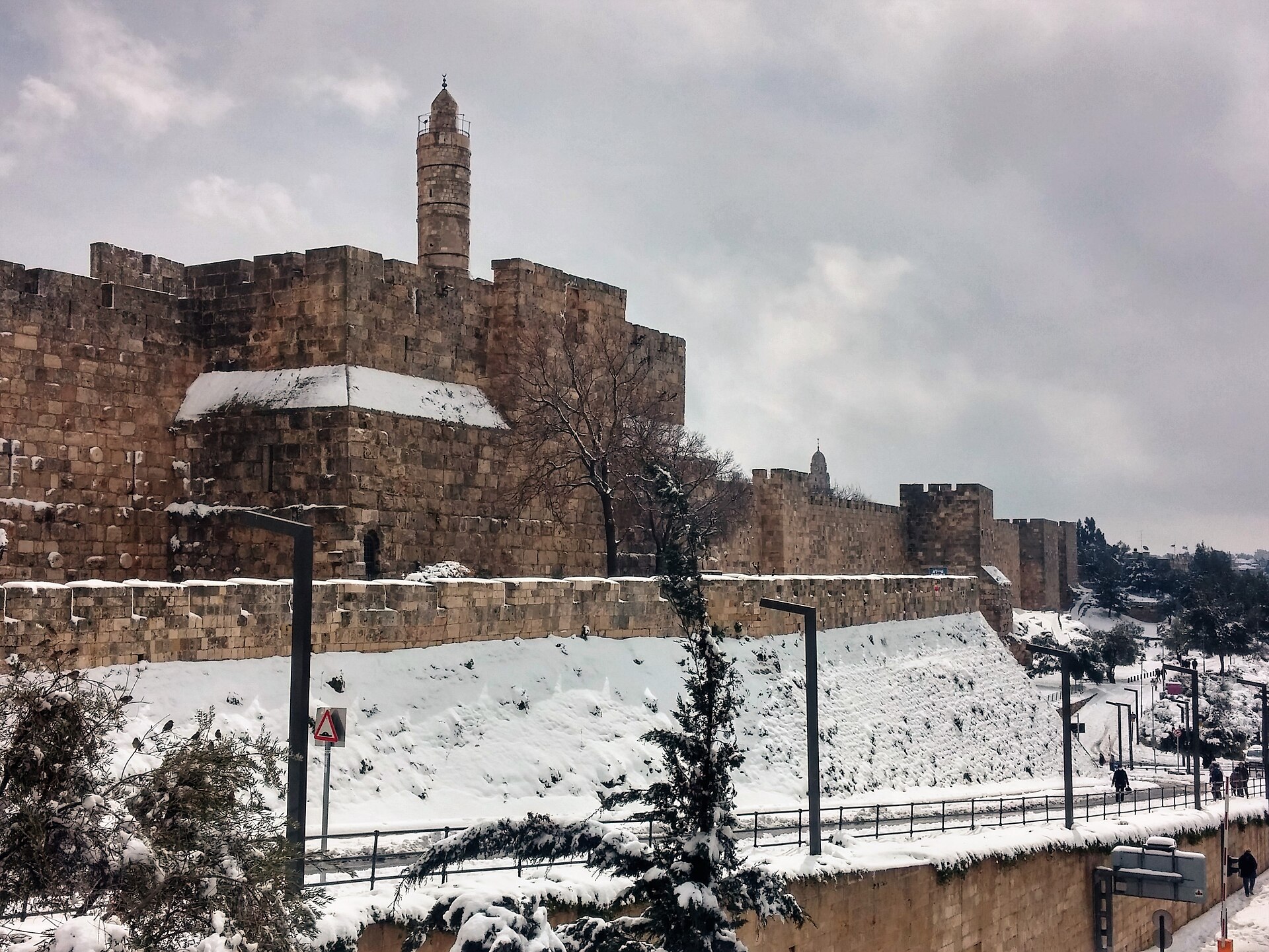
Winter is Jerusalem’s bargain season, and for the right traveler it is a genuine pleasure. Days are cool, in the low double digits Celsius, nights can drop close to freezing, and rain comes in spells rather than constant drizzle — this is the wet season, so pack a waterproof layer and shoes that handle slick stone. Snow does fall occasionally, perhaps once or twice a winter, and when it does it dusts the Old City into something unforgettable, though the city tends to grind to a halt for a day when it happens.
Crowds and prices are at their lowest for most of the season, with one big exception: Christmas and the days around New Year, when Christian pilgrims fill the Christian Quarter and nearby Bethlehem and accommodation books out far ahead. Hanukkah, usually in December, brings festive evenings and lit candles in windows without major closures, and the cooler air makes the long indoor museums an easy pleasure. If you do not mind layering up and accepting some rain, winter rewards you with quiet holy sites, short queues, and the best hotel deals of the year.
Choosing Between Spring and Autumn
Almost every guide, this one included, lands on spring and autumn. True, but not useful on its own, because the two are not interchangeable. They fail in different ways.
Spring gives you the landscape. The hills are green, the wildflowers are out, and the light is soft rather than bleached — the only time of year the countryside looks anything other than tan. Daylight is lengthening, with sunset past 19:00 by mid-April and close to 19:30 in late May. The costs are rain that has not quite finished, the year’s heaviest holiday congestion in the first half of the season, and the sharav: the hot, dusty desert wind that can push a pleasant 22°C April day past 30°C for 48 hours with no warning. The station records for April and May — 35.6°C and 38.6°C — come from exactly that.
Autumn gives you reliability. September to early November is the most predictable stretch of the year: warm, essentially rainless until late October, and once the High Holidays end the crowds thin further than at any point in spring. The costs are a landscape baked brown since June and daylight running the other way. Israel puts the clocks back on the last Sunday in October, so sunset drops from just after 18:00 to just before 17:00 overnight, and by mid-November the sun is down by 16:45. An October itinerary and a November one are not the same shape.
The Honest Case Against Each Season
Every season here has a real cost, and the ones that get glossed over are usually the ones that wreck an itinerary.
Winter’s problem is the clock, not the cold
The cold is manageable — layers solve 12°C. The daylight is not. On the shortest days the sun rises around 06:33 and sets around 16:40, giving you about ten hours, and the Old City empties fast once it is dark. Worse, Shabbat begins at sunset, so a December Friday effectively ends by 16:00: shops shut, buses stop, and West Jerusalem closes for the next twenty-four hours. On a four-night winter trip you can lose a day and a half to darkness and the weekly shutdown if you have not planned around it, which is why our guide to Shabbat timings is worth reading before you fix dates.
Set against that, the case for winter is genuine and undersold. The Church of the Holy Sepulchre on a wet Tuesday in January is a different building from the same place in April — you can stand in the rotunda, unhurried, with a handful of other people. Queues largely disappear and rates sit at their floor outside the Christmas and New Year window, which is when our advice on keeping costs down stretches furthest. Snow is a possibility rather than a plan: flurries occur most winters, heavier falls every three or four years, and when it settles the city stops for a day.
Summer’s problem is the middle of the day
Thirty degrees with unbroken sun and no shade is the constraint, and the Old City’s pale limestone reflects the heat back at you. The open sites suffer most: the ramparts walk, the Mount of Olives descent, the City of David, the desert and the Dead Sea. The workable strategy is to treat 11:00 to 16:00 as unusable and build around it. Midsummer daylight runs from about 05:33 to 19:49, so a 07:00 start costs you nothing and buys four cool hours, and the evening block from 17:00 is long and comfortable.
The second summer cost is competition for rooms. Israeli schools break for July and August, European and North American holidays overlap, and the pilgrimage groups do not stop, so the better-located hotels near the Old City sell out earliest. Decide which neighborhood suits you early rather than taking what is left — a long uphill walk back at 15:00 in August is a very different proposition from the same walk in October.
Spring and autumn have a calendar problem
Neither shoulder season has a weather problem worth the name. What they have is the densest concentration of religious holidays in the year, which means the two best-weather windows are also the two hardest to book. That is not a reason to avoid them, only to choose dates deliberately rather than at random.
How the Religious Calendar Shapes Your Trip
More than weather, the holiday calendar determines whether a given week is crowded, closed, or quietly perfect. Holidays here follow the Hebrew and Islamic lunar calendars, so their Gregorian dates shift every year — always confirm against the specific year you are traveling. The headline 2026 dates and what they mean for visitors:
- Passover (April 1–9, 2026): very busy; many Jewish-run restaurants and hotels switch to Passover-only menus, and bread is hard to find.
- Western Easter (April 5) and Orthodox Easter (April 12): the Christian Quarter and Church of the Holy Sepulchre are at their fullest; book lodging far ahead.
- Ramadan (roughly mid-February to mid-March in 2026, shifting earlier each year): the Muslim Quarter is quieter by day and lively after the evening iftar.
- Rosh Hashanah (September 11–13) and Sukkot (September 25–October 2): Jewish areas busy, with some closures.
- Yom Kippur (September 20–21): the country essentially stops for about 25 hours; no transport, almost everything closed.
- Hanukkah and Christmas (December): festive evenings citywide and a Christian Quarter peak, respectively.
Whatever season you choose, every single week includes the weekly Shabbat shutdown from Friday afternoon to Saturday nightfall, when public transport stops and much of West Jerusalem closes. It is not a holiday you can avoid by timing, so read our Shabbat in Jerusalem guide and plan your Fridays and Saturdays around it.
Three Christmases, Two Easters and a Ramadan That Moves
Jerusalem does not run on one calendar. It runs on four at once — Gregorian, Julian, Hebrew and Hijri — and the interference between them is what decides whether your week is serene or shoulder-to-shoulder. Weather varies by a few degrees. Crowds vary by orders of magnitude.
Christmas happens three times
The Latin churches, Catholic and Protestant, keep 25 December, the night of the procession to Bethlehem and midnight mass at the Church of the Nativity. The Greek Orthodox, Coptic and Syriac churches keep 25 December on the Julian calendar, which currently falls on 7 January. The Armenian Patriarchate of Jerusalem keeps 6 January by Julian reckoning, landing on 19 January. Each has its own procession and its own peak, so Christmas here is a four-week season with three spikes and quiet troughs between them — early January, after the Latin surge and before the Orthodox one, is among the better-value windows of the year. The Christian Information Center inside Jaffa Gate publishes the liturgical calendars for all of them.
Easter can be five weeks apart, or the same day
Western and Orthodox Easter are calculated differently and rarely coincide. In 2026 they fell a week apart, on 5 and 12 April. In 2027 they are five weeks apart, on 28 March and 2 May. In 2028 they fall on the same day, 16 April, which will make that week the busiest single stretch of the decade. Orthodox Holy Saturday brings the Holy Fire ceremony at the Church of the Holy Sepulchre, the most crowded hours of the Christian Quarter’s year, with police numbers caps and barriers that can make crossing the Old City difficult. Come for it deliberately, or come a week either side.
The Jewish festivals fill the city with Israelis
This is the crowd source visitors underestimate, because it is domestic rather than international. Passover and Sukkot both run a week, and their intermediate days — chol hamoed — are when Israeli families travel, filling hotels and sites nationwide. Rosh Hashanah and Yom Kippur bring closures rather than crowds: on Yom Kippur the country stops almost completely for about twenty-five hours, with no flights, no public transport and no traffic. The dates drift a long way. In 2027 Passover begins on the evening of 21 April, Rosh Hashanah falls on 1–3 October, Yom Kippur on 10–11 October and Sukkot from 15 to 22 October — about three weeks later in the year than the 2026 equivalents. Check your own travel year against Hebcal rather than a remembered date.
Ramadan shifts about eleven days earlier each year
The Islamic calendar is purely lunar, so Ramadan moves backwards through the seasons: 18 February to 19 March in 2026, roughly 8 February to 8 March in 2027, and 28 January to 25 February in 2028, with the exact start subject to local moon sighting. Within a decade it will fall in high summer.
During Ramadan the Old City’s rhythm inverts. The Muslim Quarter is subdued by day, with many stalls and restaurants shut until sunset, then becomes the liveliest street scene in the city after iftar, with Damascus Gate and the lanes around it busy late into the night. Friday prayers draw very large numbers, and Eid al-Fitr at the end is a major three-day holiday across East Jerusalem. Our calendar of what is on tracks the year across all three traditions.
Month-by-Month Verdict
- January: cool, the rainiest stretch, lowest crowds and prices. Good for budget and quiet.
- February: similar to January, occasionally milder; still very quiet.
- March: spring arrives, wildflowers begin, crowds moderate. A strong shoulder month.
- April: beautiful weather but the busiest, priciest stretch thanks to Passover and Easter.
- May: arguably the best all-round month once the early-April holidays pass.
- June: warm and getting busier as summer holidays begin.
- July: hot and peak tourism; plan around the midday heat.
- August: hot, crowded, and the most expensive.
- September: cooling and pleasant, though the High Holidays bring spikes.
- October: often the best of the year for weather and value once Sukkot ends.
- November: mild, with some of the smallest crowds you will find.
- December: cool and quiet apart from the Christmas–New Year surge.
Once you have picked your window, see how long to stay with our how many days in Jerusalem guide and turn it into a day-by-day plan using our Jerusalem itinerary planner.
How Long to Stay, and What the Season Does to Your Days
Almost every itinerary for this city quietly assumes a full, usable day of daylight. That holds in April and it does not hold in December, which is why the same three-day plan feels comfortable in one season and rushed in another.
Three full days is the realistic minimum for the Old City, the Mount of Olives, one major museum and some breathing room; four or five lets you add Bethlehem, Yad Vashem and the Dead Sea without turning the trip into a march. Those are spring and autumn numbers, when you have twelve to fourteen hours of light and can walk from 08:00 to 19:00. Adjust from there. In July and August, subtract the five middle hours that are not usable outdoors and a three-day plan becomes a four-day one. In December and January you have around ten hours of light and the last stop should finish by 16:00. In every season, subtract Friday afternoon and most of Saturday in West Jerusalem — which is why arriving on a Sunday or Monday is the easiest scheduling improvement most visitors can make.
The Old City is the part the weather really touches. It is walking-heavy, the lanes are stepped and polished limestone that is genuinely slippery when wet, and there is little shade. Wet January stone and August sun argue for the same thing: fewer sites per day and better shoes. Our breakdown of how long to allow works through the trade-offs, our day-by-day route planner can be shifted earlier or later to match the season, and the practical groundwork sits in our general advice for visitors.
One nuance worth adding to the autumn case. October has close to ideal weather and comparatively few international visitors, but Sukkot falls in the middle of it and Israelis take their annual holiday that exact week — so hotels hit their yearly peak and every site is packed even though foreign tourism is thin. The bargain is the fortnight either side. Our guide to Sukkot in Jerusalem explains the dates and what the week is actually like.
The Bottom Line
The best time to visit Jerusalem comes down to what you value. For comfortable weather and reasonable crowds, choose late April–May or September–November, with October the standout. For the lowest prices and the quietest sites, come in winter and pack for rain. For pilgrimage, time your trip to your tradition’s calendar and book early. Whenever you go, build your days around Shabbat and the holiday dates. Plan the rest with our temperature and rainfall guide, our Jerusalem travel tips, and the Jerusalem itinerary planner.
Photo Credits
Snow below the Tower of David and the Old City walls: Tower of David in snow – מגדל דוד בשלג by Alineb07, CC BY-SA 4.0, via Wikimedia Commons.
{"@context": "https://schema.org", "@type": "FAQPage", "mainEntity": [{"@type": "Question", "name": "What is the absolute best time to visit Jerusalem?", "acceptedAnswer": {"@type": "Answer", "text": "For most travelers, mid-September through November or the second half of May. You get comfortable warm days, cool evenings, and crowds that are well below the spring and summer peaks. October in particular tends to pair the year's most agreeable weather with the smallest tourist numbers, making it the standout month."}}, {"@type": "Question", "name": "Should I avoid Passover and Easter?", "acceptedAnswer": {"@type": "Answer", "text": "Only if crowds and high prices put you off, because the religious atmosphere is also at its most powerful then. In 2026 the dates cluster tightly — Passover April 1–9, Western Easter April 5, Orthodox Easter April 12 — so the city is at its fullest. If you go, book hotels and tours many months ahead; if you want spring weather without the crush, choose late May instead."}}, {"@type": "Question", "name": "Is Jerusalem too hot to visit in summer?", "acceptedAnswer": {"@type": "Answer", "text": "It is manageable if you plan around the heat. The dry, high-altitude air is more comfortable than humid coastal cities, and evenings cool off nicely. Sightsee in the morning, rest at midday, and head back out in the late afternoon and evening. Carry water, wear sun protection, and you can enjoy summer despite the higher prices and crowds."}}, {"@type": "Question", "name": "Does it actually snow in Jerusalem?", "acceptedAnswer": {"@type": "Answer", "text": "Occasionally. Most winters bring at most one or two snow events, usually in January or February, and they rarely last long. When snow does fall it transforms the Old City beautifully, but the city is not built for it and tends to shut down for a day or so. Treat snow as a rare bonus rather than something to plan around."}}, {"@type": "Question", "name": "When are flights and hotels cheapest?", "acceptedAnswer": {"@type": "Answer", "text": "From mid-November to mid-March, with the clear exception of the Christmas and New Year period. Outside that holiday window, winter hotel rates can fall well below their spring and summer levels, and airfares ease too. If your priority is value and you do not mind cool, sometimes rainy weather, this is the season to book."}}, {"@type": "Question", "name": "Should I visit during Christmas?", "acceptedAnswer": {"@type": "Answer", "text": "For Christian travelers, yes — Christmas in the Christian Quarter and nearby Bethlehem is a singular experience, with processions and packed services. Be aware that different denominations celebrate on different dates and that accommodation in Jerusalem and Bethlehem books out far in advance, so plan and reserve as early as you can."}}, {"@type": "Question", "name": "How cold does Jerusalem actually get in winter?", "acceptedAnswer": {"@type": "Answer", "text": "Colder than most people expect. January averages a daily high of 12.7°C (55°F) and a low of 6.7°C (44°F), and the record low at the Jerusalem station is −6.7°C. At 754m altitude the city runs about five degrees cooler than Tel Aviv by day, and stone buildings, limited heating and wind on exposed sites make it feel colder again. Bring a proper coat, not a light jacket."}}, {"@type": "Question", "name": "When is Ramadan, and does it affect visitors?", "acceptedAnswer": {"@type": "Answer", "text": "Ramadan follows the lunar Islamic calendar and moves about eleven days earlier each year — 18 February to 19 March in 2026, roughly 8 February to 8 March in 2027, and 28 January to 25 February in 2028, with exact dates set by local moon sighting. It does not close the sights, but it changes the Old City’s rhythm: the Muslim Quarter is quiet by day with many eateries shut, then comes alive after the evening iftar. Fridays draw large crowds and access to some streets is managed by police."}}, {"@type": "Question", "name": "Is May or October the better month?", "acceptedAnswer": {"@type": "Answer", "text": "October is the safer bet and May is the prettier one. October is warm, near-rainless and quiet once Sukkot has passed, with average highs of 25.9°C. May is greener, with longer evenings and sunset close to 19:30, but it can be hit by a sharav that pushes the temperature above 35°C for a day or two. If reliability matters most, take the second half of October; if scenery and long days matter most, take late May."}}]}