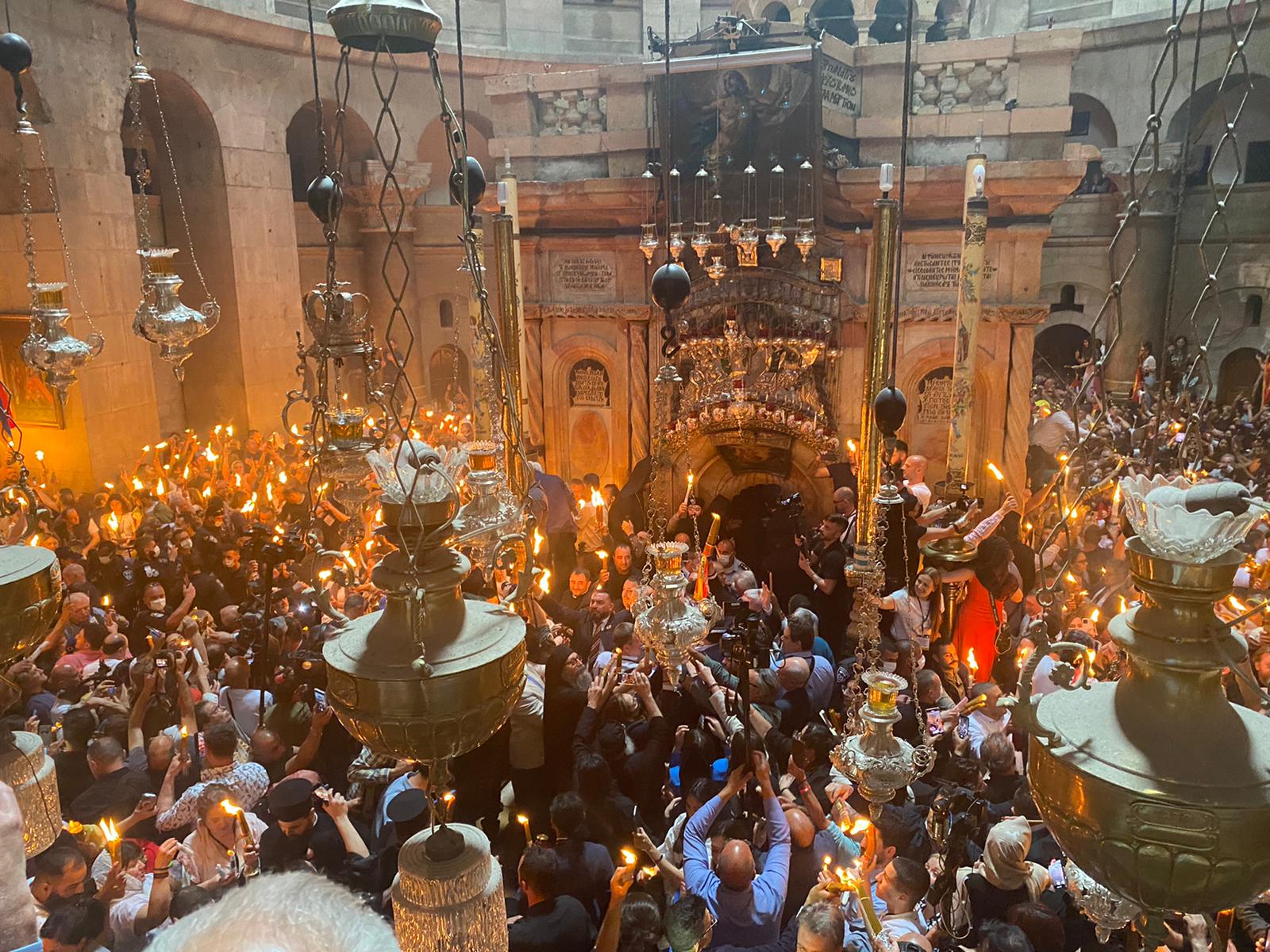
By six in the morning on Orthodox Holy Saturday, the lanes around the Christian Quarter are already blocked. Not busy — blocked, by steel barriers and police who are counting people through in ones. Inside the church, several thousand pilgrims have been standing since the night before, holding bundles of thirty-three thin candles, and they will keep standing for another seven hours. The Holy Fire ceremony Jerusalem stages once a year is the most intense hour in the city’s calendar, and it is also the hardest thing in this entire guide to actually get into.
This page is about attending: the timings, the cordons, the realistic odds, and what to do when — not if — you find you cannot get through. It covers Orthodox Holy Saturday only, which falls on 1 May 2027. For the church itself in ordinary weeks, see our guide to the Church of the Holy Sepulchre; for the rest of Holy Week, see Easter in Jerusalem. Everything here was checked in September 2026. Access arrangements are set by the Israeli police in the weeks beforehand and change from year to year, sometimes substantially — treat the detail below as the shape of the day, not a timetable.
What Happens, and What Is Claimed
The ceremony, in outline: the Greek Orthodox Patriarch of Jerusalem processes three times around the Edicule — the small chapel built over the tomb — then removes his outer vestments and is searched, in the presence of Israeli police and representatives of the other communities, to establish that he is carrying nothing that could produce a flame. He enters the tomb chamber alone with an Armenian archimandrite waiting in the antechamber. The doors are sealed. All the lamps in the church are extinguished.
After an interval — usually several minutes, occasionally much longer — flame appears at the two round openings on the sides of the Edicule and the Patriarch emerges with lit bundles of candles. The fire is passed hand to hand, and within a couple of minutes a church that was dark is full of light and noise. Runners carry the flame out to waiting crowds; it is flown the same day to Athens, Moscow, Belgrade, Bucharest and Tbilisi on chartered aircraft.
What the fire is, is disputed and has been for centuries. Orthodox Christians hold that it descends miraculously, and many pilgrims report that in the first minutes it does not burn — you will see people passing it over their faces and beards. Sceptical accounts, including some from within the churches at various points in history, describe a lamp lit inside the tomb. The Catholic Church does not participate in the ceremony. This guide is not going to tell you which account is right; it is a question of faith, not of travel writing, and the people around you in that church have thought about it a great deal longer than either of us. What is not in dispute is the effect of being there.
The 2027 Dates
| Event | 2027 date | Notes |
|---|---|---|
| Orthodox Palm Sunday | 25 April | Procession down the Mount of Olives |
| Orthodox Good Friday | 30 April | Apokathelosis and the Epitaphios procession |
| Holy Fire | Saturday 1 May | Church fills from before dawn; fire around midday |
| Orthodox Pascha | 2 May | Midnight liturgy, then the Sunday of Love |
Note that the Western Easter in 2027 falls five weeks earlier, on 28 March. If you have travelled for the Holy Fire, you want the May date. Getting this wrong is a surprisingly common and expensive mistake — see our religious holidays calendar for both.
The Day, Hour by Hour
Times below are indicative. The ceremony itself has traditionally taken place in the early afternoon, but everything upstream of it — the cordons, the church filling — starts far earlier than most visitors expect.
| Time | What is happening | What you should be doing |
|---|---|---|
| Friday evening | Pilgrims begin queuing; some stay in the church overnight | Sleep. Set an alarm for 03:30 |
| 04:00–05:00 | First cordons go up around the Christian Quarter | Be inside the Old City walls by now if you want to reach the church |
| 05:00–07:00 | Church fills. Police begin counting people through checkpoints | You are either in the parvis or you are not getting in |
| 07:00–11:00 | Waiting. Chanting, singing, the Arab Orthodox scouts’ drumming | Stand. Do not try to leave and return — you will not get back |
| ~11:00 | Procession of the Patriarchs into the church | Watch. This is the part with the drums and the banners |
| ~12:00–14:00 | The search, the sealing, the darkness, the fire | Hold your candles up and away from other people’s hair |
| Afterwards | Flame carried out; airport convoys leave | Getting out takes a long time. Be patient |
Your Realistic Odds
This is the section other guides leave out. Capacity inside the Church of the Holy Sepulchre is limited and, since the crowd-safety reviews that followed the crush concerns of recent years, the Israeli police have enforced numerical caps on how many people are admitted to the building and to the surrounding lanes. Priority goes to clergy, to the Orthodox communities themselves, to organised pilgrimage groups with a patriarchate connection, and to local Christians. Independent visitors turning up on the morning are at the end of that queue.
So, honestly:
- Inside the church, with a view of the Edicule. Very unlikely without a connection through a parish, a diocese or an organised Orthodox pilgrimage. Possible if you arrive in the middle of the night and are lucky.
- Inside the church, somewhere at the back. Possible with a very early arrival — think 03:00 to 04:00 — and a willingness to stand for nine hours without a lavatory.
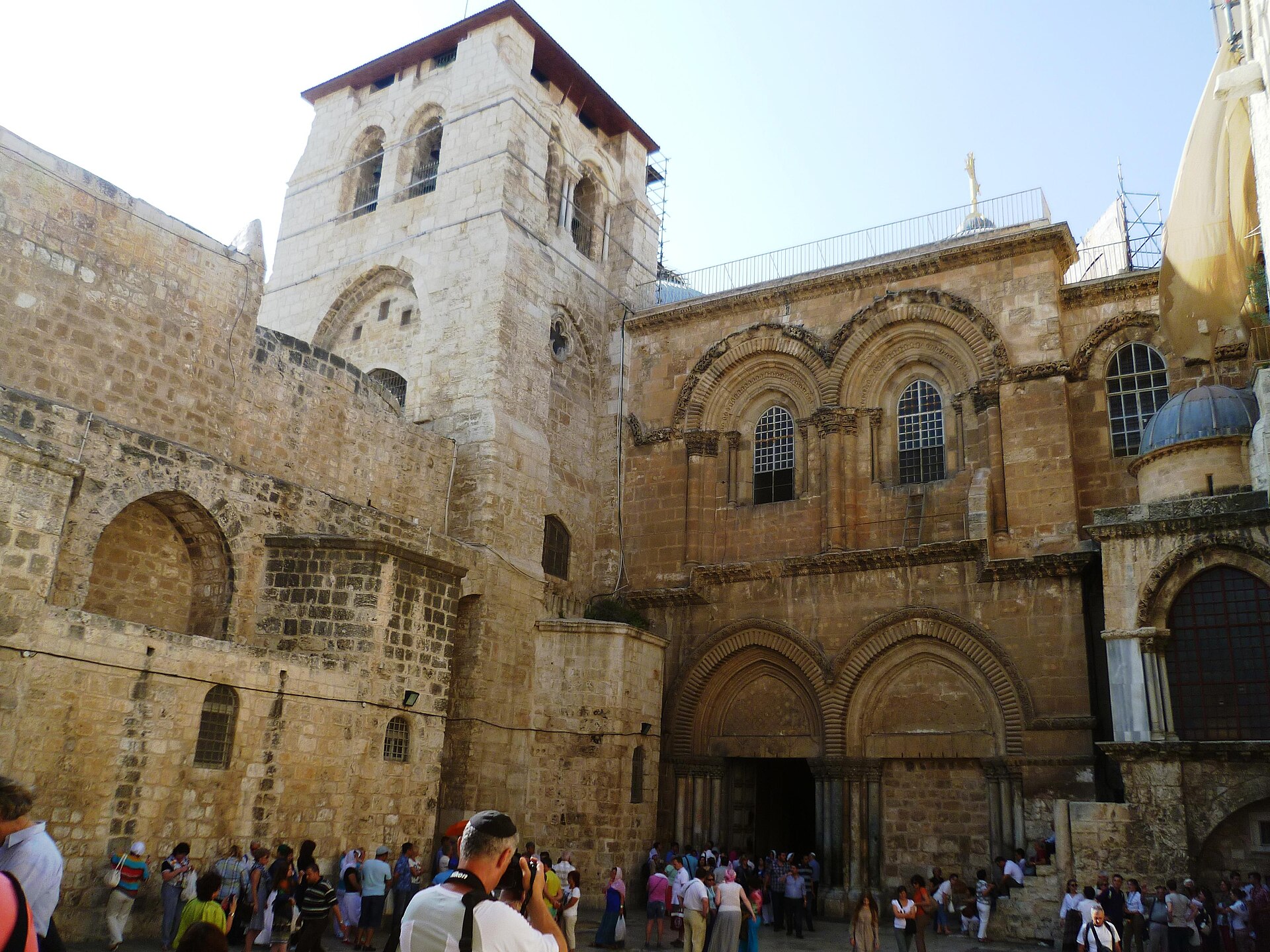
- In the parvis, the courtyard outside. Realistic if you are there by around 05:00. You will hear everything, the flame reaches you within minutes, and the atmosphere is arguably better than being wedged in a transept.
- In the surrounding lanes, at a screen. The likely outcome for most visitors. Still remarkable — the moment the fire arrives, the whole quarter erupts.
- Watching from a rooftop. Several Christian Quarter guesthouses and the Lutheran Church of the Redeemer tower offer views over the parvis. Arrange this weeks in advance, not on the day.
If any of that sounds like a disappointment, reconsider what you are travelling for. Nobody attends the Holy Fire in comfort. The Orthodox pilgrims who fly in from Greece and Georgia for it expect to stand all night in a crowd, and they come back every year.
How to Improve Your Chances
- Go through a church. If you belong to an Orthodox parish, ask. Diocesan pilgrimage groups are allocated places; individuals essentially are not. This is the single biggest lever you have.
- Stay inside the Old City walls. If you are on the wrong side of a cordon at 05:00, nothing else you do matters. A room in the Christian Quarter or near Jaffa Gate is worth paying over the odds for on this one night. See Old City hotels and the Christian guesthouses, several of which are yards from the church.
- Arrive absurdly early. Whatever time you have in mind, take two hours off it.
- Go alone or in a pair. Groups of four or more get split at checkpoints and then spend the day looking for each other.
- Buy your candles beforehand. The traditional bundle of thirty-three, one for each year of Christ’s life, is sold all over the Christian Quarter in the preceding days for a few shekels.
- Ask at the Greek Orthodox Patriarchate in the days beforehand. They will tell you what that year’s arrangements actually are, which no website will.
Getting There on the Morning
The logistics defeat more people than the cordons do. Work backwards from where you need to be at 05:00.
Which gate
The Holy Sepulchre sits in the Christian Quarter, closest to New Gate and Jaffa Gate. Both are the obvious approaches and both are therefore where the police concentrate. Damascus Gate puts you in the Muslim Quarter with a walk down Khan al-Zeit and Christian Quarter Road, which is longer but sometimes moves better. Which gates are open on the day is a police decision made overnight, so have two routes in mind. Our guide to the gates of the Old City explains where each one lands you.
Transport
The light rail runs to City Hall and Damascus Gate and is the sensible way in, but not at 04:00 — first services are considerably later. Realistically you are looking at a taxi, booked the night before, or a bed inside the walls. Roads around the Old City close progressively through the morning and taxis will not be able to get you close; expect to be dropped some distance out and to walk the last stretch. Fares and timetables are in our Jerusalem transport guide. Note that 1 May 2027 is a Saturday, so Shabbat rules apply: no light rail, no buses and no trains from Friday afternoon until after nightfall on the Saturday. That is a significant complication and it is the reason a room inside or beside the walls matters so much this particular year — see Shabbat in Jerusalem for what stops and when.
What to bring, and what to wear
- Your bundle of candles, bought earlier in the week from any shop on Christian Quarter Road.
- Modest dress — shoulders and knees covered, for men and women. You will be in a church for most of the day. Detail in our dress code guide.
- Natural fibres. Cotton, not synthetics, with thousands of open flames around you.
- Water and something to eat, in a small bag that will clear a checkpoint quickly.
- A warm layer. Early May mornings in Jerusalem are cool before the sun clears the walls, and stone churches hold the cold.
- Nothing valuable and nothing bulky. Pickpocketing is uncommon here but crushes are not, and a large pack makes you a hazard to yourself and everyone near you.
If you want photographs, think about them beforehand: the light inside the church is very low until the moment the fire spreads, and then it is chaos. Our photography guide covers the rooftops and vantage points around the Old City that are worth scouting in the days before.
Safety and Practicalities
This needs saying plainly, because the ceremony has a genuine history of crowd incidents, including a fatal crush in 1834 and repeated concerns since. Israeli police caps on numbers exist for that reason and are enforced firmly. Take them seriously rather than as an obstacle.
- Do not attempt this with small children, or with reduced mobility. Standing for nine hours in a dense crowd with open flame is not a family outing. Our accessibility guide covers the church on ordinary days, which is when to visit it if steps and crowds are an issue.
- Fire. Thousands of lit candles in a stone building with no ventilation. Hold yours upright and away from the person in front. Tie long hair back. Do not wear anything synthetic and flammable.
- No lavatories, no food, no leaving and returning. Eat before, drink moderately — this is a genuine trade-off — and accept it.
- Bag checks everywhere. Travel light. Large rucksacks will slow you down at every cordon.
- Phones lose signal in the crush. Agree a meeting point outside the walls before you separate.
- If you feel the crowd compressing, move sideways towards a wall or a pillar rather than trying to push forward or back.
Check your own government’s current travel advice before you go, and read our standing page on safety in Jerusalem. The city is heavily policed on this day and the ceremony itself passes without incident in most years, but the practical risk of crowd density is real and not worth being casual about.
If You Cannot Get In
Plan B is not a failure; for most visitors it is the plan. Options, roughly in order of quality:
- The screens in the Christian Quarter lanes. Free, open, and full of people who care intensely. The flame arrives within minutes of the fire appearing and everything around you catches light and noise at once.
- A Christian Quarter rooftop. Ask at your guesthouse well in advance. Several buildings around the Muristan have terraces with a sightline to the parvis.
- Wait at a gate. Runners carry the flame out through the Old City gates towards waiting cars and coaches. Standing at Jaffa Gate or New Gate as the flame comes through is its own kind of spectacle.
- Go to the Sunday liturgy instead. Pascha midnight on 1–2 May, and the Sunday of Love in the parvis on the afternoon of the 2nd, are both open, both beautiful and both far less contested.
- Come back on the Monday. The church on Bright Monday is calm, the decorations are still up, and you can actually see the building. Our pilgrimage guide covers what else to fit into the week.
Is It Worth Travelling For?
If you are Orthodox, the question does not arise and you already know the answer. If you are not, be clear-eyed. You are committing one full day to standing in a crowd, with perhaps a one-in-five chance of getting inside the building, in a city where hotel prices are at their spring peak. Against that: there is nothing else like it anywhere, the sound of several thousand people when the fire appears is not something you forget, and the whole thing has been happening on that spot, more or less continuously, since at least the ninth century.
The compromise most people should take: build a trip around the Orthodox Holy Week generally — Palm Sunday on the Mount of Olives, the Epitaphios on Good Friday, Pascha on the Sunday — and treat Holy Saturday as a bonus rather than the centrepiece. That way the week is extraordinary whether or not you get through the cordon. Our Holy Week guide lays the whole programme out, and where to stay in Jerusalem will help you get on the right side of the barriers.
Final Word on the Holy Fire
Come for the week, not the hour. That is the whole of the advice. The people who go home disappointed are the ones who flew in for a single Saturday, met a barrier at the end of a lane, and had nothing else planned; the people who go home changed by it are the ones who spent six days in Orthodox Holy Week, stood in the parvis at dawn with a bundle of candles, took whatever the day gave them, and stayed for Pascha. Book a bed inside the walls, buy your candles early in the week, ask at the Patriarchate what this year’s arrangements are, and then let go of the outcome. Our Easter and Holy Week guide covers the surrounding days, the Church of the Holy Sepulchre page explains the building you will be standing in, and the religious holidays calendar shows what the rest of the city is doing that week.
Photo Credits
Inside the tomb chamber of the Edicule: Jerusalem, Holy Sepulchre, cave of the sepulchre by שלמה רודד, CC BY 2.5, via Wikimedia Commons.
The parvis outside the Church of the Holy Sepulchre: Holy Sepulchre parvis — Facade of the Holy Sepulchre 2013 by Radosław Botev, CC BY 3.0 PL, via Wikimedia Commons.
The Holy Fire ceremony around the Aedicule in the Church of the Holy Sepulchre: Holy Fire in Jerusalem 2022 by Mar Sharb, CC BY 2.0, via Wikimedia Commons.
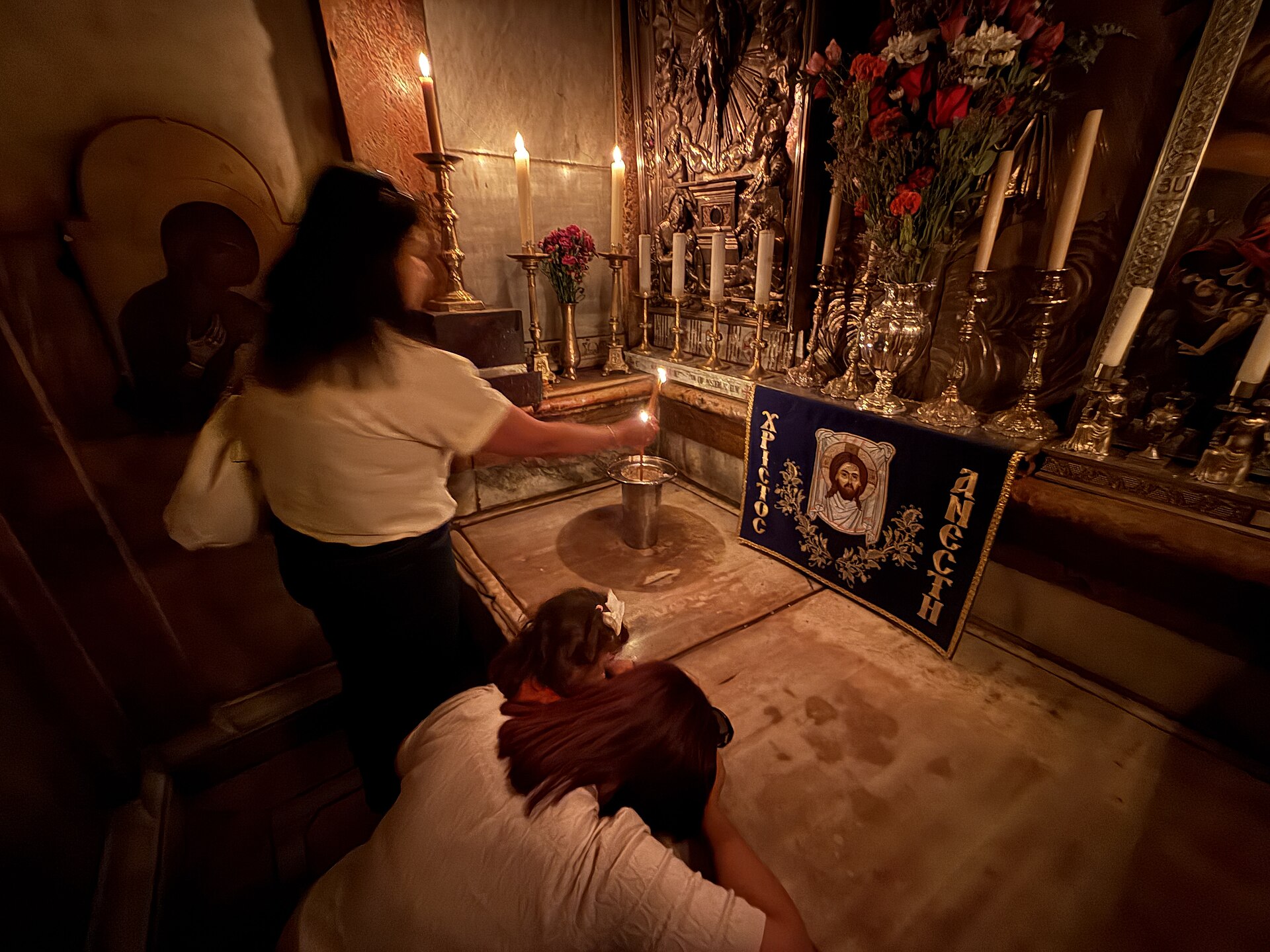
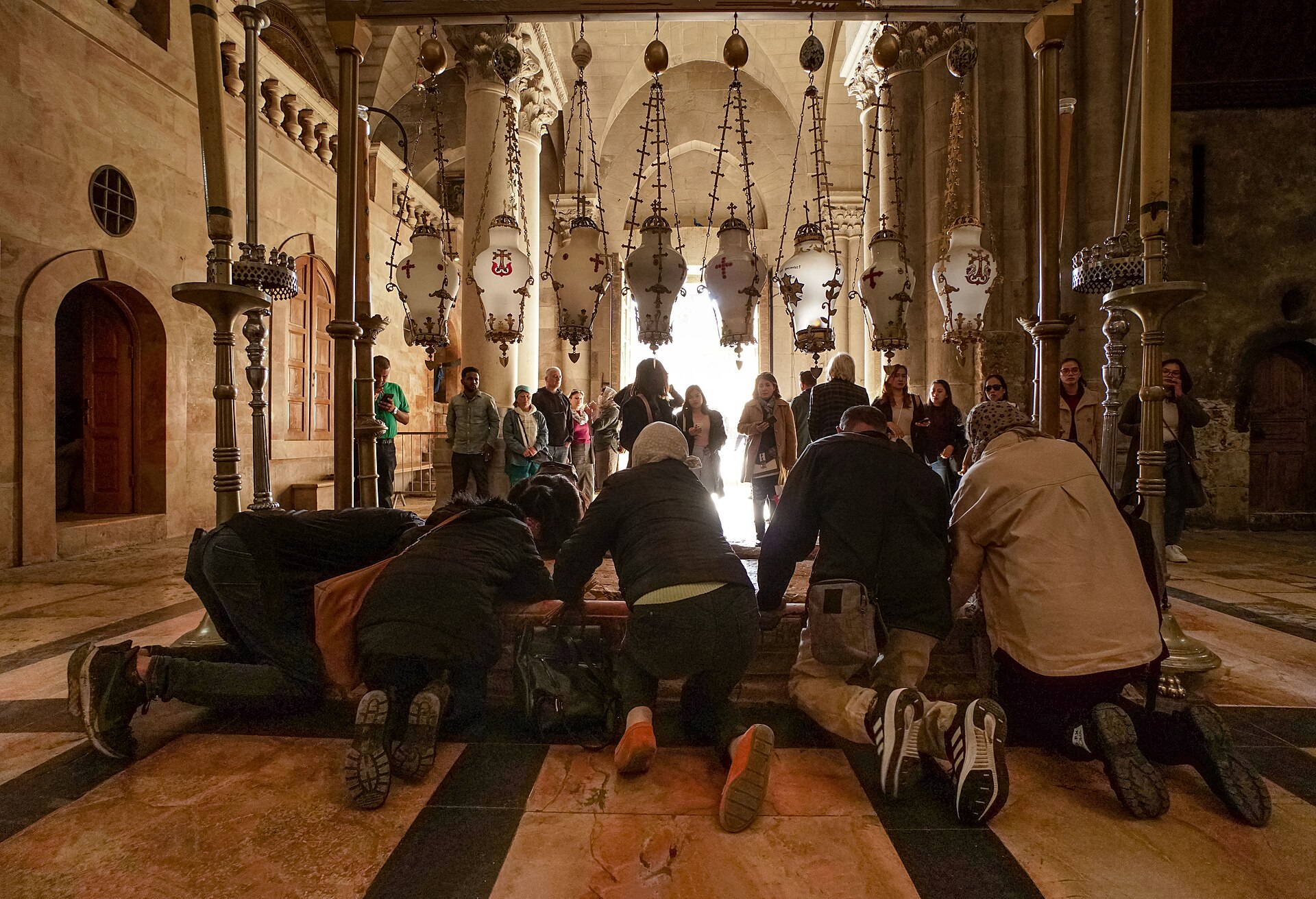
Pilgrims kneeling at the Stone of Anointing inside the Church of the Holy Sepulchre: The Stone of Anointing 1 by Eyal.benhaim, CC BY-SA 4.0, via Wikimedia Commons.