The Jerusalem dress code matters more than in almost any other city, because this is a place where three faiths run active, daily worship and where a bare shoulder can be the difference between walking into the Church of the Holy Sepulchre and being turned away at the door. The core rule is simple and consistent across the major holy sites: cover your shoulders and your knees. Beyond the sacred sites, everyday Jerusalem dresses more conservatively than beach-loving Tel Aviv, and the ultra-Orthodox neighborhoods are stricter still. Getting the dress code right is partly about respect for the people who live and pray here, and partly practical — it keeps every site on your itinerary open to you.
This guide to the Jerusalem dress code breaks down the rules site by site, then neighborhood by neighborhood, adds seasonal advice for dressing modestly in the summer heat, and finishes with a simple packing list and FAQs. Pair it with our what to pack for Jerusalem list and our Jerusalem travel tips.

The Dress Code in One Glance
If you remember nothing else, remember these points, which cover the great majority of situations you will face.
- Shoulders covered at all religious sites — no tank tops, vests, or spaghetti straps.
- Knees covered at all religious sites — no short shorts, mini skirts, or above-the-knee dresses.
- Women cover their hair at the Temple Mount / Al-Aqsa area and inside some churches; scarves are usually available to borrow.
- Men cover their heads at the Western Wall, where free paper kippot are provided.
- Shoes come off before entering mosque prayer halls.
- Everyday wear is smart-casual; save anything revealing for Tel Aviv, not religious Jerusalem.
The single most useful item you can carry is a large, light scarf or pashmina. It packs to nothing, drapes over shoulders or hair in a second at any site, and turns an otherwise too-casual outfit into an acceptable one on the spot.
Dress Code Site by Site
| Site | Women | Men |
|---|---|---|
| Western Wall plaza | Shoulders and knees covered; modest, loose clothing (trousers are fine) | Head covered (free kippot at entrance); shoulders and knees covered |
| Church of the Holy Sepulchre & churches | Shoulders and knees covered | Shoulders and knees covered; long trousers |
| Temple Mount / Al-Aqsa area | Hair, shoulders, arms and legs covered; long skirt or trousers, long sleeves preferred | Long trousers (no shorts); sleeved shirt |
| Mosque prayer halls (Muslims only) | Full modest cover; remove shoes | Long trousers; remove shoes |
| Mea Shearim & ultra-Orthodox areas | Below-knee skirt, covered shoulders, long sleeves ideal | Long trousers, modest shirt |
At the Western Wall
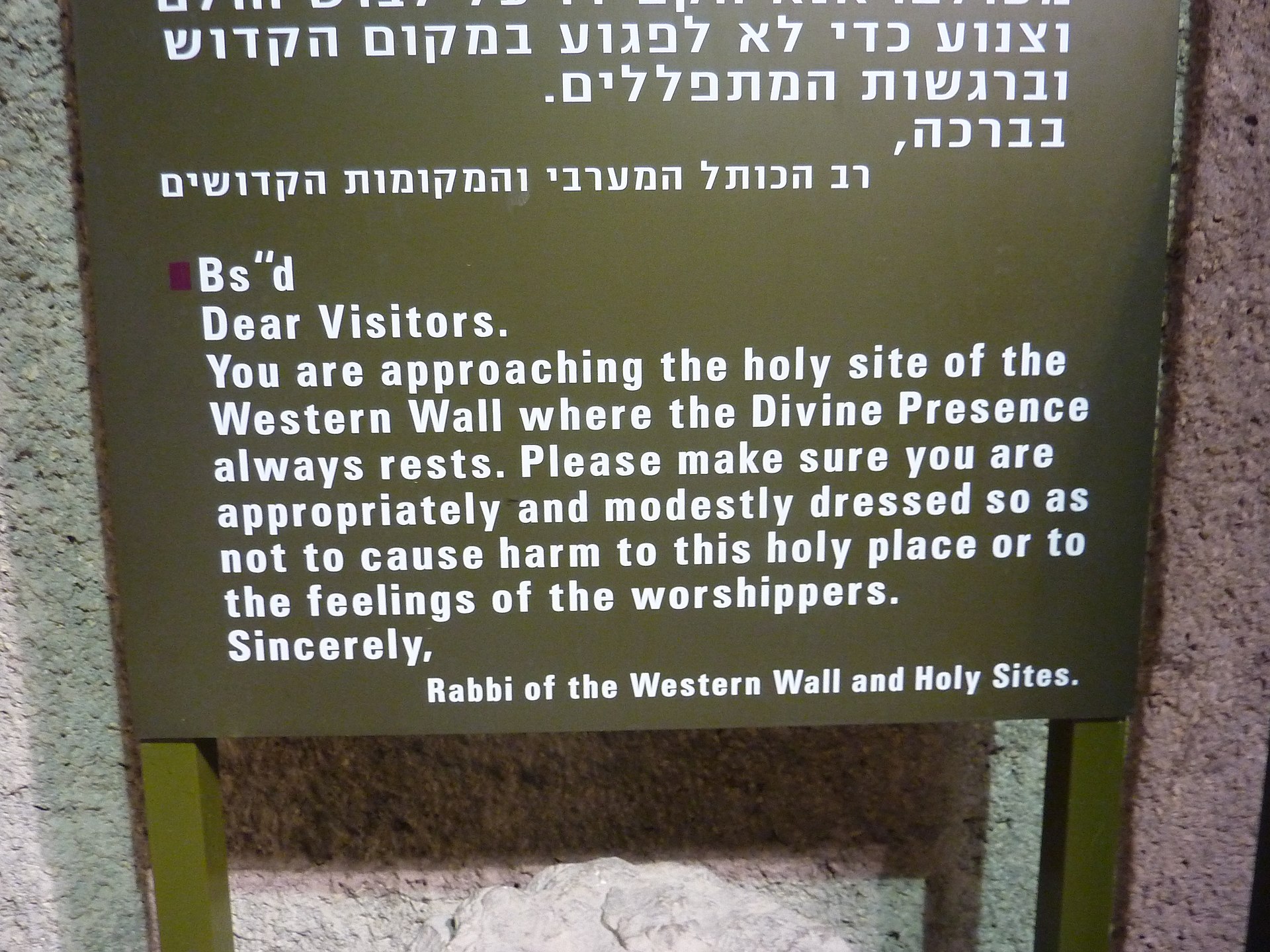
The Western Wall plaza is open and free 24 hours a day, reached through a security check. Men must cover their heads to approach the Wall itself; if you do not have a hat or kippah, free disposable paper ones sit in a basket at the entrance to the prayer area. Women should have shoulders and knees covered — trousers are perfectly acceptable, despite a common misconception, as long as the overall look is modest and not tight or revealing. Avoid backless tops and bare midriffs. The same standards apply on the Western Wall Tunnels tour beneath the plaza. Even in high summer, tuck a scarf or light layer in your bag for the moment you arrive.
At Churches and the Holy Sepulchre
Christian sites, above all the Church of the Holy Sepulchre, expect covered shoulders and knees for everyone, so long trousers or a skirt at or below the knee, paired with a sleeved top. These are active churches with services running throughout the day, so move quietly, avoid flash where signs request it, and step aside for processions and worshippers. Some chapels within the Holy Sepulchre, run by different denominations such as the Armenian and Coptic churches, may apply their own stricter expectations. Many smaller churches keep a basket of wraps at the entrance for anyone caught out.
At the Temple Mount and Al-Aqsa
The Temple Mount / Haram al-Sharif compound has the strictest dress expectations and the most limited access. Non-Muslims may visit the open plaza only during restricted hours, enter through a designated gate after security screening, and cannot enter the Dome of the Rock or the Al-Aqsa Mosque interior at all. Even to walk the plaza, modest dress is enforced: women should cover hair, shoulders, arms, and legs, with a long skirt or trousers and ideally long sleeves; men need long trousers and a sleeved shirt, no shorts. Coverings are sometimes lent at the entrance, but it is far better to arrive already dressed appropriately, as standards here are applied firmly. Always check the current visiting hours, which are limited and can change, especially around Friday prayers and Muslim holidays.

Dress Code by Neighborhood
Away from the holy sites, expectations shift by area. Jerusalem is more conservative than the coast everywhere, but how much depends on where you are.
Mea Shearim and ultra-Orthodox neighborhoods
These are the strictest places in the city, and signs at the entrances explicitly request modest dress from visitors. Women should wear a skirt below the knee with covered shoulders and, ideally, long sleeves; men should wear long trousers and a modest shirt. Skip shorts, tank tops, tight clothing, and loud, attention-grabbing outfits. Crucially, do not come to wander or photograph on Shabbat (Friday evening to Saturday night), when these streets close to traffic and an observant atmosphere prevails — a casual sightseeing visit then is genuinely unwelcome.
The Old City quarters
Throughout the Old City, modest dress is the sensible default, since you are constantly near religious sites and worshippers. Covered shoulders and trousers or knee-length clothing keep you comfortable everywhere and ready to step into any site. The Muslim Quarter in particular is conservative, so avoid skimpy clothing there.
West Jerusalem (the modern city)
The modern center is relaxed and smart-casual. Jeans, t-shirts, and knee-length skirts are all fine around Mamilla, Ben Yehuda Street, and the German Colony, and restaurants range from casual to dressy. The one thing that still looks out of place is full beachwear for sightseeing or shopping — keep that for the actual beach.
East Jerusalem
The Arab neighborhoods of East Jerusalem are socially conservative, so more modest clothing is appreciated, particularly for women — long trousers or a long skirt and a top that covers the shoulders. Men are better in long trousers than shorts. The same modest, covered approach serves you well on West Bank day trips such as Bethlehem.
Dressing Modestly Through the Seasons
The trick to the Jerusalem dress code is staying covered without overheating in summer or freezing in winter. The climate makes this a real consideration; see our month-by-month climate guide for the full picture.
Summer (roughly June to September) is hot and dry, so choose lightweight, breathable fabrics in light colors. Loose long trousers are surprisingly cool and keep the sun off, and maxi skirts or dresses work well too. A wide-brimmed hat helps with the sun, and that ever-present scarf handles shoulder or hair coverage at sites. Winter (roughly December to February) is cool and the rainy season, calling for warm layers — a sweater, a light jacket, and a waterproof shell — over long trousers or thick tights under skirts, with closed shoes that grip wet stone. Spring and autumn are about layering for warm days and cool evenings: a light cardigan or jacket you can add at sundown, over the same modest basics, with comfortable walking shoes throughout.
A Simple Packing List
You do not need a special wardrobe — just a few versatile pieces that work everywhere.
- For women: two or three pairs of long trousers or knee-length-plus skirts, sleeved tops and modest blouses, one modest dress, a light scarf or pashmina (the key item), comfortable closed walking shoes, and one smarter outfit for dinner.
- For men: long trousers (essential for religious sites; pack more than shorts), sleeved t-shirts and a couple of light button-up shirts, comfortable walking shoes, and one smarter outfit.
- Leave at home or save for the beach: short shorts, tank tops and sleeveless shirts, mini skirts, see-through fabrics, and beachwear for the city.
Jeans deserve a special mention: they are universally acceptable and meet the modesty requirement at every religious site, so a comfortable pair is one of the most useful things to bring.
Why It Matters
It is worth understanding the why, not just the what. Jerusalem’s holy sites are not museums; they belong to living religious communities for whom modesty is part of devotion, and dressing accordingly is a basic courtesy to the people praying around you. There is a practical side too: dress inappropriately and you will simply be refused entry, which can derail a carefully planned day. And there is a comfort dividend — loose, covering clothes shield you from the fierce summer sun outdoors and the surprising chill of thick-walled stone interiors, while helping you blend in rather than stand out. Respect, access, and comfort all point the same way.
The Bottom Line
The Jerusalem dress code asks you to balance comfort with respect, and a handful of versatile pieces do the job: long trousers, a knee-length-or-longer skirt or two, sleeved tops, comfortable shoes, and above all a light scarf for instant coverage. Dress that way and you can walk into every holy site, move easily between the Old City and the modern center, and show the consideration this city’s communities deserve. Plan the rest with our what to pack for Jerusalem list, our Jerusalem travel tips, and our holy sites in Jerusalem guide.
Photo Credits
The modest-dress sign at the entrance to the Western Wall: Entrance to the Western Wall site. – panoramio by panoman, CC BY 3.0, via Wikimedia Commons.