Look at people’s feet at the Western Wall on the night of the ninth of Av. Crocs, canvas trainers, rubber sandals, hotel slippers, a few men in socks: nobody is wearing leather, because leather shoes count as a comfort, and comfort is one of the things given up for twenty-five hours. Then look down, because most people are not standing either. The whole plaza sits on the stone, on folded jackets or low stools, reading from small booklets by phone light. Tisha B’Av in Jerusalem is the day the city mourns its own destruction, in the one place where that destruction still has a street address.
This guide explains what Tisha B’Av commemorates, what happens at the Western Wall and around the Old City on the eve and on the day, what closes and what does not, how to eat, how a visitor should behave, and whether it is worth planning an evening around. It also covers the three weeks of semi-mourning that lead up to it, which quietly affect restaurants, music and weddings for anyone travelling in July or August. Details were checked in September 2026. Opening hours on the day vary, so confirm locally.
Tisha B’Av at a Glance
| What | Detail |
|---|---|
| Name | Tisha B’Av, “the ninth of Av” |
| 2027 date | Sunset Wednesday 11 August to nightfall Thursday 12 August |
| What it marks | The destruction of the First Temple (586 BCE) and Second Temple (70 CE), plus later calamities in Jewish history |
| Type of day | A 25-hour fast day of mourning. Not a public holiday: buses, offices and most shops run by day |
| Busiest moment | The eve, from about an hour after sunset, when Lamentations is read at the Western Wall |
| What closes | Restaurants, cafés, bars, cinemas and entertainment venues from sunset on the eve; many kosher restaurants until the fast ends |
| Dress | Modest; covered shoulders and knees at the Wall, head covering for men |
| Worth going? | The eve at the Wall, yes, for an hour. The day itself has little to see |
What Tisha B’Av Commemorates
According to Jewish tradition, both Temples on Mount Moriah were destroyed on the same date in the calendar: the first by the Babylonians under Nebuchadnezzar in 586 BCE, the second by the Roman legions of Titus in 70 CE, six centuries later. The Mishnah adds more disasters to the same day, among them the fall of Betar at the end of the Bar Kokhba revolt in 135 CE, and later generations attached further catastrophes to it, including the expulsion of the Jews from Spain in 1492. It has become the day on which Jewish communities mourn, collectively, for everything lost.
Nowhere else does this have the same physical weight. The Western Wall is a retaining wall of the platform Herod built around the Second Temple; the platform above it is the Haram al-Sharif / Temple Mount, today the site of the Al-Aqsa Mosque and the Dome of the Rock. You can walk from a place of mourning for the Temple to the rubble the Romans left in 70 CE in a quarter of an hour. Our history of Jerusalem sets out the longer story.
The Fast
Tisha B’Av is one of only two full 25-hour fasts in the Jewish year, the other being Yom Kippur. Observant Jews refrain from eating and drinking, washing for pleasure, wearing leather shoes, using creams and perfumes, and marital relations. Until midday on the day, people sit on the floor or on low stools, as mourners do during shiva. Torah study is restricted to sad texts. People avoid greeting each other in the usual way. Nobody expects any of this from a visitor, but it explains everything you will see.
The Three Weeks and the Nine Days
Tisha B’Av is the end of a mourning period rather than a single day. It begins with the minor daylight fast of 17 Tammuz, which marks the breach of Jerusalem’s walls by the Romans, and grows stricter as it goes on. If you are in Jerusalem in late July or early August, this affects more than you might expect.
| Period | 2027 dates | What changes for visitors |
|---|---|---|
| Fast of 17 Tammuz | Thursday 22 July, dawn to nightfall | Very little. Some kosher cafés are quieter |
| The Three Weeks | 22 July – 12 August | No Jewish weddings; many observant Jews avoid live music, so fewer concerts in religious venues |
| The Nine Days | From 1 Av, Wednesday 4 August | Many Ashkenazi Jews avoid meat and wine. Some kosher meat restaurants switch to dairy and fish menus or close. Swimming and new clothes are avoided by the observant |
| Eve of Tisha B’Av | Wednesday 11 August, from sunset | Restaurants, bars and entertainment close. Huge crowds at the Wall |
| Tisha B’Av | Thursday 12 August, until nightfall | A working day, subdued. Many kosher eateries closed until evening |
The Nine Days catch a lot of visitors out at dinner: you book a kosher grill for its steak and are handed a menu of fish and pasta. It is worth checking with any kosher restaurant before you go, and non-kosher restaurants in the city are unaffected. The same few weeks happen to be the height of the summer festival season, and Hutzot Hayotzer, the arts and crafts fair at the Sultan’s Pool, usually runs in the first half of August, so check the dates if you want both.
The Eve: Lamentations at the Western Wall
This is the part of Tisha B’Av worth seeing, and there is nothing else quite like it in Jerusalem.
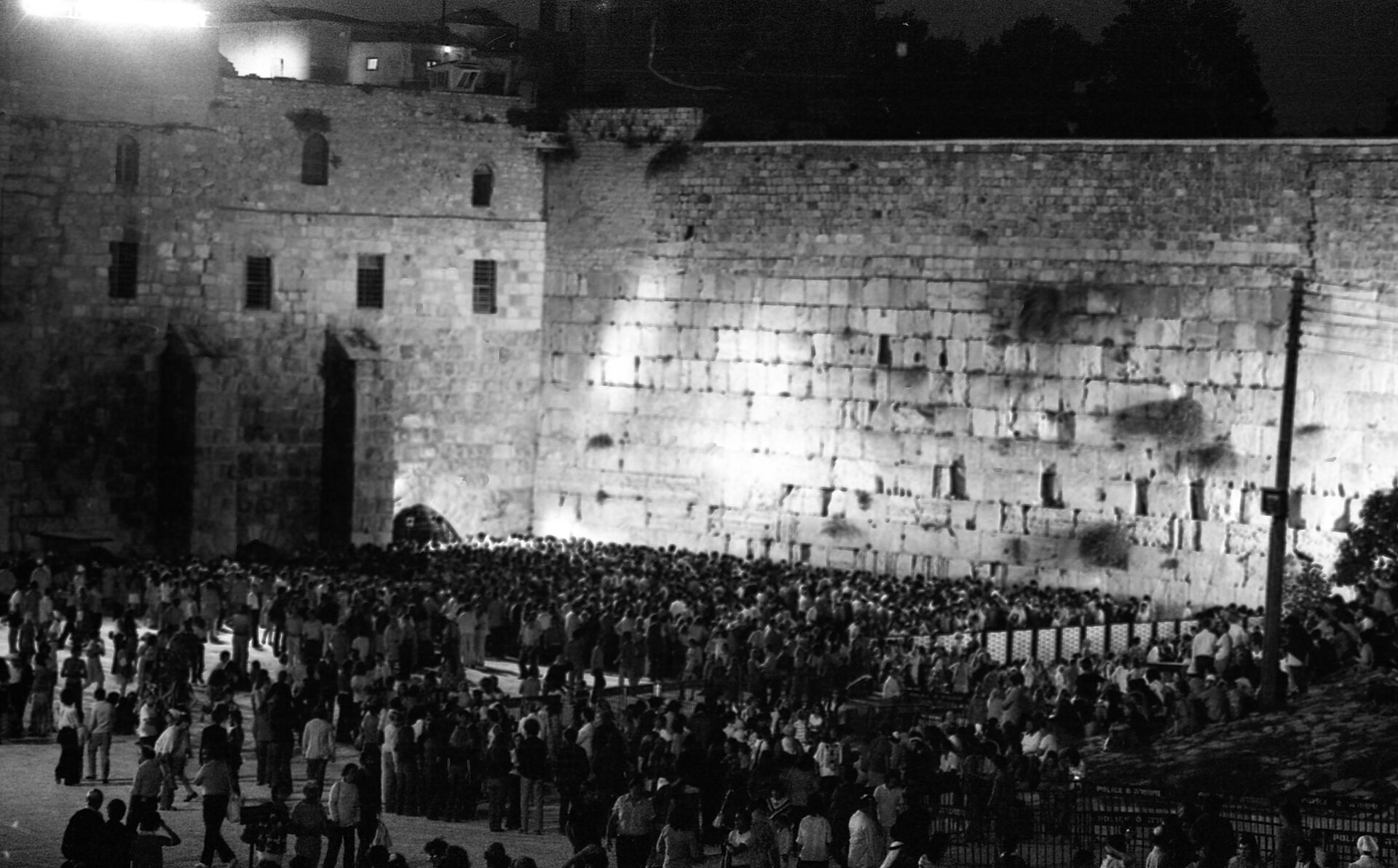
Observant families eat a last full meal, the seudah mafseket, in the late afternoon, finishing before sunset, which in mid-August falls a little after 19:10. Then the city goes quiet and people start walking towards the Old City. From about 20:00 onwards, the Western Wall plaza fills with evening prayers followed by the public reading of Eicha, the Book of Lamentations, chanted in its distinctive mournful melody. It is not a single service. Dozens of groups form, each with its own reader, sitting in circles on the stone, and their chanting overlaps across the plaza.
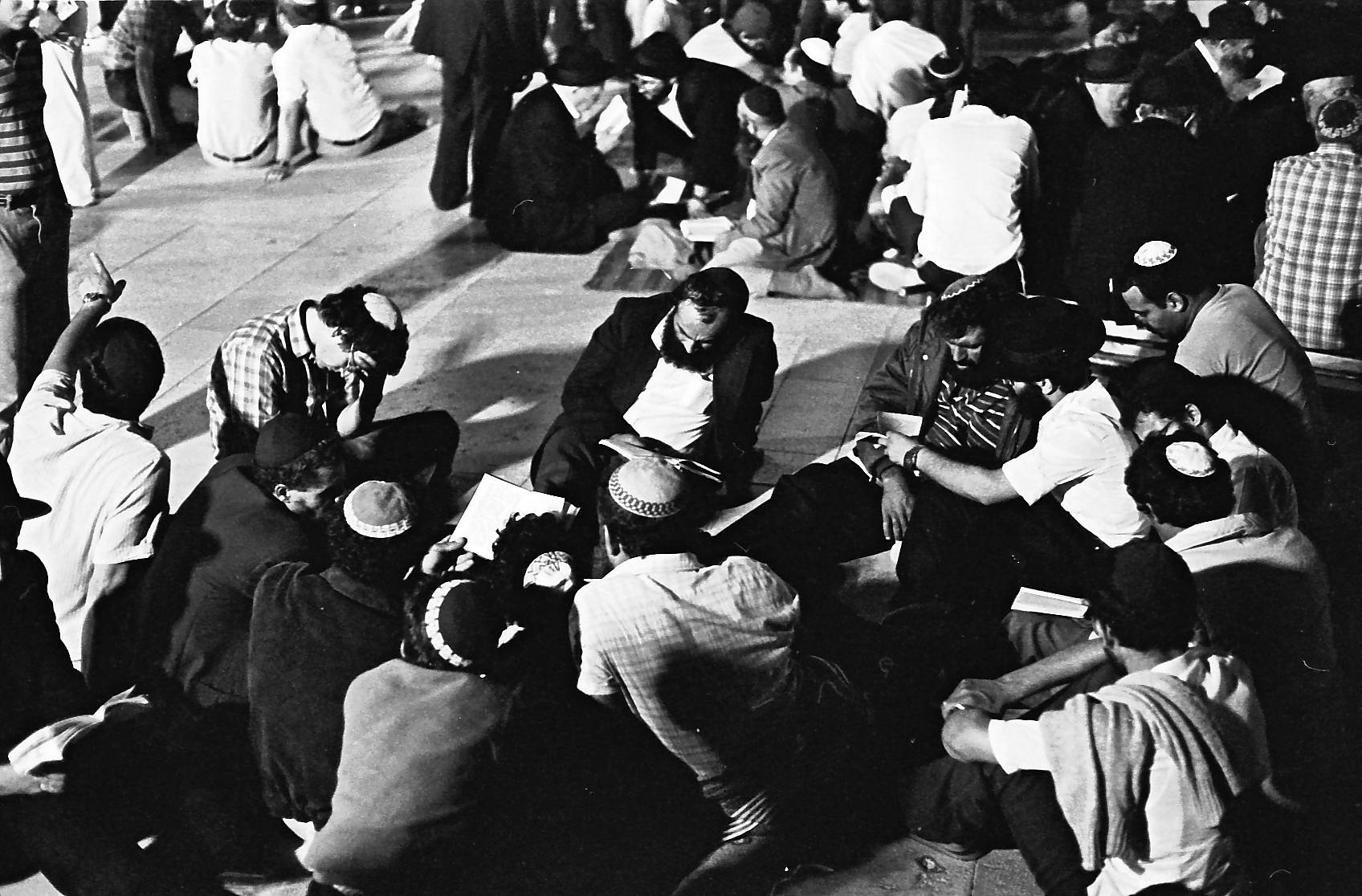
Crowds run to tens of thousands over the evening, and the plaza stays busy well past midnight as new groups arrive after readings in neighbourhood synagogues. Some people stay all night. You will see every part of Jewish Jerusalem in the one place: Hasidic men in fur-trimmed hats, religious Zionist teenagers in sandals, secular Israelis who never set foot in a synagogue the rest of the year, and families with small children asleep on a blanket.
How to Visit the Wall on the Eve
- Go between 20:30 and 22:00. Early enough to catch many readings, late enough that the first rush has settled. After midnight it is quieter and, for some people, more affecting.
- Enter from the Jewish Quarter via the steps down from the Jewish Quarter, or through the Dung Gate. Expect security screening and queues at every entrance.
- Dress properly. Covered shoulders and knees for everyone, a head covering for men (paper kippot are handed out at the entrance). See our Jerusalem dress code guide.
- Wear non-leather shoes if you have them. It is not required of visitors, but it is a quiet courtesy, and it means you blend in rather than stand out.
- Stay at the back or the edges. Do not walk through reading circles or stand over people sitting on the ground.
- Do not photograph people at close range. Photography of the general scene from the back of the plaza is tolerated on a weekday evening, but this is a night of mourning; flash photography of someone crying into a prayer book is not.
- Eat and drink out of sight. Carry water, because August nights are still warm, but drink discreetly.
- Do not wish anyone a happy anything. If someone greets you, a nod is fine.
Other Readings Around the City
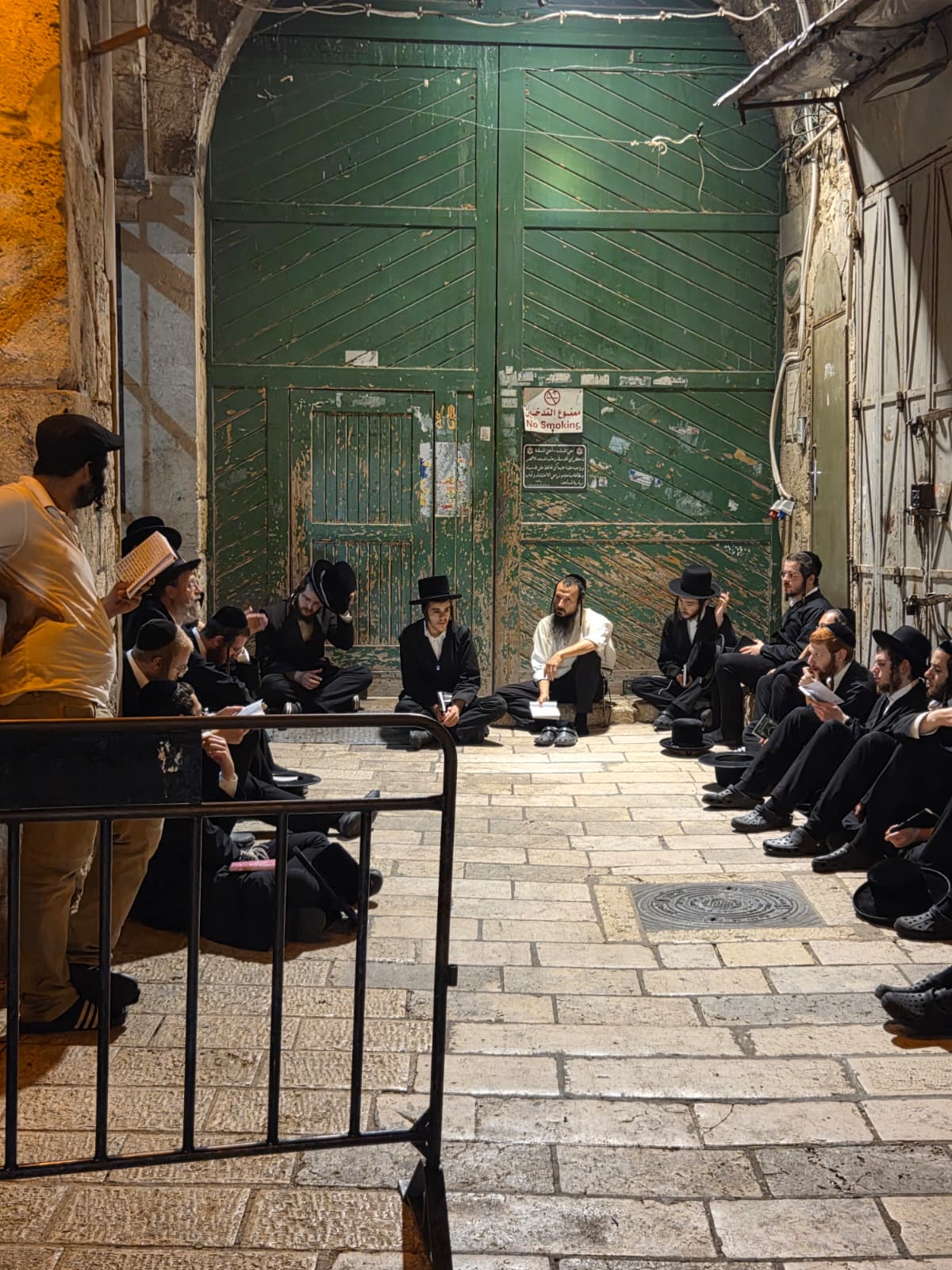
The Wall is not the only place. Synagogues all over the Old City and West Jerusalem hold readings, and Hebrew-speaking cultural centres run evenings of study and discussion, often on the rabbinic teaching that the Second Temple fell because of sinat chinam, baseless hatred between Jews. Non-Orthodox communities hold their own services, and in some years readings have been held at the egalitarian prayer area by Robinson’s Arch; the Masorti and Reform movements in Israel publish details in the weeks before. Readings are also traditionally held at several of the gates around the Haram al-Sharif / Temple Mount inside the Muslim Quarter, like the one in the photograph at the top of this page, usually with police present.
The Walk Around the Walls
Late on the eve, a large organised walk circles the outside of the Old City walls, a custom recalling the circuits once made around the ruined city. It has been organised for many years by the nationalist women’s movement Women in Green, and draws thousands; the route passes along the northern and eastern walls, where it goes by Palestinian neighbourhoods, and it is escorted by police. It is a political as well as a religious event, and it is not the place for a casual evening stroll. If you want to walk the walls, the Ramparts Walk on another day is the calmer way to do it.
The Temple Mount / Haram al-Sharif on Tisha B’Av
The compound above the Western Wall is administered by the Jordanian-funded Islamic Waqf under the Status Quo arrangement, under which Muslims pray there and non-Muslims may visit at set hours but may not pray. Israel states that it upholds this arrangement. Palestinian and Jordanian officials have repeatedly accused Israel of eroding it, and a number of Israeli groups campaign for Jewish prayer on the site.
Tisha B’Av morning is among the busiest of the year for Jewish visitors to the compound, and it attracts corresponding attention. In August 2025 Israel’s national security minister, Itamar Ben-Gvir, was filmed praying there on Tisha B’Av; the governments of Jordan and Saudi Arabia and the Palestinian Authority, among others, condemned the visit, and the Israeli prime minister’s office said Israel’s policy on the site had not changed. Police presence on the morning is heavy and access can be restricted at short notice. If you want a calm first visit, choose a different day. Our guides to Al-Aqsa Mosque and the Dome of the Rock explain the normal visiting arrangements.
The Day Itself
After the drama of the eve, the day is subdued and, frankly, unremarkable for a visitor. In the morning, kinot, long mourning poems, are recited in synagogues and at the Western Wall until around midday. Men do not put on tefillin in the morning, as a sign of mourning. After midday, people get up from the floor and sit on chairs, and in the afternoon the mood lifts slightly: mourning traditions hold that the Messiah will be born on Tisha B’Av, so the day ends on a note of hope. The fast ends at nightfall, around 19:45 in mid-August, and restaurants and cafés open soon after to a rush of hungry people.
What Is Open and What Is Not
| Service | Eve (from sunset) | The day |
|---|---|---|
| Buses, light rail, trains | Normal | Normal |
| Restaurants, cafés and bars (West Jerusalem) | Closed by law | Secular places mostly open; many kosher places closed until nightfall |
| Restaurants in East Jerusalem and the Muslim and Christian Quarters | Many trade as usual | Normal |
| Hotel restaurants | Serve guests; confirm with your hotel | Open |
| Cinemas, theatres, clubs | Closed by law | Largely quiet |
| Shops, supermarkets, banks | Close as usual in the evening | Open, some observant-owned shops closed |
| Museums and attractions | Closed | Most open; check before you go |
| Western Wall | Open all night, very crowded | Open, busy until midday |
Israeli law, passed in 1997 and extended in 2002 to cover restaurants explicitly, prohibits restaurants and entertainment venues from opening on the eve of Tisha B’Av, with enforcement through local authorities. In Jerusalem the closure on the eve is close to total in the western city; in Tel Aviv, by contrast, some restaurants open anyway every year. The simple rule is to eat your dinner before sunset on the eve, or plan to eat at your hotel.
The day itself barely affects public transport, which is unlike Yom Kippur. Our Yom Kippur in Jerusalem guide explains the difference: that is a total shutdown, including the airport, while Tisha B’Av is a fast that the rest of the city lives around. The Mahane Yehuda market trades, though more quietly than usual, and its evening bar scene is shut on the eve.
A Tisha B’Av History Trail
If you want the day to mean more than a crowd at night, spend the morning in the places where the destruction of 70 CE is still physically visible. It is a walk of about two hours, and you should confirm hours before you set out, as some sites open later or close earlier on fast days.
- The Roman street under Robinson’s Arch. In the Jerusalem Archaeological Park (Davidson Center), south of the Western Wall plaza, the Herodian paved street is still heaped with massive stones thrown down from the Temple Mount by Roman soldiers in 70 CE, exactly where they fell.
- The Burnt House in the Jewish Quarter, the basement of a priestly family’s home destroyed by fire in the same year, excavated with ash, broken pots and a spear still in place.
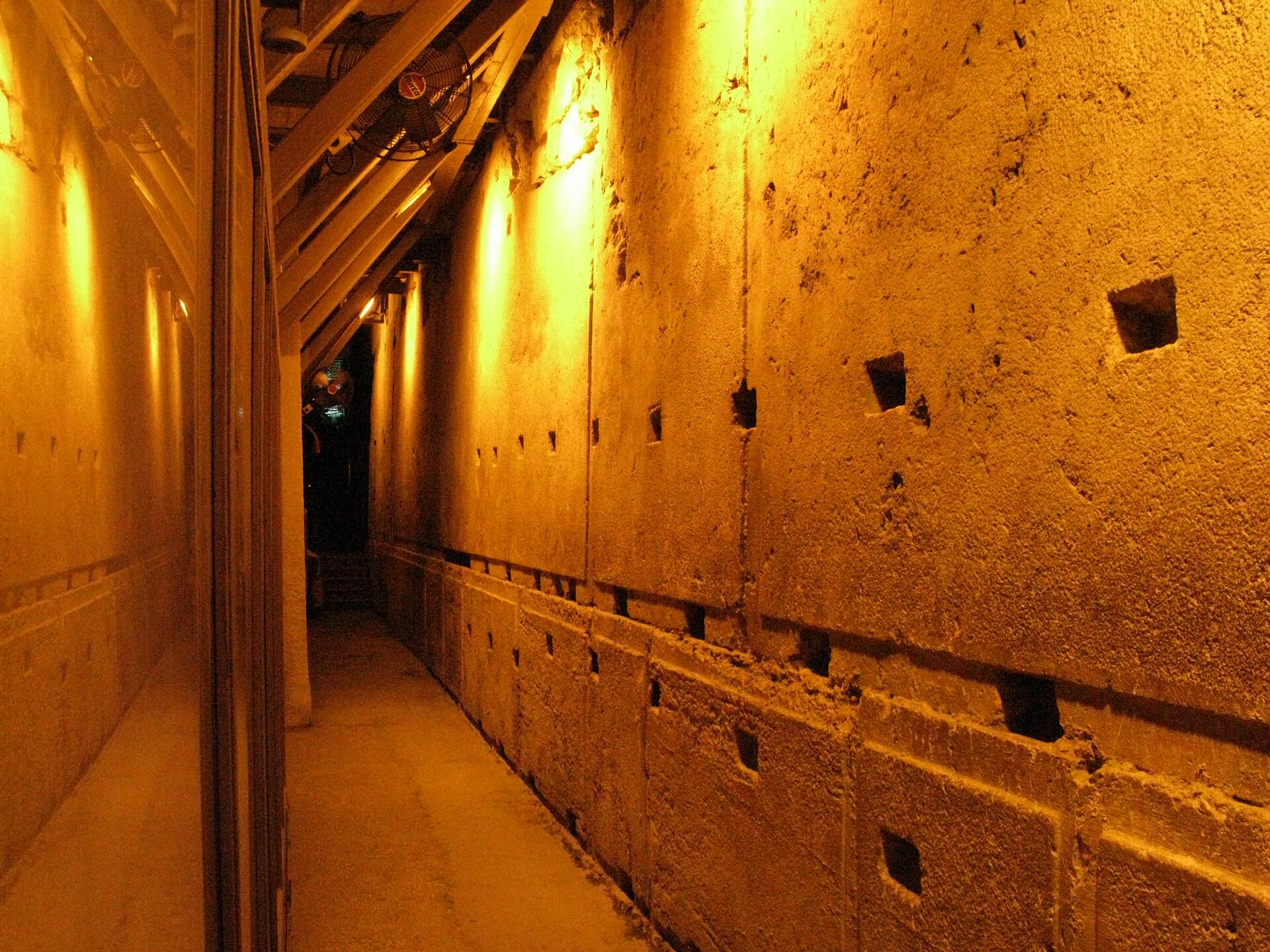
- The Western Wall Tunnels, which follow the Herodian wall northwards underground. See our Western Wall Tunnels guide, and book ahead; confirm tours are running on the day.
- The City of David, for the layer beneath: evidence of the Babylonian destruction of 586 BCE, including burnt debris and arrowheads found in the excavations.
End at the Tower of David, whose museum tells the whole story of the city’s sieges in order. Our guide to Jewish holy sites in Jerusalem covers the rest.
Is Tisha B’Av a Good Time to Visit Jerusalem?
It is neither a reason to come nor a reason to avoid. Mid-August is hot, often 30°C or more by day (see Jerusalem weather by month), and Israeli school holidays mean busy attractions and high domestic demand. The mourning period itself costs you some meat dinners and a bit of nightlife, and one evening without restaurants. Against that, the eve at the Wall is one of the most striking things you can witness in Jerusalem, and it is free. If your dates already overlap, build the evening in. If you are choosing dates from scratch, our guide to the best time to visit Jerusalem will point you at spring or autumn instead.
Six days after the fast comes Tu B’Av, the 15th of Av, an ancient festival of love revived in modern Israel as something like a Hebrew Valentine’s Day, with a spike in weddings and romantic evenings out. The mood change inside a single week is part of what makes the Jewish calendar so interesting to travel through.
Final Word on Tisha B’Av in Jerusalem
Most of the Jewish calendar invites visitors to join a celebration. Tisha B’Av does not, and that is exactly why the eve at the Wall is so memorable: you are allowed to witness a people grieving at the site of what it lost, in the open, with nothing staged for you. Eat early, dress properly, find a spot at the back of the plaza and listen for an hour. Then read about the rest of the religious calendar, the full story of the Western Wall, and Shabbat in Jerusalem for the city’s weekly rhythm of rest.
Photo Credits
Reading Lamentations outside Sha’ar HaMashgiach on Tisha B’Av: קריאת איכה בשער המשגיח by גיברס, CC BY-SA 4.0, via Wikimedia Commons.
A reading circle at the Western Wall on Tisha B’Av, late 1970s: PikiWiki Israel 3428 9 av kotel by SAIMI, CC BY 2.5, via Wikimedia Commons.
The Western Wall plaza on Tisha B’Av night, 1973: Tisha B’Av at the Western Wall (FL61957433) by IPPA photographer, CC BY 4.0, via Wikimedia Commons.
Herodian ashlars along a passage in the Western Wall Tunnels: Western Wall Tunnel 9555 by Lodo27 from Moscow, Russia, CC BY-SA 3.0, via Wikimedia Commons.