A Bethlehem day trip from Jerusalem takes you to the traditional birthplace of Jesus, just about 10 kilometres south of the city but across into the West Bank, in an area administered by the Palestinian Authority. The journey is short and, for foreign visitors, the crossing is usually quick. The Church of the Nativity is one of the oldest continuously used churches in the world, and half a day is enough to see the main sites, while a full day leaves room for Shepherds’ Field, the Milk Grotto, and the murals along the separation barrier.
This guide to a Bethlehem day trip from Jerusalem covers how to get there, the crossing and passport rules in plain, practical terms, the Church of the Nativity, Manger Square, Shepherds’ Field and other sites, opening hours, what to wear and bring, and a sample half-day plan. Pair it with our Day Trips from Jerusalem guide and our Christian pilgrimage to Jerusalem guide.

Bethlehem Day Trip at a Glance
| Distance from Jerusalem | About 10 km south |
| Travel time | 30–45 minutes, depending on the crossing |
| Half-day visit | Around 4–5 hours total |
| Full-day option | 7–8 hours with Shepherds’ Field and lunch |
| Guided tour | Roughly 180–360 ILS per person for a half-day |
| Church of the Nativity | Free entry; modest dress required |
Crossing into Bethlehem: Passport and Practicalities
Bethlehem lies within Area A of the West Bank, under Palestinian Authority administration. The same arrangements cover the other Area A towns, including Jericho down in the Jordan Valley, if you plan more than one West Bank day. For tourists the main crossing point is Checkpoint 300, near Rachel’s Tomb. The process is routine, but a few facts are worth knowing in advance so there are no surprises.
- Carry your passport. Foreign visitors need it to cross, even though most nationalities do not require any separate visa for a day visit.
- Entering Bethlehem is generally quick. On the way in there is often little or no check; the more thorough screening usually happens on the way back into Jerusalem.
- Israeli citizens are not permitted by Israeli law to enter Area A, which includes Bethlehem. Foreign passport holders and Palestinian residents can enter freely.
- Israeli rental cars cannot be driven into Bethlehem. Insurance does not cover Area A, which is why most independent visitors arrive by bus, by Palestinian taxi, or on a tour.
- Returning to Jerusalem involves an Israeli security check, where you may be asked to show your passport. At quiet times this takes a few minutes; at busy periods it can take longer.
Conditions at crossings can change, so it is sensible to check current travel advice from your government before you go and to allow extra time on the return. For more general guidance on the practical side of visiting the region, see our Jerusalem travel tips.
How to Get to Bethlehem from Jerusalem
Guided Tour
A guided tour is the easiest way to visit, particularly on a first trip. It removes any uncertainty about the crossing and transport, and a good guide adds religious and historical context as well as a local perspective. Half-day tours typically cost in the region of 180–360 ILS per person and usually include the Church of the Nativity, often with Shepherds’ Field and sometimes lunch. Operators range from Jerusalem-based companies such as Tourist Israel and Abraham Tours to Bethlehem-based Palestinian guides, the latter often offering a more in-depth look at the town itself.
Taxi to the Crossing, then a Local Taxi
A common independent approach is to take an Israeli taxi from Jerusalem to Checkpoint 300, walk through the crossing, and pick up a Palestinian taxi on the other side to Manger Square, reversing the process on the way back. The Israeli leg costs roughly 50–80 ILS and the Palestinian leg somewhat less; agree the fare before you set off. This gives you flexibility without the cost of a full tour.
Public Bus
The cheapest and most local option is the Arab bus from the station near Damascus Gate in East Jerusalem. Lines 231 and 234 run to Bethlehem for only a few shekels and take around 40 minutes, dropping you a short walk or quick taxi from the centre. The bus uses a different crossing on the way and is a straightforward, everyday way for locals and budget travellers to make the trip. As with everything here, the return check is usually the slower part of the day.

The Church of the Nativity
The Church of the Nativity stands over the cave that Christian tradition identifies as the birthplace of Jesus. First built under Constantine and dedicated around 339 CE, then substantially rebuilt by the Emperor Justinian in the sixth century, it is among the oldest churches still in continuous use anywhere. A major restoration completed in recent years cleaned and revealed long-hidden Crusader-era wall mosaics, and the basilica was inscribed on the UNESCO World Heritage list in 2012. Visitors following the life of Jesus often head north later in their trip to Nazareth, the town of his childhood.
What to See Inside
- The Door of Humility — the low stone entrance, barely over a metre high, that obliges everyone to stoop as they enter.
- The basilica — with its rows of columns, sections of original mosaic floor visible beneath the current one, and the restored golden wall mosaics.
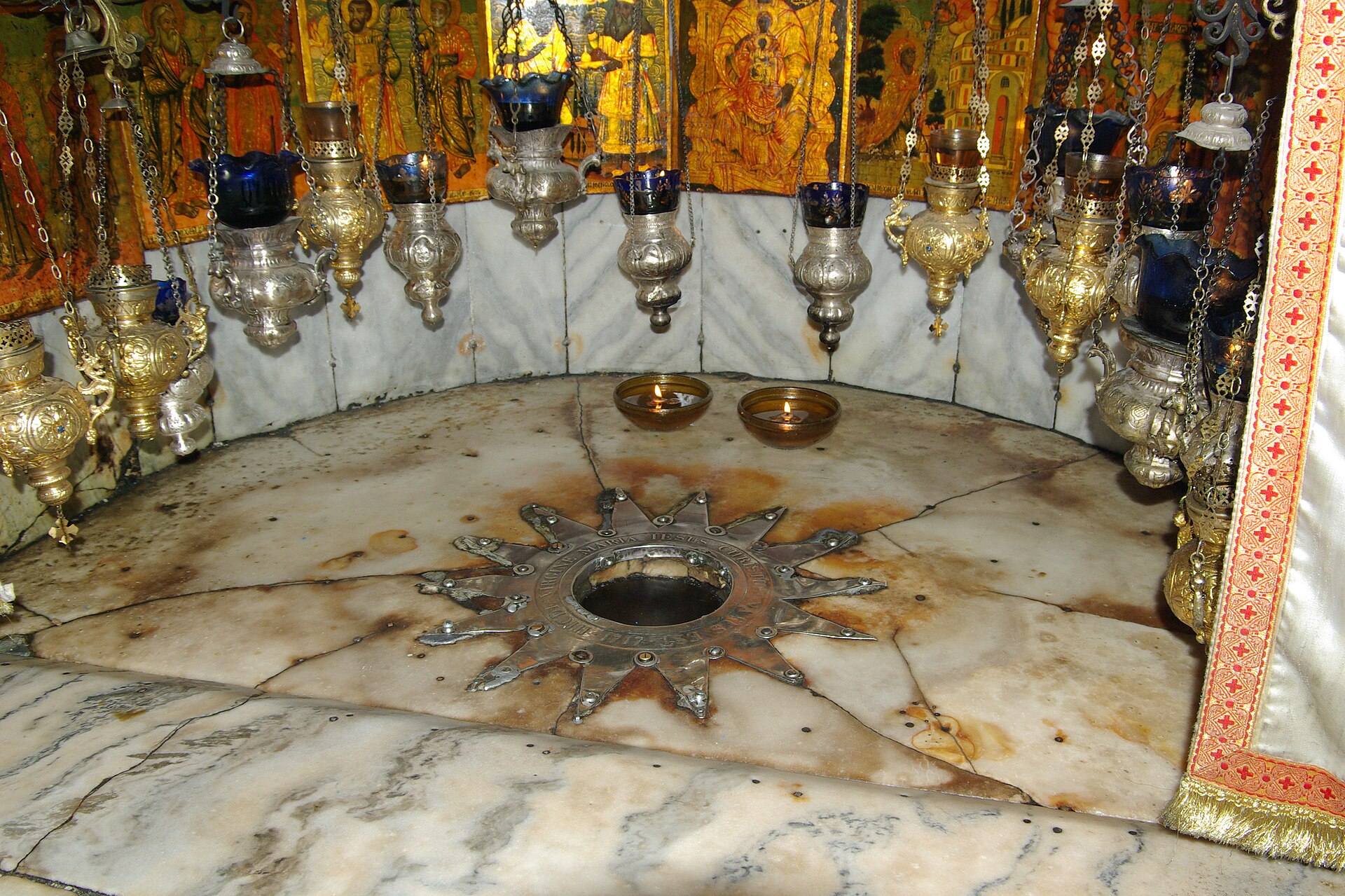
- The Grotto of the Nativity — the cave beneath the altar, where a 14-pointed silver star set into the floor marks the traditional spot of the birth. In August 2026 the grotto was closed for maintenance and construction until further notice, with visits allowed only on a restricted basis, so ask your guide what is possible on the day.
- The Manger Chapel — close by in the grotto, marking where tradition places the manger.
- St. Catherine’s Church — the adjoining Roman Catholic church, from which the broadcast Christmas Eve Midnight Mass is celebrated.
Hours, Entry, and Dress
The church is generally open daily from around 6:00 to 18:00, with hours varying by season and during services. Entry is free, though donations are welcome. Modest dress is expected, with shoulders and knees covered for both men and women. The grotto is small and can involve a queue when it is open, so arriving soon after opening is the best way to see it without a long wait. For more on what is appropriate at religious sites across the region, see our guide to dressing for holy sites.
Other Sites in and around Bethlehem
Shepherds’ Field
A short drive from Manger Square, in the neighbouring town of Beit Sahour, Shepherds’ Field marks the place where, in Christian tradition, angels announced the birth to shepherds in the fields. Two chapels, one Roman Catholic and one Greek Orthodox, sit on adjacent sites, each set in quiet gardens with views over the surrounding hills. If that pastoral setting appeals, the church-dotted village of Ein Karem on Jerusalem’s western edge has a similar feel and gentle walking trails.
The Milk Grotto
A short walk from the Church of the Nativity, this small chapel built around a pale limestone cave is associated with a tradition that the Holy Family sheltered here. It is a calm, atmospheric stop and is much less crowded than the main basilica.
The Separation Barrier and Street Art
Part of the Israeli West Bank barrier runs through the edge of Bethlehem, and the concrete wall on the Bethlehem side has become a well-known canvas for street art, including works attributed to the artist Banksy. Nearby is the Walled Off Hotel, which doubles as a small museum and gallery. Many visitors find this part of the trip thought-provoking; it is presented here simply as something travellers commonly see and ask about.
Rachel’s Tomb
Traditionally the burial place of the matriarch Rachel, this site sits on the Jerusalem side of the crossing and is visited mainly by Jewish pilgrims. Because of its location relative to the checkpoint, it is generally not part of a standard Bethlehem itinerary. Pilgrims drawn to the patriarchs and matriarchs usually continue further south instead, to the Cave of the Patriarchs on a day trip to Hebron.
A Sample Half-Day Plan
- Leave Jerusalem around 8:00 — earlier if you want the church before the tour groups arrive.
- Reach Manger Square by about 8:45 — by tour, taxi, or bus.
- Visit the Church of the Nativity — allow about 1.5 hours, including the grotto.
- Stop at the Milk Grotto — a short, quiet detour nearby.
- Add Shepherds’ Field — if you have time, a 30-minute visit.
- Lunch on or near Manger Square — local Palestinian food and coffee.
- Return to Jerusalem in the early afternoon — allowing extra time for the return crossing.
What to Bring and Practical Tips
- Passport — carry it with you the whole day.
- Comfortable shoes — Manger Square and the surrounding lanes are paved with stone.
- Modest clothing — for the churches.
- Cash — Palestinian taxis and small shops take shekels and often US dollars; smaller notes are handy.
- An early start — the Church of the Nativity is quietest just after opening.
- Time for the return — the journey back into Jerusalem can be the slowest part of the day.
If you are timing a visit around Christmas, the celebrations in Bethlehem are the most famous moment of the year and draw large crowds; the Midnight Mass at St. Catherine’s in particular requires booking accommodation and any tour well in advance. For ideas on fitting Bethlehem into a wider trip, see our Jerusalem itinerary guide, and our Jerusalem safety guide covers how to stay informed about current conditions.
Where to Eat and Shop in Bethlehem
Bethlehem is a good place to pause for lunch, and the food is Palestinian home cooking at its best. Around Manger Square and the lanes leading off it you will find restaurants serving fresh hummus and falafel, grilled meats, stuffed vine leaves, and musakhan, the local dish of roast chicken with sumac and onions on flatbread. Finish with strong cardamom coffee or a glass of mint tea. Prices are generally a little lower than in central Jerusalem, and many places are used to visitors.
The town is also known for olive-wood carving, a craft passed down through generations of local families. Workshops and shops near the Church of the Nativity sell hand-carved nativity scenes, crosses, and ornaments, and buying directly supports the artisans. Mother-of-pearl work and embroidery are other traditional crafts worth looking for. If you enjoy this kind of shopping, our guides to olive wood in Jerusalem and Jerusalem souvenirs cover what to look for and how to tell quality pieces apart.
Best Time to Visit Bethlehem
Bethlehem can be visited year-round, and because it is so close to Jerusalem the weather is much the same: warm and dry in summer, cool and sometimes wet in winter. Spring and autumn are the most comfortable for walking around the town. The Christmas season, from late December into early January, is the most atmospheric time, with decorations across Manger Square and a series of celebrations marked by the different Christian denominations on separate dates, but it is also the busiest and requires booking well ahead.
For day-to-day visits, mornings are best for the Church of the Nativity, before tour groups fill the grotto. Unlike in Jerusalem, the Saturday Shabbat closures do not apply in Bethlehem, so a weekend visit is straightforward, though it is worth remembering that getting to and from the crossing on the Jerusalem side is affected by Shabbat transport. Fridays and Sundays can be a little busier with worshippers and weekend visitors.
Everything above describes Bethlehem on an ordinary day. On 24 December it becomes a different proposition entirely — free Ministry of Tourism shuttles running non-stop from Jerusalem, marching bands in Manger Square from late morning, a ticket ballot for Midnight Mass that closes in mid-December, and a checkpoint queue home that can run to three hours. Our guide to Christmas in Jerusalem and Bethlehem covers the day hour by hour, including the two quieter January Christmases most visitors never hear about.
Visiting from a cruise ship is a different proposition. Bethlehem appears on many itineraries from Ashdod, but the return checkpoint into Jerusalem can take minutes or an hour, and nobody can predict which against a fixed all-aboard time. That is why this is the excursion where the ship’s own tour, with its guarantee, earns its price. Our guide to Jerusalem cruise ports and shore excursions explains how to plan it.
Bethlehem is usually one day of a longer pilgrimage. Our Holy Land pilgrimage itinerary pairs it with Ein Karem on its first full day in Jerusalem, after three nights in the Galilee, and explains what changed at the holy places in 2026.
Photo Credits
The silver star in the Grotto of the Nativity, Bethlehem: Bethlehem BW 2010-09-21 14-13-38 by Berthold Werner, CC BY-SA 3.0, via Wikimedia Commons.