Walk out of the Old City through Zion Gate and turn round. The stone around the arch is pitted with hundreds of bullet holes from the fighting of 1948, deliberately left unrepaired when the gate was restored. Turn back again and, a couple of minutes up the lane, there is a single building where a Jewish holy site occupies the ground floor, a Christian holy site the upper floor, and the fittings of a sixteenth-century mosque are still in the walls of both. Next to it rises the conical grey roof of a German Benedictine abbey. Mount Zion Jerusalem is a small hilltop with an enormous amount of history packed on it, and a surprising number of visitors walk straight past.
This guide covers the three sites that most people come for, King David’s Tomb, the Room of the Last Supper and the Dormition Abbey, together with the quieter places around them: the Chamber of the Holocaust, Oskar Schindler’s grave and the Church of St Peter in Gallicantu. It explains the three different opening patterns, the one dress code that covers them all, the competing traditions over what happened here, and how to fit it into a day. Hours and fees were checked in September 2026 and change with the religious calendar, so confirm locally before you go.
Mount Zion at a Glance
| Site | Hours (checked September 2026) | Entry | Notes |
|---|---|---|---|
| King David’s Tomb | Daily 08:00–17:00; Friday to 14:00; open on Shabbat | Free | Active Jewish prayer site. Separate men’s and women’s sections; men cover their heads |
| Room of the Last Supper (Cenacle) | Daily 08:00–18:00; closed Yom Kippur | Free | Directly above the tomb. Reached by an outside staircase |
| Dormition Abbey | Monday to Saturday 08:00–17:00; Sunday 12:30–17:00 | Free | Crypt included. Services take priority |
| St Peter in Gallicantu | Monday to Saturday 08:30–17:00; closed Sunday | ₪7 | On the eastern slope, 10 minutes’ walk down |
| Chamber of the Holocaust | Check locally | Check locally | Small museum, next to the tomb compound |
| Oskar Schindler’s grave | When the cemetery gate is open | Free | Catholic Franciscan cemetery, below the abbey |
Time needed: 90 minutes for the three main sites; two and a half hours with St Peter in Gallicantu and Schindler’s grave. Dress code: shoulders and knees covered everywhere, heads covered for men at the tomb. Getting there: on foot through Zion Gate, about ten minutes from Jaffa Gate through the Armenian Quarter.
Where Is Mount Zion, and Why the Name Moved
Mount Zion is the hill immediately south-west of the Old City walls, outside Zion Gate and beside the Armenian Quarter. It is not, confusingly, the Zion of most of the Hebrew Bible. There, “Zion” meant the fortress David captured from the Jebusites, on the ridge now called the City of David, and later came to mean the Temple Mount and the whole city. By the time of the first-century historian Josephus, the higher western hill had been identified as David’s citadel, and in the Byzantine period the name Zion settled here for good. By then the hill was already sacred to Christians, as the traditional site of the Last Supper and of Pentecost, and a great basilica, Hagia Sion, stood on it.
So Mount Zion is a place where traditions have accumulated rather than a place where every tradition is historically certain, and that is a large part of its interest. Our guide to biblical sites in Jerusalem sets the hill in the context of the rest of the ancient city.
Zion Gate
Most visitors reach Mount Zion through Zion Gate, called Bab al-Nabi Daoud, the Gate of the Prophet David, in Arabic. It is one of the Ottoman gates built by Suleiman the Magnificent in the 1530s, with an L-shaped entrance designed to slow down attackers. In May 1948, Jewish Palmach fighters broke through here in an attempt to relieve the besieged Jewish Quarter. The battle scars were preserved in the stone during later restoration work, and they are the most vivid record of that year anywhere in the Old City walls. Between 1948 and 1967 Mount Zion was held by Israel while the Old City behind the gate was held by Jordan, and the gate stood on the line between them. The gates of Jerusalem guide covers all eight.
King David’s Tomb
On the ground floor of the old Crusader-era building is a room containing a large stone cenotaph draped in a velvet cloth embroidered with a crown and Hebrew text. Since at least the twelfth century, Jewish, Christian and Muslim tradition has identified it as the tomb of King David. It is now an active Jewish prayer site administered by Israeli religious authorities, with separate sections for men and women on either side of the cenotaph.
Most historians and archaeologists do not believe David is buried here; the Bible places his burial in the City of David, on the eastern ridge, and the cenotaph itself is medieval. None of that affects what the site means to the people who pray at it, and it is treated with the reverence of any synagogue.
Visiting the Tomb
- Hours: daily 08:00 to 17:00, closing at 14:00 on Fridays. It is open on Shabbat.
- Entry: free.
- Dress: men must cover their heads; paper kippot are available at the entrance. Everyone should have shoulders and knees covered.
- Sections: men and women enter by different doorways.
- Shabbat: the site is open, but as at any Jewish prayer site, avoid photography and phone use on Shabbat.
The room is small and dim, and many visitors spend only a few minutes inside. It is worth staying longer if a group is praying or studying: the atmosphere is more intimate than at the Western Wall.
A Muslim Holy Site Too
For centuries this building was also a mosque. Muslims revere David as the prophet Daoud, and in the 1520s the Ottoman authorities converted the building; the Franciscan friars who had held it were expelled from Mount Zion a few decades later. The Dajani family served as custodians of the Nabi Daoud mosque for generations, until 1948. The prayer niche and Arabic inscriptions of that period remain in the building today, including in the room upstairs. The building’s history is a small version of Jerusalem’s history, which is covered at length in our pages on Crusader Jerusalem and Ottoman Jerusalem.
The Room of the Last Supper (Cenacle)
Up an outside staircase, directly above the tomb, is the Cenacle, or Coenaculum, the room Christian tradition identifies as the Upper Room where Jesus shared the Last Supper with his disciples, and where the Holy Spirit descended on the apostles at Pentecost. The room you see is not first-century. It is a Gothic hall with ribbed vaults and slender columns, built in the Crusader period and restored by the Franciscans in the fourteenth century, and then altered by the Ottomans after its conversion to a mosque.
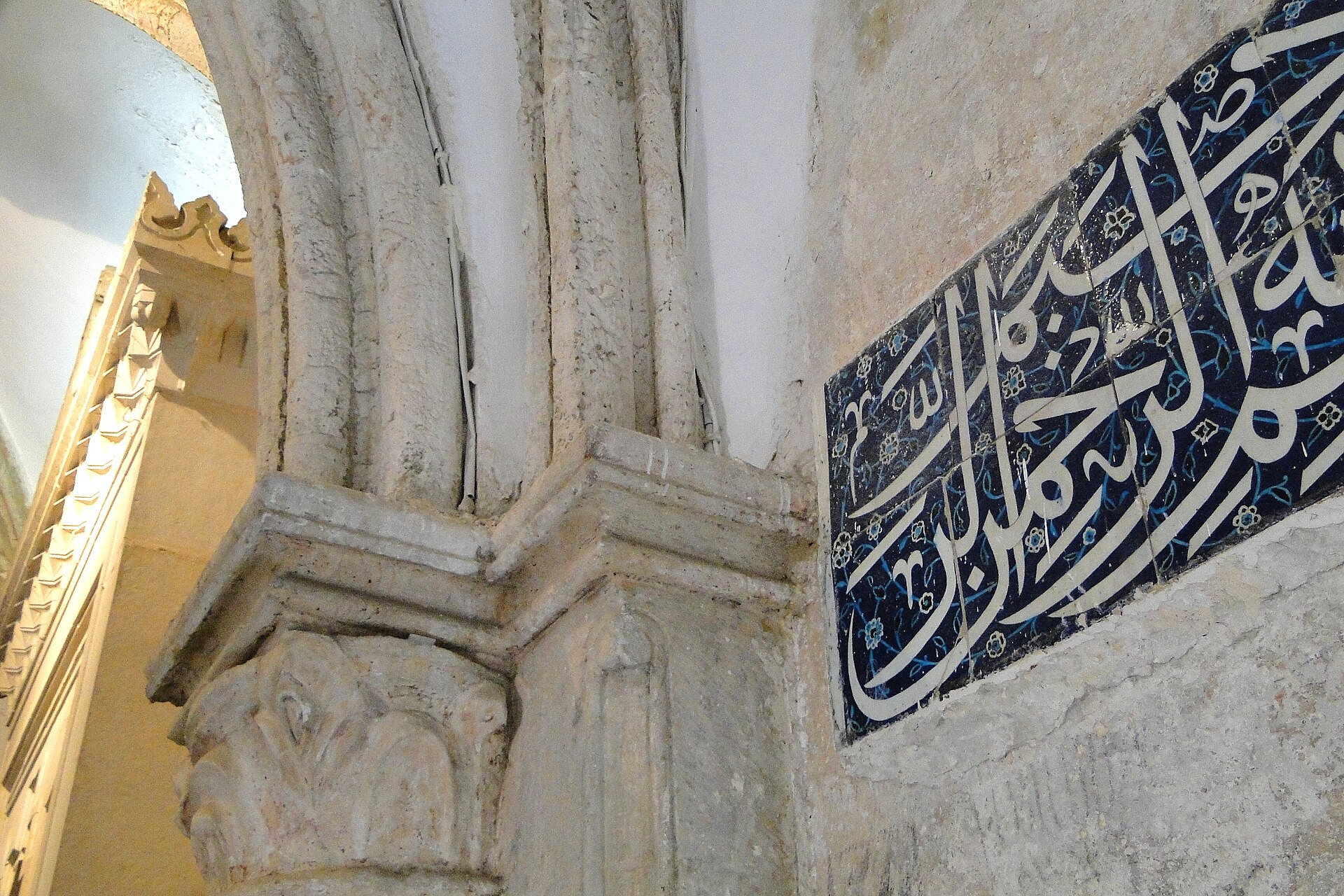
Look for the Gothic capitals, including one carved with a pelican feeding its young, an old Christian symbol, alongside the Ottoman mihrab and the tiled Arabic inscriptions. It is one of the few places in Jerusalem where you can see Christian and Islamic religious art side by side in the same room, without anyone having removed either.
Visiting the Cenacle
- Hours: daily 08:00 to 18:00, closed on Yom Kippur.
- Entry: free.
- Worship: the room is under Israeli state administration, and Christian services are permitted only on limited occasions by arrangement. Pope Francis celebrated Mass here in 2014, which drew protests from some Jewish groups. On most days visitors simply stand and look.
- Crowds: pilgrim groups arrive in waves from mid-morning; before 09:30 or after 14:30 is calmer.
The Cenacle plays a part in Holy Week too: the Franciscan Custody leads pilgrims here on Holy Thursday. Our guide to Easter in Jerusalem explains the week’s processions.
A Shared and Sometimes Tense Building
Because Jews, Christians and Muslims all have claims to this one building, it has seen friction. Some Jewish groups oppose any Christian worship in the Upper Room, the Vatican has long sought greater access, and Muslim organisations point to its four centuries as a mosque. In recent years, Christian clergy on Mount Zion have reported harassment, and there have been graffiti attacks on church property in the area, incidents condemned by Israeli political and religious leaders. None of this is likely to affect a visitor directly. It explains the security staff you may see, and why the building is run so carefully.
The Dormition Abbey
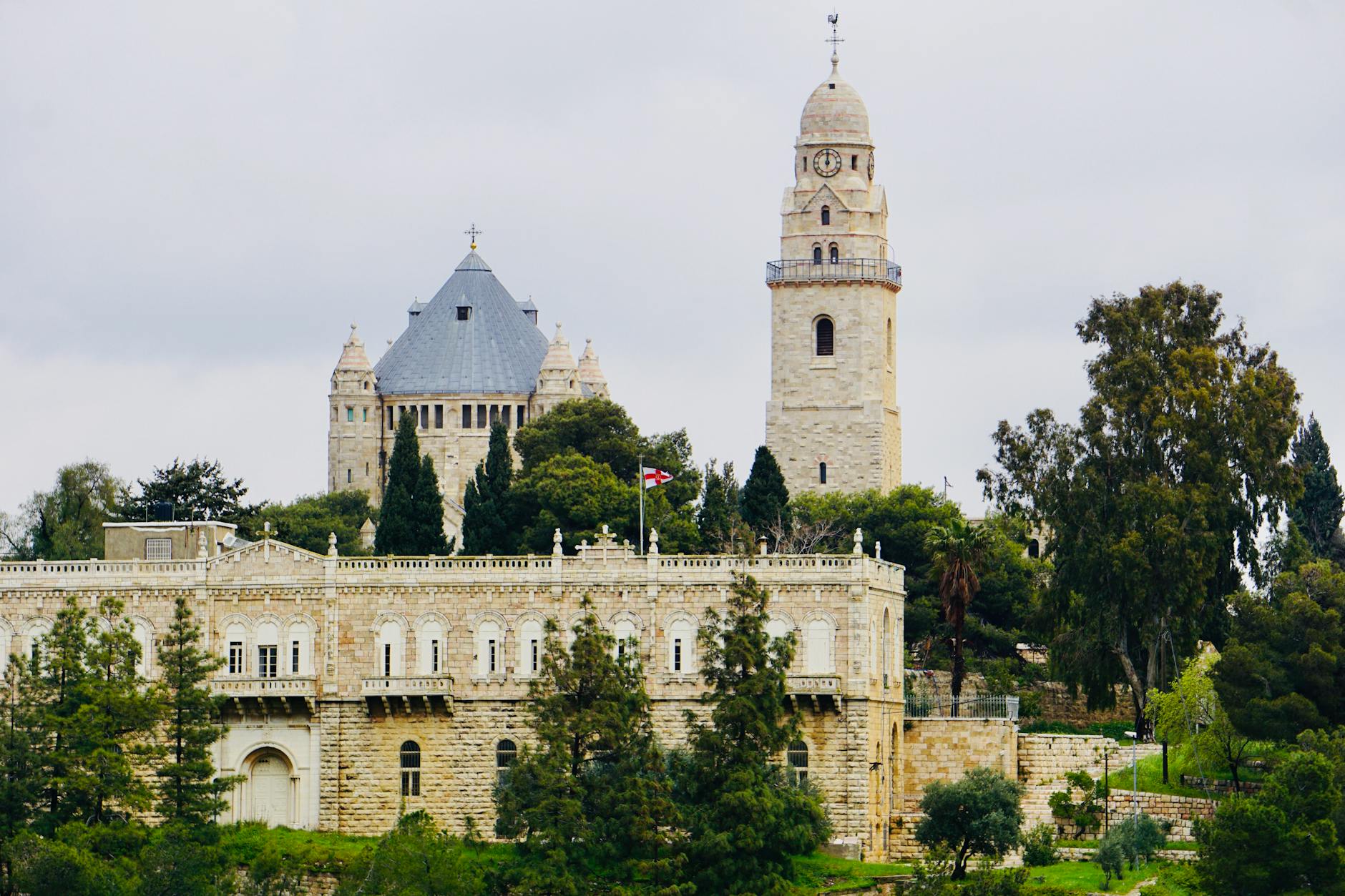
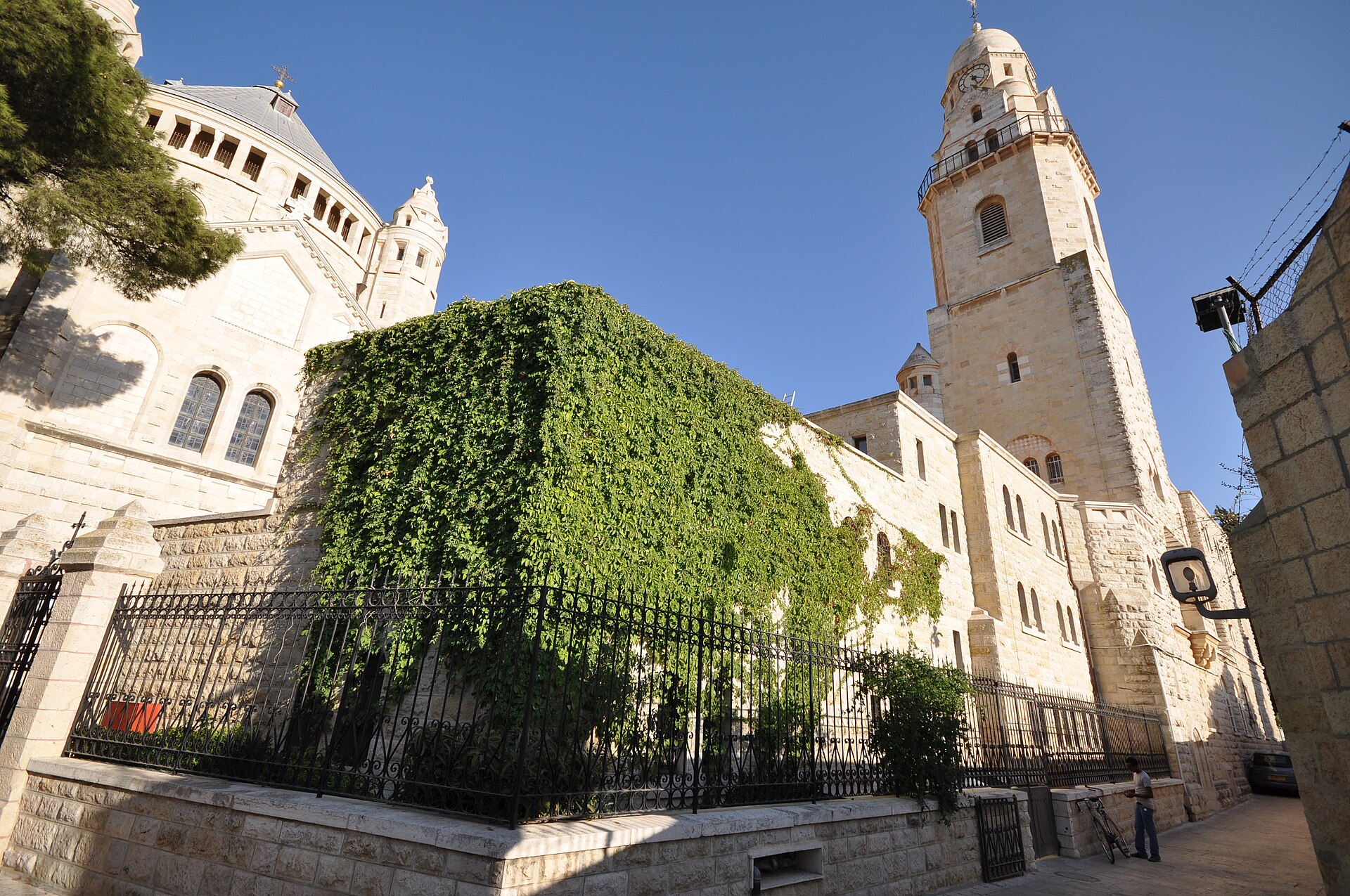
The dome and tall bell tower of the Dormition Abbey dominate the skyline of Mount Zion and are visible from much of south Jerusalem. The land was given by the Ottoman sultan Abdul Hamid II to the German emperor Wilhelm II during his visit in 1898, and German Benedictines completed the church in 1910 on the traditional site where the Virgin Mary “fell asleep”: the Dormition. The monks still live here and hold daily services.
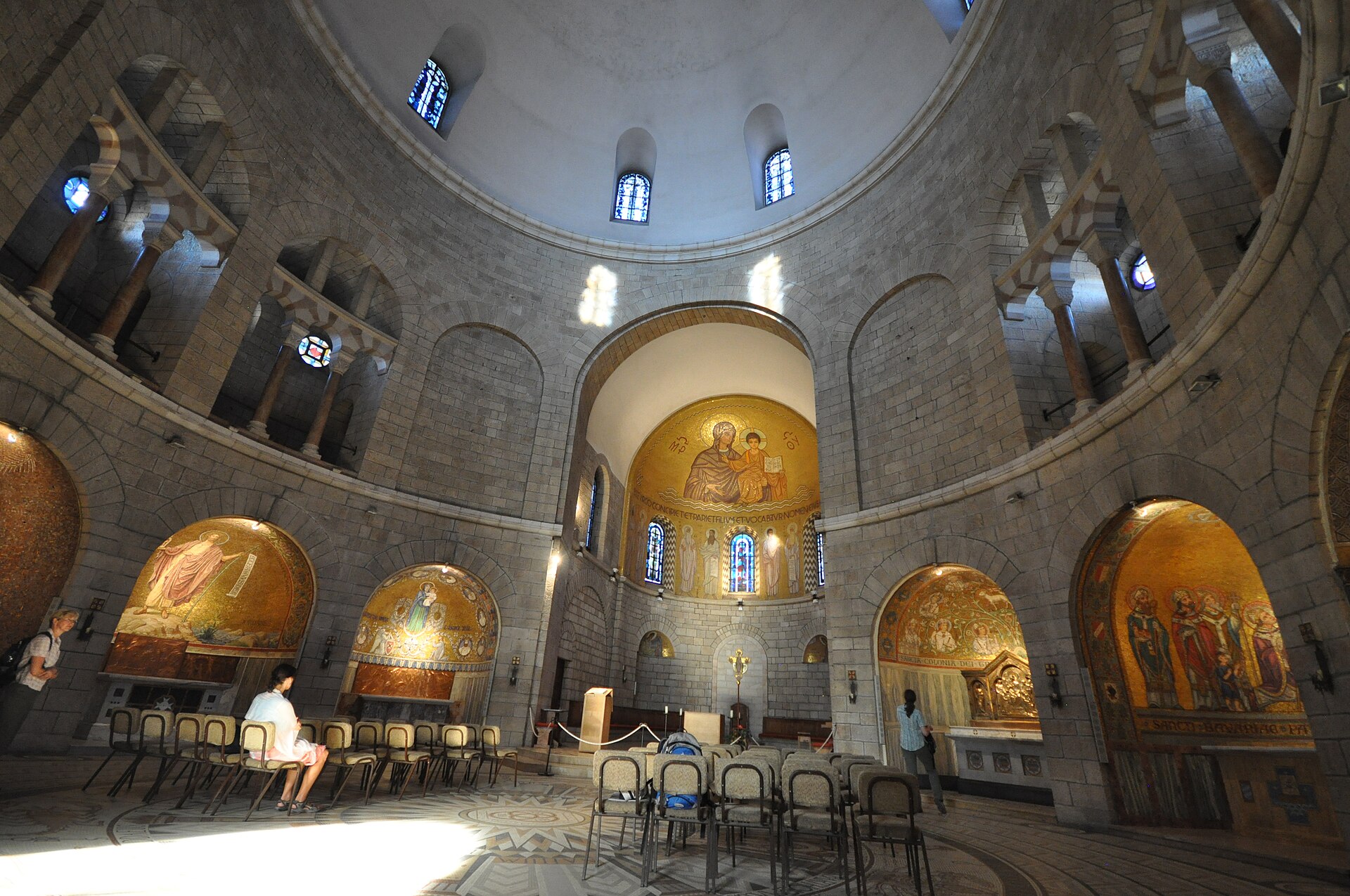
The upper church is a round, domed space with golden apse mosaics of the Virgin and Child and chapels around its edge, each decorated by donors from different countries. Its floor mosaic is patterned with the signs of the zodiac and names of saints and prophets. Downstairs, the crypt holds a life-size effigy of Mary asleep on her deathbed, beneath a dome of mosaics showing women of the Hebrew Bible. It is peaceful, beautiful and, for most visitors, the highlight of Mount Zion.
Visiting the Dormition Abbey
- Hours: the Christian Information Centre listed it in 2026 as open Monday to Saturday from 08:00 to 17:00 and on Sunday from 12:30 to 17:00. These times change around services and feasts, so check at the door.
- Entry: free, including the crypt.
- Dress: modest; shoulders and knees covered.
- Behaviour: silence during services, which take priority over visits.
Beyond the Big Three
The Chamber of the Holocaust
Beside the tomb compound, a series of dim rooms holds the Chamber of the Holocaust, Martef HaShoah. Founded in 1949, it is regarded as Israel’s first Holocaust memorial, created years before Yad Vashem, and its walls are lined with memorial plaques for Jewish communities destroyed in Europe. It is small, unpolished and deeply affecting in a completely different way from the national memorial. Hours and admission are not reliably published in English, so ask locally. For the national museum, see our guide to Yad Vashem.
Oskar Schindler’s Grave
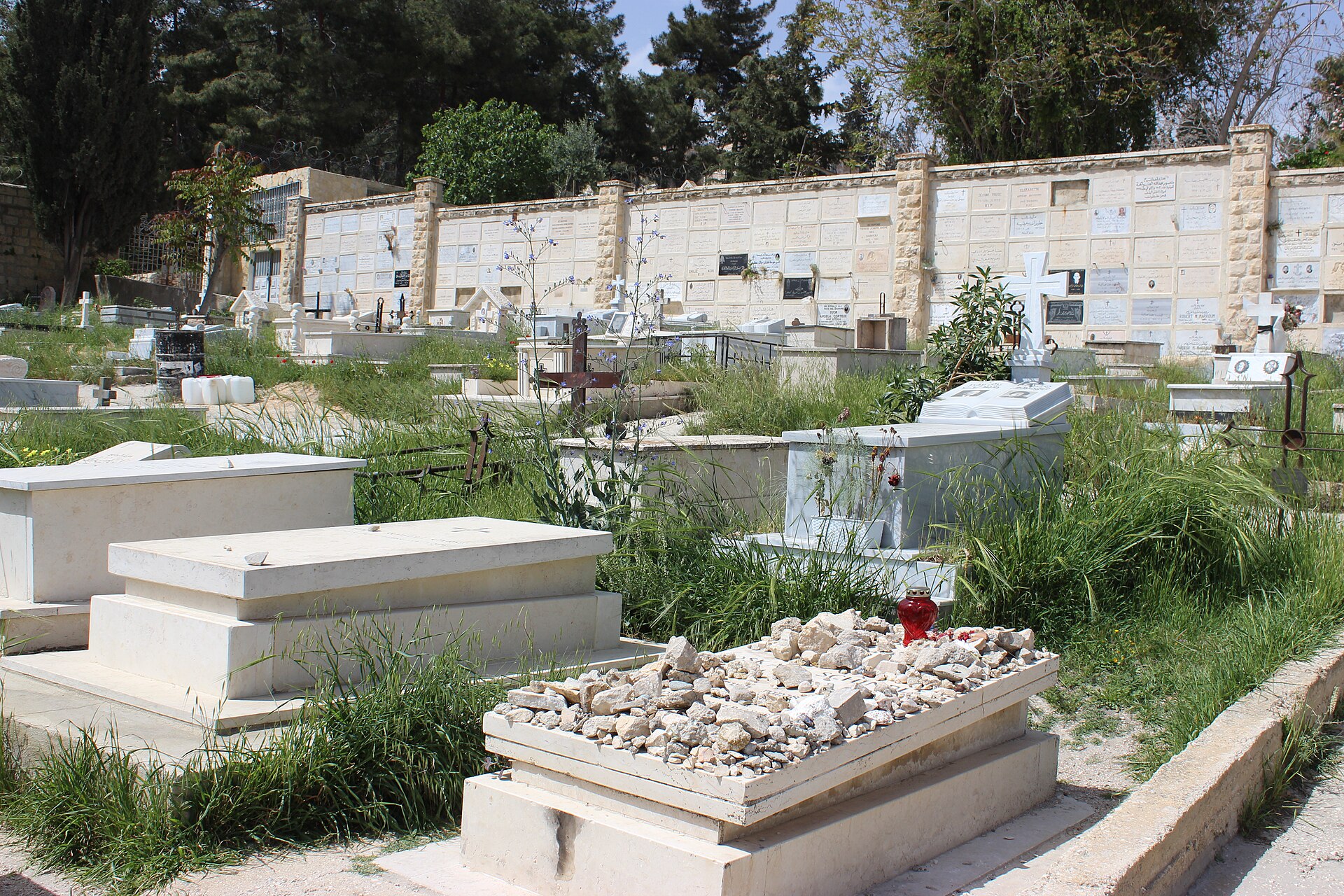
Below the Dormition Abbey, in the Catholic Franciscan cemetery on the south slope, lies Oskar Schindler, the German industrialist who saved more than a thousand Jews during the Holocaust. He died in 1974 and, at his request, was buried in Jerusalem; he is one of the Righteous Among the Nations recognised by Yad Vashem. His grave is covered with small stones left by visitors, following the Jewish custom of marking a visit. The cemetery gate is not always open. Mornings, away from Sunday, are your best chance; if it is locked, the grave can sometimes be seen from the path.
The Church of St Peter in Gallicantu
On the eastern slope of Mount Zion, looking across the Kidron Valley towards the City of David and the Mount of Olives, stands the Church of St Peter in Gallicantu, “at the cock’s crow”. It was built in 1931 by the Assumptionist Fathers over a site that one tradition identifies with the house of the high priest Caiaphas, where Peter denied Jesus three times before the cock crowed. Beneath the church are rock-cut chambers and a cistern pit that tradition describes as a prison cell. Outside, an ancient stepped street runs down the hill, and the terrace has one of the finest views in this part of the city.
- Hours: Monday to Saturday, 08:30 to 17:00. Closed on Sundays, 25 December and 1 January.
- Entry: ₪7.
- Time: about an hour, plus ten minutes’ walk down from the abbey, and back up.
Other Corners
Mount Zion also holds the Protestant cemetery, where the archaeologist Flinders Petrie is buried, and the Armenian Monastery of St Saviour; both have limited access. If you continue east along the walls you reach the Dung Gate and the Western Wall, and the southern section of the Ramparts Walk passes above Zion Gate.
A Suggested Route
- Jaffa Gate to Zion Gate through the Armenian Quarter, about ten minutes. Stop to look at the bullet marks on the outside of the gate.
- Dormition Abbey, 30 to 40 minutes including the crypt. Go first, before the midday break.
- King David’s Tomb, 15 minutes, entered from the courtyard behind the abbey.
- The Cenacle, 15 minutes, up the outside stairs of the same building.
- The Chamber of the Holocaust, 20 minutes, if open.
- Schindler’s grave, 15 minutes, if the cemetery is open.
- St Peter in Gallicantu, an hour, except on Sundays.
- Onward: back up to Zion Gate and into the Jewish Quarter, or along the walls to the Dung Gate for the Western Wall and the City of David.
The whole route is easily walkable, though Mount Zion’s lanes are cobbled and the path to St Peter in Gallicantu is steep. Our self-guided walking tour links Mount Zion to the rest of the Old City.
Opening Patterns: Which Day Works Best
| Day | What to expect |
|---|---|
| Monday to Thursday | Everything open. The best days |
| Friday | King David’s Tomb closes at 14:00; go in the morning |
| Saturday | The tomb is open for Shabbat prayer (no photography); the Cenacle and Dormition are open, with shorter breaks at the abbey; St Peter in Gallicantu is open |
| Sunday | St Peter in Gallicantu closed; the Dormition opens later after Mass; the cemetery is less likely to be open |
Jewish and Christian holidays change things. On Shavuot, which Jewish tradition links with David’s death, crowds gather at the tomb; on Pentecost and Holy Thursday, pilgrims fill the Cenacle. Our religious holidays calendar has the dates.
What to Wear
One dress code covers every site on the hill: shoulders and knees covered, for everyone, and no see-through fabrics. Men need a head covering at King David’s Tomb, where paper kippot are provided. A light scarf and trousers or a long skirt will take you from the synagogue to the abbey without a change. Our Jerusalem dress code guide has more detail.
Views and Photography
Mount Zion is at its most photogenic from a distance. The Dormition Abbey’s dome and bell tower, rising above the Ottoman walls, are best seen from the west, across the Hinnom Valley: from the Sultan’s Pool below Yemin Moshe, or from the promenade by the windmill in Yemin Moshe itself, in late-afternoon light. From the terrace of St Peter in Gallicantu the view runs the other way, down over the City of David and across the Kidron Valley to the villages of Silwan and the Mount of Olives. Our guides to the best viewpoints in Jerusalem and photography spots have more.
On the hill itself, photography is generally fine inside the Dormition Abbey and the Cenacle when no service is under way. At King David’s Tomb, be discreet and ask before photographing people at prayer, and put the camera away entirely on Shabbat.
Combining Mount Zion With the Rest of Your Day
Mount Zion sits at a natural junction, which makes it easy to build into a longer walk.
- With the Jewish Quarter and the Western Wall. Go through Zion Gate into the Jewish Quarter, and follow the lanes down to the Western Wall plaza. It is about fifteen minutes on foot.
- With the City of David. Walk along the outside of the southern walls towards the Dung Gate, then downhill to the City of David visitor centre. Allow twenty minutes, and book any tunnel tour in advance.
- With the Armenian Quarter. Mount Zion and the Armenian Quarter make a quiet, rewarding morning together, well away from the busiest parts of the Old City.
- With Yemin Moshe and the German Colony. Descend west into the Hinnom Valley, cross to Yemin Moshe, and continue to the cafés of the German Colony for lunch.
For visitors on a single day in the city, including cruise passengers, Mount Zion is usually the first thing to go. If you have a little extra time near the Jewish Quarter, the Dormition Abbey alone is a twenty-minute detour worth making.
Is Mount Zion Worth Visiting?
Yes, with one honest caveat. None of the three main sites is spectacular in the way the Church of the Holy Sepulchre or the Western Wall is. The tomb is a small dim room, the Cenacle a bare Gothic hall, and on a crowded morning both can feel like a queue. What makes Mount Zion worth the ninety minutes is the layering: three religions in one building, a Benedictine abbey, a Holocaust memorial and the grave of a Righteous Gentile, all within a few hundred metres, and all just outside the walls. The Dormition Abbey alone justifies the walk. If you have only one day in Jerusalem, it is a lower priority than the Church of the Holy Sepulchre and the Western Wall; with two or more, include it.
Final Word on Mount Zion
Mount Zion rewards the visitor who slows down. Stand in the Cenacle long enough to find the pelican on the capital and the Arabic tiles on the wall, sit for a few minutes in the crypt of the Dormition, and leave a stone on Schindler’s grave if the gate is open. Then walk back through Zion Gate and run your hand over the bullet marks. For the rest of the Old City, read our Old City guide, the wider guide to holy sites in Jerusalem, and our pages on Christian pilgrimage and Jewish holy sites.
Photo Credits
The Dormition Abbey and its bell tower: Church of the Dormition – Dormition Abbey (10804899693) by Jorge Láscar from Australia, CC BY 2.0, via Wikimedia Commons.
Gothic capital and Ottoman tiles inside the Cenacle: Detail of Interior of Room of the Last Supper (Cenacle) – Old City – Jerusalem – Israel (5676100495) by Adam Jones from Kelowna, BC, Canada, CC BY-SA 2.0, via Wikimedia Commons.
Mosaic chapels inside the Dormition Abbey: Church of the Dormition – Dormition Abbey (10804792194) by Jorge Láscar from Australia, CC BY 2.0, via Wikimedia Commons.
The Franciscan cemetery and Oskar Schindler’s grave: Mount Zion Franciscan Cemetery Schindler 03319 by Kenyh, CC BY-SA 3.0, via Wikimedia Commons.