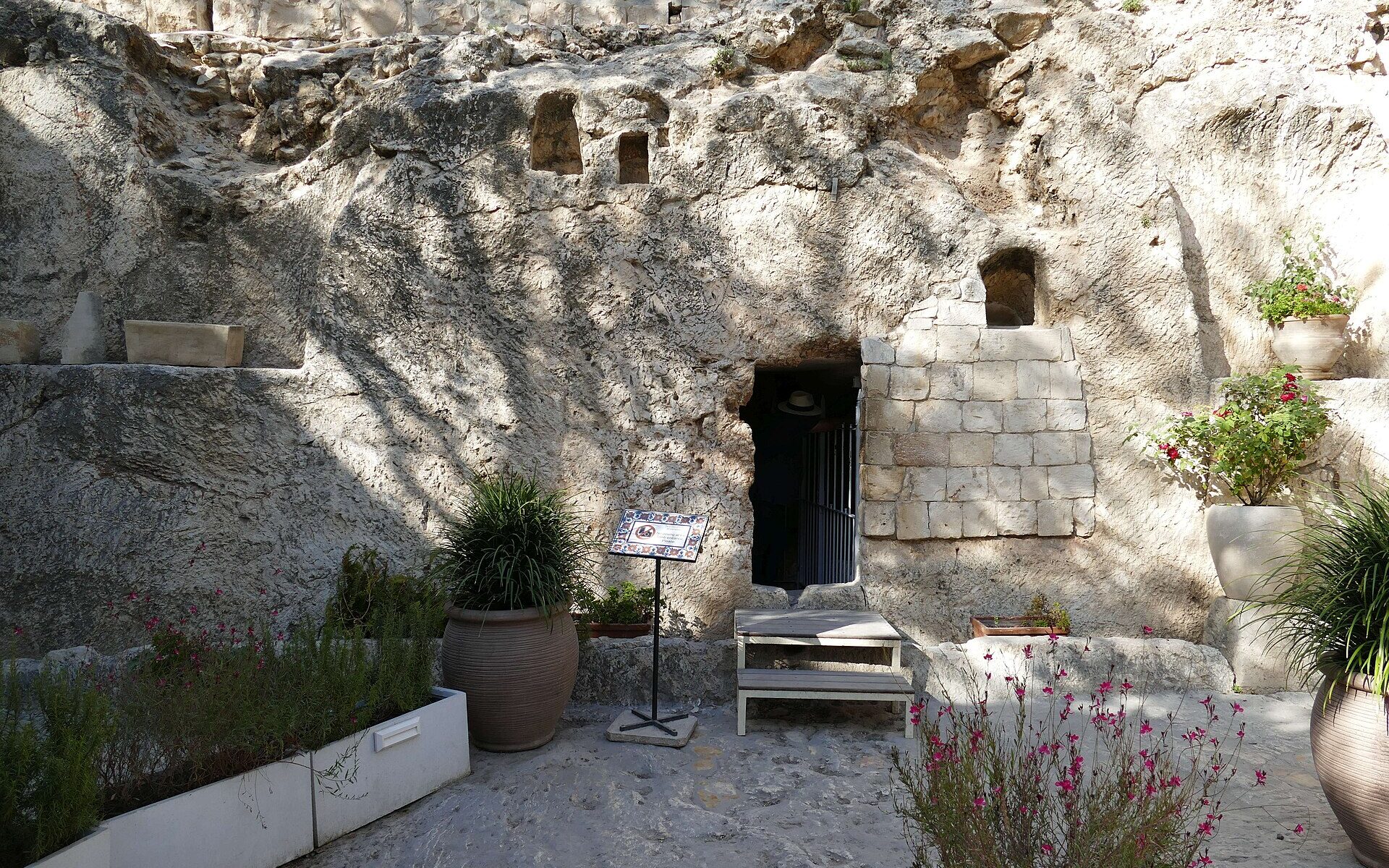
Walk up Nablus Road from Damascus Gate on a weekday morning and you pass money changers, falafel stands, the crush of the East Jerusalem bus station and a constant stream of traffic. Then you turn into a narrow lane, go through a green gate in a stone wall, and the noise drops away. Trees, flowerbeds, benches, birdsong, and at the bottom of the path a rock face with a low doorway cut into it. That contrast is the first thing almost everyone remembers about the Garden Tomb Jerusalem visit, and for many Protestant pilgrims it is the moment the trip makes sense.
This guide explains what the Garden Tomb is, why it exists alongside the Church of the Holy Sepulchre, what the two traditions and the archaeologists say about each site, and how to visit: hours, groups, getting there and what is nearby. Hours and practical details were checked in October 2026 against the Garden Tomb’s own website; it trims its hours from time to time, so check it the day before you go.
The Garden Tomb at a Glance
| What | Details (October 2026) |
|---|---|
| What it is | A garden with an ancient rock-cut tomb, regarded by many Protestants as a possible site of Jesus’s burial and resurrection |
| Where | Conrad Schick Street, off Nablus Road, about 400 m north of Damascus Gate |
| Hours | 09:00 to 13:00; closed Friday and Sunday |
| Entry | Free; donations welcome |
| Booking | Not needed for groups of 10 or fewer; larger groups request a reservation |
| Run by | The Garden Tomb (Jerusalem) Association, a charitable trust based in the UK, since 1894 |
| Time needed | 45 minutes to an hour; longer if you join a group for worship |
| Nearest light rail | Damascus Gate stop on the Red Line |
What the Garden Tomb Is
The Garden Tomb is a walled garden of about two acres just north of the Old City, owned and run by the Garden Tomb (Jerusalem) Association, a Christian charity registered in the United Kingdom and in Israel. It has been open to visitors as a place of worship since 1894. Inside are a rock-cut tomb, an ancient winepress, terraced paths, and several outdoor areas set with benches where groups hold short services, sing and take communion.
It is not a church, and it belongs to no denomination in the way the great Old City churches belong to the Greek Orthodox, the Franciscans or the Armenians. The Association describes it as a site of Christian worship and witness. The Association’s own description is careful: it calls the tomb a “possible location” of the burial and resurrection of Jesus, and says that whether this is the actual tomb is not what matters. What matters to them is the message of the empty tomb, and the garden is designed for reflecting on it.
Two Tombs: The Honest Answer
Every visitor asks the same question, and it deserves a straight answer rather than a polite fudge. There are two places in Jerusalem shown as the tomb of Jesus, and the traditions behind them are very different in age and in who holds them.
The Church of the Holy Sepulchre, inside the Old City walls, is the site recognised by the Catholic, Greek Orthodox, Armenian, Coptic, Ethiopian and Syriac churches, which together account for most of the world’s Christians. Its tradition goes back to the fourth century, when the emperor Constantine had a church built over a rock-cut tomb that Bishop Macarius of Jerusalem identified as the burial place of Jesus; that church was consecrated in 335. Archaeology has shown that the area was a disused quarry with rock-cut tombs, outside the city wall of the early first century, which fits the gospel accounts of a burial outside the city.
The Garden Tomb’s claim is much more recent. It was proposed in the nineteenth century, at a time when some Protestant visitors, used to plainer churches, found the Holy Sepulchre crowded, ornate and hard to square with the gospel picture of a garden outside the walls. A rocky hill north of Damascus Gate, whose face some thought looked like a skull, seemed a better fit for Golgotha, “the place of the skull”, and the tomb nearby a better fit for the garden tomb of Joseph of Arimathea.
The archaeologists’ view of the Garden Tomb itself is less helpful to it. The Israeli archaeologist Gabriel Barkay, who studied the tomb closely, concluded in 1986 that it was most likely cut in the eighth or seventh century BCE, in the Iron Age, and lacked the features of tombs from the time of Jesus; another study has argued for a Hellenistic date, a few centuries before Jesus. Either way, it would not have been a “new tomb” in the first century. Barkay also observed that defenders of both sites tend to argue more on theological than on scientific grounds.
So the fair summary is this. The Holy Sepulchre has the older tradition and the support of most churches, and excavations there have found first-century tombs in a former quarry. The Garden Tomb has the setting, which many visitors find far closer to what they imagine when they read the gospels, and its keepers do not insist that it is the place. Many pilgrims visit both and find that each gives them something the other does not. Our guide to holy sites in Jerusalem sets both in the wider landscape of the city’s sacred places.
How Skull Hill Entered the Story
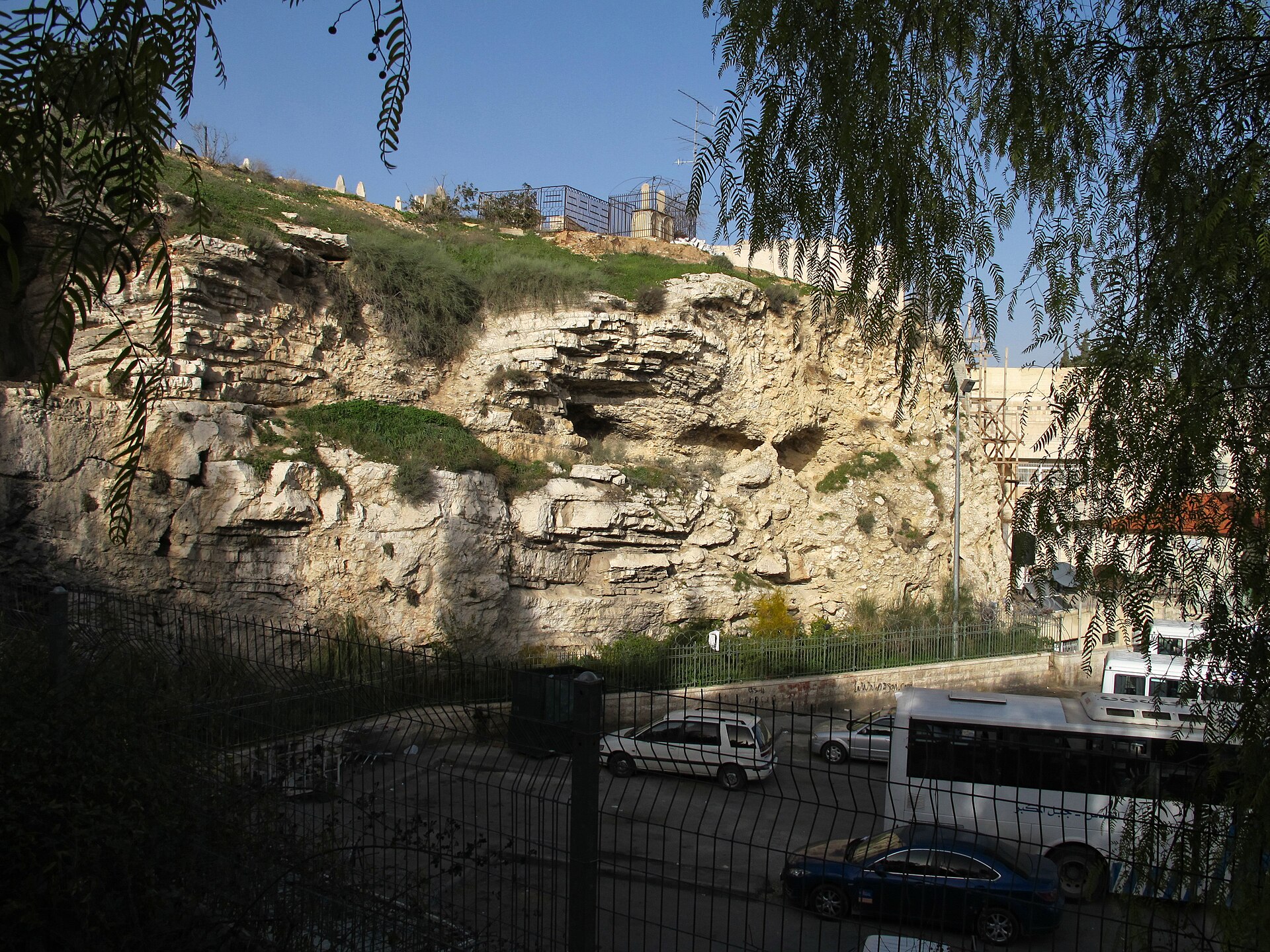
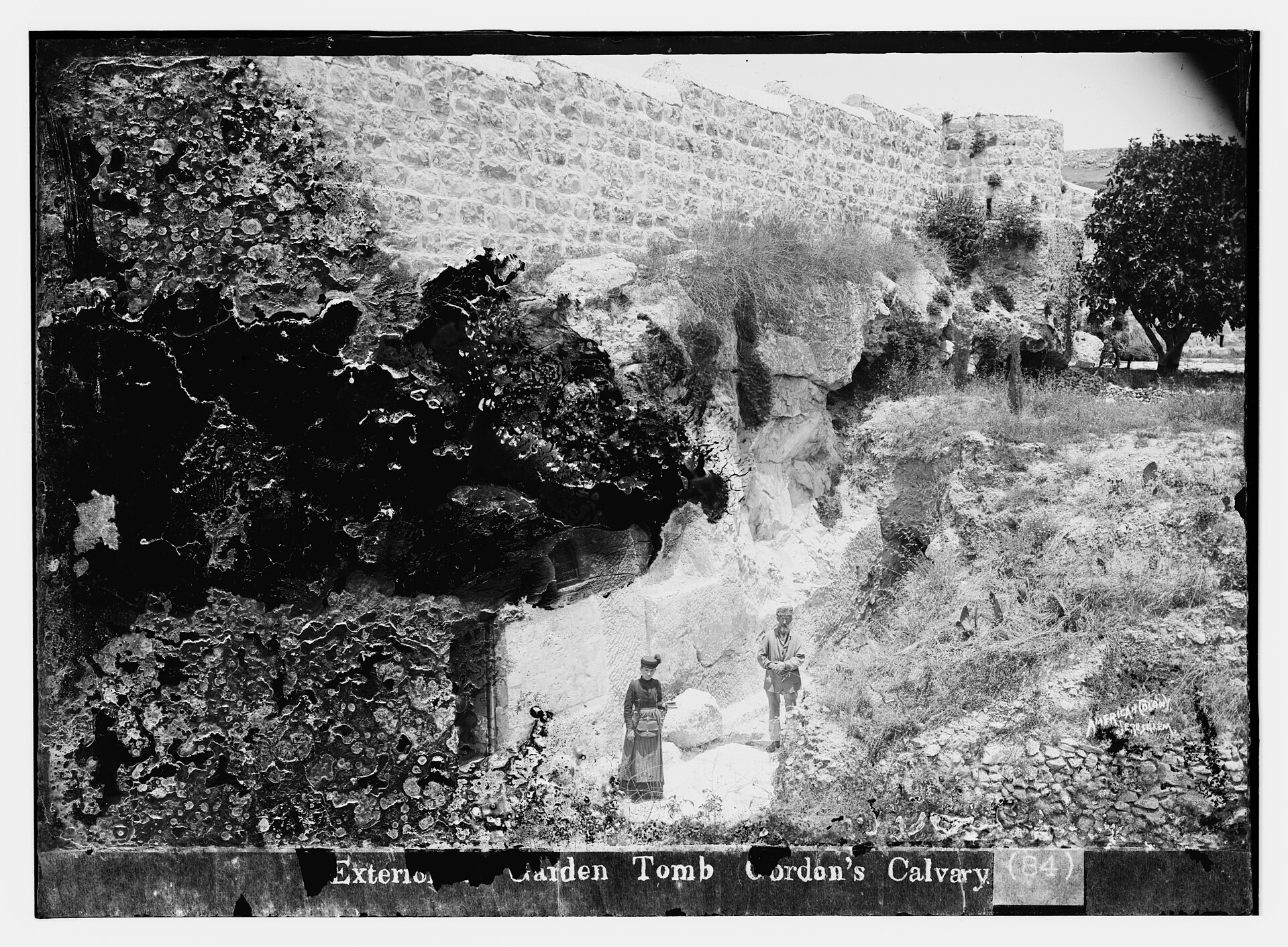
The idea did not begin with the man whose name is usually attached to it. The German scholar Otto Thenius first published the proposal that the rocky hill north of Damascus Gate was Golgotha in 1842, and other writers took it up in the decades that followed. The architect and archaeologist Conrad Schick, after whom the lane outside is named, reported on the tomb in 1874.
What made the theory famous was General Charles Gordon, the British soldier later killed at Khartoum, who spent much of 1883 in Jerusalem, became convinced of the identification, and wrote about it enthusiastically. For years afterwards the hill was known in English as “Gordon’s Calvary”. In 1894 a group of British supporters bought the land with the tomb, and the Garden Tomb (Jerusalem) Association has looked after it ever since.
Today the “skull” is easy to miss. Erosion has softened the features, and the foot of the cliff is now occupied by the East Jerusalem bus station. From the viewing platform inside the garden you look across at the rock face; some visitors see the eye sockets at once, others never do.
What You See on a Visit
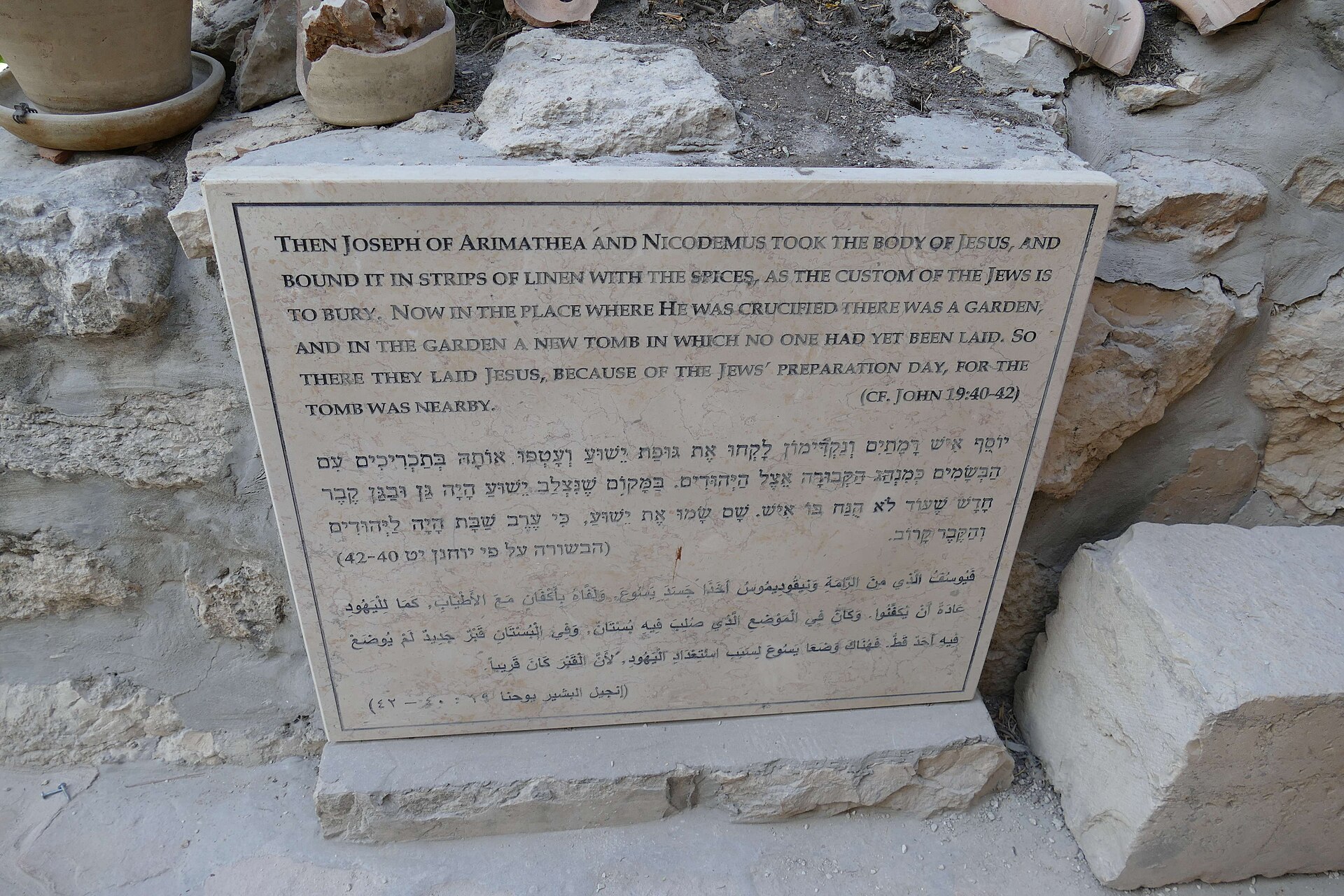
- The garden. The point of the place. Shaded paths wind between trees and flowerbeds, with quiet corners and benches, and it is beautifully kept. Even visitors who come with no religious interest tend to slow down here.
- The Skull Hill viewpoint. A platform looking across to the rock face, with the bus station below. It is the best spot to understand why nineteenth-century visitors were drawn to the place.
- The tomb. A rock face with a low doorway leads into a small chamber with burial places cut into the rock. You go in a few at a time, and there is often a short queue at busy hours. Inside it is cool, plain and silent.
- The winepress. An ancient winepress cut into the rock, which the Association cites as evidence that the area was once a cultivated garden or vineyard.
- The worship areas. Small open-air spaces with benches where booked groups hold services. If you arrive while a group is singing, you will hear hymns sung in many languages.
Visiting the Garden Tomb
Hours and closures
In October 2026 the Garden Tomb was open 09:00 to 13:00, and closed on Friday and Sunday. These hours are shorter than the garden kept in past years, and older guidebooks and websites still carry the earlier timetable, so check the hours on the Garden Tomb’s own site before you go. Arrive early: by late morning the coach groups are in, and the first hour is the quietest.
The Friday and Sunday closures catch many people out, especially those who assume a Protestant site will be open on a Sunday. Plan it for a Monday to Thursday or a Saturday morning, and remember that Saturday is Shabbat, which affects the light rail and buses across the city; our guide to Shabbat in Jerusalem explains what runs.
Entry, guides and groups
- Entry is free, and the site’s own words are that the garden is “freely open to all”. Donations are welcome.
- Guided tours. The Garden Tomb offers a free guided tour that visitors can reserve a place on through its website, and an e-Guide in several languages.
- Small groups and individuals, up to 10 people, can simply walk in. Private groups of more than 10 should request a reservation through the website, and tour companies book through a separate agents’ system.
- Communion and group worship. Groups who want a communion service or a private worship slot book by email through [email protected].
- Contact. The main office is on +972 2 539 8100 and [email protected].
Etiquette
It is a place of prayer, and the tone is quiet rather than formal. Modest clothing is the sensible choice, as for any religious site in the city; our Jerusalem dress code guide explains what that means in practice. Lower your voice near the worship areas, let groups finish before you walk through their space, and be patient at the tomb door. Photography in the garden is a normal part of a visit.
Easter at the Garden Tomb
Easter is a key date for the Garden Tomb, which hosts seasonal worship events. Western Easter falls on 28 March in 2027. Check the events page on the Garden Tomb’s website in the weeks before Easter for services and how to join them. Our guide to Easter in Jerusalem covers the whole of Holy Week across the city’s churches, including the different dates kept by the Orthodox churches.
Getting There
The Garden Tomb is a short walk from Damascus Gate. Its own directions are the clearest:
- On foot from Damascus Gate: cross Sultan Suleiman Street and walk about 400 m up Nablus Road (Derech Shchem). Conrad Schick Street is the lane on the right.
- By light rail: take the Red Line to the Damascus Gate stop, turn right (east) along Antara Ben Shadad Street, walk through the bus terminal area, and go up Conrad Schick Street. Our light rail guide covers tickets and the Rav-Kav card.
- By car: vehicle access to the lane is restricted. The site points drivers to a pay car park on Nablus Road opposite the Legacy Hotel.
The walk up Nablus Road takes you through a busy, mainly Palestinian commercial district of East Jerusalem, past shops, cafés and the bus station; it is an ordinary city street and a normal route for visitors. Our page on whether Jerusalem is safe to visit explains how to read the current official travel advice for the city.
What Is Nearby
- Damascus Gate. One of the Old City gates, leading into the Muslim Quarter. Our Muslim Quarter guide picks up from there.
- Zedekiah’s Cave. Also called Solomon’s Quarries, a huge underground quarry beneath the Old City, with its entrance in the wall between Damascus Gate and Herod’s Gate. It is run by the East Jerusalem Development Company and opens Sunday to Thursday, 09:00 to 16:00 in winter and to 17:00 in summer, closed Friday and Saturday. A self-guided visit is ₪25 for adults and ₪15 reduced; with the audio-visual show it is ₪45 and ₪35, and the show needs booking online.
- St George’s Cathedral. The Anglican cathedral of the Episcopal Diocese of Jerusalem, a little further up Nablus Road, a handsome Victorian Gothic church and a natural companion to a Garden Tomb visit for Anglican pilgrims. Check with the diocese for visiting times.
- The Holy Sepulchre and the Via Dolorosa. Back through Damascus Gate and across the Old City on foot. Walking the Via Dolorosa to the Holy Sepulchre and then coming out to the Garden Tomb is a natural half-day for anyone who wants to see both tombs.
Is It Worth Visiting?
Yes, for most people, and not only Protestants. If you have spent a morning in the crowds and incense of the Holy Sepulchre, the Garden Tomb shows you a completely different way of approaching the same story, and it is one of the few genuinely quiet green spaces near the Old City. It costs nothing, takes under an hour and is easy to reach.
Who might skip it? Anyone short of time whose interest is mainly historical or archaeological: the Holy Sepulchre is the site with the older tradition, and the Garden Tomb’s appeal is spiritual and atmospheric rather than evidential. And because it closes at 13:00, it rarely fits an afternoon. If your days in the city are mostly Fridays and Sundays, it may simply not fit at all.
A Half-Day Plan: Both Tombs
- From 09:00: the Garden Tomb, while it is quiet. Allow an hour, including the Skull Hill viewpoint.
- Mid-morning: walk back to Damascus Gate and through the souk of the Muslim Quarter towards the Via Dolorosa.
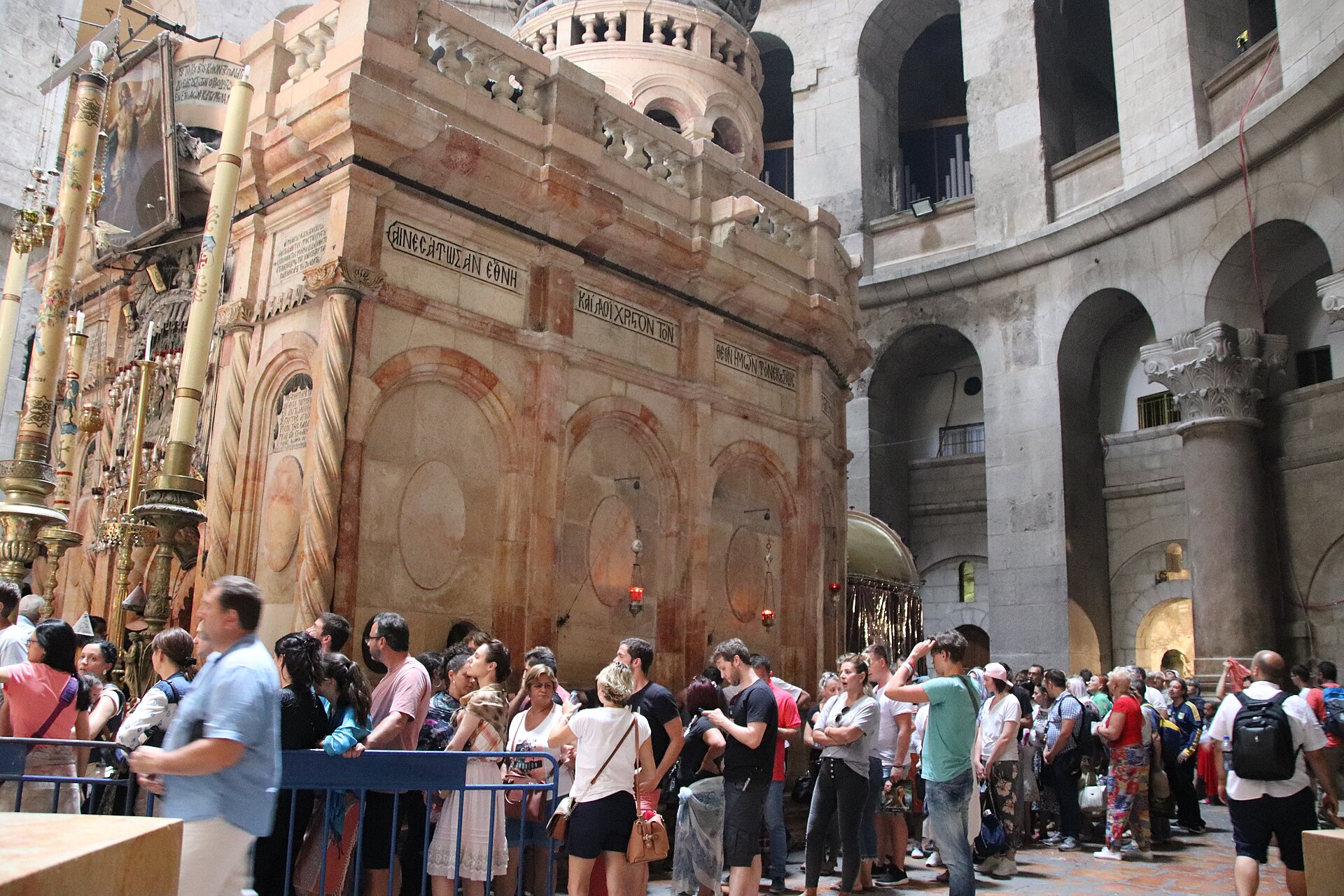
- Late morning: the Church of the Holy Sepulchre, the Stone of Anointing, Calvary and the Aedicule.
- Lunch: in the Christian Quarter, or back out at Jaffa Gate.
Pilgrims planning a longer stay will find this sits naturally in our Christian pilgrimage guide and the day-by-day Holy Land pilgrimage itinerary.
Final Word on the Garden Tomb
The Garden Tomb does not ask you to believe it is the place, and that is part of its quiet appeal. Go in the morning, sit in the garden for a while, look into the empty tomb, and then walk back into the Old City to see the Holy Sepulchre with fresh eyes. For the wider story of these sites, see our guides to biblical sites in Jerusalem and the Garden of Gethsemane, and if you are spending a few days in the city, our list of free things to do in Jerusalem has more places like this one.
Photo Credits
The tomb entrance at the Garden Tomb: Jerusalem-Garden-Tomb-KTM-1266 by Bukvoed, CC BY 4.0, via Wikimedia Commons.
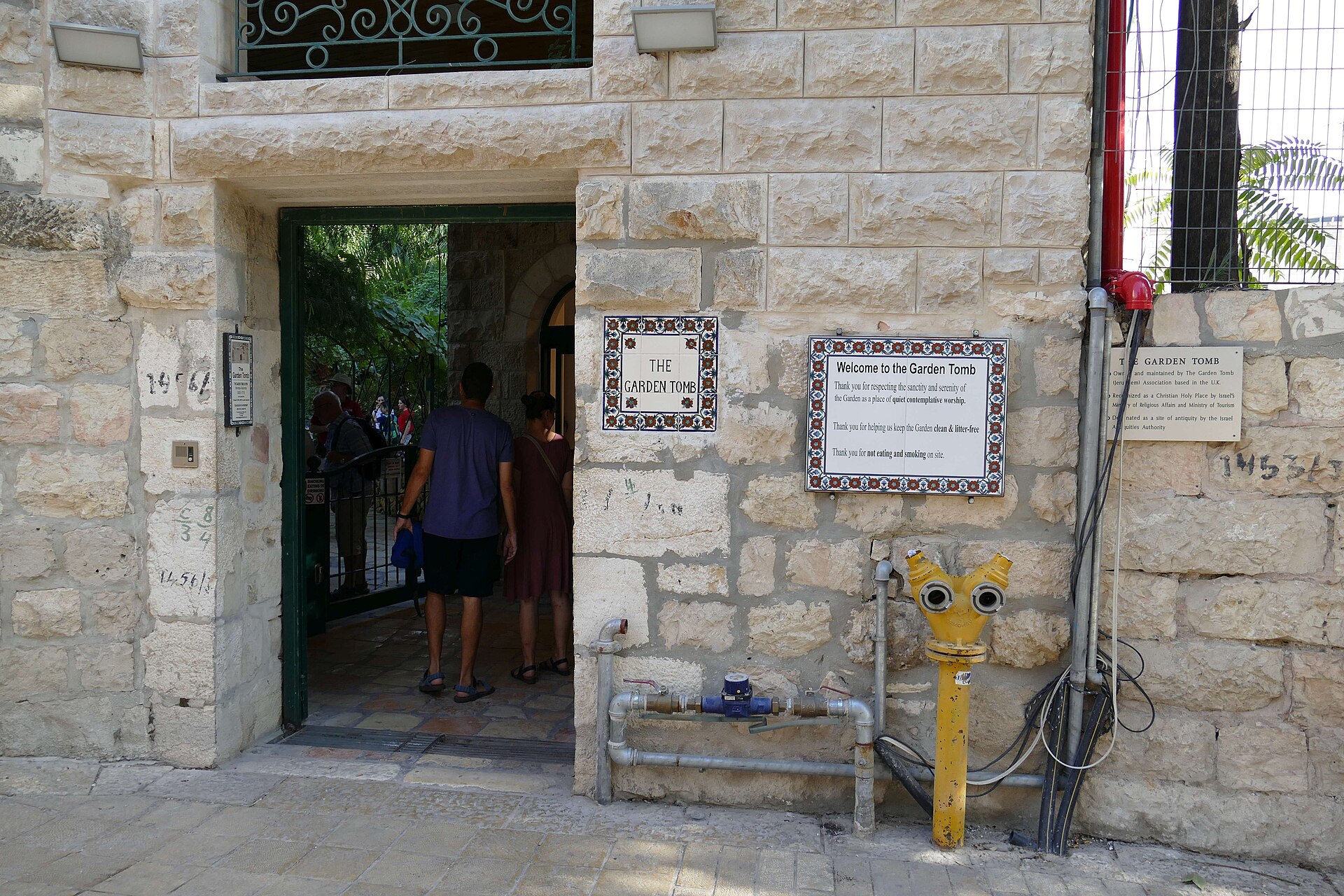
The Garden Tomb gate on Conrad Schick Street: Jerusalem-Garden-Tomb-KTM-1262 by Bukvoed, CC BY 4.0, via Wikimedia Commons.
Gospel plaque in the garden: Jerusalem-Garden-Tomb-KTM-1265 by Bukvoed, CC BY 4.0, via Wikimedia Commons.
Skull Hill above the bus station: 20110224 Israel 0384 Jerusalem (5539897905) by Dan Lundberg, CC BY-SA 2.0, via Wikimedia Commons.
Early photograph of Gordon’s Calvary: Exterior, Garden Tomb, Gordon’s Calvary LOC matpc.08478 by Matson Collection, Public domain, via Wikimedia Commons.