The Western Wall in Jerusalem is the most sacred prayer site in Judaism — the last remaining structure of the Second Temple complex destroyed by the Romans in 70 CE. It never closes, it costs nothing, and it asks nothing of you except basic respect. Come at 6 AM and you will share the stones with a few dozen early risers and the pigeons; come at Friday sunset and you will stand among hundreds singing in the Sabbath. We have visited at both extremes and a dozen times in between, and it lands differently every single time.
This complete visitor’s guide to the Western Wall in Jerusalem for 2026 covers history, what to expect, etiquette, dress code, the best times to visit, the prayer-note tradition, security procedures, accessibility, photography rules, and the broader Western Wall plaza experience. Pair this with our complete guide to Jerusalem holy sites and Old City Quarters guide.

What Is the Western Wall?
The Western Wall (Hebrew: HaKotel HaMaaravi, “The Western Wall,” or simply The Kotel) is a 488-meter-long limestone retaining wall built by King Herod the Great around 19 BCE to expand the Temple Mount platform. The visible portion above ground is only ~57 meters wide and represents about 10% of the full wall — the rest extends north and south underground (see our Western Wall Tunnels Tour guide).
After the Roman destruction of the Second Temple in 70 CE, the Western Wall became the closest point Jews could pray to the former site of the Holy of Holies. For nearly 2,000 years, it has been Judaism’s most sacred prayer site and a focal point of Jewish identity, longing, and return. The Wall anchors a wider circuit of Jewish holy sites across Jerusalem, from the Hurva Synagogue to the tombs on the Mount of Olives.
How to Read the Stones
One thing worth carrying into the plaza: the Western Wall is not a wall of the Temple. It is a retaining wall. Herod’s engineers wanted a single level esplanade on top of an uneven hilltop, so they built an enormous rectangular box around the summit, packed it with fill and vaulting, and paved the top. The Temple stood somewhere on that paved surface, and nothing of it survives above ground. What you put your hand on is the outer skin of the box, on its western side — the side nearest where the Holy of Holies is traditionally placed. The platform it holds up is the same esplanade that carries the Dome of the Rock and al-Aqsa Mosque today, which is why the two sites are physically inseparable.
Knowing that turns the Wall from a photograph into something you can read. The masonry is not uniform — it was built in one period, damaged, patched, raised and patched again, and the joins are visible from where you stand.
- The bottom courses — Herodian, around 19 BCE. Enormous limestone blocks, most about a metre high and two to five metres long, weighing several tonnes each. The giveaway is the dressing: a flat, finely chiselled border a hand’s width wide runs around all four edges of every block, framing a slightly raised central panel. Once you spot that margin you will never mistake Herodian work for anything else in Jerusalem.
- The middle courses — early Islamic, seventh to eighth century. Noticeably smaller stones, plainer faces, no margins. The line between the last big block and the first small one is the clearest chronological seam on the whole facade.
- The upper courses — later medieval, Ottoman and nineteenth century. Smaller again, more roughly finished, added to raise and stabilise the wall rather than to build anything sacred.
Two details reward a slow look. The Herodian blocks were laid dry, without mortar — weight and precision hold them in place, and a business card will not go into most of the joints. And each course sits back a centimetre or two from the one beneath, so the face leans very slightly away from you as it rises. That was deliberate: it stops the elevation reading as a blank cliff.
Three features in the visible stretch get walked past. In the women’s section, near the southern end, a colossal lintel sits above a blocked opening — Barclay’s Gate, one of the original entrances up onto the platform, sealed since antiquity. At the far left of the men’s section the roofed hall shelters under Wilson’s Arch, which once carried a bridge from the Upper City. Beyond the southern end of the prayer area, the stub of Robinson’s Arch juts from the wall face — the springing point of a monumental staircase that came down into the street below.
If the stones grab you, going underground is the natural next step: the excavated passages running north along the buried courses reach the largest block in the structure, roughly 13.6 metres long and estimated at several hundred tonnes, still sitting where it was placed. One last thing at eye level in the plaza — the stone is polished smooth and slightly darkened to about the height of an outstretched hand, and rough above it. That is not weathering. That is contact.
Hours and Admission
- Hours: Open 24/7, 365 days a year.
- Admission: Free, no ticket needed.
- Security check at the plaza entrance (small bag inspection).
- Friday sunset to Saturday nightfall (Shabbat): Plaza is open but no photography or use of electronics (including phones).
Getting There
The plaza sits in the southeast corner of the Old City, below the Jewish Quarter. There is no parking at the Wall itself, and driving into the Old City is not an option, so plan on arriving on foot for the last stretch whichever way you come.
- Light rail: Red Line to City Hall or Damascus Gate, then a 15–20 minute walk through the Old City. From Jaffa Gate, the most direct route runs through the Armenian Quarter and down through the Jewish Quarter — follow the brown “Western Wall” signs.
- Bus: Lines 1 and 3 stop near Dung Gate, the closest gate to the plaza (about 5 minutes on foot from the security check).
- Taxi: Ask for “Sha’ar HaAshpot” (Dung Gate). A ride from the city center runs around 30–45 ILS on the meter.
- Parking: The closest paid lot is by Dung Gate near the City of David; it fills by mid-morning. Mamilla’s underground garage plus a 20-minute walk is the more reliable choice.
Staying close pays off here more than anywhere else in the city, because the Wall rewards repeat visits at odd hours. See our guide to hotels near the Western Wall and the broader roundup of hotels inside the Old City.
Best Times to Visit
- Sunrise (5:30-7:00 AM): Quietest, most contemplative. Recommended for first visit.
- Mid-morning weekdays (9-11 AM): Busier; many tour groups.
- Friday afternoon (3-5 PM in summer, earlier in winter): Pre-Shabbat preparations build energy.
- Friday at sunset (Kabbalat Shabbat): Hundreds of locals welcoming the Sabbath with singing and dancing. The most uplifting time.
- Saturday morning: Heavy religious service.
- Holidays (Yom Kippur, Tisha B’Av, Sukkot): Mass gatherings.
How to Visit the Western Wall
- Enter the Old City through any gate. Jaffa Gate or Dung Gate are closest.
- Walk to the Western Wall plaza (signs in multiple languages).
- Pass through the security checkpoint (small bag inspection).
- Two prayer sections — men’s (left, larger) and women’s (right, smaller).
- Cover your head before approaching (free paper kippot at the entrance for men).
- Approach the wall. Place your hand on the stone. Pray or reflect.
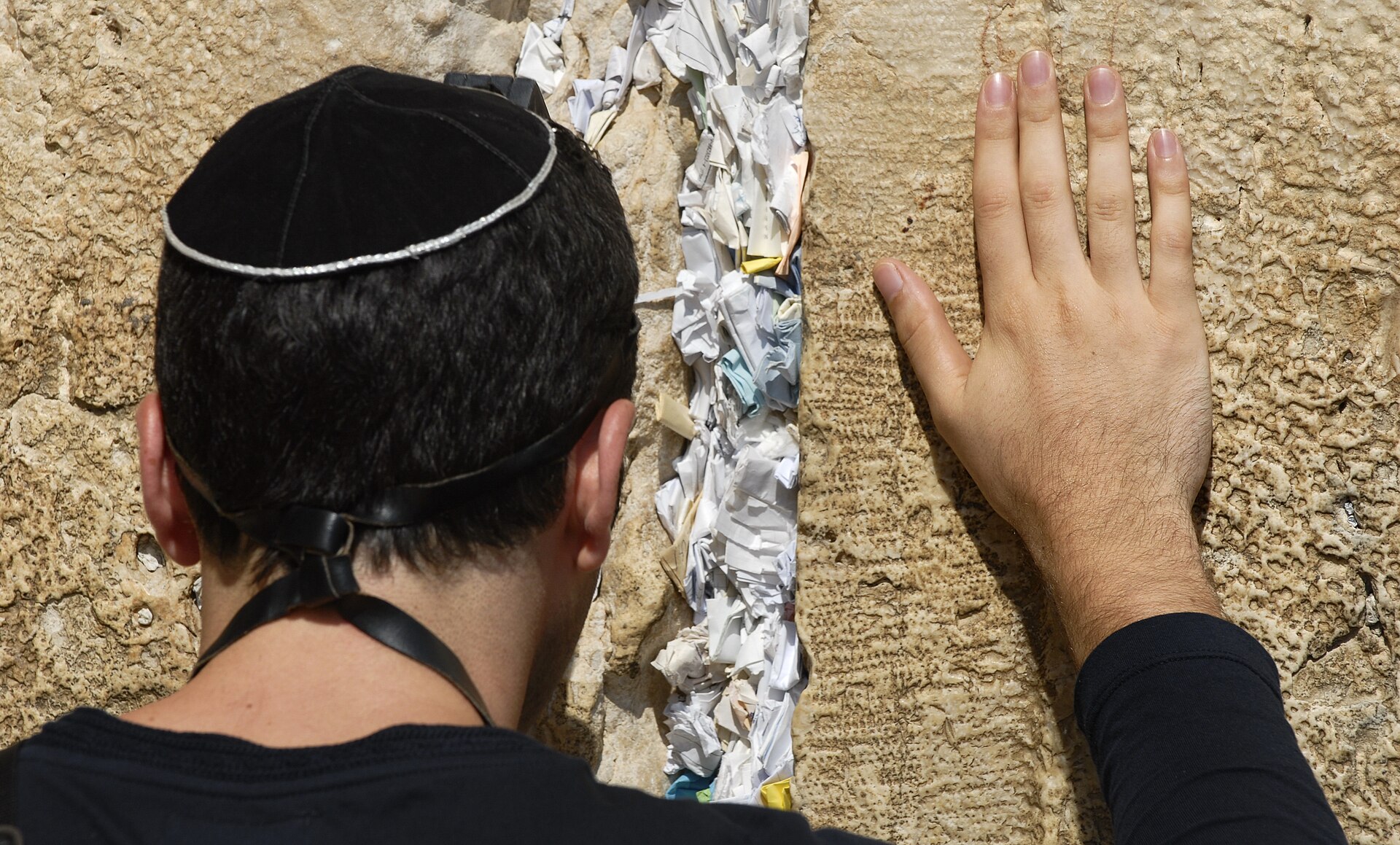
- Many visitors write a prayer note (kvitel) and place it in a crack in the wall — see below.
- Walk backward away from the wall as a sign of respect when leaving.
The Men’s and Women’s Sections
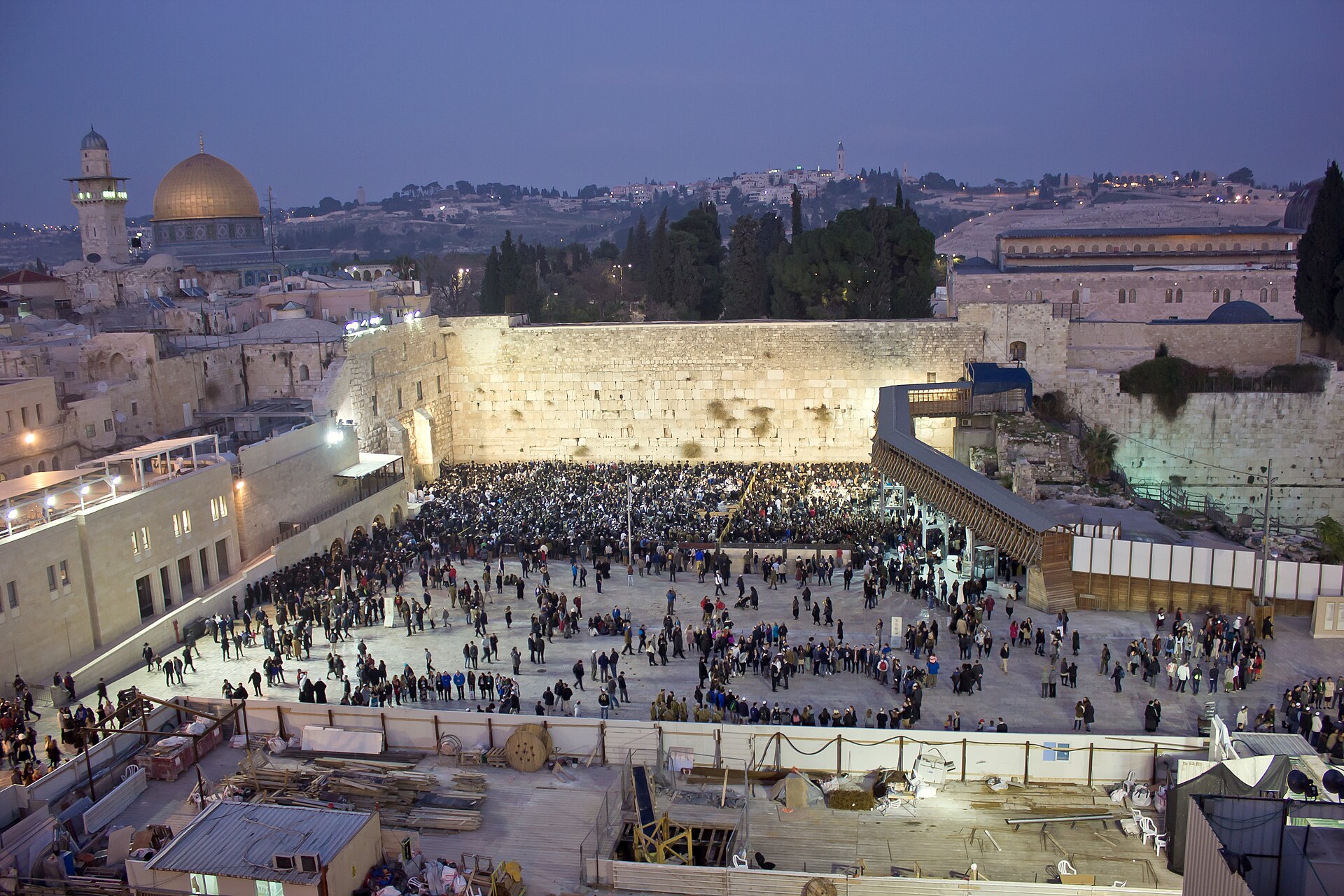
The prayer area in front of the Wall is divided by a partition called a mechitza, following Orthodox practice. Facing the Wall, the men’s section is on the left and takes up roughly two thirds of the width; the women’s section is on the right. Both have plastic chairs, prayer books on open shelves, and shaded areas. Couples and mixed groups split up at the divider and meet again in the open plaza behind, where everyone mingles freely.
Two additional prayer spaces are easy to miss. Wilson’s Arch, the covered hall at the left edge of the men’s section, sits under a 2,000-year-old stone arch and stays open around the clock — it is air-conditioned, quiet, and the best place to be on a rainy or 35°C day. South of the Mughrabi ramp, the Ezrat Yisrael platform (sometimes called the Robinson’s Arch section) is a separate deck set aside for egalitarian, mixed-gender prayer; it is reached through the Davidson Archaeological Park entrance and is far less crowded than the main plaza.
Bar Mitzvah Mornings: Mondays and Thursdays
The Torah is read publicly on Monday and Thursday mornings, which makes those the traditional days for bar mitzvah ceremonies at the Wall. Arrive between roughly 8:00 and 10:00 AM and you will see a procession every few minutes: a thirteen-year-old under a canopy, drummers and shofar blowers leading the way, fathers and grandfathers carrying the Torah scroll, and candy flying through the air. Female relatives, who cannot enter the men’s section, stand on plastic chairs along the partition to watch and ululate — it sounds chaotic, and it is, in the best way.
If you want a lively, joyful Wall, come on a Monday or Thursday morning. If you want silence, come literally any other weekday morning before 8. For help slotting this into a wider plan, see our first-time visitor guide.
The Prayer Note Tradition
The tradition of writing a prayer on a small piece of paper (a kvitel) and placing it in the cracks between the stones dates back at least 300 years. Visitors of all faiths and backgrounds participate. Notes can be:
- Written in any language.
- As short or long as you wish.
- Prayers, requests, thanks, or names of loved ones.
Twice a year (before Passover and Rosh Hashanah), the notes are collected and respectfully buried on the Mount of Olives.
You can also submit a prayer note remotely via the Western Wall Heritage Foundation website — they will print and place it for you.
Dress Code
- Men: Head covering required (free paper kippot available). Shoulders and knees covered.
- Women: Shoulders and knees covered. No head covering required for non-married women. Married Jewish women often cover their hair.
- Shawls are available free at the entrance for those needing them.
Etiquette and Cultural Sensitivity
- No photography on Shabbat (Friday sunset to Saturday nightfall) or major Jewish holidays. Strictly enforced.
- No smoking in the plaza.
- Quiet voices near the wall itself. Conversation is fine in the broader plaza.
- Don’t disturb worshippers. If someone is praying intensely or rocking back and forth (davening), give them space.
- Walking backward away from the wall is traditional. Tourists are not obligated but it’s appreciated.
- No phone calls on or near the wall.
- Bar/Bat Mitzvah ceremonies occur regularly. Observe respectfully.
Accessibility
- Wheelchair accessible via the ramp at the Dung Gate entrance.
- The plaza is paved and level.
- Free Wi-Fi.
- Restrooms available.
- Free water fountains.
Security and Photography
- Security check at all entrances. Small bag inspection. Quick.
- Cameras are welcome Sunday through Friday afternoon.
- No flash photography directly at worshippers; ask permission for close portraits.
- Photography prohibited on Shabbat and Jewish holidays — even phone photos. The plaza is monitored.
- Tripods generally allowed at off-peak times.
Connected Sites Worth Visiting
- Western Wall Tunnels Tour (paid, book ahead) — see our dedicated Western Wall Tunnels Tour guide.
- Davidson Center Archaeological Park — adjacent to the plaza.
- Temple Mount esplanade — accessible via the Mughrabi Bridge during non-Muslim visiting hours; see our Dome of the Rock guide.
- Jewish Quarter — climb the staircase up from the plaza.
- City of David — 5-minute walk south from Dung Gate.
Friday Night at the Wall
One of the most moving experiences in Jerusalem. Beginning ~30 minutes before sunset, hundreds of people fill the plaza to welcome Shabbat (Kabbalat Shabbat). Some sing in circles, some dance, families bring children, soldiers come in uniform. Visitors of all faiths are welcome to observe respectfully. No photography. Free, open, profound.
Where to Eat Nearby
The plaza itself has water fountains and not much else, which is part of its dignity. Climb the staircase into the Jewish Quarter and you reach Hurva Square in about five minutes, where a cluster of cafes and falafel counters serves quick lunches in the 35–60 ILS range. Walk ten minutes north along El-Wad Street into the Muslim Quarter and you hit Abu Shukri, the hummus institution near the Via Dolorosa corner — a plate with pita and pickles runs around 35–45 ILS, and it closes by late afternoon. The rooftop cafe of the Austrian Hospice, with its apple strudel and views over the Old City, is a few minutes further up the same street.
One caution: on Fridays and Saturdays the Jewish Quarter options close for Shabbat, while the Muslim Quarter stays open. Time your meal accordingly, and check our Jerusalem travel tips for the full rundown of opening-day quirks.
Historical Context
- 10th century BCE: Solomon builds the First Temple on the Temple Mount.
- 586 BCE: Babylonians destroy the First Temple.
- 515 BCE: Second Temple completed.
- 19 BCE: Herod the Great rebuilds and expands the Temple Mount platform — the Western Wall is part of these retaining walls.
- 70 CE: Romans destroy the Second Temple. The Western Wall remains standing.
- 1948–1967: Jordanian control; Jews barred from the Wall.
- 1967 (Six-Day War): Israel captures the Old City. Jewish access restored.
- Today: Open to all visitors and faiths.
Two details in that timeline deserve a longer look. First, the Wall you pray at today was an ordinary retaining wall to its builders — Herod’s engineers were holding up a platform, not making a shrine. Its sanctity grew out of catastrophe: after 70 CE it was simply the nearest surviving piece of the Temple complex that Jews could reach, and centuries of prayer did the rest. Ottoman records from the 16th century already describe Jewish worship here, and Suleiman the Magnificent formally recognized the right to pray at the Wall.
Second, the broad plaza is new. Until 1967 worshippers squeezed into a stone alley barely four meters wide, hemmed in by the houses of the Moroccan Quarter. In the days after the Six-Day War, Israeli authorities demolished that quarter to create the open space you see today — a transformation that remains historically charged, and worth knowing about as you stand in it. The exposed stretch of Wall was also extended downward: archaeologists cleared two more courses of Herodian stone, so today’s Wall is taller than the one in pre-1948 photographs. The full story continues underground in the Western Wall Tunnels, and the political history of the site is covered in our Jerusalem history guide.
The Rest of the Complex: Tunnels, Museums and the Archaeological Park
The free, open-all-hours prayer area is one part of what rings the plaza. Four separate paid attractions sit around it, and they are genuinely different experiences — you do not need all four. Prices below were checked in August 2026; confirm before you go, because they move.
The Western Wall Tunnels
The one to prioritise if you add a single paid item. A guide walks you north along the buried face of the same wall through Hasmonean-era water channels, ritual baths and vaulted chambers. Adults pay 38 NIS; children aged 5–18, students, soldiers, seniors and visitors with disabilities pay 25 NIS, including a guided tour of about an hour and ten minutes. Entry is by booking only — you cannot walk up — and groups are capped at 35. Published hours run Sunday to Thursday from 07:20 until late evening and Friday 07:20 to noon, with Saturday-night slots by arrangement. Book via the Western Wall Heritage Foundation or on +972-2-627-1333, Sunday to Thursday 08:30–17:00. English departures fill first in spring and autumn. Our full walkthrough of the route is in the dedicated tunnels guide.
The Chain of Generations Centre
Quieter and stranger: a sequence of underground halls beneath the plaza filled with sculpted glass, lit and scored as a walk-through narrative of Jewish history. It takes around 45 minutes and suits people who find conventional museums heavy going. Adults are 30 NIS, with children, students, soldiers, seniors and visitors with disabilities at 15 NIS as of August 2026. Advance booking is required through the same call centre, hours are shorter than the tunnels and it closes early on Friday — check the Chain of Generations Center page for the current timetable. Small children may find the dark halls a lot.
The Davidson Centre and the Jerusalem Archaeological Park
Immediately south of the plaza, reached from just inside Dung Gate, this open-air park covers the excavated ground at the southern corner of the platform: the Herodian street with the collapsed stones still lying where they fell in 70 CE, the broad southern staircase pilgrims climbed, the Hulda Gates, and Robinson’s Arch from below rather than above. It is the best place in Jerusalem to understand what the Wall was part of, and it is almost always quieter. Ticketing is handled alongside the City of David excavations, with a combined Pool of Siloam and archaeological garden ticket from 28 NIS per person listed on the City of David ticketing site. Hours follow the national park: roughly 09:00–17:00 Sunday to Thursday and 09:00–14:00 Friday in winter, extending to 19:00 and 15:00 in summer, closed Saturday. There is almost no shade. Go early.
The Ezrat Yisrael platform at Robinson’s Arch
South of the Mughrabi ramp, a raised deck alongside the archaeological remains functions as a prayer space where men and women pray together, without the partition used in the main plaza. It has been in use since 2013 and is reached through the archaeological park entrance rather than the main security check. Its status has been the subject of prolonged public and political disagreement in Israel: a 2016 government decision to expand it into a larger permanent section with a shared entrance was suspended in 2017, and the arrangement has remained broadly unchanged since. As it stands the platform is small, far less crowded than the main plaza, and sits directly beneath some of the most dramatic Herodian masonry on the site. Access and practice are actively negotiated at several places in the city, a pattern the wider survey of Jerusalem’s sacred sites returns to repeatedly.
One-day sequencing: archaeological park at opening, up into the lanes and squares of the Jewish Quarter for lunch, tunnels mid-afternoon, then the plaza for late light. Under 100 NIS in admissions per adult.
The Wall Across the Jewish Year
The plaza has a calendar, and it changes the site more than the time of day does. On an ordinary Tuesday you share it with a few hundred people. On half a dozen dates a year, tens of thousands arrive and the character of the place inverts. None of these charge admission or require registration — only that you turn up early.
Birkat Kohanim — the priestly blessing at Passover and Sukkot
Twice a year, on the intermediate days of Passover in spring and Sukkot in autumn, hundreds of men of priestly descent gather at the front of the men’s section, draw their prayer shawls over their heads and recite the priestly blessing in unison to a packed plaza. Attendance has been reported above 50,000 at recent gatherings, and the visual — an unbroken field of white wool — is unlike anything else in the city. The blessing falls within the morning service, so be in the plaza by around 08:00, and expect it to be run twice to handle the numbers.
Tisha B’Av — the fast for the destruction
In midsummer, the ninth of Av marks the destruction of both Temples, and the Wall is the natural place to observe it. Thousands sit on the ground or on low stools from nightfall reading the Book of Lamentations, and the fast continues through the next day. It is sombre rather than spectacular, and it is arguably the most revealing night of the year for a visitor trying to understand why this stretch of retaining wall matters. Restaurants across Jewish West Jerusalem close.
Selichot before the High Holidays
For the weeks before Rosh Hashanah, and intensively in the nights before Yom Kippur, penitential prayers are recited at the Wall in the small hours, typically from around midnight to 02:00. Crowds on the biggest Selichot nights run to tens of thousands, the Old City lanes stay busy until dawn and extra transport is laid on. If you are in Jerusalem in September this is the most atmospheric thing available to you, and almost no tourist itinerary includes it.
Yom Kippur, Hanukkah and the smaller set-pieces
On Yom Kippur the country stops — no flights, no buses, no cars on most roads — and people walk in from every direction, many in white; photography and phone use are prohibited across the full 25 hours. Giant oil lamps are kindled in the plaza on each night of Hanukkah in December. Jerusalem Day in late spring brings marches and a loud, young, flag-carrying crowd. The first day of each Hebrew month draws its own gatherings, including monthly prayer by women at the Wall that has been a focus of public argument in Israel for decades. The rhythm of these dates sits in our overview of Jewish sites and observance around the city, and the backstory of how the plaza came to look as it does is in the city history guide.
Shabbat at the Wall: The Rules in Detail
Shabbat begins at sunset on Friday and ends at nightfall on Saturday — roughly forty minutes to an hour after Saturday sunset, not at sunset itself. Across that whole window, use of electronic devices anywhere in the plaza is prohibited: no photographs, no video, no calls, no checking messages, no smartwatch. This is not a polite request. Stewards patrol, the rule is enforced, and pulling out a phone to capture the Friday-night singing is the fastest way to be approached and asked to stop. Leave it in your bag until you are back up the steps.
The same applies on Jewish festivals and Yom Kippur. Smoking is prohibited in the plaza at all times. Writing is also avoided on Shabbat, so write your prayer note before Friday sunset if you want to place one that weekend.
What the plaza provides, free and without asking, is more than most visitors expect:
- Paper skullcaps for men at the entrance to the men’s section, and shawls for anyone needing to cover shoulders.
- Prayer books on open shelves in both sections, in Hebrew and several translations — take one, use it, put it back.
- Drinking-water fountains and ritual handwashing basins at the edge of the prayer area.
- Toilets, shaded seating and plastic chairs you are free to move.
- Nothing to buy. There is no shop, no ticket desk and no donation pressure at the Wall itself.
Getting there on a Saturday takes planning, because Israeli buses and the light rail stop from Friday afternoon until Saturday night. From West Jerusalem you either walk — 30 to 40 minutes from the centre — or take an Arab-operated taxi from around Damascus Gate, which does run. Our guide to how the city works from Friday afternoon to Saturday night covers what stays open, and the walkthrough of the walled city and its gates explains which entrances stay busy after dark.
Where to See the Wall From Above
Standing at the Wall, you cannot see the Wall. You see stone at arm’s length and a lot of sky. To grasp the shape of the place — the scale of the platform, the relationship between plaza, esplanade and golden dome — you need height, and there are several ways to get it within a few minutes’ walk.
- The plaza’s own upper terrace. Free, and barely used. Come down the steps from the Jewish Quarter and stop at the railing on the western side before the security check. You look straight down the axis of the prayer area with the platform rising behind. Best in the two hours before sunset.
- The Hurva Synagogue lookout. A walkway around the base of the dome gives a 360-degree sweep over the rooftops to the Mount of Olives, the Dome of the Rock and the plaza. Tickets start from around 12 NIS and the visit takes about half an hour; book through the Jewish Quarter tourism office. The spiral stair is narrow and there is no lift.
- The Aish World Center roof. The modern stone building facing the plaza has a rooftop terrace with a large-scale model of the Second Temple set against the real skyline. Access is usually by donation or short visit and hours are irregular, so ask at the door.
- The Mughrabi ramp. The covered walkway carrying non-Muslim visitors up to the esplanade passes over the southern end of the prayer area, giving an unusual downward view. Open only during the restricted visiting hours above.
If you have one afternoon, do it in this order: rooftop first for the geography, then the plaza at ground level, then the tunnels for the underground extension of the same stone. It reads as a single story that way. Fitting it around everything else is covered in our quarter-by-quarter guide to the walled city, with the surrounding synagogues in the Jewish Quarter walking route.
Final Word: The Single Most Powerful Spot
For most visitors, the Western Wall in Jerusalem is the single most emotionally powerful spot in the entire city — regardless of religious background. Visit it more than once, at different times of day, and absorb the layers. Pair this with our guide to Jerusalem holy sites, Tunnels Tour guide, and Old City Quarters guide.
Photo Credits
A worshipper’s hand on the Western Wall beside a crack full of prayer notes: Prayer at the Western Wall (2008-01) by Simon Mannweiler, CC BY-SA 4.0, via Wikimedia Commons.
The Western Wall plaza on a Friday evening at dusk: Jerusalem Western Wall Friday evening 12 January 2018 by Demetrios Karatassos, CC0, via Wikimedia Commons.
{"@context": "https://schema.org", "@type": "FAQPage", "mainEntity": [{"@type": "Question", "name": "Can non-Jews visit the Western Wall?", "acceptedAnswer": {"@type": "Answer", "text": "Yes — anyone can visit, regardless of faith or background. The plaza is open to all visitors."}}, {"@type": "Question", "name": "Do I have to pray?", "acceptedAnswer": {"@type": "Answer", "text": "No. Many visitors simply observe respectfully. Prayer is welcome but not required."}}, {"@type": "Question", "name": "What if I'm not Jewish — can I still write a prayer note?", "acceptedAnswer": {"@type": "Answer", "text": "Yes. People of all faiths write notes. There is no requirement to be Jewish."}}, {"@type": "Question", "name": "What time is best for first visit?", "acceptedAnswer": {"@type": "Answer", "text": "Sunrise (5:30-7:00 AM in summer, 6:30-8:00 AM in winter) is the quietest and most contemplative. For energy, Friday late afternoon as Shabbat approaches."}}, {"@type": "Question", "name": "Is the Western Wall the same as the Wailing Wall?", "acceptedAnswer": {"@type": "Answer", "text": "Yes. \"Wailing Wall\" is the older English name. \"Western Wall\" or \"Kotel\" are current preferred names."}}, {"@type": "Question", "name": "Can I take photos at the Western Wall?", "acceptedAnswer": {"@type": "Answer", "text": "Yes, Sunday through Friday afternoon. Strictly prohibited on Shabbat and Jewish holidays. No flash on worshippers; ask before close portraits."}}, {"@type": "Question", "name": "Are there guided tours of the Western Wall?", "acceptedAnswer": {"@type": "Answer", "text": "Yes — the Western Wall Heritage Foundation runs free 45-minute introduction tours in English Sun-Thu at 11 AM and 2 PM. The paid Western Wall Tunnels Tour (essential) is by reservation only."}}, {"@type": "Question", "name": "How much does the Western Wall Tunnels tour cost and can I just turn up?", "acceptedAnswer": {"@type": "Answer", "text": "As of August 2026 adults pay 38 NIS and children aged 5–18, students, soldiers, seniors and visitors with disabilities pay 25 NIS, including a guided tour of about 70 minutes. You cannot turn up on spec — entry is by advance booking only through the Western Wall Heritage Foundation, and English-language slots in spring and autumn often sell out a week or more ahead."}}, {"@type": "Question", "name": "Is there anywhere at the Western Wall where men and women can pray together?", "acceptedAnswer": {"@type": "Answer", "text": "Yes. The Ezrat Yisrael platform at Robinson’s Arch, south of the Mughrabi ramp and reached through the archaeological park entrance, is a mixed-gender prayer area without a partition and has operated since 2013. Its long-term arrangement has been the subject of continuing public debate in Israel, but the platform itself is open and in regular use."}}]}