The Jewish Quarter is the most carefully restored corner of Jerusalem’s Old City, a sun-warmed maze of pale limestone where Roman columns, medieval synagogues, and modern apartments share the same lanes. Largely rebuilt after the fighting of 1948, it feels cleaner and quieter than the market-filled quarters around it, yet it sits directly above the Western Wall and some of the deepest archaeology in the city. This guide covers what to see in the Jewish Quarter of Jerusalem, how to navigate it, opening hours, prices in shekels, and the Shabbat rhythm that shapes any visit.
Compact enough to cross in fifteen minutes but layered enough to fill an afternoon, the Jewish Quarter rewards slow walking. It is one of the four quarters of the Old City, alongside the Christian, Muslim, and Armenian Quarters, and the most logical base from which to reach the holiest sites of Judaism. Here is how to make the most of it.
A Brief History of the Jewish Quarter
Jews have lived in this part of the Old City for well over a thousand years, and the quarter took its recognizable shape under Ottoman rule. In 1948, during the war that followed the end of the British Mandate, the quarter fell and its synagogues were destroyed; the area passed to Jordanian control for nineteen years. After 1967, Israel rebuilt the quarter, and archaeologists used the reconstruction as a chance to excavate. The result is unusual: a living neighborhood deliberately layered over its own ruins, where you can stand on a 2,000-year-old street beneath a 1970s home. For the deeper story, see our Jewish holy sites in Jerusalem guide.
Etiquette and Best Time to Visit
The Jewish Quarter is a living religious neighborhood, so a little awareness goes a long way. Dress modestly with shoulders and knees covered, keep your voice down near synagogues and homes, and ask before photographing people at prayer. On Shabbat and Jewish holidays, refrain from photography at the Western Wall and avoid smoking or using your phone openly in the streets.
For the best experience, come on a weekday morning when the light is soft on the limestone and the tour groups have not yet filled Hurva Square. Spring and autumn bring the most comfortable weather; summer middays are hot, so pause for shade and water, and winter can be cool and occasionally wet. Whatever the season, build your sightseeing into Sunday through Thursday and let Friday evening and Saturday belong to the quieter, more reflective side of the quarter. Our guide to Jerusalem’s modest dress rules covers exactly what to wear at each kind of site.
What to See in the Jewish Quarter
The sites below cluster within a few hundred metres of each other around the central Hurva Square.
The Western Wall (Kotel)
At the eastern edge of the quarter, steps descend to the Western Wall plaza, the holiest site where Jews pray today. The plaza is open 24 hours, free, with separate men’s and women’s prayer sections. It is the spiritual anchor of the whole quarter, and most visits begin or end here. Cover your head (free paper kippot for men), dress modestly, and avoid photography on Shabbat and holidays.
The Hurva Synagogue
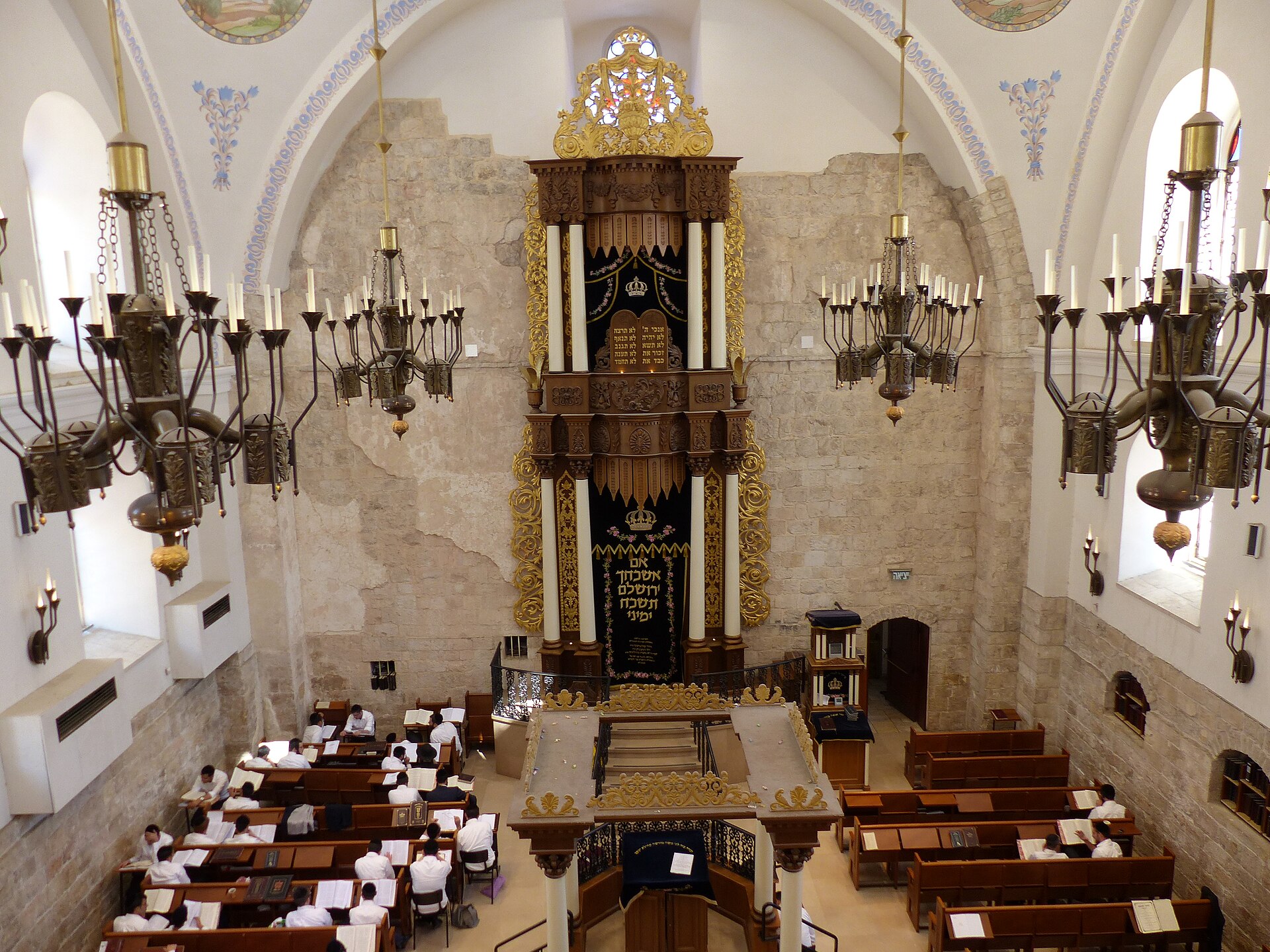
The Hurva (“the Ruin”) rises over the quarter with its great white dome, reopened in 2010 after a meticulous reconstruction of the 19th-century building destroyed in 1948. Inside, painted ceilings and a soaring ark reward a look, and a climb to the upper gallery gives one of the best rooftop panoramas in the Old City. Modest entry fees apply for the gallery; it generally opens Sunday to Thursday with shorter Friday hours, closed Shabbat. For more vantage points, see our best viewpoints in Jerusalem guide.
The Four Sephardic Synagogues
This connected group of four 16th- and 17th-century synagogues sits partly below street level, a result of Ottoman-era height limits. Lovingly restored, they served the Sephardic Jews of the city for centuries and remain quietly atmospheric. A small entry fee supports their preservation; hours follow the quarter’s Sunday-to-Friday-morning pattern.
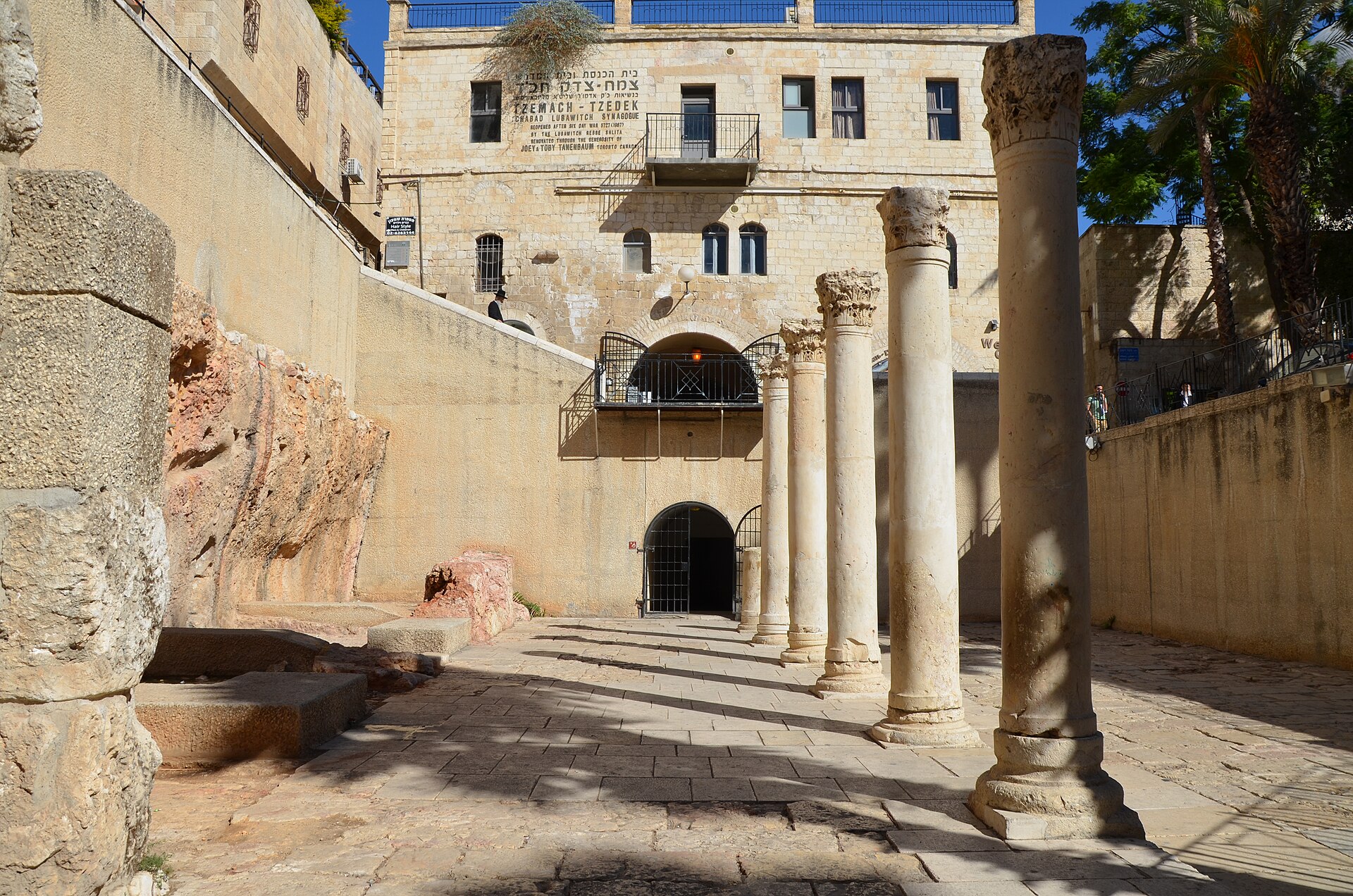
The Cardo
The Cardo was the main north-south street of Roman and Byzantine Jerusalem, and a restored stretch runs through the heart of the quarter. Reconstructed columns line a sunken walkway, and a covered section now holds upscale Judaica shops and galleries. A wall mosaic reproduces the 6th-century Madaba Map, the oldest surviving map of the city. The Cardo is open-air and free to walk; the shops keep daytime hours and close for Shabbat.
Burnt House (Beit Katros)
The Burnt House preserves the basement of a priestly family’s home, destroyed when the Romans burned Jerusalem in 70 CE. Charred walls, stone vessels, and a chillingly preserved spear point bring the city’s destruction to life, explained by a short audiovisual presentation. Tickets cost around 30 shekels, often available as a combined ticket with the Wohl Museum. Open Sunday to Thursday and Friday morning.
Wohl Archaeological Museum (Herodian Quarter)
Beneath the modern quarter lies the Herodian Quarter, the excavated mansions of Jerusalem’s wealthy priestly class from the Second Temple period. The Wohl Museum lets you walk among mosaic floors, ritual baths (mikvaot), and frescoed walls, the finest domestic remains of their era in the city. Entry is around 30 shekels, and it keeps the same Sunday-to-Friday-morning schedule.
The Cardo Rooftop and Quarter Views
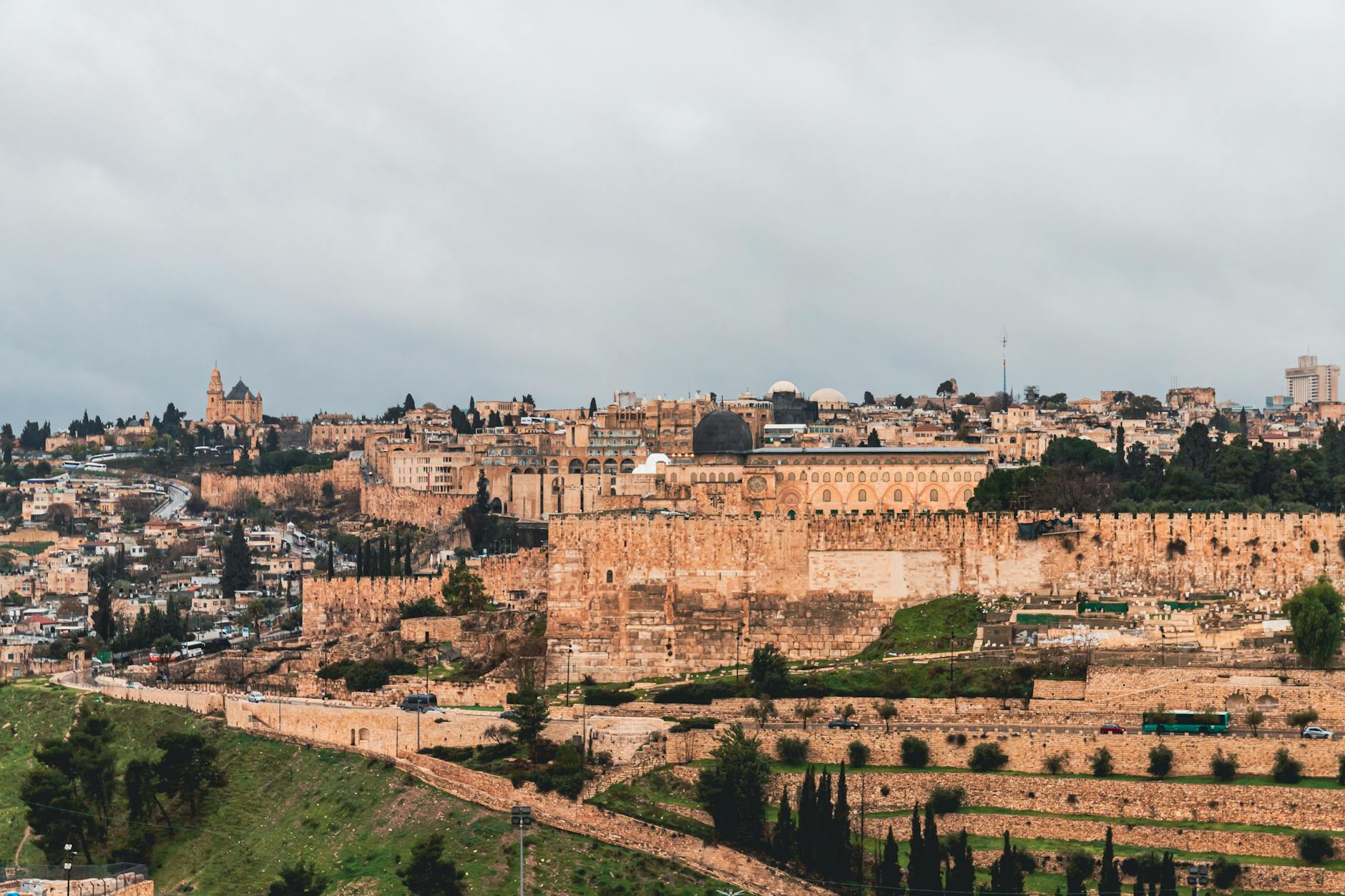
The Jewish Quarter’s high ground and open squares give some of the Old City’s clearest views toward the Temple Mount and across the rooftops to the other quarters. The terrace by the Hurva and the open area near the Cardo are good spots to pause with a coffee and orient yourself before heading back into the lanes. For a wider sweep, the Hurva Synagogue’s upper gallery and the nearby rooftop promenade look out over the gold of the Dome of the Rock, the spires of the Christian Quarter, and the Mount of Olives beyond the walls, a single frame that captures why so many traditions converge on this small city.
Food and Cafés in the Jewish Quarter
Dining here is overwhelmingly kosher, calmer and a little pricier than the street food of the souks. Around Hurva Square and the Cardo you will find dairy cafes, pizza and pasta spots, falafel and shawarma counters, and bakeries selling rugelach and burekas. A falafel runs roughly 18 to 25 shekels, a sit-down dairy meal perhaps 60 to 90 shekels. Crucially, almost everything closes from Friday afternoon until Saturday night for Shabbat, so plan meals accordingly; for a Saturday lunch, walk over to the Christian Quarter, where the cafes and bakeries stay open. Our kosher restaurants guide has fuller recommendations across the city.
Shopping in the Jewish Quarter
Shopping here leans toward quality Judaica rather than the haggling of the souks. The Cardo’s covered galleries sell silver, menorahs, mezuzahs, art, and fine ceramics at fixed (and not low) prices, and several artists keep studios in the quarter. It is a calmer, more boutique experience than the market lanes nearby, and a good place for a meaningful keepsake if bargaining is not your style.
Practical Tips for the Jewish Quarter
- Mind Shabbat. From Friday afternoon to Saturday nightfall, shops, museums, and most restaurants close, and the quarter goes quiet. Visit sites Sunday to Thursday; come Friday evening only for the Kotel. See our Shabbat in Jerusalem guide.
- Combine tickets. The Burnt House and Wohl Museum often sell a combined ticket; ask at either entrance to save a few shekels.
- Dress modestly. This is a religious neighborhood with synagogues and observant residents; cover shoulders and knees, and men should carry a head covering for the Wall.
- Wear good shoes. The stone lanes and steps are uneven and polished smooth; closed, grippy shoes are safest.
- Enter from Jaffa or Zion Gate. Both give easy access; Dung Gate is closest to the Western Wall and the southern archaeology.
- Go early or late. Midday tour groups crowd Hurva Square; mornings and late afternoons are calmer and better for photos.
- Respect residents. People live and pray here; keep noise down near synagogues and homes.
How to Get to the Jewish Quarter
The Jewish Quarter sits in the southeastern Old City, and the nearest gates are Zion Gate (a short, quiet walk straight into the quarter) and Dung Gate (closest to the Western Wall and the southern excavations). From the New City, the Light Rail Red Line stops at City Hall near Jaffa Gate; from there it is a ten-minute walk east through the Old City to Hurva Square. A single Light Rail ride costs around 6 shekels, and the line does not run on Shabbat. Taxis can drop you near Jaffa, Zion, or Dung Gate, but cannot enter the pedestrian lanes. Zion Gate also opens onto the quiet lanes of the Armenian Quarter, barely five minutes west. If you are coming from the airport or Tel Aviv, our Jerusalem transportation guide lays out every option. Within the quarter itself, everything is on foot over stone lanes and steps, so wear comfortable shoes and plan for a gentle uphill in places.
Suggested 3-Hour Walking Itinerary
Enter through Zion Gate and walk to Hurva Square (15 minutes), taking in the rebuilt Hurva Synagogue and climbing to its gallery for the view. Drop into the Four Sephardic Synagogues nearby, then follow the Cardo, pausing at the Madaba Map mosaic and the Judaica shops. Visit the Wohl Museum and the Burnt House to descend into the Herodian-era city (allow an hour for both). Pause for a kosher coffee or falafel near the square, then take the steps down to the Western Wall to finish at Judaism’s holiest accessible site. If you have more time, our Old City guide links the Jewish Quarter to the other three.
Where to Stay In and Near the Jewish Quarter
Sleeping inside the walls puts you steps from the Western Wall and lets you experience the Old City after the day-trippers leave. Options range from simple guesthouses to a few boutique stays, and the quarter’s quiet makes it a peaceful base. Note that vehicle access is limited and luggage may need to be carried over cobbles. Our guide to hotels in the Old City covers what is available and where, including the practicalities of staying within the walls.
Photo Credits
The restored Byzantine colonnade of the Cardo in the Jewish Quarter: Reconstructed southern section of the Cardo Maximus of Aelia Capitolina dating to the Byzantine era, Jerusalem (15010411884) by Carole Raddato from FRANKFURT, Germany, CC BY-SA 2.0, via Wikimedia Commons.
The prayer hall of the rebuilt Hurva Synagogue: Interior de la sinagoga Hurva, Jerusalén, Israel, 2017 01 by Benjamín Núñez González, CC BY-SA 4.0, via Wikimedia Commons.