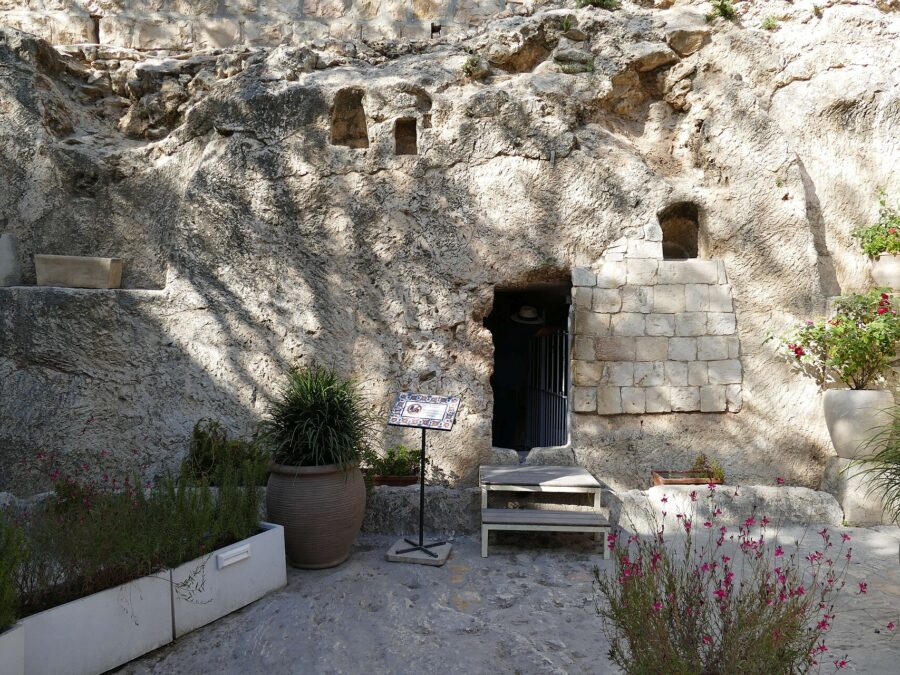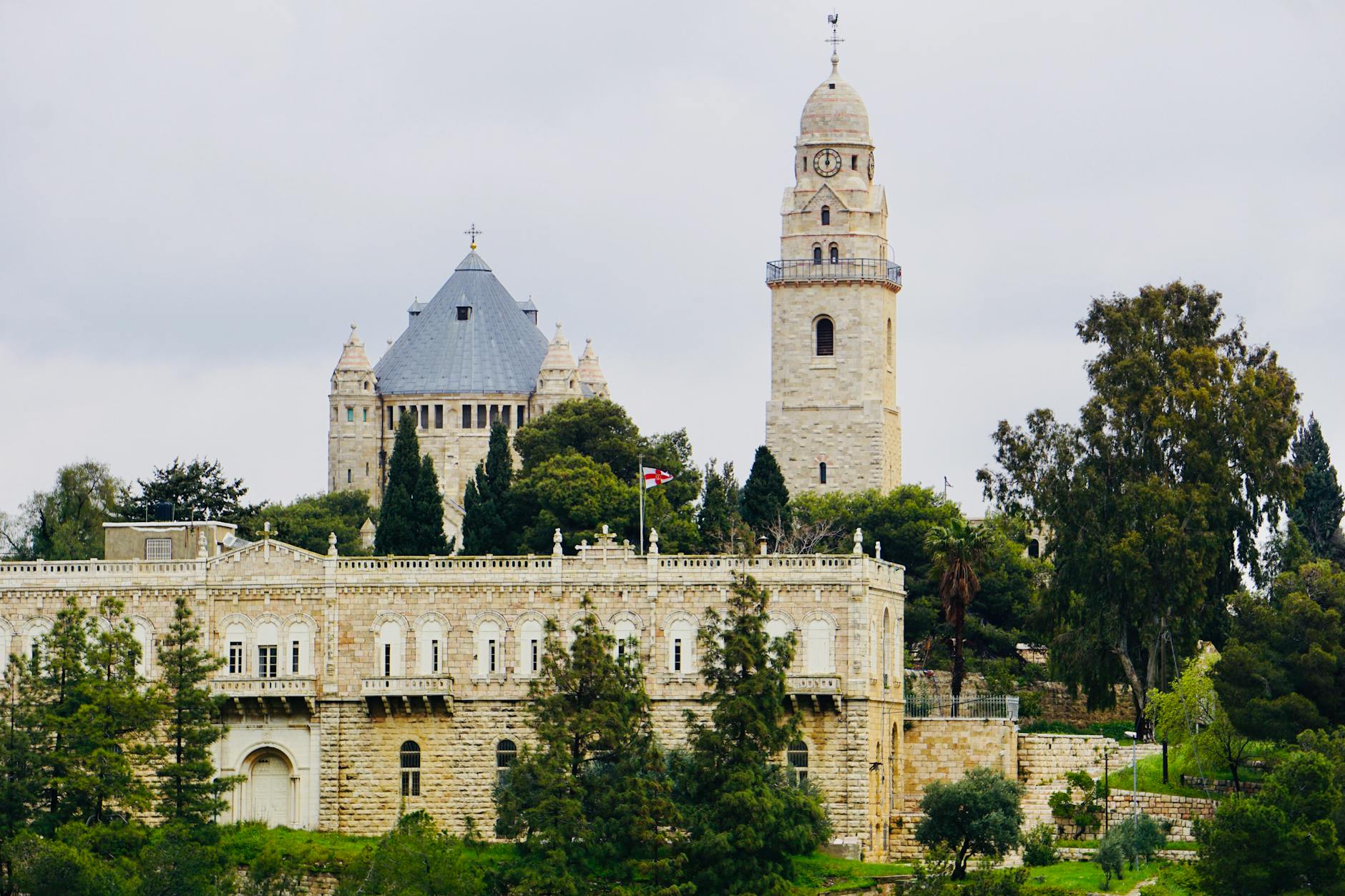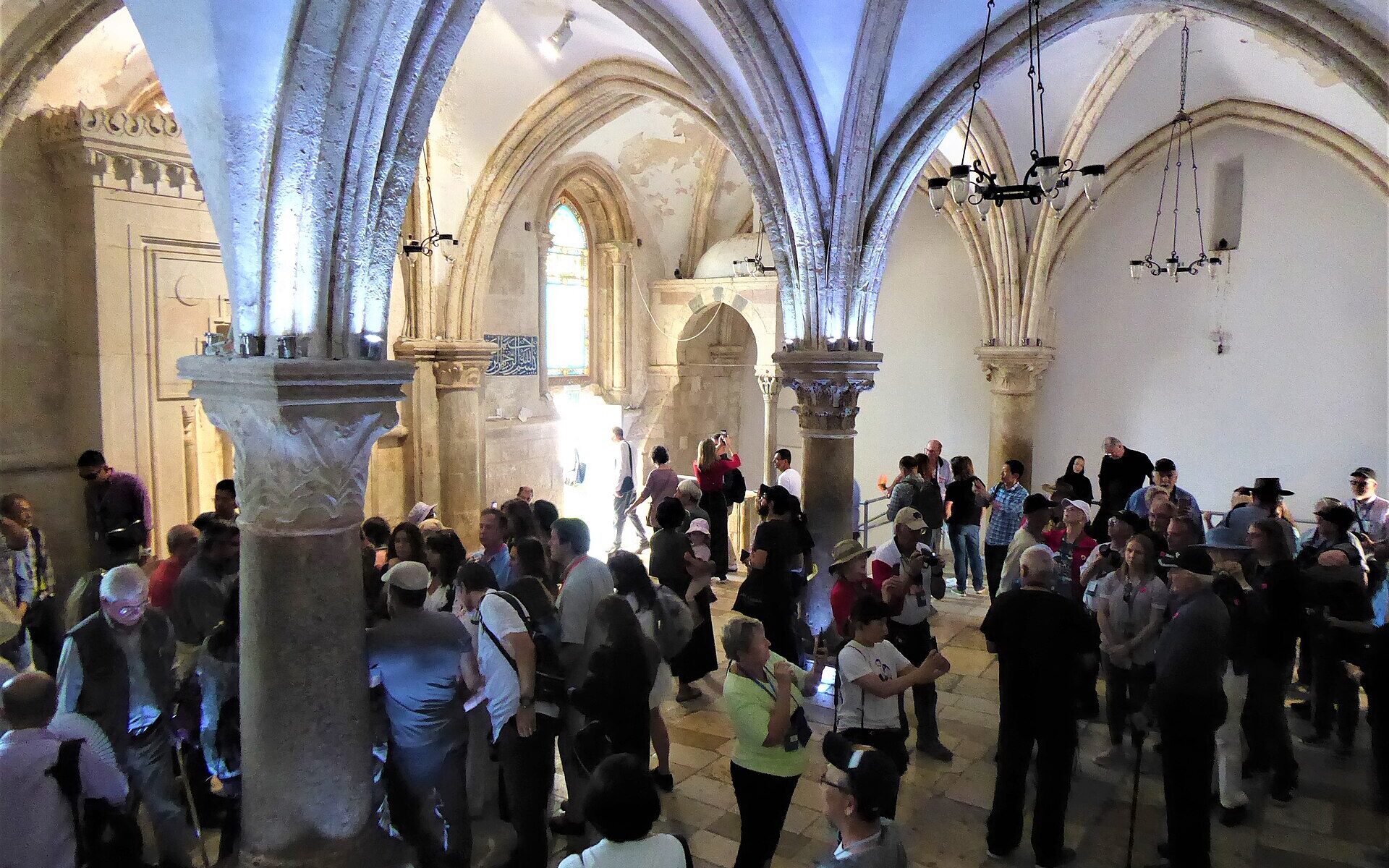
Climb a stone staircase on Mount Zion, push through a low door, and you come out into a bright, empty Gothic hall: slender columns, ribbed vaults, pale stone, and on the south wall a carved prayer niche pointing to Mecca. Groups crowd in, a guide reads from the Gospel of Mark, someone sings, and ten minutes later the room is quiet again. Few places in the city pack so much contested history into so little space. The Room of the Last Supper Jerusalem visitors come to see sits directly above a synagogue built around the traditional tomb of King David, and Jews, Christians and Muslims have all prayed in this building at one time or another.
This guide goes into the building in depth: what the Upper Room tradition is, how a Byzantine church became a Crusader hall, a Franciscan friary, a mosque and an Israeli-administered heritage site, what you can and cannot do there today, and how to visit both the Cenacle and King David’s Tomb downstairs. Hours were checked in October 2026 against the Christian Information Centre’s published list, the Custody of the Holy Land and the institutions’ own pages. For the wider hill, with the Dormition Abbey, Schindler’s grave and St Peter in Gallicantu, see our Mount Zion guide.
The Cenacle and David’s Tomb at a Glance
| Room of the Last Supper (Cenacle) | King David’s Tomb | |
|---|---|---|
| Where in the building | Upper floor, reached by an outside staircase | Ground floor, entered from the courtyard below |
| Who venerates it | Christians, as the place of the Last Supper and Pentecost | Jews, as the burial place of King David; a Muslim shrine of the Prophet David until 1948 |
| What it is now | An empty Gothic hall run as a heritage site | A working place of Jewish prayer |
| Hours (October 2026) | 08:00 to 18:00; closed Yom Kippur | Published hours conflict; check before you go |
| Dress | Modest: shoulders and knees covered | Modest; men cover their heads |
| Time needed | 15 to 20 minutes | 10 to 15 minutes |
| Getting there | A short walk outside Zion Gate, in the south-west corner of the Old City | |
The Upper Room: What the Tradition Says
The gospels describe Jesus sending two disciples into the city to find a man who would show them “a large upper room furnished and ready”, where they prepared the Passover meal that became the Last Supper. The Acts of the Apostles places the disciples in an upper room after the Ascension, and Christian tradition has long identified the same room as the place where the Holy Spirit came down on them at Pentecost. The Latin word for a dining room, cenaculum, gives the building its usual Christian name, the Cenacle.
Whether the meal took place on this exact spot is beyond proof, and the hall you stand in is many centuries younger than the events it commemorates. What is clear is that Christians have venerated this part of the south-western hill as the place of the early Jerusalem church for a very long time. Many scholars connect the site with the great Byzantine basilica of Hagia Sion, “Holy Zion”, built here in the late fourth century, and some have argued that older masonry survives in the lower walls.
A Building With Four Lives
Byzantine and Crusader
The Byzantine basilica was destroyed and rebuilt more than once. The Crusaders built a large church on the hill in the twelfth century, and the upper hall seems to have been part of that complex. According to the Custody of the Holy Land, the Crusader church was demolished in 1219, leaving the Cenacle standing with the commemorative tomb of David beneath it.
The Franciscans
The Franciscan friars took over the Cenacle in the fourteenth century. The Custody gives 1333 as the year the Cenacle came to them, as a gift from King Robert of Anjou and Queen Sancia of Majorca, and it became the first seat of what is still called the Custody of the Holy Land; some historians give a slightly later year. The vaulted Gothic hall you see today, with its columns and capitals, is medieval work whose date and builders scholars debate: some point to the Crusaders, some to the emperor Frederick II, others to the Franciscan rebuilding of the 1330s. The head of the Franciscans in the Holy Land still carries the title Guardian of Mount Zion.
The mosque of the Prophet David
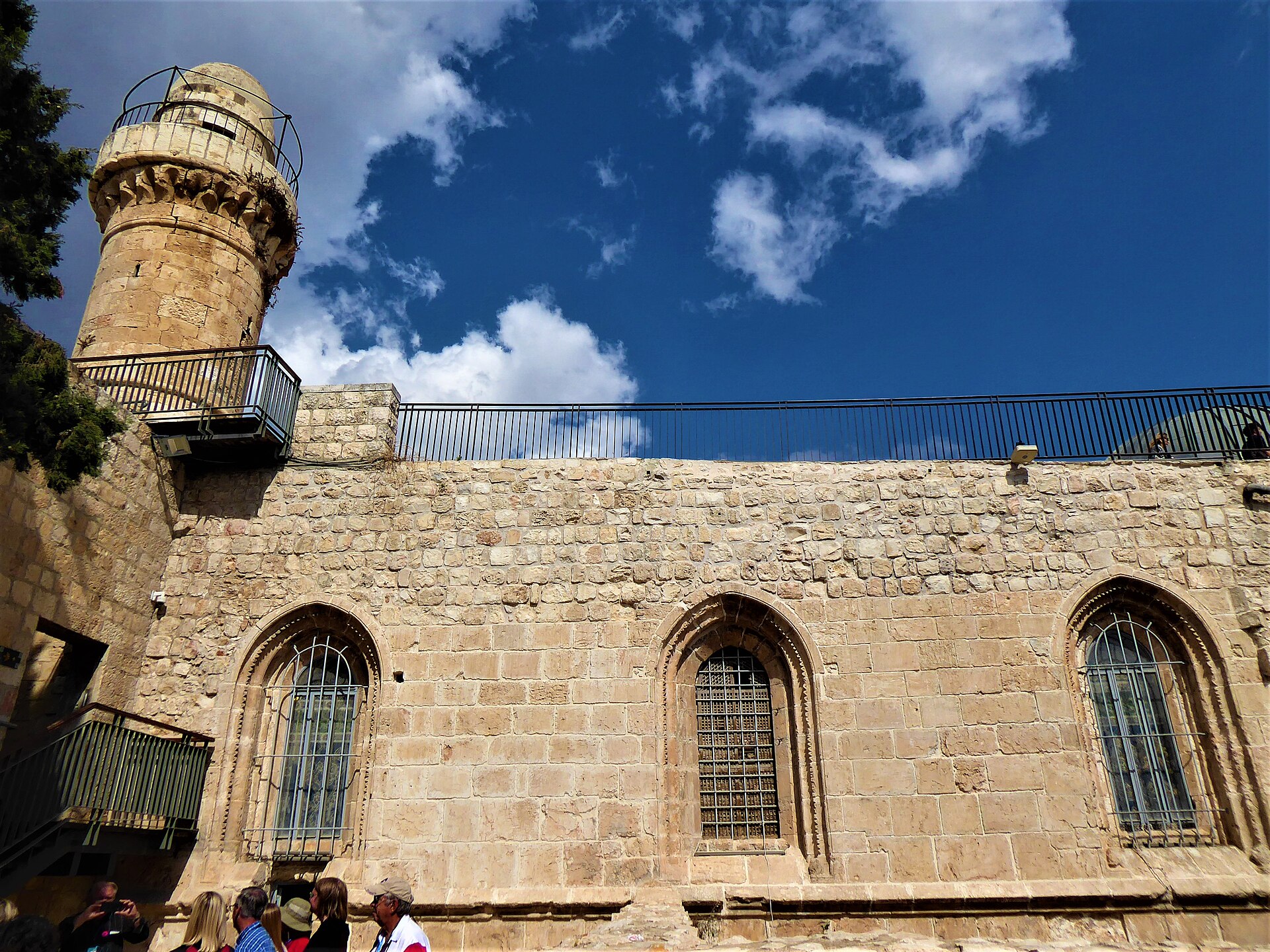
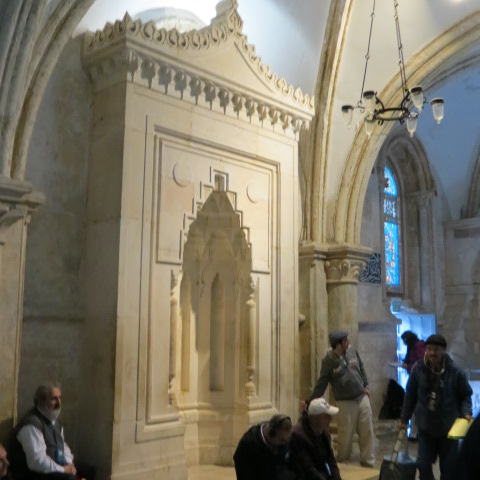
In the sixteenth century the Ottoman authorities took the building from the friars. The Cenacle was converted into a mosque, dedicated to the Prophet David, Nabi Daud, in 1524, and the Franciscans were driven out of the surrounding buildings by 1551. The carved mihrab in the south wall, the prayer niche facing Mecca, and the Arabic inscriptions and tiles you still see in the hall date from the Ottoman period, as does the minaret. Zion Gate itself is still called Bab al-Nabi Daud, the Gate of the Prophet David, in Arabic.
Since 1948
Mount Zion came under Israeli control in 1948, and the building has been administered by Israeli state bodies since then; the Christian Information Centre lists the Cenacle’s hours under the Ministry of Tourism. The Franciscans returned to Mount Zion in 1936 and keep a friary, St Francis ad Coenaculum, a few steps away, but the room itself is not theirs. That history explains a great deal about the building’s atmosphere: it is a holy site for three faiths, owned by none of them in the way most Jerusalem shrines are owned, and arrangements for worship are a sensitive matter.
What You See in the Cenacle
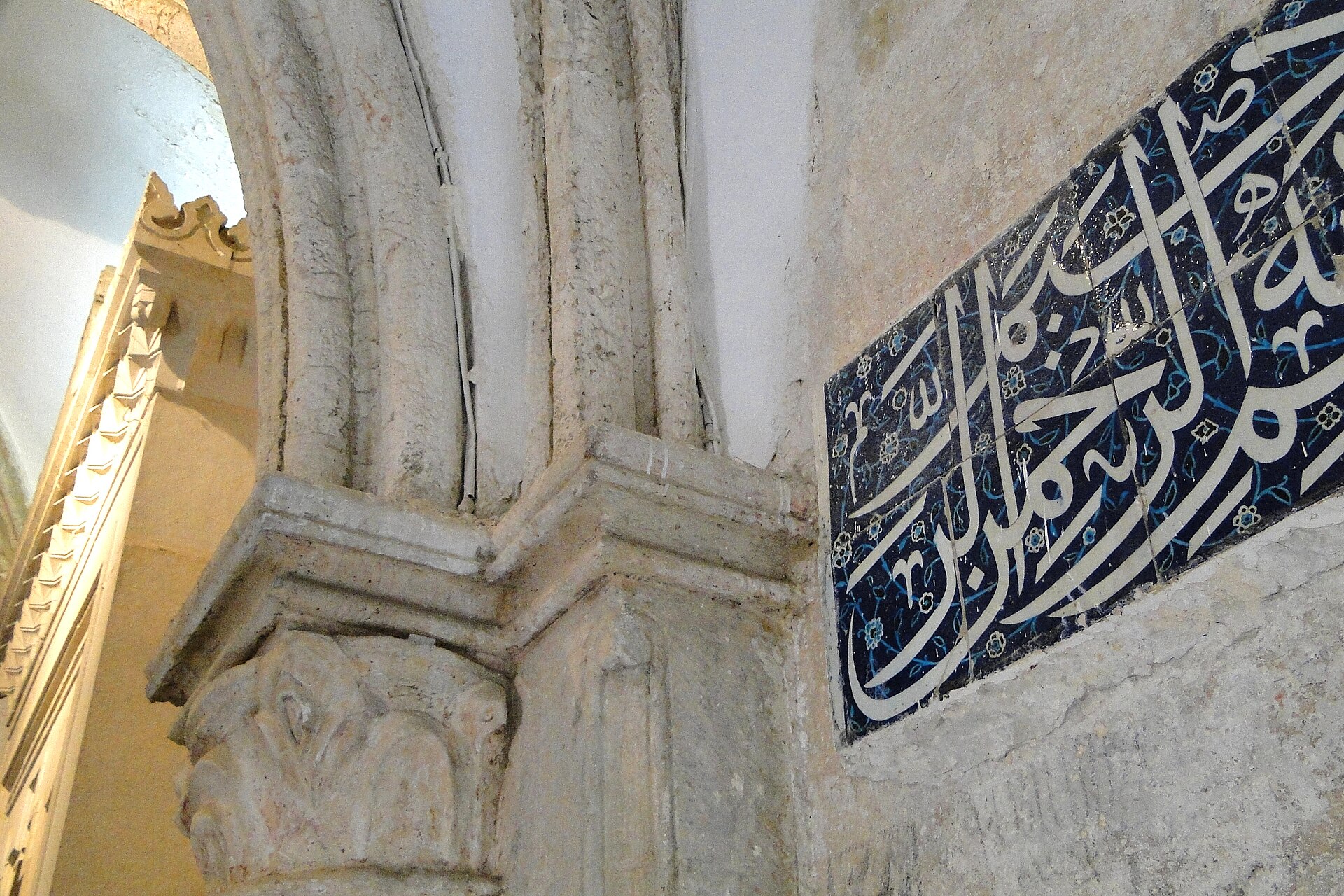
- The hall. A long room divided into bays by columns, with pointed ribbed vaults. It is bare: no altar, no pews, no images. That emptiness surprises many first-time visitors, who expect a chapel.
- The capitals. Look up at the carved capitals of the columns, some with leaf patterns and some reused from earlier buildings. Guides point out the details they like best.
- The mihrab and inscriptions. The Ottoman prayer niche, Arabic inscriptions and tiled panels, a reminder that for four centuries this was a mosque.
The best time to visit is first thing in the morning or late in the afternoon, between the coach groups. At busy hours the room fills with tour groups, and you may share it with three guides talking at once.
Can Christians Pray or Celebrate Mass Here?
This is the question pilgrims most often ask, and the answer is mostly no. The Custody of the Holy Land says that Mass cannot be celebrated in the Cenacle. The friars may gather there in prayer at Pentecost, and on Holy Thursday they stop there during their pilgrimage for the washing of the feet. Occasionally a celebration has been allowed by special arrangement: Pope John Paul II celebrated Mass in the room during his visit in 2000, Pope Benedict XVI prayed there with the Catholic bishops of the Holy Land in 2009, and Pope Francis celebrated Mass there on 26 May 2014.
Private, quiet prayer by individuals is part of an ordinary visit, and groups often read the gospel passage aloud. If your group wants to celebrate Mass on Mount Zion, the Franciscans’ Ad Coenaculum chapel next door is the place to ask. The Christian Information Centre lists it as open Monday to Saturday, 08:00 to 12:00 and 14:00 to 17:45, closing at 16:45 in winter.
Holy Thursday and Pentecost in 2027
- Western Holy Thursday: 25 March 2027.
- Western Pentecost: Sunday 16 May 2027.
- Orthodox Pentecost: Sunday 20 June 2027, because Orthodox Easter falls on 2 May in 2027.
Check the programme with the Custody of the Holy Land or the Christian Information Centre nearer the time. Our guide to Easter in Jerusalem covers Holy Week across the city, and our religious holidays guide lists the other feasts of all three faiths.
King David’s Tomb
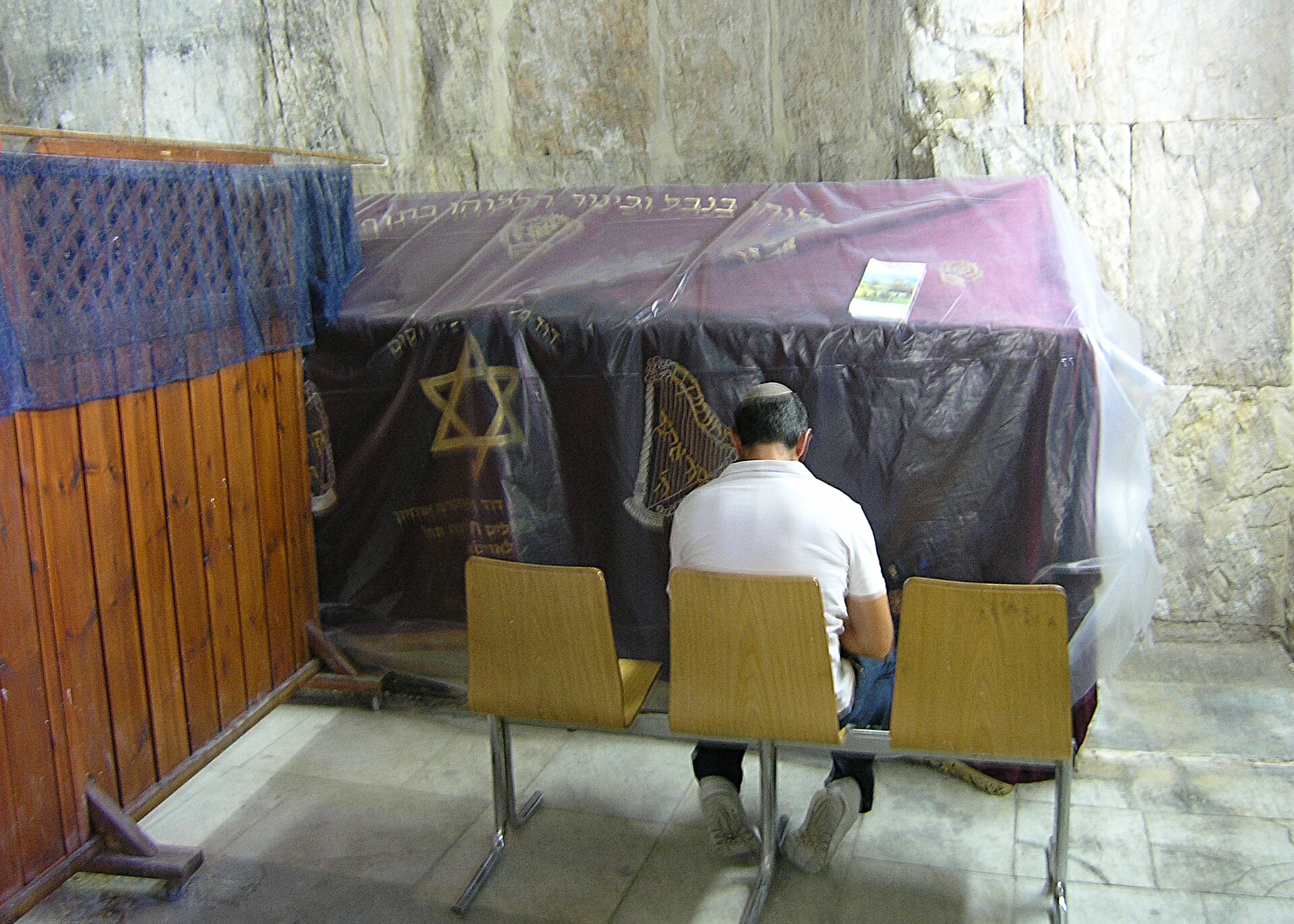
Downstairs, entered from the courtyard, is a small complex of rooms around a large cenotaph draped in an embroidered cloth. Since 1948 it has been a Jewish place of prayer, with a synagogue and study rooms around it, and you will usually find men praying, reciting psalms or studying.
Is David really buried here?
Almost certainly not, as far as historians are concerned. The Bible places David’s burial in the City of David, the original settlement on the hill south of the Temple Mount, not on this western hill. The identification of the tomb on Mount Zion grew up in the Middle Ages, and the cenotaph itself is Crusader-era work. None of that diminishes its importance to the people who pray there, and the site has been venerated by Jews, Christians and Muslims for centuries. If you want to see the archaeology of David’s city, our City of David guide covers it.
A place that was closed to Jews
Under Ottoman rule the tomb was part of the Muslim shrine of Nabi Daud, and access for Jews and Christians was long restricted. Between 1948 and 1967, when the Old City and the Western Wall were under Jordanian control and closed to Israelis, Mount Zion was on the Israeli side of the line, and the roof of the building became a place where Jews came to look towards the Temple Mount. That history explains why the tomb carries such emotional weight in Israel today.
Visiting the tomb
- Dress modestly: shoulders and knees covered. Men cover their heads, and paper kippot are usually available at the entrance.
- Men and women may be directed to separate sides; follow the signs and the attendants.
- Hours: published hours for the tomb disagree, and they change around Friday, Shabbat and the Jewish holidays. Check with the Christian Information Centre inside Jaffa Gate before you plan around it.
- Behaviour: it is an active synagogue. Keep your voice down, don’t photograph people at prayer, and avoid walking in front of someone who is praying.
How to Visit
Hours
The Christian Information Centre’s list, updated in August 2026, gives the Cenacle as open 08:00 to 18:00 and closed on Yom Kippur. The building is in the care of Israeli authorities, so it also follows the Jewish calendar for some closures. Check before you go if your visit falls on a Jewish holiday, and see our guide to Shabbat in Jerusalem for how Friday and Saturday affect the rest of the city.
Dress
One building, two dress codes that are easiest to meet with one outfit: long trousers or a long skirt, covered shoulders, and something to cover your head for the tomb. Our dress code guide covers every major site in the city.
Getting there
The building stands just outside Zion Gate, in the south-west corner of the Old City. From inside the walls, walk through the Armenian Quarter to Zion Gate, go out through the gate, and follow the signs a short way up the lane. From Jaffa Gate you can walk inside the walls through the Armenian Quarter, or walk outside them along the road below the walls. There is no light rail stop nearby; check the Israeli public transport journey planner if you want a bus.
What Is Nearby
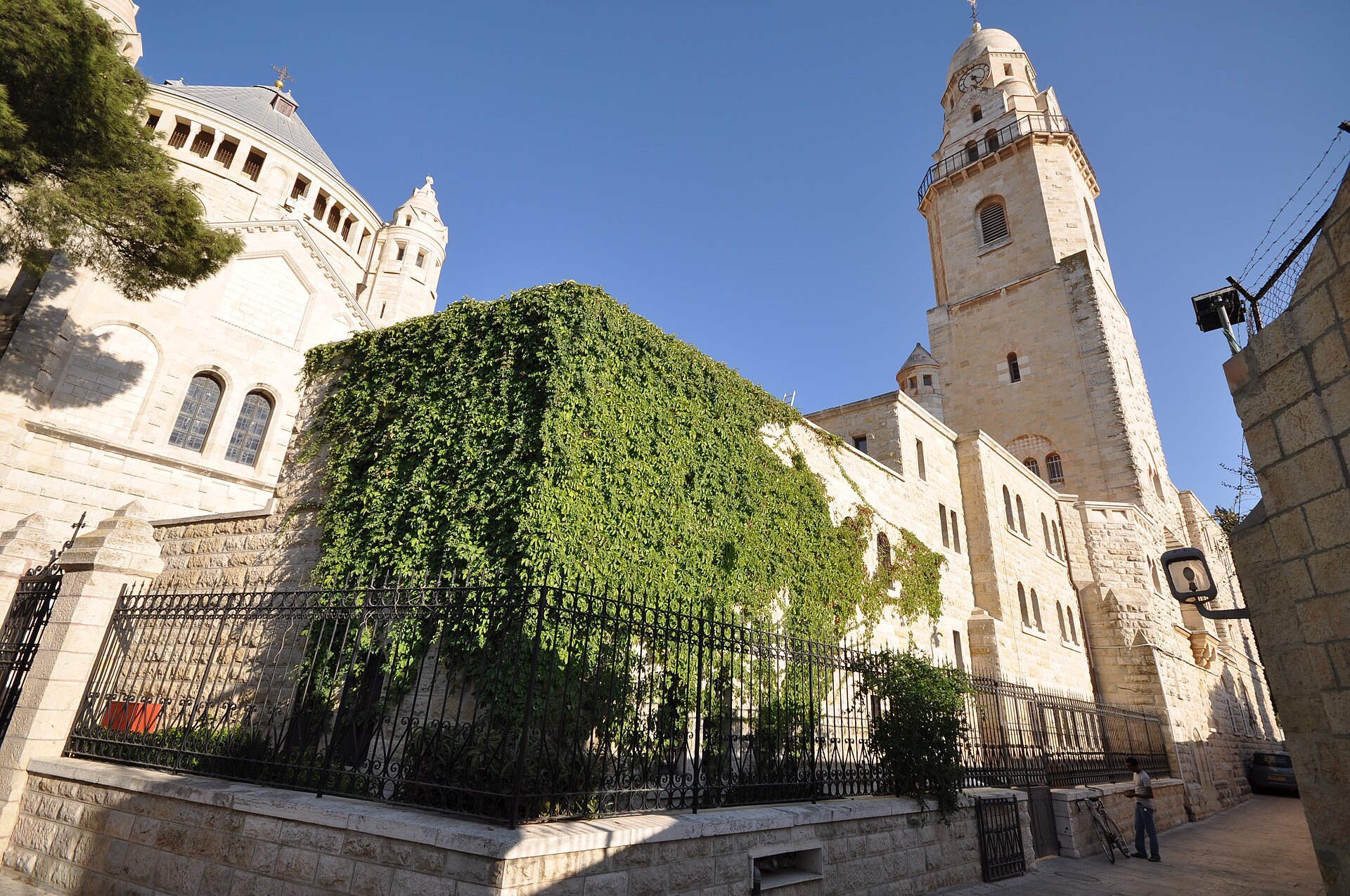
- The Dormition Abbey. The great round Benedictine church next door, where tradition places the “falling asleep” of Mary. Its own site gives weekday and Saturday hours of 09:00 to 17:00 and Sunday 11:30 to 17:00; the abbey was closed on police orders for a period in early 2026, so check its notices before you go.
- St Francis ad Coenaculum. The Franciscan friary and chapel a few steps away, where groups can arrange Mass.
- The Chamber of the Holocaust. A small, intense museum in the Mount Zion complex, among the first Holocaust memorials in Israel. Its own site gives hours of Sunday to Thursday 09:00 to 14:00, generally closed on Jewish holidays; groups should book ahead on +972 2 671 5105.
- Oskar Schindler’s grave in the Catholic cemetery on the slope below, and St Peter in Gallicantu further down the eastern side of the hill, open Monday to Saturday 08:30 to 17:00.
Is It Worth Visiting?
Yes, but go knowing what to expect. If you arrive imagining an intimate first-century room, you will be disappointed: it is a medieval hall, it is bare, and at peak times it is crowded. If you arrive knowing the story of the building, it is one of the most interesting rooms in Jerusalem, a place where you can read the city’s history in the stonework, from Gothic capitals to Ottoman tiles, and where the different faiths’ claims sit literally on top of one another.
Together the Cenacle and the tomb take under an hour. Combine them with the Dormition Abbey and St Peter in Gallicantu for a Mount Zion morning, or fold them into a longer walk; our self-guided walking tour passes this way, and our guide to planning a Christian pilgrimage shows where the Upper Room fits in a week of holy sites.
Final Word on the Room of the Last Supper
The Room of the Last Supper is not a place to rush. Spend a few minutes reading the walls, the Gothic vaults and the Ottoman niche, then go downstairs to the tomb and see how the same building is lived in by a different faith. For the rest of the hill, our Mount Zion guide has the full route; for the Christian sites across the city, start with our guide to holy sites in Jerusalem, and for the city’s longer story, our history of Jerusalem and our account of Crusader Jerusalem fill in the background.
Photo Credits
The Cenacle hall with visitors: Abendmahlssahl Cenacle (Jerusalem) (06) by Chris06, CC BY-SA 4.0, via Wikimedia Commons.
The building from the courtyard: Abendmahlssahl Cenacle (Jerusalem) (03) by Chris06, CC BY-SA 4.0, via Wikimedia Commons.
The mihrab in the Cenacle: The Cenacle, Last Supper Room – Mount Zion, Jerusalem 22 by Hoshvilim, CC BY-SA 4.0, via Wikimedia Commons.
King David’s Tomb: Jerusalem – King David’s tomb by Marco Plassio, CC BY-SA 3.0, via Wikimedia Commons.