Where else can you see the Dead Sea Scrolls, an eighteenth-century synagogue from Suriname with sand on its floor, a 1:50 model of Herod’s Jerusalem and a room of Impressionist paintings in the same afternoon? Nowhere, and nowhere else keeps its doors shut until four o’clock on a Tuesday, either. That is the Israel Museum Jerusalem in two sentences: the most important museum in the country, with a collection that could fill a week, and a timetable that rewards anyone who reads it before calling a taxi.
This guide covers the whole campus: how the hours and tickets work, how to get there, how the pavilions fit together, what to see in each wing, where to eat, and how to shape a three-hour visit or a full day. Hours and prices were checked in September 2026; treat them as the right order of magnitude rather than a quotation, and confirm on the museum’s website before you go, because holiday timetables change at short notice. Two neighbouring guides go deeper on particular angles: the Israel Museum with kids covers the Youth Wing and family routes, and our Dead Sea Scrolls guide tells the story of the scrolls themselves. For the city’s other collections, start with our overview of museums in Jerusalem.
The Israel Museum at a Glance
| Address | Derech Ruppin 11, Givat Ram, a few minutes’ walk from the Knesset |
| Opening hours | Sunday, Monday, Wednesday, Thursday 10:00–17:00 · Tuesday 16:00–21:00 · Friday and holiday eves 10:00–14:00 · Saturday and holidays 10:00–17:00 |
| Adult ticket | ₪54 at the door; ₪49 bought online through the municipality’s iTravelJerusalem site (September 2026) |
| Child (5–17) | ₪27 at the door; ₪24 online. Under-fives go free |
| What the ticket covers | Every wing, the Shrine of the Book, the Second Temple model and the Art Garden |
| Time needed | Three hours for the highlights; a full day for everything |
| Audio guide | Free app covering the permanent and changing exhibitions. Bring headphones |
| Getting there | Green Line light rail (opened August 2026), city buses or a taxi; paid parking on site |
| Accessibility | The entrance pavilion, the Shrine of the Book and the model are wheelchair accessible |
| Ticket enquiries | +972 2 670 8811 |
The Hours: Read This Before You Book a Taxi
Most museums in the world open at roughly the same time every day. The Israel Museum does not, and every week a small crowd of visitors learns this in the car park.
- Sunday, Monday, Wednesday and Thursday: 10:00–17:00. These are the ordinary days. Sunday is a working day in Israel, so it is not a quiet weekend day as it would be in Europe.
- Tuesday: 16:00–21:00. The museum swaps its Tuesday morning for an evening. Come expecting the morning and you will find the doors shut. Come at five, though, and you get four hours with far fewer school groups, and you can finish in the Shrine of the Book as the light goes. For adults without children, it is the best time of the week.
- Friday and the eve of a holiday: 10:00–14:00. A short day, because the country stops for Shabbat or the festival in the afternoon. Four hours is enough for the highlights and nothing more.
- Saturday and Jewish holidays: 10:00–17:00. The museum is open on Shabbat, when a large part of the city is shut, and it is one of the best places to spend a Saturday. It is busy with Israeli families, and there are no buses or trams until Saturday night, so plan on a taxi or a walk. Our guide to Shabbat in Jerusalem explains what else is open.
Two further wrinkles. Virtually everything in the country shuts for Yom Kippur, so check before planning anything around it. The intermediate days of Sukkot and Passover are the museum’s busiest of the year, because Israeli families have the week off and many of them come here. Our calendar of Jerusalem religious holidays has the 2027 dates, so you can see what your week will look like before you book.
Tickets, Discounts and What Is Included
An adult ticket cost ₪54 at the door in September 2026, and a child aged five to seventeen ₪27, with under-fives free. Students and seniors pay reduced rates, so bring ID. At the time of checking, the municipality’s iTravelJerusalem booking site sold the same tickets for ₪49 and ₪24, which is worth the thirty seconds it takes if you already know your date. Buying ahead also saves a queue at the busy times: Saturday late morning, and the holiday weeks.
The ticket covers the whole campus: the three main wings, the Shrine of the Book, the Second Temple model, the Youth Wing and the Art Garden. Most temporary exhibitions are included, and the ticket desk will tell you if one is not. The museum’s downtown branch, Ticho House, is free, and it is covered further down along with the Rockefeller Archaeological Museum, whose galleries the Israel Museum has long run. Combined tickets with the Bible Lands Museum across the road have been offered in some years and not in others, so ask at either desk.
The free audio-guide app is good and covers both permanent and temporary exhibitions, so download it on the hotel Wi-Fi before you leave and bring headphones. It is the easiest way to make sense of the archaeology wing in particular, where the objects are small and the stories behind them are long.
Getting There
The museum sits on a hilltop in Givat Ram, west of the city centre, beside the Knesset, the Supreme Court and the Givat Ram campus of the Hebrew University. Everything around it is government buildings and parkland, which is lovely to look at and means there is almost nowhere nearby to buy a coffee except the museum itself.
- Light rail. The Green Line opened in August 2026 and runs through the Givat Ram campus and the government quarter. Check Moovit for the stop that suits you and the walk from it, which is uphill whichever way you come. Our light rail guide explains fares and how the two lines connect.
- Bus. Several city lines stop within a few minutes’ walk. Routes and numbers change, so use Moovit rather than an older guidebook.
- Taxi. From the city centre, the ride is usually short outside the rush hours, and a little longer from the Old City. It is the only practical option on Shabbat unless you walk. Our getting around Jerusalem guide covers apps and fares.
- Car. There is paid parking on site.
- On foot. On a cool morning, the walk from Rehavia down into the Valley of the Cross, past the fortress-like Monastery of the Cross, and up the far side to the museum takes about half an hour and is a lovely way to arrive. In July, it is not.
How the Campus Works
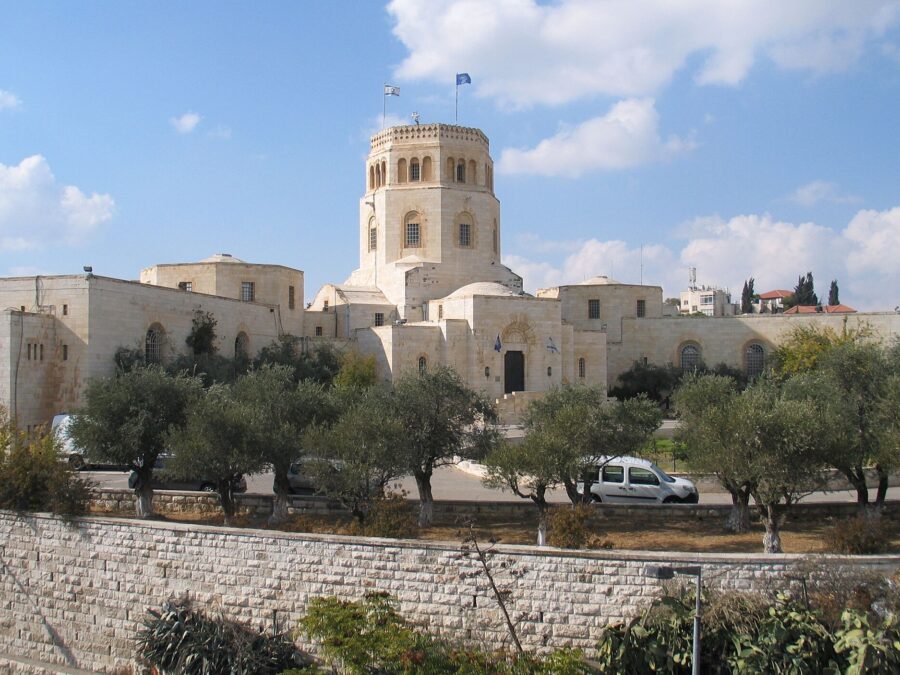
The architects Alfred Mansfeld and Dora Gad designed the museum, which opened in 1965, as a cluster of low stone pavilions stepping across the hilltop. They drew on the hill villages of the region, and the idea was that the museum could grow by adding pavilions rather than by building upwards. A renewal completed in 2010 added a new entrance pavilion at the bottom of the hill and a long covered walkway that climbs to the main building. The walk up takes a few minutes and sets the tone: this is a campus, not a building, and the distances are real.
From the top of the walkway, the main building holds the three great wings, archaeology, Jewish art and life, and fine arts, with the temporary exhibition galleries between them. The Shrine of the Book and the Second Temple model stand apart, outdoors, along their own path. The Youth Wing has its own entrance area, and the Art Garden falls away down the slope. A visit involves a good deal of walking in and out of the sun, so wear proper shoes, carry water from April to October, and use the maps at the entrance or in the app, because the galleries connect in ways that are not always obvious.
Every visitor goes through a security check at the entrance with bag screening. It takes a few minutes. Photography rules differ between galleries and some spaces restrict it, but the signs are clear.
The Shrine of the Book
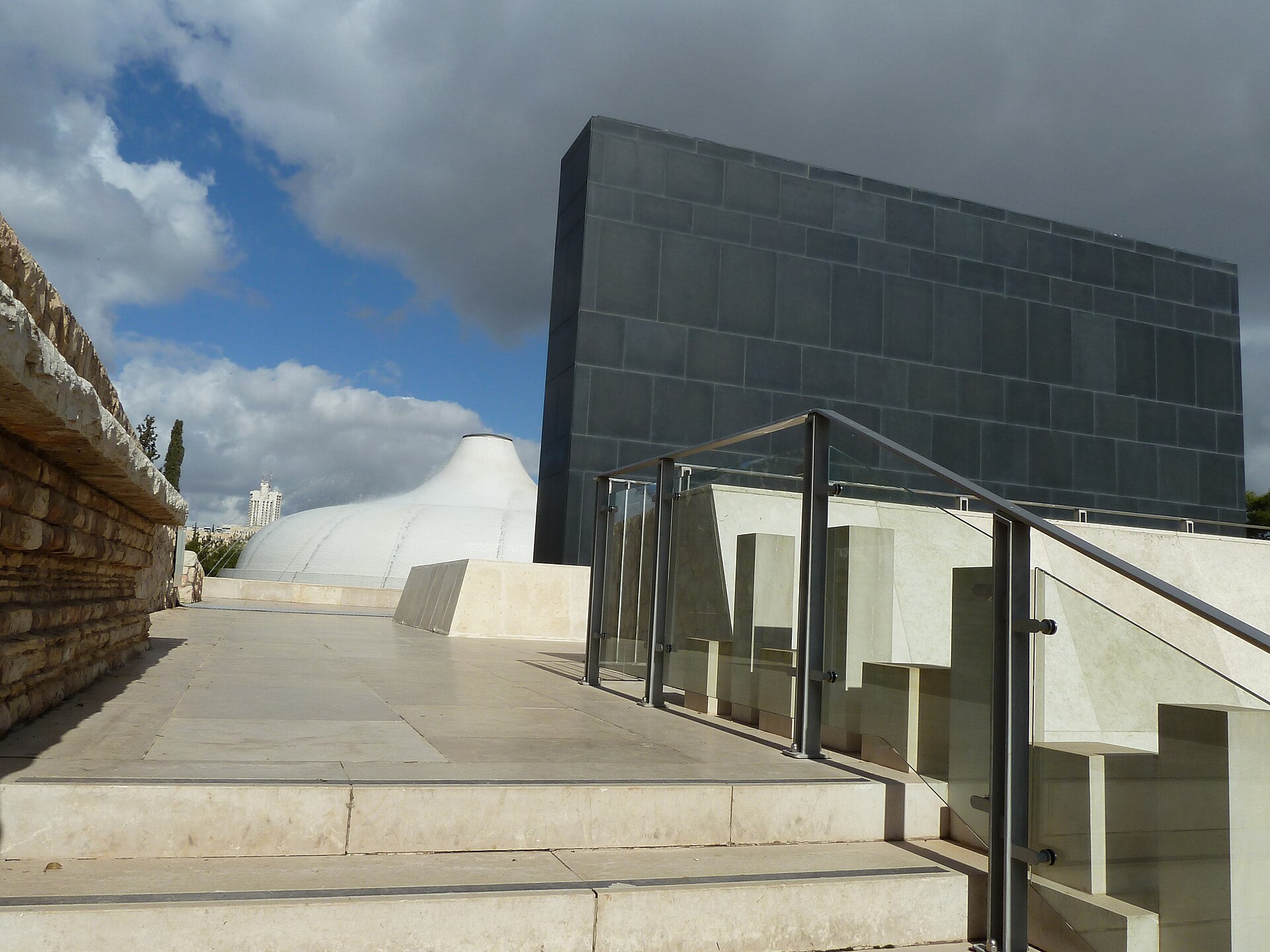
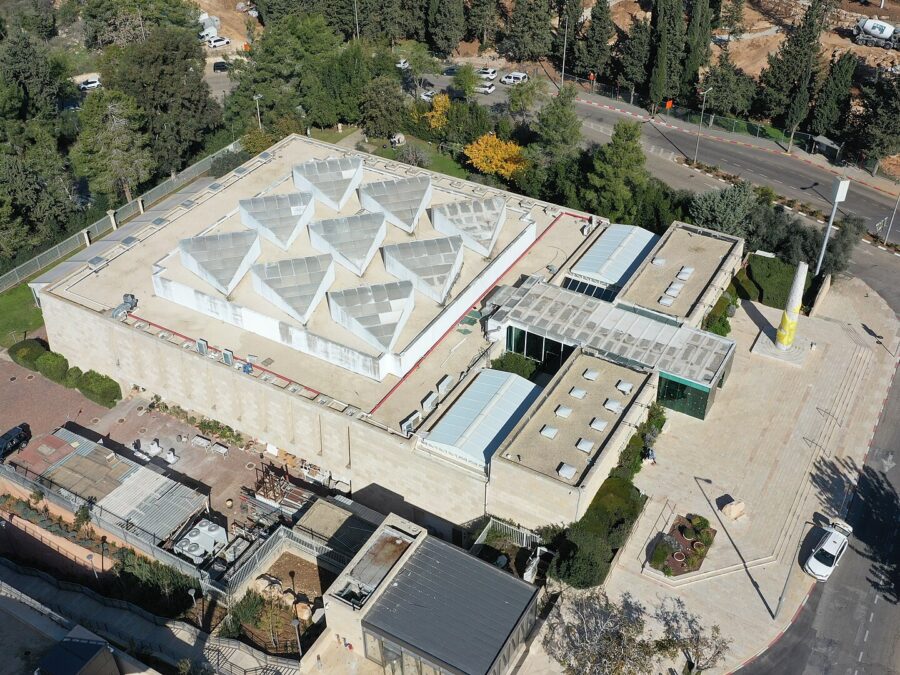
Frederick Kiesler and Armand Bartos’s Shrine, opened with the museum in 1965, is one of the most recognisable buildings in Israel. The white dome is shaped after the lids of the clay jars in which the first scrolls were found at Qumran. It faces a black basalt wall, and the contrast is usually read as the scrolls’ own war between the Sons of Light and the Sons of Darkness. Most of the building is underground, and you enter down a dim, cave-like corridor, which is exactly the point.
Inside, the scrolls are too fragile to stay on show for long, so original fragments are rotated. The central showcase, under the dome, normally holds a facsimile of the Great Isaiah Scroll, the most complete of the biblical scrolls. For its sixtieth anniversary, however, the museum put the entire original on display for the first time since 1968, so ask at the entrance what is out when you visit. The lower level holds the Aleppo Codex, a tenth-century manuscript of the Hebrew Bible of enormous authority, with its own dramatic twentieth-century history.
Go to the Shrine first thing, before the tour groups arrive in late morning, and allow forty-five minutes. For the story of how the scrolls were found, who wrote them and what they contain, see our Dead Sea Scrolls guide. If you want to see the place they came from, Qumran is on the road to the Dead Sea, and our Dead Sea day trip passes it.
The Model of Jerusalem in the Second Temple Period
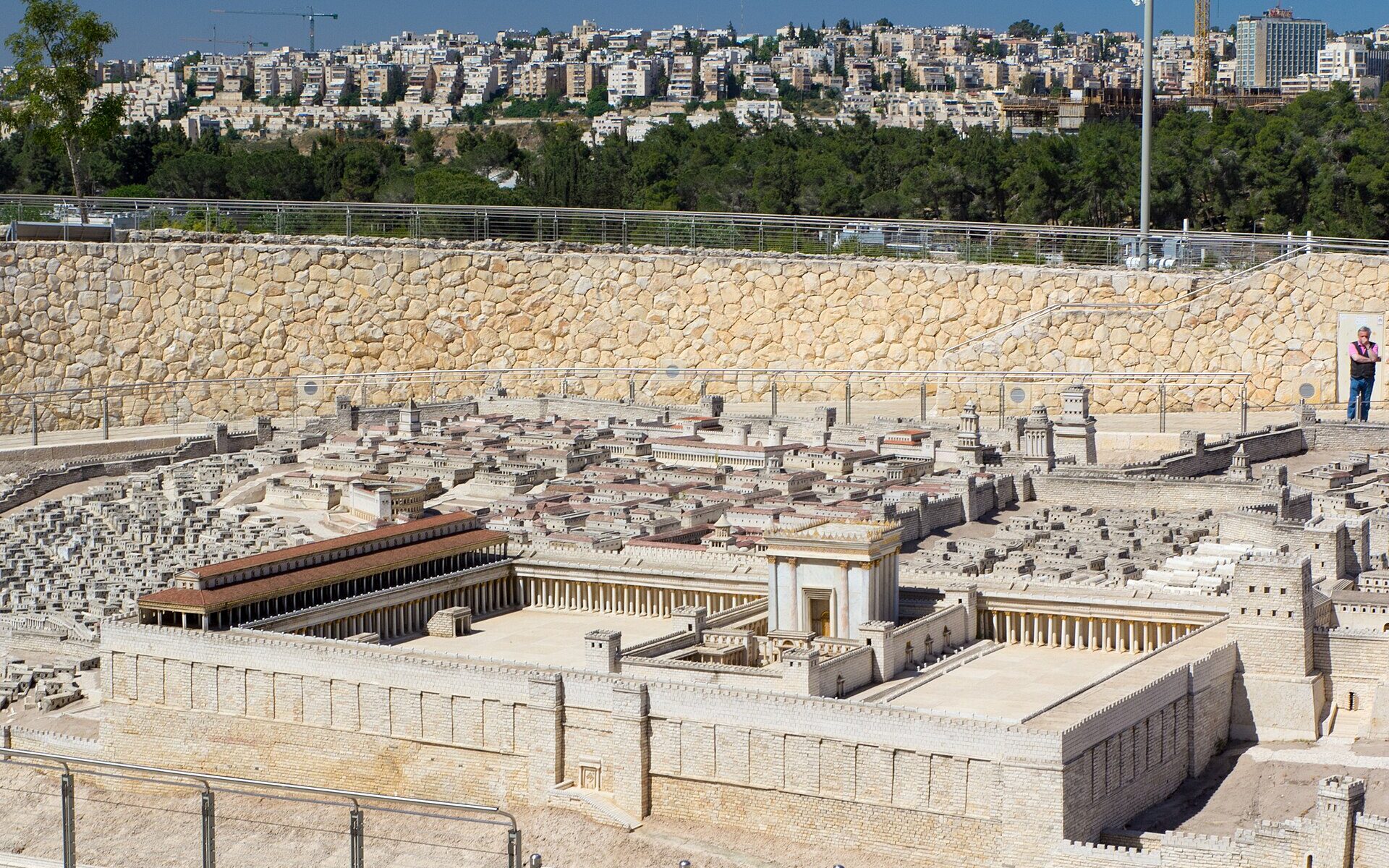
Just beyond the Shrine is the open-air Second Temple model, and for many visitors it does more to explain Jerusalem than anything else in the city. It was commissioned in the 1960s by Hans Kroch, owner of the Holyland Hotel, in memory of his son, who was killed in 1948. The historian Michael Avi-Yonah drew up the plan. It stood in the hotel grounds for four decades before it was moved here, piece by piece, in 2006. At a scale of 1:50, it shows the city as it looked in 66 CE, on the eve of the revolt that ended with the Roman destruction four years later.
Walk slowly round it and look for:
- The Temple and its platform, with the long Royal Stoa along the southern edge. The platform is the one you can still see today as Haram al-Sharif / the Temple Mount, and its retaining walls include the stretch now known as the Western Wall.
- The Antonia Fortress at the platform’s north-west corner, the Roman garrison that overlooked the courts.
- Herod’s palace on the western hill, with its three great towers. The base of one of them survives in the citadel at Jaffa Gate, today’s Tower of David.
- The lower city running down the ridge to the Pool of Siloam, the area now excavated in the City of David.
The model is a scholarly reconstruction, and parts of it have been updated as the archaeology has moved on. Treat it as an informed picture rather than a photograph. Then go and stand in the real places. Seeing the model in the morning and walking the Old City in the afternoon is one of the best days you can have in Jerusalem.
The Archaeology Wing
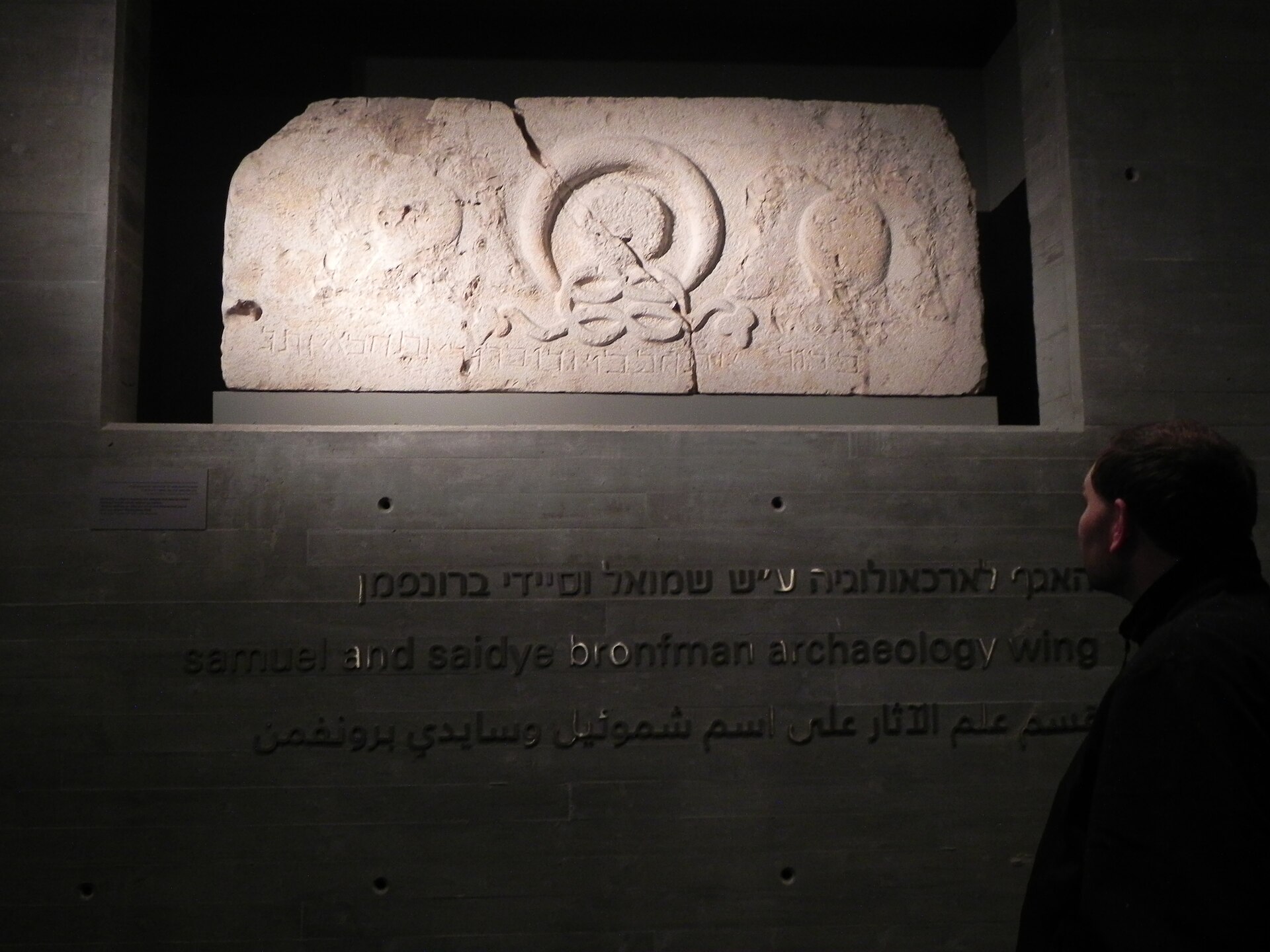
The Samuel and Saidye Bronfman Archaeology Wing is the heart of the museum and, for most visitors, the reason to give it more than a morning. It runs chronologically from prehistory to the Ottoman period, and it is laid out clearly enough that you can follow the story or dip into it. The highlights are spread out, so here is where to stop:
- The Nahal Mishmar hoard. More than four hundred copper objects, including sceptres, crowns and maceheads, found in 1961 wrapped in a reed mat in a cave in the Judean Desert. They date to the Chalcolithic period, more than five and a half thousand years ago, and they are strange and beautiful, like nothing else in the building.
- The Deir el-Balah coffins. Clay coffins from the thirteenth century BCE, with faces modelled on their lids, found at Deir el-Balah in the Gaza Strip. They are among the most photographed objects in the museum.
- The Tel Dan Stele. A broken basalt slab from the ninth century BCE, with an Aramaic inscription widely read as mentioning the “House of David”, the earliest known reference to the dynasty outside the Bible.
- The Pilate inscription. A limestone block found at Caesarea in 1961, naming Pontius Pilate as prefect of Judea, one of the very few objects from his own lifetime that carry his name.
- The “Place of Trumpeting” inscription. A stone from the top of the Temple Mount’s retaining wall, found in the excavations below it after 1967, marking where a priest stood to blow the trumpet announcing the Sabbath.
- The Caiaphas ossuary. An ornately carved bone box inscribed with the name Caiaphas, found in Jerusalem in 1990, which many scholars associate with the high priest of the Gospels.
- The bronze Hadrian. A superb bronze of the emperor, found at Tel Shalem in the Jordan Valley, and a reminder that the Roman story here did not end in 70 CE.
Allow at least an hour and a half for the highlights alone. The wing makes a natural pair with the city’s other archaeology collections, which our archaeology museums guide covers site by site, and with our history of Jerusalem for the bigger picture.
Jewish Art and Life
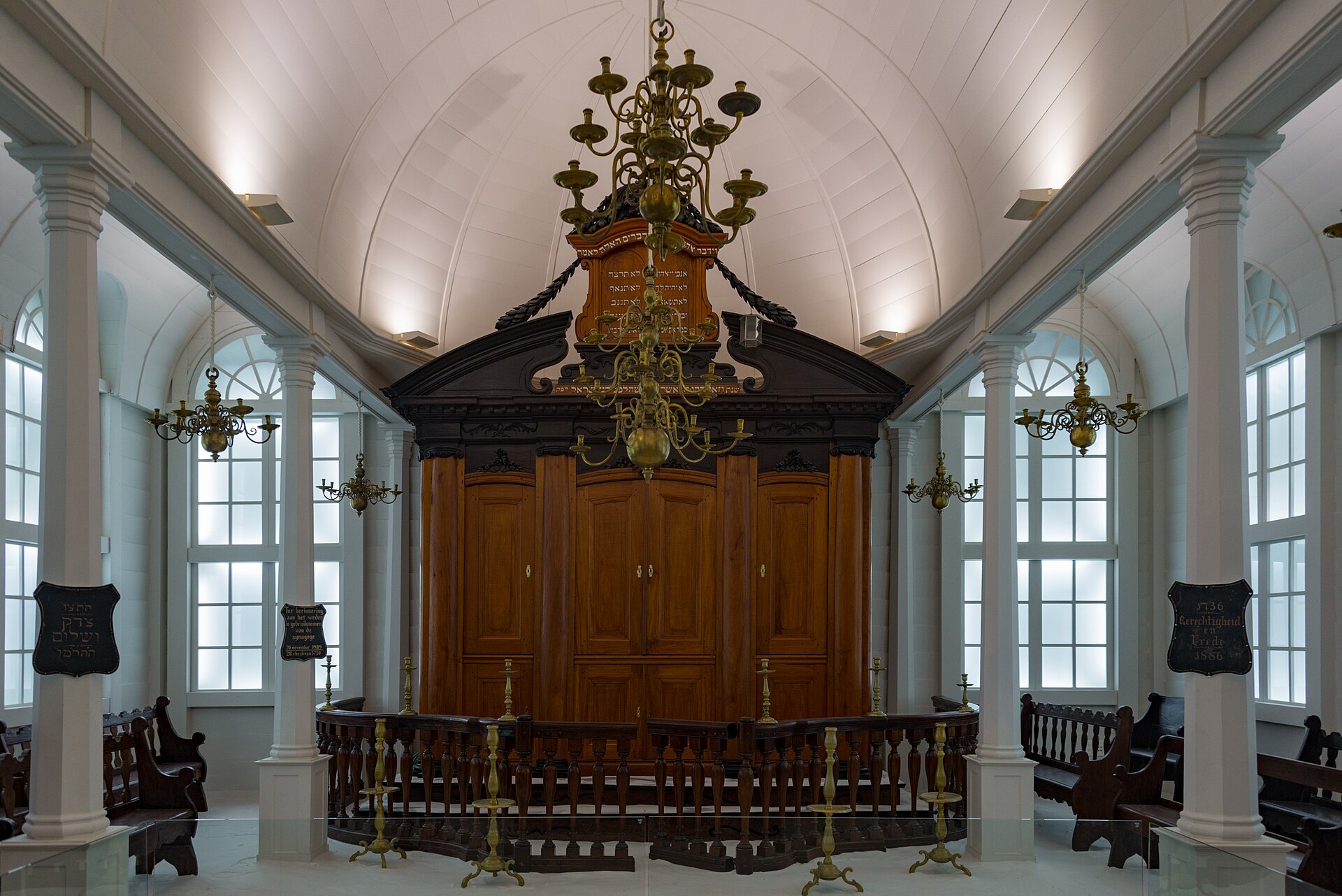
This is the wing that surprises people who came only for the scrolls. At its centre are four complete synagogue interiors, dismantled and rebuilt inside the museum:
- Vittorio Veneto, Italy, a gilded eighteenth-century interior of great elegance.
- Horb, Germany, a small eighteenth-century prayer room with a painted wooden ceiling, a rare survivor of a rural tradition that was almost entirely destroyed.
- Tzedek ve-Shalom, Suriname, an eighteenth-century synagogue from Paramaribo with its floor of sand, a custom of some Caribbean Sephardi communities.
- Kadavumbagam, Cochin, India, a carved and painted wooden interior from one of the oldest Jewish communities in Asia.
Around them are galleries of ceremonial objects, costume and jewellery from Jewish communities from Morocco to Afghanistan, marriage contracts, and one of the great collections of Hanukkah lamps. If you are in town in December, our guide to Hanukkah in Jerusalem explains why that display is at its best then. Illuminated manuscripts, such as the medieval Birds’ Head Haggadah, are shown in rotation for conservation, so what is out changes from visit to visit. Give the wing an hour. Even visitors with no particular interest in Judaism tend to leave it saying it was their favourite part of the day.
Fine Arts and the Art Garden
The fine arts collection is broad: European art with a good showing of Impressionists and Post-Impressionists, one of the most important collections of Dada and Surrealism anywhere, thanks to the gift of Vera and Arturo Schwarz, a strong collection of Israeli art, Asian art, and the arts of Africa, Oceania and the Americas. There are also a handful of European period rooms.
Be honest about your time. If you live near a major art museum and have one day here, this is the wing to cut, with one exception. The Israeli art galleries show work you will not see anywhere else, and after a few days in the city, the painters’ views of Jerusalem and the desert will look familiar. For the contemporary scene beyond the museum, see our guide to Jerusalem art galleries.
Outside, the Billy Rose Art Garden was designed by the Japanese-American sculptor Isamu Noguchi as a series of stone terraces for modern sculpture, stepping down the hillside with long views. It has been undergoing renovation, so check which parts are open when you visit. Around the campus, look out for Anish Kapoor’s huge polished-steel Turning the World Upside Down, which reflects the sky and the hills the wrong way up, and Robert Indiana’s rust-red AHAVA, the Hebrew version of his famous LOVE sculpture.
The Youth Wing
The Youth Wing runs exhibitions, art workshops and activities designed for children, and it is one of the best family resources in the city. It is covered in detail, along with the best family route round the campus, in our guide to the Israel Museum with kids. The short version: go in the morning, do the Youth Wing and the model before small legs give out, and save the archaeology for the parents’ second visit.
Eating, Shopping and the Small Practicalities
- Food. There are cafés and a restaurant on the campus, and you will need them, because there is nowhere else within easy walking distance. Opening times and operators change, so check on the day.
- The shop. The museum shop is one of the better places in the city for good-quality replicas, jewellery based on pieces in the collection, and books on archaeology and Jewish art. It is a sound alternative to the souvenir stalls of the Old City.
- Water and shade. From April to October the outdoor sections, the Shrine path, the model and the garden are hot by late morning. Do them first or last.
- Accessibility. The entrance pavilion, the Shrine of the Book and the model are wheelchair accessible. The campus is large and sloping, so plan the route; our accessibility guide has more on getting around the city.
- Weather. On a wet winter day, the museum is the best indoor option in Jerusalem. Our weather by month guide shows how often you are likely to need it.
Three Ways to Do It
Three hours: the highlights
Arrive at 10:00 (not on a Tuesday). Go straight to the Shrine of the Book (forty-five minutes) and the model (thirty minutes) while it is cool and quiet. Walk up to the main building for the archaeology wing, and pick your stops from the list above (an hour and a quarter). Finish with twenty minutes in the synagogues. Then have lunch on the campus, or take a taxi back to town.
A full day: everything that matters
Follow the three-hour route, then have a long lunch, and give the afternoon to Jewish Art and Life properly, then the Israeli art galleries and a temporary exhibition. End in the Art Garden in the late-afternoon light, if it is open. If you still have energy, the Bible Lands Museum is across the road, and the Knesset is a few minutes’ walk away if you have booked its tour.
Tuesday evening: the quiet visit
Arrive at 16:00. Do the archaeology wing and the synagogues first, while it is still light outside, then walk out to the model and finish in the Shrine as the day fades. Take a taxi back to the city centre for a late dinner. It is the calmest the museum ever is, and it fits neatly into a plan that spends the morning in the Old City. Our Jerusalem at night guide has ideas for what to do afterwards.
The Museum’s Other Branches
Two more buildings are linked to the Israel Museum. Ticho House, a nineteenth-century stone house with a garden a few minutes from Zion Square, was the home of the ophthalmologist Abraham Ticho and the artist Anna Ticho. It shows her drawings of the Jerusalem hills and his collection of Hanukkah lamps, and it is an easy hour in the city centre.
The Rockefeller Archaeological Museum, just outside the Old City walls opposite Herod’s Gate, is a superb building from the British Mandate with an old-fashioned, beautifully presented collection. It has been closed to walk-in visitors since 2023, with only occasional pre-booked tours, and our Rockefeller Museum guide explains the current position. Both appear in our guide to museums in Jerusalem.
Is the Israel Museum Worth It?
Yes, without qualification, if you have more than two days in Jerusalem. It is the single most rewarding indoor visit in the country, and the Shrine, the model and the archaeology wing together will change how you see everything else you visit. The ticket is fair for what you get, and cheaper than an evening meal.
There are two honest caveats. If you have only one day in the city, spend it in the Old City and come back another time; the museum explains Jerusalem, but it cannot replace walking it. And do not try to see everything. The visitors who leave disappointed are almost always the ones who tried to do all three wings, the garden and a temporary exhibition in one go and ended up in the Surrealist galleries with nothing left. Choose two things to do properly. Our Jerusalem itinerary and two days in Jerusalem plans show where a museum morning fits best.
The museum’s nearest neighbours are Israel’s parliament and supreme court, and both open their doors to visitors for free. On a Sunday or Thursday you can take the 08:30 Knesset tour, join the Supreme Court’s 12:00 English tour, and still reach the museum for a long afternoon, which neatly avoids its Tuesday-morning closure.
Directly across the road, the Bible Lands Museum fills in the world around ancient Israel, with galleries on Egypt, Assyria, Babylon and Persia. It stays open until 21:00 on Wednesdays, with an English tour at 17:30, which makes it an easy way to end an Israel Museum day. There was no joint ticket when we checked in 2026, but the Bible Lands ticket includes a free return visit within a month.
Final Word on the Israel Museum
The Israel Museum is the place where the stories told in the Old City’s stones come with evidence: the inscriptions, the scrolls, the coffins, the coins and the synagogues, gathered on one hilltop. Get the timing right, which means not on a Tuesday morning and not everything in one go, and it will be one of the best days of your trip. Pair it with a walk through the Old City the day before or after. Round out the city’s big three with Yad Vashem and the Tower of David, and use our guide to things to do in Jerusalem to fill the rest of the week.
Photo Credits
The Second Temple model at the Israel Museum: Israel Museum 290416 Model of Jerusalem 01 by Oren Rozen, CC BY-SA 4.0, via Wikimedia Commons.
The Shrine of the Book dome and basalt wall: Jerusalem Israel Museum Shrine of the Book by Utilisateur:Djampa – User:Djampa, CC BY-SA 4.0, via Wikimedia Commons.
The entrance to the Samuel and Saidye Bronfman Archaeology Wing: Samuel and Saidye Bronfman Archaeology WingDSCN4917 by yoav dothan, GFDL, via Wikimedia Commons.
The Tzedek ve-Shalom synagogue from Suriname: The Tzedek ve-Shalom Jerusalem by xiquinhosilva from Cacau, CC BY 2.0, via Wikimedia Commons.