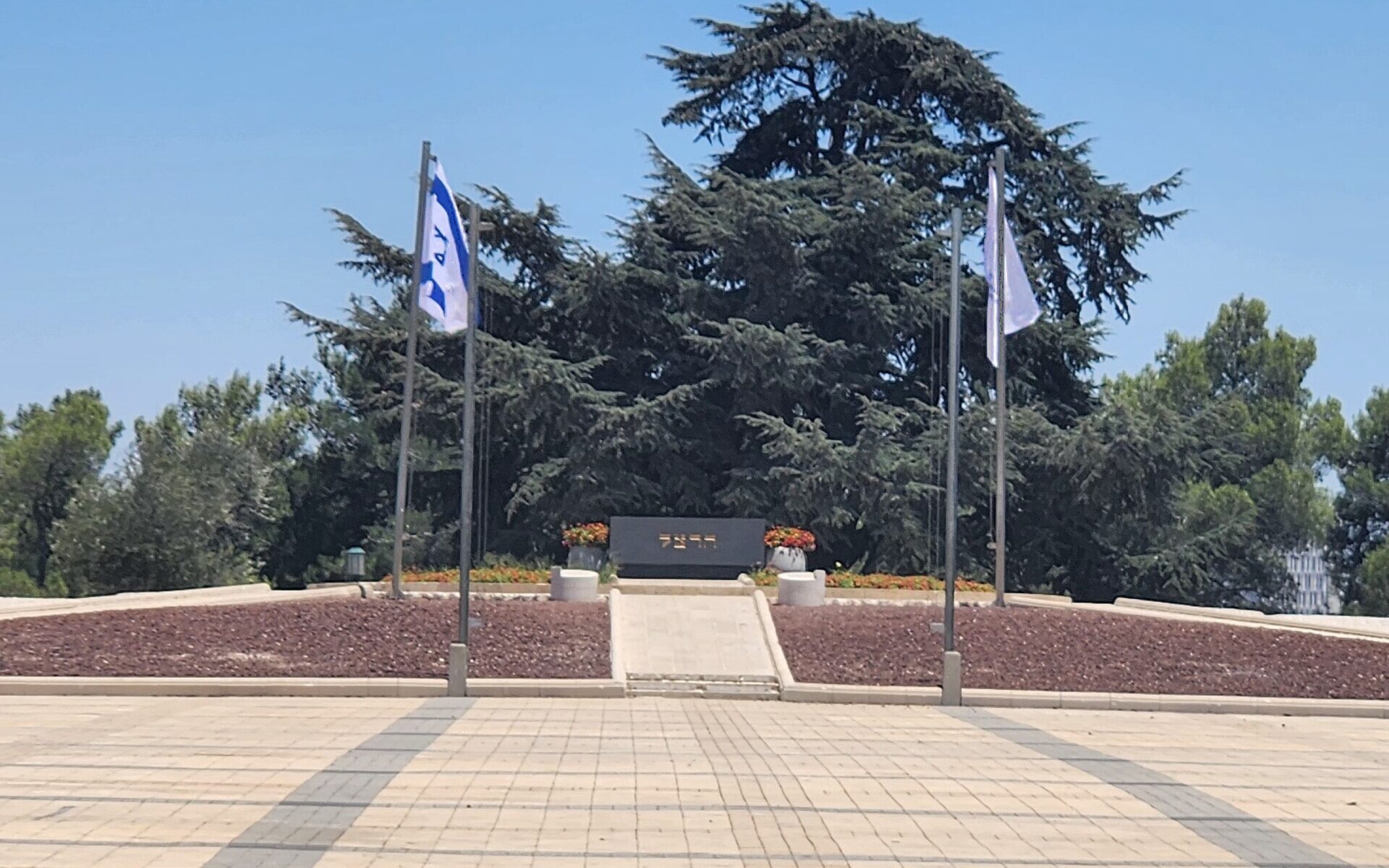
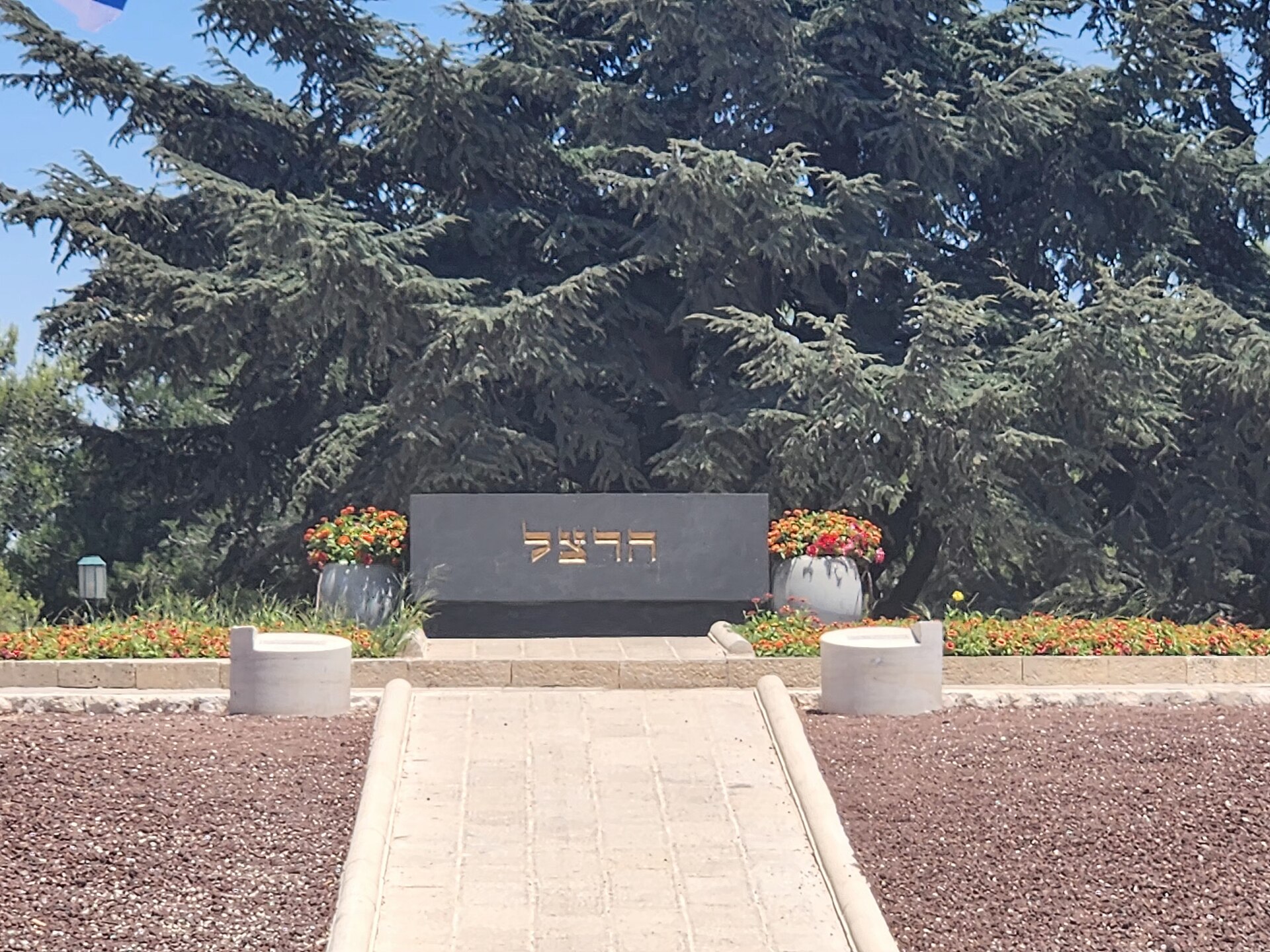
The grave at the top of the hill is a long slab of black stone with a single word on it, picked out in gold Hebrew letters: הרצל, Herzl. There is no first name, no dates and no epitaph, and none is needed. Every Israeli schoolchild knows whose grave it is, and the whole hill takes its name from the man beneath it. Mount Herzl is Israel’s national cemetery, the place where the state buries its founders, its prime ministers and its soldiers, and it tells you more about how the country sees itself than any museum in Jerusalem.
This guide covers the whole hill: who Theodor Herzl was and why he is buried here, the small Herzl Museum and how to book it, a walking route through the national and military cemeteries and the National Memorial Hall, how to behave in a place that is still very much in use, what happens here on the national days, and how to combine it with Yad Vashem next door. Hours and prices were checked in September 2026; treat them as the right order of magnitude and confirm before you go. Yad Vashem has its own guide, and this page leaves the Holocaust memorial to it: see our Yad Vashem visitor guide. For the city’s other collections, start with our overview of museums in Jerusalem.
Mount Herzl at a Glance
| What it is | Israel’s national civil cemetery, its main military cemetery, the National Memorial Hall for Israel’s Fallen, and the Herzl Museum |
| Where | Herzl Boulevard, on the western edge of the city, next to Yad Vashem |
| Getting there | Light rail Red Line to the Mount Herzl stop |
| Cemetery entry | Free, no booking. Open during the day Sunday to Friday, closing early on Friday |
| Herzl Museum | Guided visits by reservation only. The municipality’s listing gave Sunday–Thursday 08:30–16:30 and Friday 08:30–12:15 (September 2026); closed Saturday |
| Museum ticket | Quoted at ₪30 for adults and ₪24 for children over six, students and seniors, with under-sixes free; confirm when you book |
| Museum bookings | +972 2 632 1515 |
| Time needed | An hour for the museum, one to two hours for the grounds |
| Dress | Respectful: shoulders and knees covered is the safe choice |
| Combine with | Yad Vashem, 10–15 minutes’ walk away |
Who Was Herzl, and Why Is He Buried Here?
Theodor Herzl was born in Pest, in Hungary, in 1860, and made his name in Vienna as a journalist and playwright, a thoroughly assimilated man of letters. In the mid-1890s he was in Paris as correspondent for the Vienna Neue Freie Presse when the Dreyfus affair broke, and the antisemitism it exposed in one of Europe’s most liberal societies was something he later said had turned him to the Jewish national cause. Historians still argue about how much weight that single episode deserves. What is not in doubt is what he did next. In 1896 he published Der Judenstaat, “The Jewish State”, and in 1897 he convened the First Zionist Congress in Basel. In his diary he wrote, “At Basel I founded the Jewish State.”
He spent the rest of his short life lobbying sultans, kaisers and ministers, and died in Austria in 1904, aged 44. He was buried in Vienna, having asked in his will that the Jewish people one day carry his remains to the Land of Israel. In August 1949, a year after the state was declared, they did. His coffin was flown to Israel and buried on a hill on the western edge of Jerusalem, which was renamed after him. The national cemetery grew up around the grave.
For the wider story of how the modern city took shape, including the 1948 war that divided it, see our history of Jerusalem.
The Herzl Museum
The Herzl Museum sits near the main entrance to the hill and tells Herzl’s life in a guided, hour-long multimedia visit. You move with a small group through a series of rooms, from Paris and the Dreyfus trial, through the Zionist Congresses in Basel, to his early death. Visits run in Hebrew, English, Arabic, Russian, Spanish, French, German, Amharic and Mandarin.
The important thing to know is that you cannot just turn up. The museum only runs pre-arranged, guided visits, so book your slot and language in advance by phone (+972 2 632 1515). English slots go first in the busy seasons. The municipality’s iTravelJerusalem listing gave hours of 08:30–16:30 from Sunday to Thursday and 08:30–12:15 on Friday in September 2026, and the museum is closed on Saturday. Tickets have been quoted at ₪30 for adults and ₪24 for children over six, students and seniors, with under-sixes free. Confirm the current price when you book. The museum describes itself as fully accessible for visitors with physical and cognitive disabilities.
Is it worth it? If you are interested in the history of Zionism or in how Israel tells its own founding story, yes. It is a lively, well-made hour that explains a figure most visitors know only as a name on street signs. If you are not, the grounds outside will move you more, and they are free.
Walking Mount Herzl: A Route Through the Hill
The hill is laid out as a park, with pine and cypress shading paths that wind between the different sections. It is bigger than it looks from the road, and many of the signs are in Hebrew only. A sensible route starts at the entrance near the museum, climbs to Herzl’s tomb, and then comes down through the leaders’ plot and the military cemetery.
The summit: Herzl’s tomb and the ceremonial plaza
The tomb stands at the head of a broad paved plaza, flanked by flagpoles. This is where the state holds its Independence Day torch-lighting ceremony each year, so the space is laid out for grandstands and television cameras, and it feels oddly empty on an ordinary weekday. Close by are the graves of members of Herzl’s family. His children Hans and Pauline, who both died in 1930, were reburied here in 2006. His youngest daughter, Trude, has no grave; she died in the Theresienstadt ghetto in 1943. Ze’ev Jabotinsky, the founder of Revisionist Zionism, who died in New York in 1940 and was reburied here in 1964, lies nearby.
The Great Leaders of the Nation plot
Down the slope from the summit is the section reserved for the country’s leaders. Five prime ministers are buried here: Levi Eshkol, Golda Meir, Yitzhak Shamir, Shimon Peres and Yitzhak Rabin, who was assassinated in 1995 and lies beside his wife Leah. So are presidents including Zalman Shazar and Chaim Herzog, speakers of the Knesset and other figures the state chose to honour. Teddy Kollek, the mayor who shaped modern Jerusalem, is here too. Two absences are just as telling: David Ben-Gurion chose to be buried at Sde Boker in the Negev, and Menachem Begin chose the Mount of Olives, near the graves of two Jewish underground fighters who died in British custody in 1947. Our Mount of Olives guide covers the cemetery there.
You will see small stones left on the graves. It is an old Jewish custom, a sign that someone came and remembered, and visitors of any background are welcome to follow it.
The military cemetery
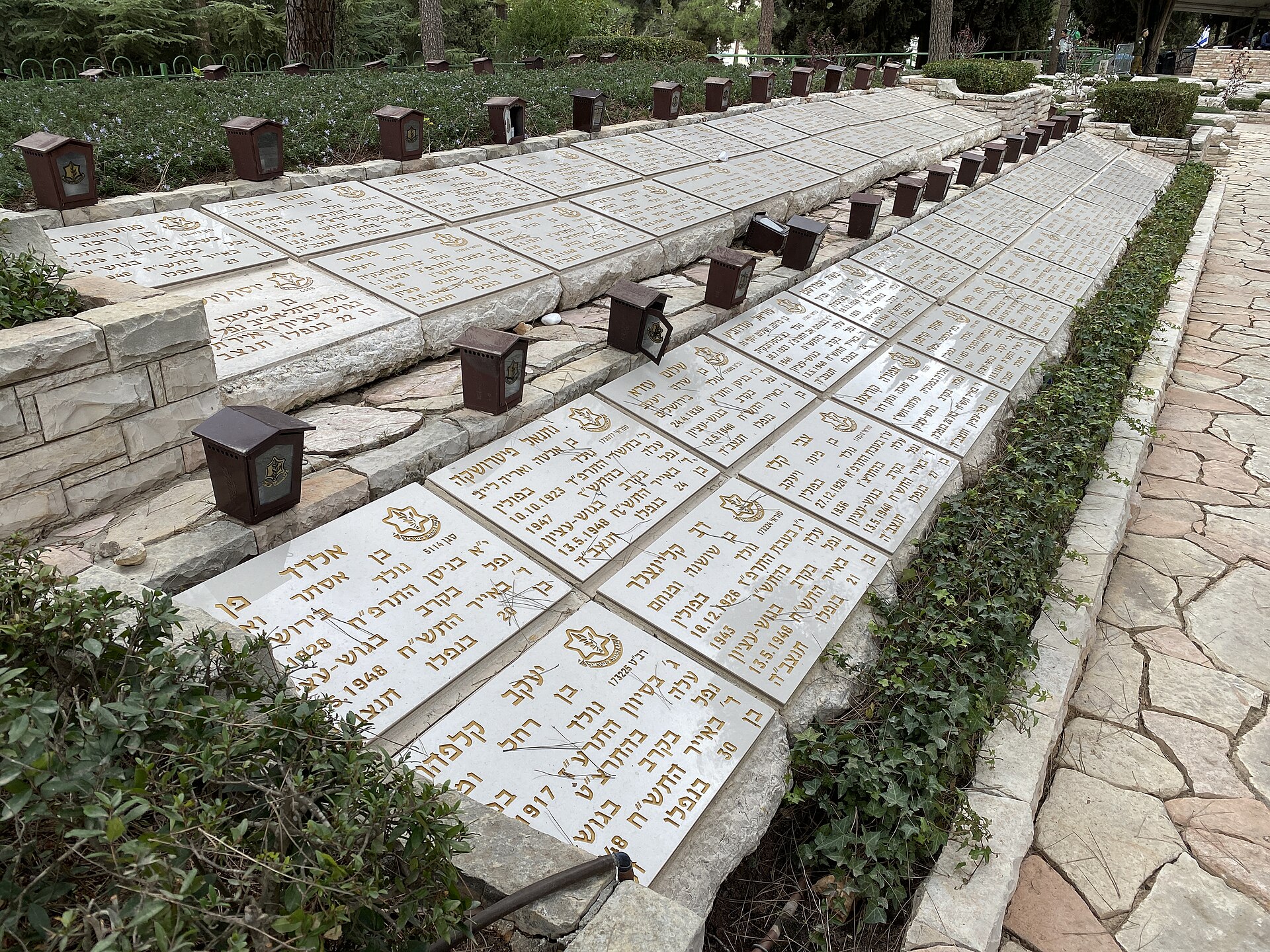
Israel’s main military cemetery covers the northern slopes, section after section of low stone graves, laid out by war and by unit. The oldest plots belong to the fighting of 1948, and many stones there carry the same few dates. Among the best-known graves is that of Hannah Szenes, the poet and paratrooper executed in Budapest in 1944, whose remains were brought here in 1950.
This is not a historic cemetery in the way the Mount of Olives is. It is in constant use. Since October 2023 it has received many new burials, and on any given day you may find families at fresh graves, a funeral under way, or soldiers visiting friends. Walk quietly, keep your distance from mourners, and leave your camera down wherever people are grieving. First-time visitors almost always find this part of the hill harder, and more affecting, than they expected.
The National Memorial Hall for Israel’s Fallen
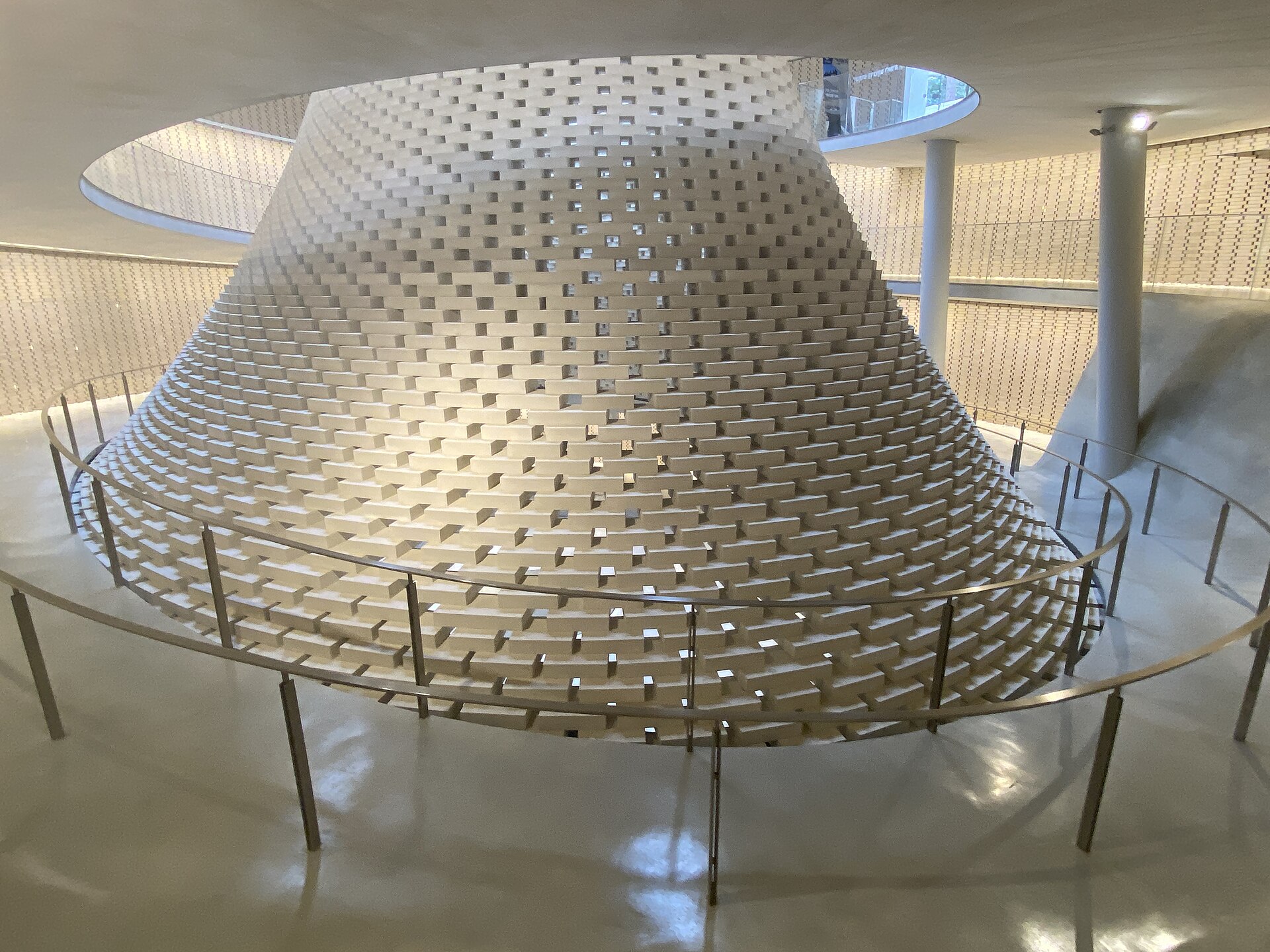
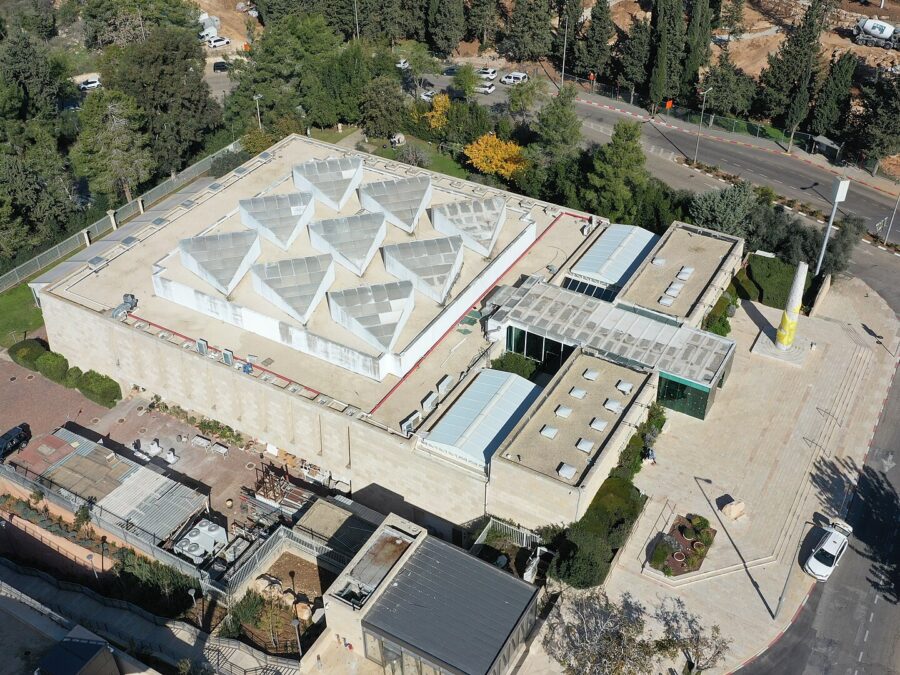
Completed in 2017 on the edge of the military cemetery, the National Memorial Hall commemorates all of the country’s fallen in a single building. Walls of small bricks spiral around a tall central cone that rises to a skylight, and each of the dead has a brick bearing their name and the date of their death. A memorial marks each anniversary. It is one of the most striking modern buildings in Jerusalem and one of the quietest, so check its visiting arrangements on the day, as they can be affected by ceremonies.
Other memorials on the hill
Scattered along the paths are smaller national memorials. The most affecting for many visitors is the memorial to the Ethiopian Jews who died on the journey to Israel through Sudan in the 1980s. Others commemorate civilian victims of terror and soldiers whose burial places are unknown. None of them take long, and together they explain why Israelis call this Memorial Mountain.
How to Visit Respectfully
- Dress. There is no formal code for the grounds, but shoulders and knees covered is the respectful choice, and you will fit in better. Our Jerusalem dress code guide has the details for the whole city.
- Noise and phones. Keep your voice down, and take calls outside the cemetery sections.
- Photographs. The tomb, the plaza and the memorials are fine to photograph. Mourners, funerals and individual family graves are not.
- Funerals and ceremonies. If one is under way, stay well back and take another path. Military funerals include a volley of shots, which can be startling if you are not expecting it.
- Food. Eat and drink before you arrive or after you leave, not among the graves.
Mount Herzl on the National Days
Two days in spring put Mount Herzl at the centre of national life. On Yom HaZikaron, Israel’s Memorial Day for fallen soldiers and victims of terror, a siren sounds across the country at 11:00. Everything stops, drivers get out of their cars, and the main state ceremony takes place in the military cemetery here, while families fill every section of the hill. That evening, as Memorial Day ends, Independence Day begins with the state torch-lighting ceremony on the plaza by Herzl’s tomb. Attendance is by invitation or ticket, and most Israelis watch it on television. In 2027, Yom HaZikaron runs from the evening of 10 May to the evening of 11 May, followed at once by Yom HaAtzmaut. Our calendar of Jerusalem’s holidays puts those days in context.
For visitors, this means two things. On Memorial Day the hill is for the bereaved, and you should not visit as a sightseer. In the days before Independence Day, rehearsals for the torch-lighting close parts of the summit and the surrounding roads. If your trip falls in early May, plan Mount Herzl for another week, and read our best time to visit Jerusalem guide for the rest of the spring calendar.
Combining Mount Herzl with Yad Vashem
Mount Herzl and Yad Vashem sit on the same ridge, share a light rail stop, and are 10–15 minutes’ walk apart. Most visitors do both on the same day. That works, but think about the order and do not add a third thing.
- Yad Vashem first is the usual choice. It needs the fresh morning hours and at least three hours of your attention. Mount Herzl afterwards, in the early afternoon, is a shorter, outdoor visit, and walking the hill in the open air is a way of coming back into the present.
- Mount Herzl first makes sense if you have booked an early Herzl Museum slot, or if you want the story of the state’s founding before the history that Yad Vashem tells.
- Timing: both are closed on Saturday and close early on Friday, so a Sunday to Thursday is best.
Our Yad Vashem guide covers the memorial campus in full, and families should read our advice on Yad Vashem with children before planning the day. Afterwards, the village of Ein Karem is a few minutes away by taxi or light rail, and a coffee in its lanes is a gentle way to end a heavy morning.
Getting There
Take the light rail Red Line to the Mount Herzl stop, where Alexander Calder’s red steel stabile stands by the entrance plaza. The tram runs from the Old City’s Damascus Gate through the city centre and Mahane Yehuda, and since 2025 it has continued past Mount Herzl to Hadassah Ein Kerem. Our light rail guide explains fares and frequencies. Several buses run along Herzl Boulevard, and a taxi from the city centre is quick outside the rush hours; our getting around Jerusalem guide has the options. There is no public transport from Friday afternoon until Saturday night, although that matters less here, because the museum is closed on Shabbat anyway and the published visiting hours for the grounds run from Sunday to Friday. Our Shabbat guide explains what is open instead.
When to Go
Weekday mornings are best. The paths through the cemeteries are shaded by pines, but the summit plaza around Herzl’s tomb has no cover at all, and from June to September it is fierce by late morning. Either arrive when the grounds open or come in the mid-afternoon after Yad Vashem, and walk the shady military cemetery before the exposed summit. Winter visits are lovely on a clear day, with long views west over the Jerusalem hills, but the stone paths are slippery after rain; our Jerusalem weather by month guide shows what to expect.
A few dates are worth avoiding. Friday afternoons are short, because everything closes early before Shabbat. Memorial Day belongs to the bereaved. In the week before Independence Day, rehearsals close parts of the summit. Official memorial ceremonies, such as the annual state ceremony at Yitzhak Rabin’s grave in the autumn, close sections of the hill for a morning. None of them is a reason to skip Mount Herzl, only a reason to check the day you have chosen.
Visiting with Children
Mount Herzl is a gentler introduction to the country’s modern history than Yad Vashem, and children of any age can walk the grounds. Older children usually follow the Herzl Museum’s multimedia show well, and the park gives younger ones room to move between the quieter sections. The military cemetery raises questions, so it is worth preparing them beforehand: what the graves are, why people leave small stones on them, and why everybody lowers their voice. The gravestones give the age at death, and many of the soldiers were painfully young. That detail tends to affect teenagers more than any exhibit could. Our guides to Jerusalem with kids and Jerusalem for teenagers have ideas for balancing a day like this with something lighter.
Is Mount Herzl Worth Visiting?
Yes, for anyone who wants to understand modern Israel rather than only ancient Jerusalem. The Old City shows you what the country’s faiths hold sacred. Mount Herzl shows you what the state itself holds sacred: its founder, its leaders, and above all its dead. It costs nothing, takes a couple of hours, and sits right beside Yad Vashem, which you are probably visiting anyway.
What it is not is a sight in the usual sense. There is nothing to “see” as such beyond graves, trees and a fine view west over the Jerusalem hills, and visitors who treat it like a monument to be photographed tend to leave puzzled. Walk it slowly, read the names, and it will stay with you. The Herzl Museum is an optional extra for the history-minded. The cemetery is the reason to come. For how it fits alongside the rest of the city, see our Jerusalem itinerary.
Mount Herzl sits at the western end of the Red Line, and at the other end, in north Jerusalem, is Ammunition Hill, the 1967 battlefield where paratroopers fought for the road to Mount Scopus. Its preserved trenches and museum take about an hour and a half. Seen in the morning, followed by Mount Herzl after lunch, the two make a coherent half-day on the modern state, about half an hour apart on the same tram without changing.
Final Word on Mount Herzl
Most of Jerusalem’s great sites are about faith. Mount Herzl is about a state: the man who imagined it, the leaders who ran it and the soldiers who died for it, laid out on a hillside of pines with the city behind and the hills rolling west towards the sea. Come on a weekday, walk slowly, and give it the same attention you would give a church or a synagogue. Pair it with Yad Vashem next door, round out a museum day with the Israel Museum, and use our list of free things to do in Jerusalem for more places that cost nothing and give a great deal.
Photo Credits
Herzl’s tomb and the ceremonial plaza on Mount Herzl: 114938 herzls tomb jerusalem PikiWiki Israel by ברוך ניב, CC BY 2.5, via Wikimedia Commons.
Herzl’s tombstone: 114940 herzls tomb jerusalem PikiWiki Israel by ברוך ניב, CC BY 2.5, via Wikimedia Commons.
Graves from 1948 in the military cemetery: 121973 jerusalem mount herzl PikiWiki Israel by שלמה רודד, CC BY 2.5, via Wikimedia Commons.
Inside the National Memorial Hall for Israel’s Fallen: 121972 jerusalem mount herzl PikiWiki Israel by שלמה רודד, CC BY 2.5, via Wikimedia Commons.