The Dead Sea Scrolls are among the most consequential manuscript finds ever made, and you can stand in front of them at the Shrine of the Book, the white-domed wing of the Israel Museum built specifically to house them. These fragile parchment and papyrus texts, written between roughly the 3rd century BCE and the 1st century CE and recovered from caves above the Dead Sea, include the oldest known copies of the Hebrew Bible by about a thousand years. This guide to seeing the Dead Sea Scrolls Jerusalem visitors travel for covers the discovery, what is on display, current hours and shekel fees, and how to pair the museum with a trip to where the scrolls were found.
Whatever your background, the scrolls reward a little preparation, since their importance is as much textual as visual. Read this alongside our archaeology museums guide and our biblical sites guide to set them in context.
What the Dead Sea Scrolls are
The collection comprises hundreds of manuscripts, many in tiny fragments, found in eleven caves near the ancient settlement of Qumran. Most are in Hebrew, with some in Aramaic and a few in Greek. They fall into three broad groups: copies of biblical books (every book of the Hebrew Bible except Esther is represented in some form), other Jewish religious writings including works like Enoch and Jubilees, and texts that appear to belong to a specific community, with rules and beliefs of their own. Scholars commonly associate that community with the Essenes, a Jewish sect, though the exact relationship between the people of Qumran and the scrolls remains debated.
Their survival is owed to the desert. Sealed in jars or simply left in dry caves above the lowest point on land, the manuscripts escaped the decay that would have destroyed them almost anywhere else. The result is a library that lets scholars compare the biblical text as it stood two millennia ago with later versions, and the degree of continuity, especially in a book like Isaiah, is remarkable.
The discovery
The story began in 1947, when a Bedouin shepherd searching for a stray animal near Qumran came upon a cave containing old jars holding the first scrolls. Over the next several years, from 1947 into the mid-1950s, Bedouin and archaeologists located eleven caves in all, yielding thousands of fragments. The initial scrolls passed through antiquities dealers before scholars grasped their significance; some of the first seven were eventually acquired for Israel, and the Shrine of the Book was built to display them, opening in 1965. Study of the full corpus has continued ever since, with fragments still being analyzed three-quarters of a century on.
The Shrine of the Book building
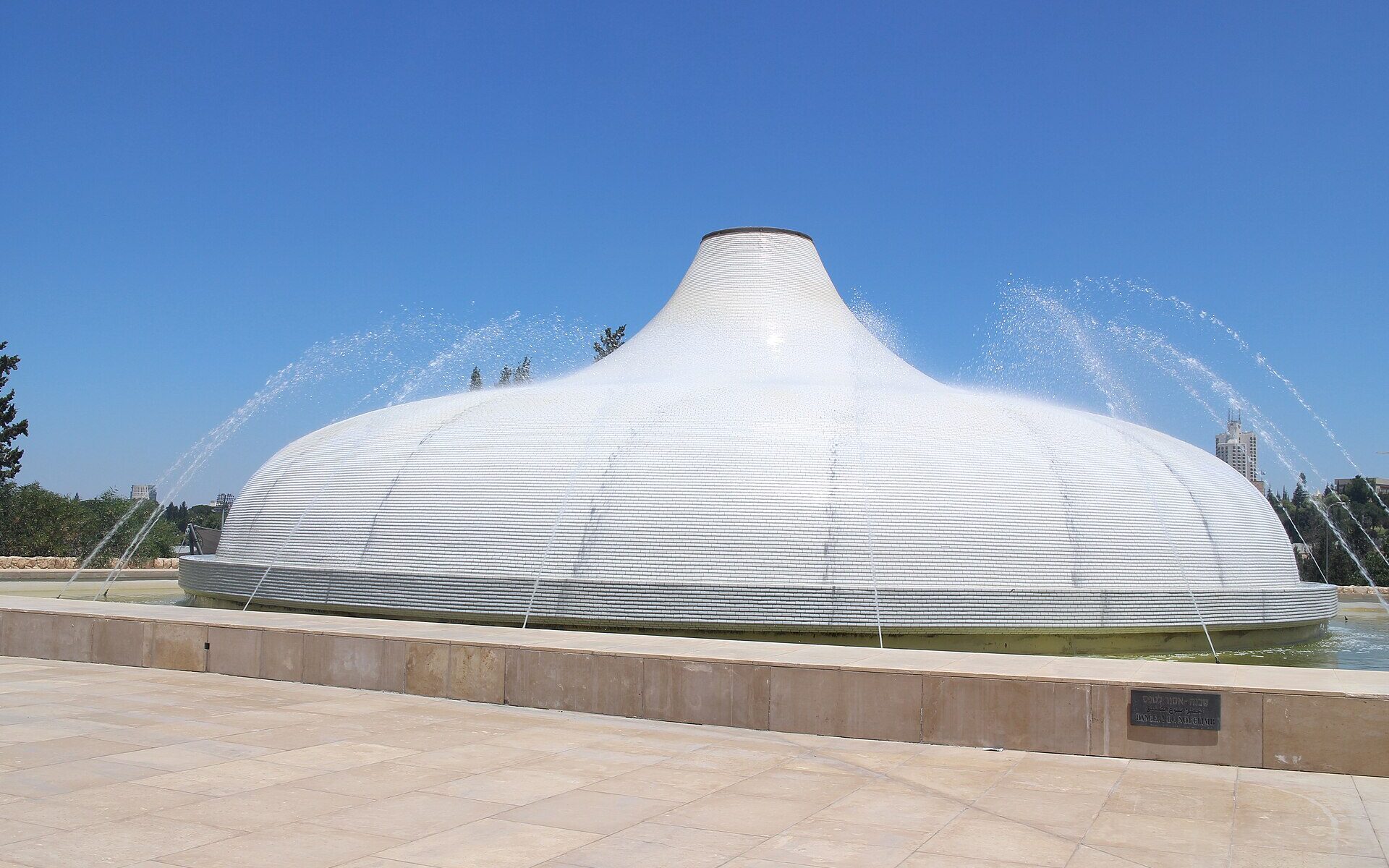
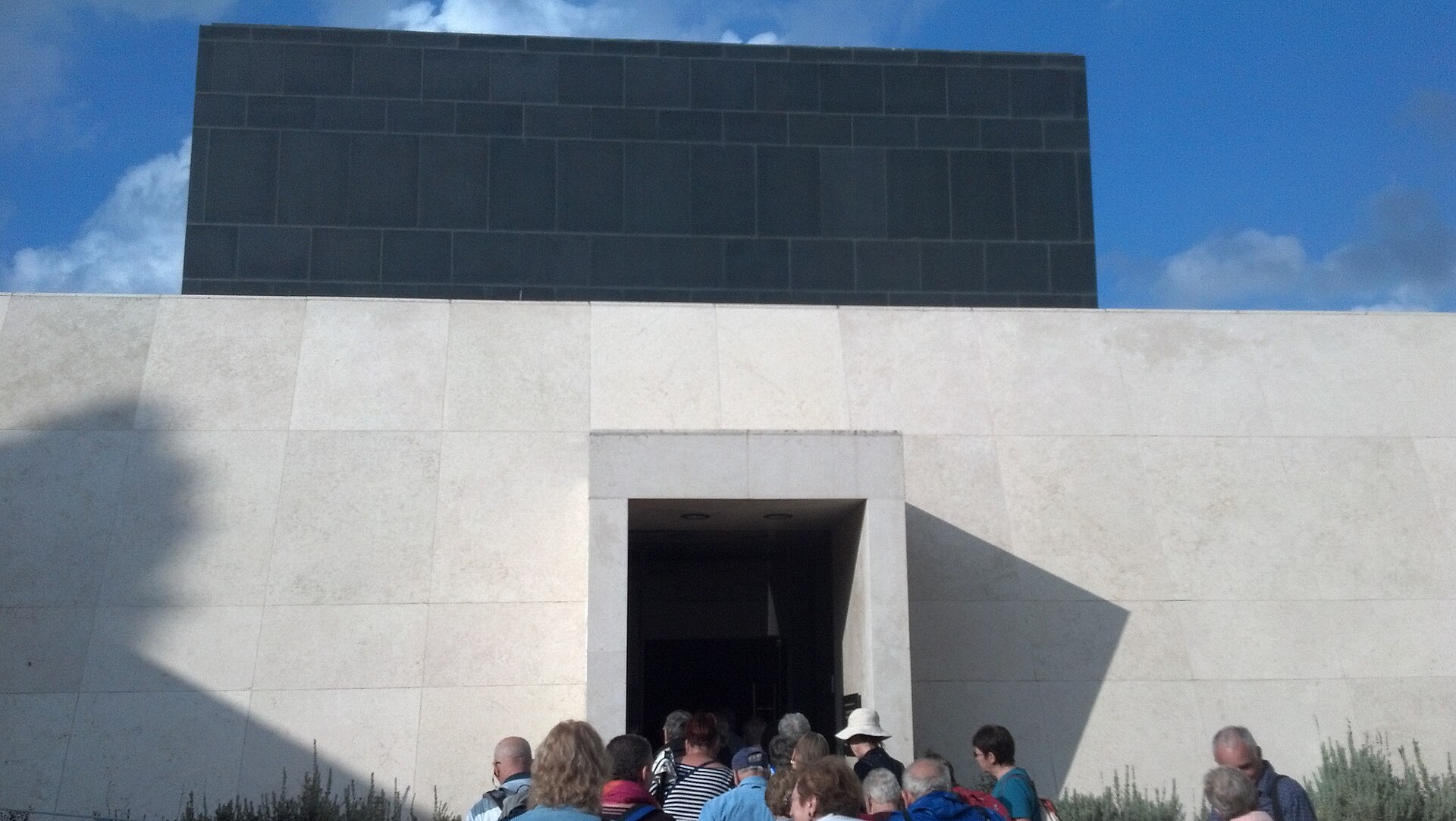
The Shrine is a piece of architecture worth noticing in its own right. Designed by Frederick Kiesler and Armand Bartos, its brilliant white dome echoes the shape of the lids of the jars in which scrolls were found, and it is set across a reflecting pool from a contrasting black basalt wall, evoking the cosmic struggle between the “Sons of Light” and the “Sons of Darkness” described in one of the scrolls. The main exhibition hall lies below ground, a deliberate nod to the caves, and the environment is carefully climate-controlled to protect the manuscripts. The effect is hushed and a little otherworldly, which suits the contents.
What to look for inside
The Great Isaiah Scroll
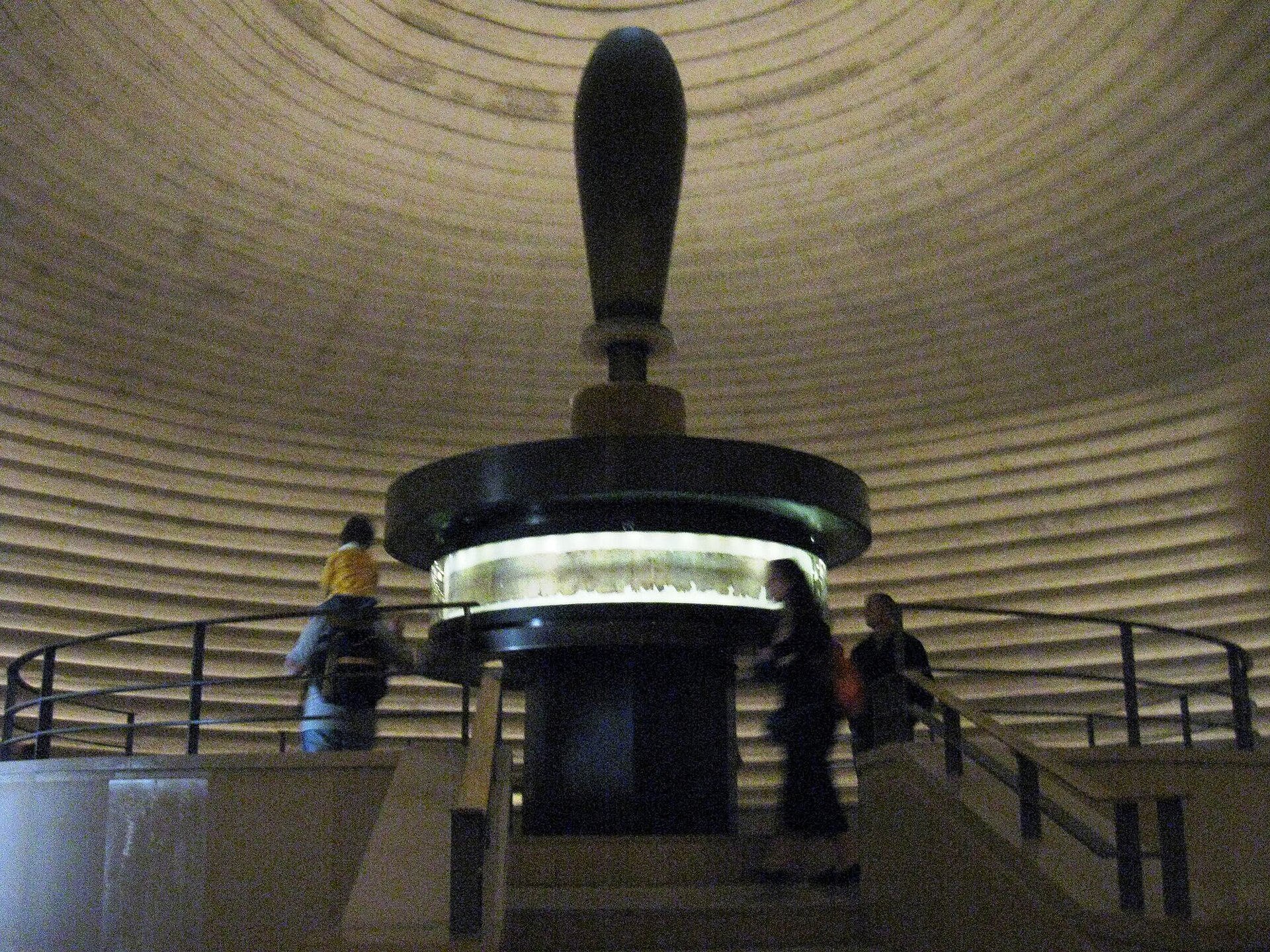
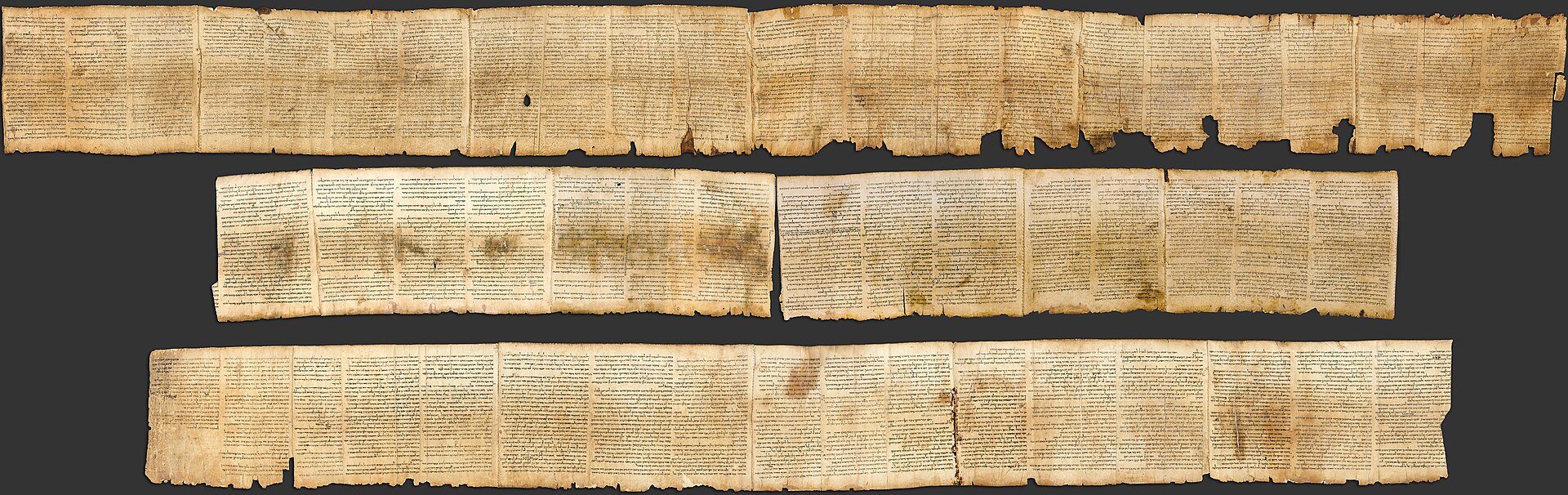
The centerpiece is the Great Isaiah Scroll, the best preserved of the biblical scrolls and the only complete book among the original finds, dated to around 125 BCE. It is displayed around the raised central drum of the hall. Comparing it with the Book of Isaiah as we have it today is the single most striking demonstration of how faithfully the text was copied across the centuries.
The community texts
Look also for the sectarian writings, such as the Community Rule, which sets out the regulations and ideals of the Qumran group, and the War Scroll, an apocalyptic text imagining a final battle between the forces of light and darkness. These offer a rare, direct window into Jewish religious life and thought in the centuries around the turn of the era, the world into which both rabbinic Judaism and early Christianity emerged.
The Aleppo Codex
The Shrine also displays the Aleppo Codex, a 10th-century manuscript widely regarded as the most authoritative medieval text of the Hebrew Bible and a cornerstone of the scribal tradition. Though far younger than the scrolls, it is a treasure in its own right and rounds out the story of how the biblical text was transmitted.
Why they matter
- Textual continuity: they show the Hebrew Bible changed remarkably little over two thousand years.
- Lost literature: they preserve Jewish works that had otherwise vanished or survived only in translation.
- A sect made real: they give the first direct evidence of a community like the Essenes.
- Historical backdrop: they illuminate the Jewish world of the late Second Temple period.
- Ongoing scholarship: new readings and reconstructions continue to emerge.
Visiting the Shrine of the Book
The Shrine sits within the Israel Museum on Givat Ram, west of the city center near the Knesset, so your ticket to the museum covers it; there is no separate admission. As a 2026 guide, adult entry to the Israel Museum is around 54 shekels, with reduced rates for children, roughly 14 to 15 US dollars. Hours generally run Sunday to Wednesday and Saturday from 10am to 5pm, later on Thursday, and 10am to 2pm on Friday, but they shift on holiday eves, so confirm before you go.
| Detail | Information |
|---|---|
| Location | Shrine of the Book, Israel Museum, Givat Ram |
| Cost | Included in Israel Museum entry, around 54 ILS adult |
| Typical hours | Sun-Wed and Sat 10am-5pm; Thu later; Fri 10am-2pm |
| Time for the Shrine | About 45 minutes to an hour |
| Getting there | City buses or a short taxi; allow a separate half-day for the museum |
| Photography | Generally allowed without flash; check signage |
Set aside enough time to enjoy the rest of the Israel Museum while you are there, especially the outdoor model of Second Temple Jerusalem, which sits just outside the Shrine and brings the scrolls’ era to life at city scale. The neighbouring Bible Lands Museum adds further context. For transport options, see our transportation guide.
Practical tips
- Go mid-morning to be ahead of the larger tour groups, and budget a half-day for the whole museum.
- Rent the audio guide or join a tour; the scrolls mean far more with their backstory explained.
- Expect facsimiles at times. To protect the fragile originals, the museum rotates them and may display high-quality facsimiles when an original is resting. The experience remains compelling either way.
- Pair with the Second Temple model outside and the Bible Lands Museum next door for a fuller picture.
- Mind the calendar: the museum closes or shortens hours around Shabbat and Jewish holiday eves.
Qumran: where the scrolls were found
To complete the story, you can visit Qumran itself, the archaeological site on the northwestern shore of the Dead Sea about 35 kilometers east of Jerusalem, roughly an hour to ninety minutes away. The national park preserves the ruins of the settlement and looks out toward the caves where the scrolls came to light, with a short film and modest entry fee (around 30 shekels). It pairs naturally with a day at the Dead Sea or a Masada excursion. Our Dead Sea day trip guide and Masada day trip guide cover the logistics.
Putting the scrolls in Jerusalem’s story
It is easy to treat the Dead Sea Scrolls as a stand-alone marvel, but they belong to a specific moment in the city’s long history: the late Second Temple period, when Jerusalem was a thriving religious center under Herodian and then Roman rule, and Jewish life was alive with competing movements and ideas. The Qumran community withdrew to the desert during these same centuries, and the scrolls preserve the texts and disputes of that world. Reading the scrolls against the wider arc of the city, laid out in our Jerusalem history guide, turns a room of parchment into a chapter of a continuous narrative that runs from the City of David to the present day.
That connection is also geographic. The Second Temple model standing just outside the Shrine reconstructs the very Jerusalem that existed while the scrolls were being copied and hidden, and many of the biblical sites you can still walk, the Western Wall among them, date to or recall that era. Seeing the scrolls and then visiting these places, or the other way around, lets each illuminate the other.
Make a half-day of it: a Givat Ram plan
The Shrine takes under an hour, but the Israel Museum complex deserves more, so it is worth planning the visit as a relaxed half-day rather than a quick dash. Here is a sequence that works well.
- Arrive mid-morning and head straight to the Shrine of the Book before groups build up, taking in the Isaiah Scroll and the community texts.
- Step outside to the Second Temple model to see the city of the scrolls’ own time at 1:50 scale.
- Tour the archaeology wing of the Israel Museum to trace the land from prehistory onward.
- Break for coffee in the museum grounds, which are pleasant and shaded.
- Finish next door at the Bible Lands Museum if you have the appetite, for the surrounding ancient cultures.
If you would rather spread things out, do the scrolls and the model on one visit and return another day for the rest, since a single museum ticket can feel like a lot to absorb at once. Our archaeology museums guide helps you build a longer history-focused itinerary across the city.
Etiquette and accessibility
The Shrine is a quiet, reverent space, so keep voices low and follow staff guidance, particularly around the central Isaiah display. The galleries are climate-controlled and dimly lit to protect the manuscripts, which can make reading labels tricky, another reason the audio guide helps. The Israel Museum is among the more accessible major sites in the city, with step-free routes and facilities for wheelchair users; our accessibility guide has the detail. Strollers are generally fine in the museum, though the Shrine’s ramps and the crowds at peak times can make a carrier easier with a small child.
The Shrine of the Book is only one part of the campus. The museum’s archaeology wing, its four rebuilt synagogue interiors and the open-air Second Temple model are all included in the same ticket, and are worth planning around rather than leaving to chance. Our Israel Museum guide covers the hours, tickets and the best route through the whole site.
Photo Credits
The white dome of the Shrine of the Book at the Israel Museum: Shrine of the Book 20180705 by Suicasmo, CC BY-SA 4.0, via Wikimedia Commons.
The central scroll display inside the Shrine of the Book, Israel Museum: Israel Museum, Jerusalem 2008 25 by Daniel Ventura, CC BY-SA 4.0, via Wikimedia Commons.
The complete Great Isaiah Scroll (1QIsa-a): Great Isaiah Scroll, photographed by Ardon Bar Hama, public domain, via Wikimedia Commons.
Visitors entering the Shrine of the Book beneath its black basalt wall: Shrine of the Book entrance by PMATAS, CC BY-SA 3.0, via Wikimedia Commons.