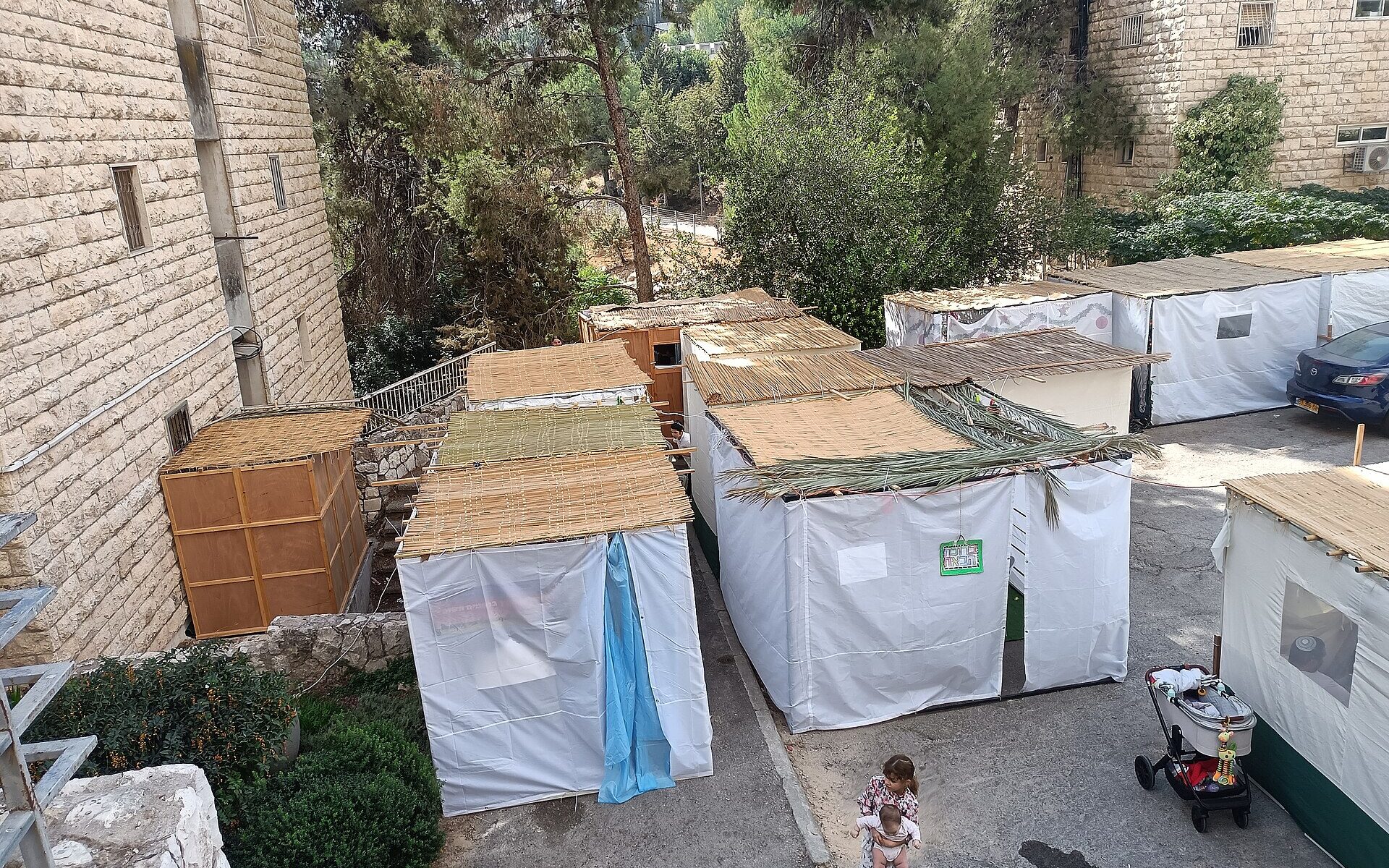
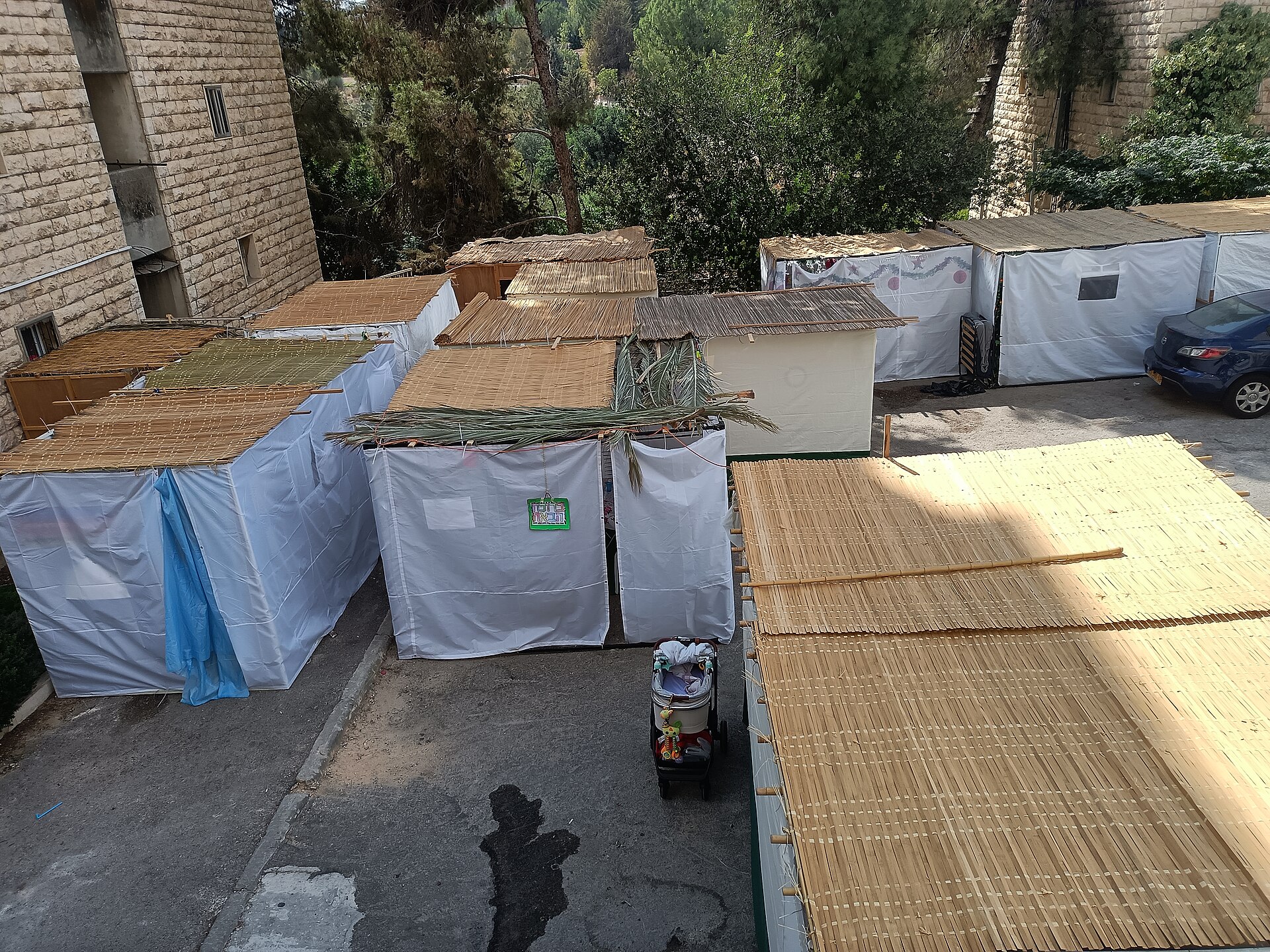
Four days after the city switches itself off for Yom Kippur, it starts building. Timber and bamboo mats appear on every pavement, whole car parks vanish under white sheeting, and by the eve of the festival there is a small hut on almost every balcony in West Jerusalem with palm fronds laid loosely enough across the roof to let the stars through. Then everybody moves in — eats, sleeps and entertains outdoors for a week. Sukkot in Jerusalem is the festival most first-time visitors have never heard of, and it is the best week of the year to be here.
This page covers the seven days: what the booths are for, which single day closes the city, the Priestly Blessing at the Kotel, the Jerusalem March, and why autumn is a genuinely under-exploited booking window. Details were checked in September 2026 — confirm hours before you rely on them, since Sukkot programming is announced late and changes annually.
The 2027 Dates
| Date (2027) | What it is | What is open |
|---|---|---|
| Fri 15 October, afternoon | Festival eve. Shops close early | Everything, until roughly 14:00 |
| Sat 16 October | First day — full festival day, and Shabbat | No transport, no shops, museums closed |
| Sun 17 – Thu 21 October | Chol HaMoed. The national holiday week | Everything open, extended hours, packed |
| Fri 22 October | Chol HaMoed, then festival eve from mid-afternoon | Open until early afternoon |
| Sat 23 October | Shemini Atzeret / Simchat Torah — full festival day | No transport, no shops, museums closed |
Note that in 2027 both closed days fall on Saturdays, which is unusually convenient: the closures coincide with Shabbat rather than adding to it, so you lose two days rather than four. That does not happen every year, and it makes 2027 a particularly good year to come for Sukkot.
In Israel, Shemini Atzeret and Simchat Torah are a single day. In the diaspora they are two, which is why online calendars often disagree — see our full religious holidays calendar for the Israeli dates throughout.
The Booths
The sukkah commemorates the temporary shelters of the Exodus, and the rules are specific enough to be interesting: at least three walls, a roof of cut vegetation loose enough to see the sky through and to let rain in, and it must be temporary. Meals are eaten inside for the week, and a good many people sleep in theirs.
What that produces in a dense city is remarkable. Restaurant terraces are roofed over and become sukkot. Hotels build enormous ones so guests can eat in them. Balconies in Nachlaot and the Jewish Quarter sprout huts three storeys up. Municipal sukkot appear in parks and squares. There is even a mobile version — a sukkah on a trailer, towed around so that people who cannot reach one can eat in it.
- Where to see them at their best: Nachlaot, Mea Shearim and the Bukharan Quarter for density and decoration; the Jewish Quarter of the Old City for the setting; the German Colony for the restaurant versions.
- Can you go in one? If invited, yes, and invitations are common — hospitality in the sukkah is part of the festival. Do not simply walk into a private one.
- Photography. The booths themselves are fine. People eating in them, particularly children, are not, without asking.
The Four Species
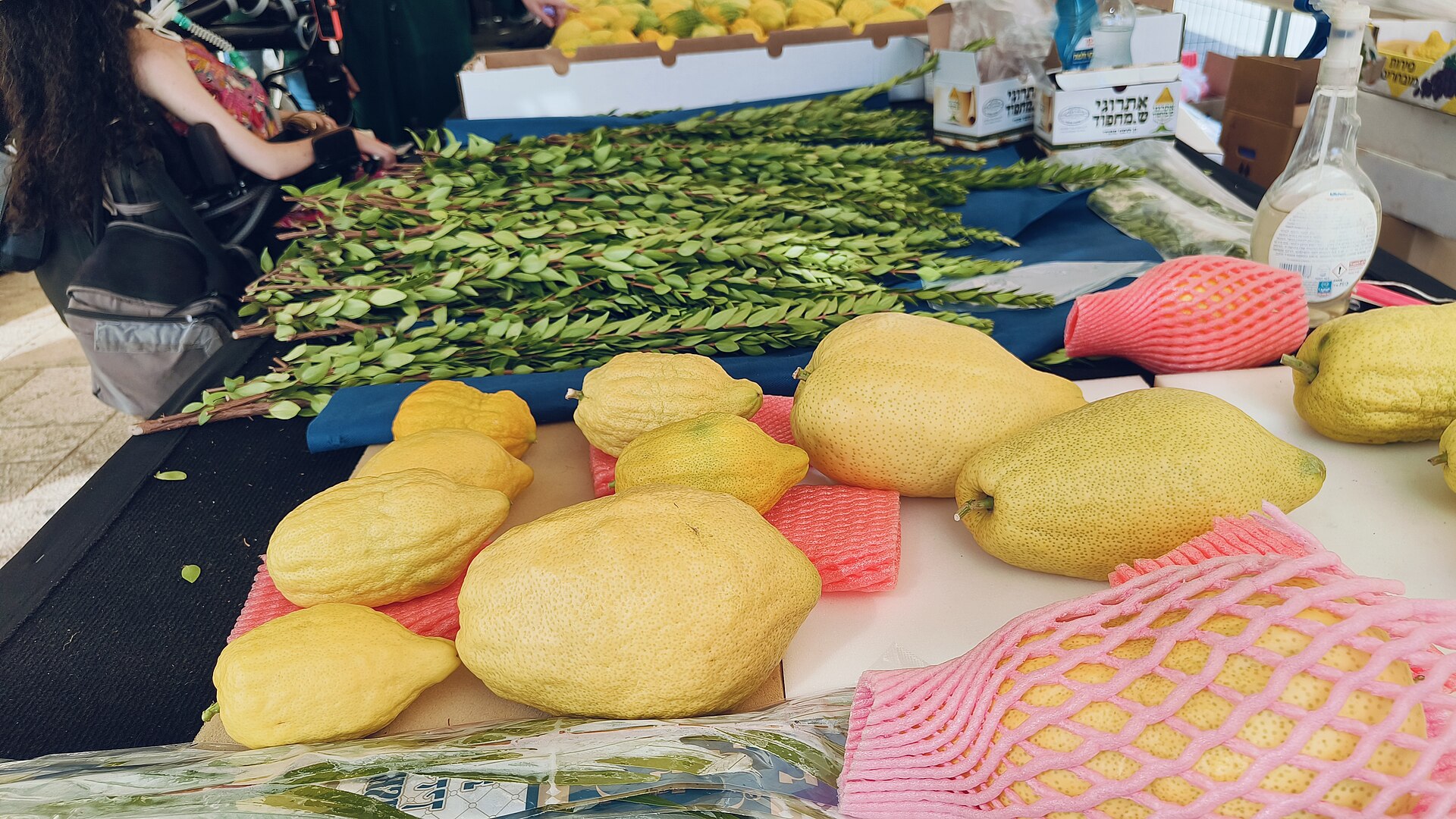
In the days before the festival, temporary markets appear selling the arba minim, the four species carried and waved during the festival: a palm frond (lulav), myrtle and willow branches, and a citron (etrog). The largest is around Mahane Yehuda and in the religious neighbourhoods, and it is one of the most photogenic and least-visited things in the Jerusalem year.
It is worth an hour even if you are buying nothing. Buyers examine etrogim under jewellers’ loupes, checking for blemishes and for an intact stem, and the difference between an ordinary fruit and a perfect one is a great deal of money. Vendors are used to curious onlookers and are generally delighted to explain. Go in the last two or three days before the festival, in the evening, when the markets are busiest — our Mahane Yehuda guide covers the area.
The Priestly Blessing
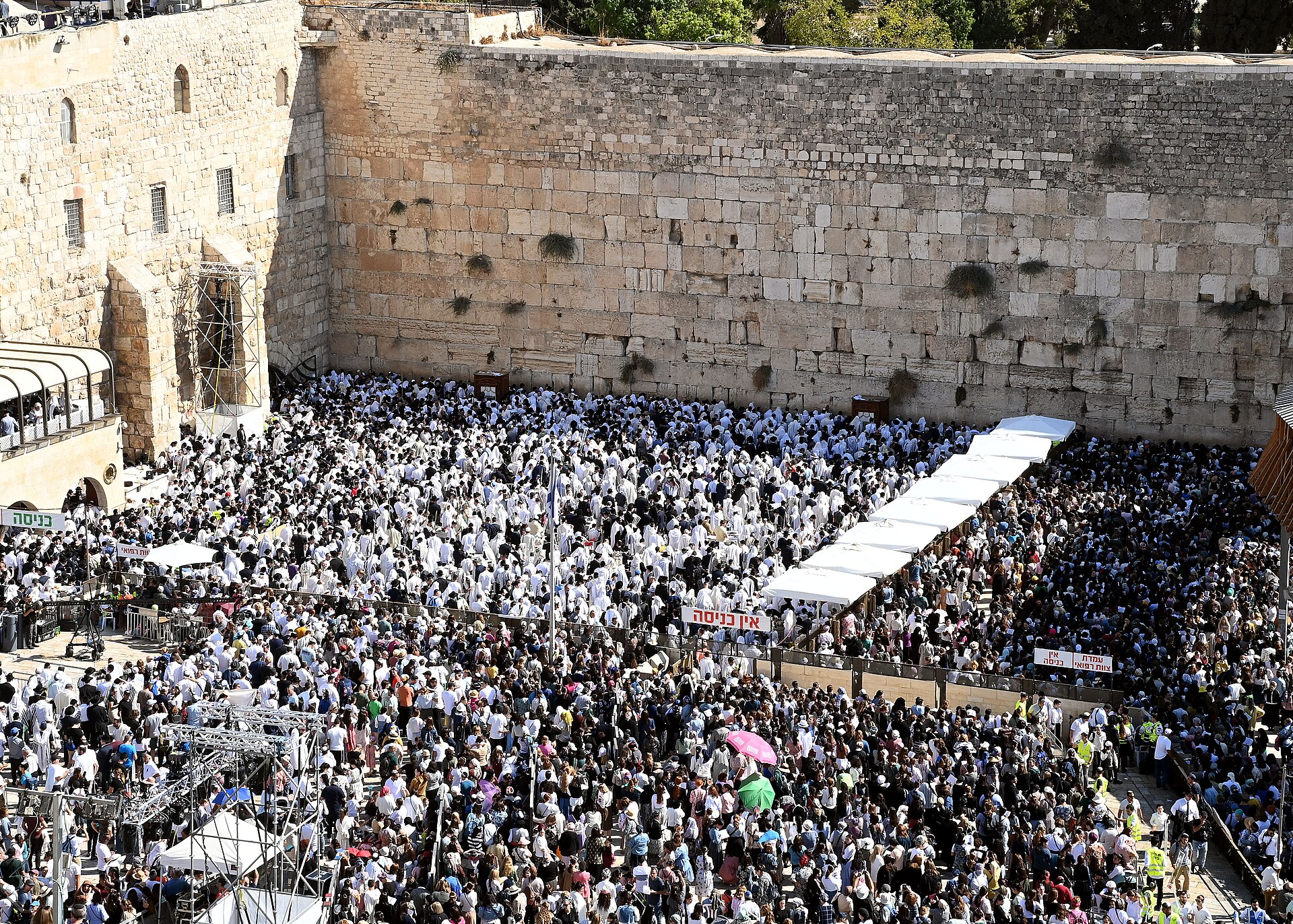
Birkat Kohanim, the mass Priestly Blessing, is held on one Chol HaMoed morning at the Western Wall — the autumn counterpart to the one at Passover. Tens of thousands fill the plaza; men of priestly descent draw their prayer shawls over their heads and bless the crowd, and children stand underneath.
- It runs in the morning, typically starting around 08:45 with the main blessings mid-morning. Confirm the year’s timing with the Western Wall Heritage Foundation.
- Arrive by 07:30 at the latest. Police close the approaches once the plaza reaches capacity.
- Modest dress; separate men’s and women’s sections; photography permitted on Chol HaMoed, unlike full festival days.
- For a view without the crush, use the overlook above the plaza from the Jewish Quarter side.
The Jerusalem March
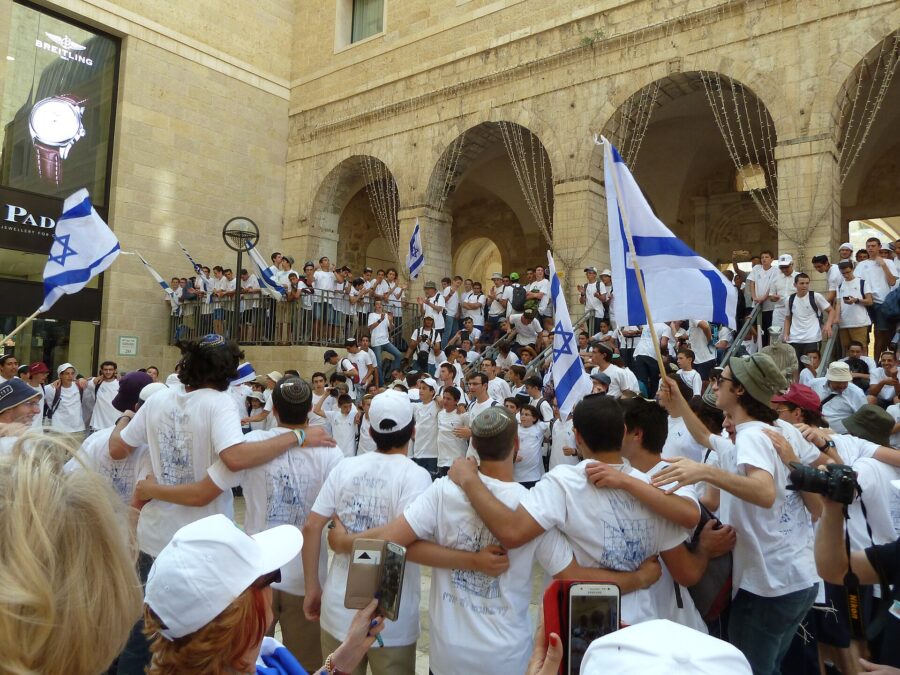
On one Chol HaMoed day, tens of thousands of people walk through the city in the annual Jerusalem March — a mix of Israeli school and community groups, marching bands, and a large contingent of Christian pilgrims from dozens of countries who come specifically for the festival, in national dress, carrying flags. It is entirely open, entirely free, and it is one of the more genuinely surprising sights in the city: a Fijian choir, a Brazilian brass band and a Norwegian delegation walking down Jaffa Road in October.
Routes vary by year and are published by the municipality shortly beforehand; the finish is usually in Sacher Park or the city centre. Turn up anywhere along the route with an hour to spare. Our festivals and events guide covers the secular side of the calendar in more detail.
Chol HaMoed: The Busiest Week of the Year
The five intermediate days are a national holiday. Every museum in the country runs extended hours and special programming, every family is out, and every site you wanted to see quietly has a queue.
- Book ahead. The Western Wall Tunnels, Hezekiah’s Tunnel and the City of David sell out days in advance.
- Start early. The Old City before nine belongs to you. By eleven it does not.
- Use the Christian and Muslim quarters in the middle of the day — they are no busier than usual.
- The upside is real. Free concerts, street theatre, museums open late, and the best week of the year for children — see Jerusalem with kids and kid-friendly attractions.
- Day trips are heaving. The Dead Sea and Masada are at capacity all week. Go on the first Sunday or not at all — see day trips from Jerusalem.
The Night Celebrations
The part of Sukkot that visitors stumble into by accident and then talk about afterwards is Simchat Beit HaShoeva — the Rejoicing of the Water-Drawing, held on the nights of Chol HaMoed in memory of a Temple-era ceremony. In practice it means live music, dancing and enormous crowds in the religious neighbourhoods, running from about nine in the evening until well after midnight, night after night.
Where to find it: yeshiva courtyards and squares across Nachlaot, Mea Shearim, Geula and the Bukharan Quarter, and larger organised events in the Old City and at some of the big synagogues. Nothing is ticketed and nothing is advertised in English; you find it by walking towards the noise. Men and women dance separately in the Orthodox venues. Modest dress matters more here than almost anywhere else in the city, and cameras are unwelcome in the ultra-Orthodox neighbourhoods.
Alongside it, the municipality runs a substantial programme of free concerts and street performance through the week, much of it outdoors and family-oriented, and several museums stay open late. Between the two, Sukkot has more going on after dark than any other week of the Jerusalem year — see Jerusalem after dark and live music in Jerusalem.
Hoshana Rabbah
The seventh day of the festival, 22 October in 2027, carries a solemn undertone that the rest of the week does not. Many spend the night before awake studying, and at dawn the Western Wall fills for prayers in which worshippers circle with the four species and then beat bundles of willow branches against the ground. It is an unusual thing to watch, it happens early, and almost no visitor is there for it. If you are awake, go.
Simchat Torah
The festival ends with Shemini Atzeret and Simchat Torah, combined into one day in Israel — 23 October in 2027. The annual cycle of Torah readings finishes and restarts, and it is marked with dancing: circuits around the synagogue with the scrolls, spilling out into the street in the religious neighbourhoods, going on for hours. In Jerusalem this is at its most exuberant in Nachlaot, Mea Shearim and around the Old City synagogues. Visitors are generally welcome to stand and watch at the edge; ask before joining in, and note that it is a full festival day with all the usual closures.
Why Autumn Is Under-Booked
Here is the case for the season, made honestly. October in Jerusalem is close to ideal — 25 to 28°C by day, cool evenings, almost no rain, and the harsh summer light gone. The city is at its most animated. And yet international visitor numbers are lower in autumn than in spring, because the northern hemisphere associates the Holy Land with Easter.
The catch is that domestic demand more than fills the gap: Israelis take their annual holiday in this exact week, so hotels are at peak rates and sites are full even though foreign tourists are thin on the ground. What that means practically is that the weeks either side of Sukkot are the bargain, not Sukkot itself. Late October after the festival ends, and the first three weeks of November, give you the same weather, open sites, no crowds and considerably lower prices. Our guides to the best time to visit and weather by month lay it out, and what a trip costs has the arithmetic.
So: come for Sukkot if you want the festival, and book six months out. Come the week after if you want the city.
Practicalities
- Transport. Nothing on the two full festival days, from mid-afternoon the day before until nightfall. Normal and reinforced on Chol HaMoed. See getting around Jerusalem.
- Food. Unlike Passover, there are no dietary restrictions — ordinary food, simply eaten outdoors. Restaurants that have built a sukkah do very well and need booking.
- Weather. Warm days, cool nights, and the first rains sometimes arrive during the festival, which is a running joke given the roof arrangements. Bring a layer.
- Where to stay. Anywhere walkable to the Old City, since you will have two days with no transport. See where to stay in Jerusalem.
- Yom Kippur is four days earlier in 2027, on 10–11 October, which makes a fortnight from early October an extraordinary — and expensive — visit. See Yom Kippur in Jerusalem.
Final Word on Sukkot in Jerusalem
Of all the weeks described across this site, this is the one to recommend to somebody making a first trip and willing to pay for it. The weather is right, the city is open, only two days are lost, and the sight of a whole modern capital voluntarily moving outdoors into huts for a week is genuinely unlike anything else. Go to the Four Species market in the evening before the festival, be at the Kotel by half past seven for the blessing, catch the March, and take one afternoon out of the Old City to let the crowds pass. Then read our religious holidays calendar for the rest of the autumn, Shabbat in Jerusalem for the weekly rhythm underneath it all, and things to do in Jerusalem for the days in between.
Photo Credits
Sukkah booths in a Jerusalem car park: Sukkot 2024 in Jerusalem 2 by Joalbertine, CC BY-SA 4.0, via Wikimedia Commons.
A Four Species market stall: Etrog and lulav for sale by Danielrosehill, CC0, via Wikimedia Commons.
The Western Wall plaza packed for the Priestly Blessing on Sukkot: Ambassador joins Aish Global at the Birkat HaKohanim ceremony on Sukkot. October 12, 2022 16 by U.S. Embassy Jerusalem, CC BY 2.0, via Wikimedia Commons.