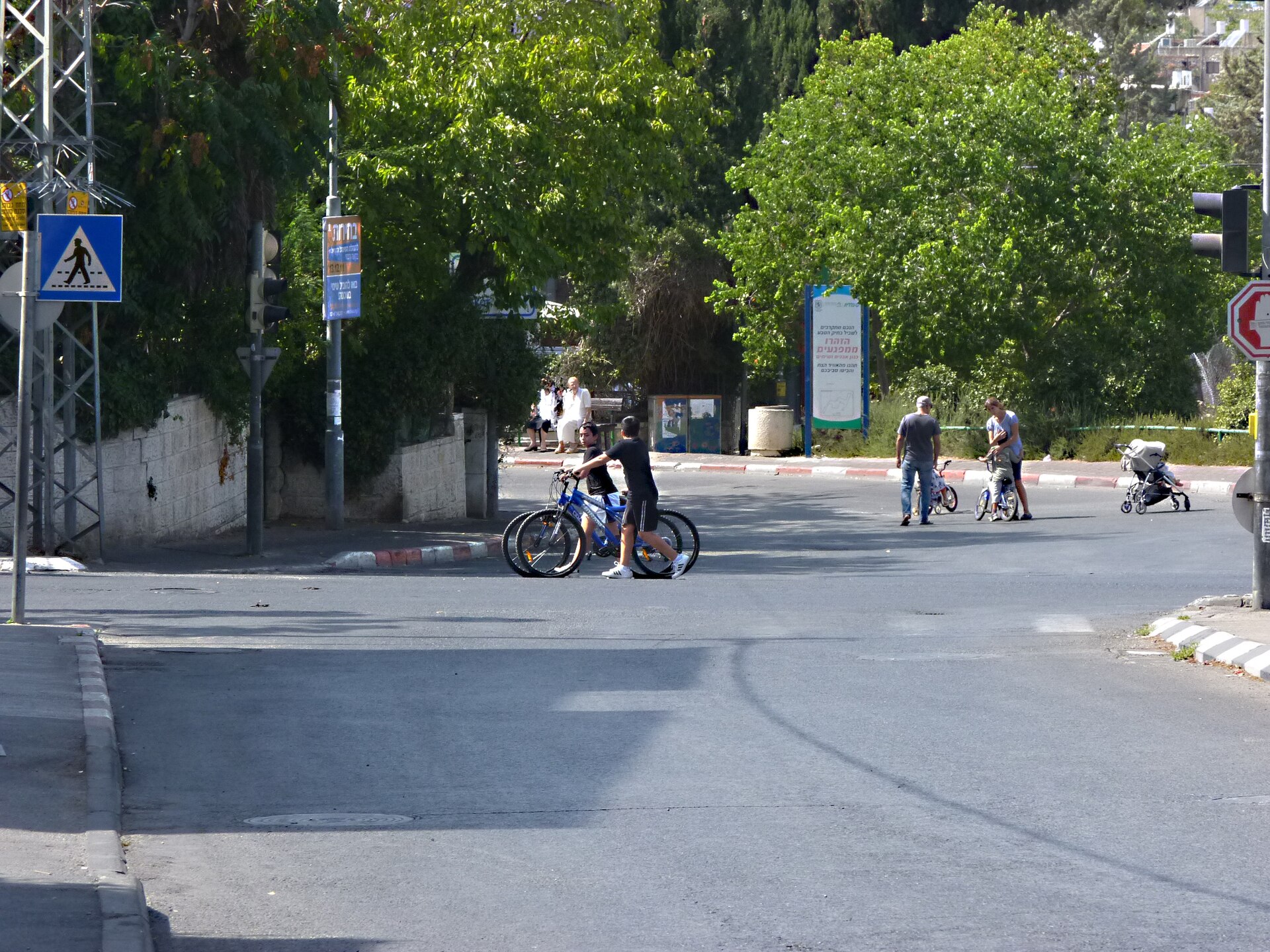
Stand on Route 1 at four in the afternoon on the tenth of Tishrei and you can hear a bicycle bell from two hundred metres. Six lanes of motorway, no cars, and a six-year-old wobbling down the fast lane with a parent jogging behind. Nothing prepares you for it, and no photograph really conveys it either, because what makes it extraordinary is the absence of a sound you did not know you were listening to. Yom Kippur in Jerusalem is the most complete civic shutdown that happens anywhere in the developed world, and it happens every single year.
This page covers the autumn High Holidays — Rosh Hashanah, the ten Days of Awe, and Yom Kippur itself — from a visitor’s point of view: what closes and for exactly how long, how to eat, where to be, what is expected of you, and whether the last is a day worth planning a trip around. Fares, routes and networks for the rest of the year are in our Jerusalem transport guide rather than repeated here. Details were checked in September 2026; confirm hours locally before you rely on them.
The 2027 Dates
| Observance | 2027 dates | What it does |
|---|---|---|
| Selichot | Nightly from early September | Late-night penitential prayers; huge crowds at the Kotel |
| Rosh Hashanah | Sunset Fri 1 Oct – nightfall Sun 3 Oct | Two festival days running straight into Shabbat: three days shut |
| Days of Awe | 3–10 October | Normal working days; a subdued, reflective mood |
| Fast of Gedaliah | Mon 4 October | Daylight fast. Little practical effect on visitors |
| Kol Nidre | Sunset Sun 10 October | The city stops. Everything closes |
| Yom Kippur | Sun 10 Oct (eve) – nightfall Mon 11 Oct | Total shutdown, including the airport |
A warning specific to 2027: Rosh Hashanah begins on a Friday evening and its second day runs directly into Shabbat, giving you Saturday 2 October and Sunday 3 October both closed with no gap. Three consecutive days with no public transport and almost nothing open is a lot to absorb if you have not planned for it.
Rosh Hashanah
The Jewish new year is two festival days observed as one long unit. Practically, it behaves exactly like Shabbat but twice as long: no light rail, no buses, no trains, no intercity coaches, shops and museums closed, restaurants shut apart from hotels and the Arab-owned places that trade regardless.
What it does to the city is more social than visible. Hotels fill with Israeli families and with diaspora visitors who come specifically for the season, which is why room rates in late September and early October are at their annual peak and stay there through Sukkot. Synagogues are full, including many that are half-empty the rest of the year. Round challah loaves and honey appear in every bakery in the fortnight beforehand, and apples in honey are on every table.
- Tashlich. On the first afternoon, people go to flowing water to symbolically cast away the year’s wrongs. Jerusalem has no river, so this happens at fountains, pools and springs across the city, including at Ein Karem and the pools in the city parks. It is a quiet, oddly touching thing to come across.
- The shofar. Blown in synagogues on both mornings; you will hear it from the street in any religious neighbourhood.
- What to do as a visitor. Walk. The Old City is open and its Christian and Muslim quarters are trading normally. So is East Jerusalem. The Mount of Olives viewpoint costs nothing and requires no bus if you are willing to climb.
Selichot: The Best-Kept Secret of the Season
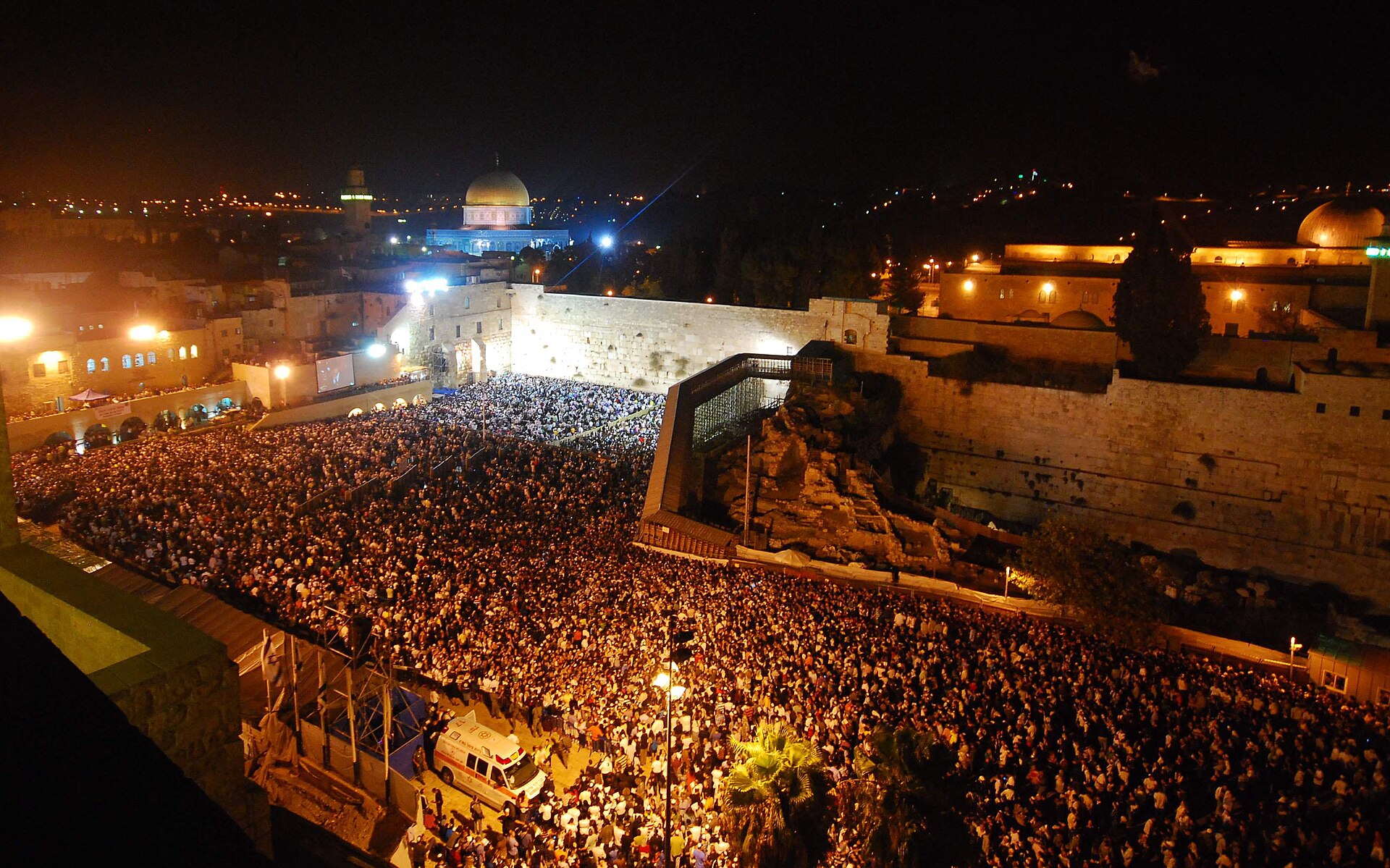
For the weeks leading up to Rosh Hashanah and through the Days of Awe, penitential prayers are recited late at night — often from midnight, sometimes at four in the morning. At the Western Wall, on the biggest nights, this means a plaza packed with tens of thousands of people at one in the morning, under floodlights, with the Dome of the Rock lit on the ridge behind.
Almost no guidebook mentions it and almost no visitor goes, largely because it happens at an hour when most people are asleep. If you are in Jerusalem in September, set an alarm once. Buses run late on the big Selichot nights, dress modestly, and remember that the plaza divides into men’s and women’s sections. Many Sephardi congregations in Nachlaot and the Bukharan Quarter hold their own Selichot, often with singing that is worth hearing in its own right — see Jerusalem at night for how to get around at those hours.
The Ten Days in Between
The stretch from Rosh Hashanah to Yom Kippur — the Days of Awe, 3 to 10 October in 2027 — is a working week that does not feel like one. Shops are open, buses run, museums keep normal hours, and yet the register of the city changes: more people in synagogues on weekday mornings, quieter bars, a general air of accounts being settled. For a visitor it is one of the most interesting and least inconvenient weeks of the year, because you get the atmosphere of the season with none of the closures.
Things you will see and may not understand
- Kapparot. In the ultra-Orthodox neighbourhoods in the days before Yom Kippur, a custom involving swinging a live chicken or, increasingly, a bundle of money over the head before donating it. It is done at night, in the street, and it is startling to walk into unprepared. If you find the version with birds distressing, avoid Mea Shearim and Geula in the small hours of the eve; nobody is doing it for visitors and photographing it is not appreciated.
- White clothing. Many people wear white through the season, and some men wear a plain white robe called a kittel on Yom Kippur itself.
- Immersion. Long queues outside the mikveh, the ritual bath, on the eve.
- Apology season. Israelis text, phone and stop each other in the street to apologise for the year’s slights. If a shopkeeper you barely know wishes you a good sealing in the Book of Life, that is what is going on.
- Sukkah timber. From about a week beforehand, stacks of poles, bamboo mats and prefabricated walls appear on pavements everywhere, ready for the festival that follows.
Where to base yourself
On a day with no transport, your hotel is your itinerary. The practical question is what falls inside a comfortable walk, and the answer differs a good deal by neighbourhood.
| Area | Walk to the Old City | Food available on the day | Verdict for the High Holidays |
|---|---|---|---|
| Inside the Old City | You are in it | Christian and Muslim quarters, entirely normal | Best of all, if you can get a room |
| Jaffa Gate / Mamilla | 5 minutes | Old City in five minutes | Excellent |
| City centre / Jaffa Road | 20–25 minutes | Nothing nearby; walk to the Old City | Good, with a supply of snacks |
| German Colony | 35–45 minutes | Nothing nearby | Pleasant, but a long walk to anything |
| East Jerusalem | 10–15 minutes | Everything open around you | The easiest place to be, practically speaking |
Our guides to the best neighbourhood to stay in and Old City hotels go into the areas in detail, and Jerusalem on a budget is worth a look given what the season does to rates.
Yom Kippur: What Actually Happens
Yom Kippur runs from sunset on 10 October to nightfall on 11 October in 2027 — roughly twenty-five hours. It is a fast day: no food, no water, for those observing it. And it is observed, in Jerusalem, by a very large majority of the Jewish population, including a great many people who are secular the other 364 days.
The shutdown, item by item
- No vehicles. Not by law, but by an almost total social convention that holds across the city. Emergency vehicles run; almost nothing else does. Driving through a religious neighbourhood on Yom Kippur will draw a reaction and, occasionally, stones — do not do it.
- No flights. Ben Gurion Airport closes entirely, from a few hours before sunset until after nightfall the following day. Check your flight dates against the calendar.
- No public transport of any kind. No light rail, no buses, no trains, no sheruts, no taxis to speak of.
- No shops, no restaurants, no cafés, no bars. Including, unusually, most of the West Jerusalem places that open on Shabbat.
- No broadcasting. Israeli television and radio go off air. Mobile networks work; many people switch their phones off anyway.
- Hotels serve a pre-fast meal before sunset and a break-fast after nightfall. Between the two, room service is minimal or non-existent. Ask your hotel exactly what it will provide before the day, not on it.
What East Jerusalem and the Old City do
This matters and is often glossed over. The Christian, Muslim and Armenian quarters of the Old City and the whole of East Jerusalem are not observing Yom Kippur, and life there continues: shops open, restaurants serving, traffic moving within those areas. If you need to eat, that is where you go. Crossing between the two halves of the city on foot on Yom Kippur, from total silence into an ordinary Monday, is one of the strangest and most instructive walks available anywhere.
Kol Nidre and Ne’ilah
The two ends of the day are the ones to be present for. Kol Nidre, at sunset on the eve, is sung in every synagogue and is the emotional high point of the Jewish year; you will hear it drifting out of open windows across whole neighbourhoods. Ne’ilah, the closing service the following afternoon, builds to a single long blast of the shofar at nightfall, at which point the fast ends, the city exhales, and within about twenty minutes the first cars are on the road again. Standing anywhere in West Jerusalem for that shofar is worth arranging your whole day around.
Being a Visitor on Yom Kippur
Nothing is required of you. Nobody will ask whether you are fasting and nobody will comment. What is expected is discretion, and it is not a heavy demand.
- Do not drive. If you have a hire car, leave it parked and do not move it. This is the one genuinely important rule.
- Do not eat or drink visibly in the street in Jewish neighbourhoods. In the Old City and East Jerusalem, behave entirely normally.
- Buy food two days ahead. Shops close on the afternoon of the eve and there is nothing open for twenty-five hours. A hotel with a kettle and a bag of supplies is a fine plan.
- Dress modestly if you are going near synagogues or the Kotel. Many people wear white. See our dress code guide.
- Do not photograph worshippers, and no cameras or phones at the Western Wall. Photographing the empty roads is entirely fine, and everybody does it.
- Walk everywhere. Whatever is within an hour’s walk of your bed is your world. Choose accommodation accordingly — see where to stay in Jerusalem.
The Best Things to Do on the Day
This is a day for walking and looking, and it is genuinely one of the great days of the year to do both.
- Walk a motorway. Sacher Park, the ring roads, Route 1 towards the Old City — roads you could never otherwise set foot on, with nothing on them.
- Walk the Old City walls or the ridge of the Mount of Olives for the view over a city with no traffic on it. Our viewpoints guide has the options.
- Go to a synagogue. Visitors are generally welcome to stand at the back at Kol Nidre and Ne’ilah. The Great Synagogue, the Italian Synagogue and the congregations of the German Colony are all used to it. Ask beforehand rather than walking in cold.
- Cross into East Jerusalem for lunch, then walk back. The contrast is the whole point.
- Be somewhere open at nightfall for the final shofar and the extraordinary five minutes afterwards.
The Practical Warnings
- Flights. Ben Gurion is shut. People do book flights for Yom Kippur and then discover this. Check the date.
- Arrival and departure days. The eve is nearly as difficult: transport stops mid-afternoon and shops close before that. Do not schedule an arrival for the afternoon of 10 October 2027.
- Medical needs. Pharmacies close. Hospitals and emergency services run normally, and Magen David Adom is on duty throughout, but fill any prescription two days beforehand.
- Cash. Nothing is open to break a note and cash machines in the Jewish neighbourhoods may be out of service. Sort this out in advance.
- Children. Israeli children have the run of the streets on their bicycles and love it, but there is nothing else to do and no ice cream to be had. Families often find the day easier than expected precisely because of the bikes — see Jerusalem with kids.
- Heat. Early October can still reach the high twenties. If you are fasting, or simply walking all day, plan for it — the weather guide has the numbers.
Should You Plan a Trip Around It?
Yes, once, if the idea appeals at all — and the honest reason is that there is nothing comparable anywhere else. A modern city of a million people voluntarily switching itself off for a day is a thing worth seeing, and Jerusalem does it more completely than Tel Aviv or anywhere else in the country.
But be clear about the cost. You will do no sightseeing: every museum, site, tunnel and tour is closed. You cannot leave the city or reach the airport. You will eat what you bought earlier. And the surrounding fortnight is peak season, so you will pay peak rates for the privilege. The way to do it well is to build a nine- or ten-day trip that has Yom Kippur in the middle rather than at the edge, so the day is a remarkable pause inside a proper visit rather than a wasted quarter of a short one. Sukkot begins four days later in 2027, which makes a fortnight from early October a genuinely excellent — and very expensive — window. Our religious holidays calendar shows how the autumn stacks up, and the best time to visit covers the alternatives.
Yom Kippur is not the only 25-hour fast in the Jewish year. The other, Tisha B’Av, falls in the heat of August and mourns the destruction of the two Temples, and it could hardly affect the city more differently: buses run and offices open, but restaurants and bars close by law on the eve, and the Western Wall plaza fills with tens of thousands of people sitting on the stone reading Lamentations. Our guide to Tisha B’Av in Jerusalem explains how to see it respectfully.
Final Word on Yom Kippur in Jerusalem
Most travel is about seeing things. This is the opposite: a day defined entirely by what is not there, and the reason it stays with people is that nothing in ordinary life gives you the experience of a large city with the engine switched off. Come for the fortnight rather than the day, buy your food on the ninth, walk somewhere you could never otherwise walk, and be standing in the open air when the shofar goes at nightfall. Then read Shabbat in Jerusalem for the weekly rehearsal of the same thing, Passover in Jerusalem for the spring equivalent, and the full religious holidays calendar to see what else the autumn holds.
Photo Credits
An empty Jerusalem road on Yom Kippur: כביש ביום כיפור-6 by zeevveez from Jerusalem, Israel, CC BY 2.0, via Wikimedia Commons.
Selichot at the Western Wall: Slichot22 by Yael Shilo, CC BY 3.0, via Wikimedia Commons.
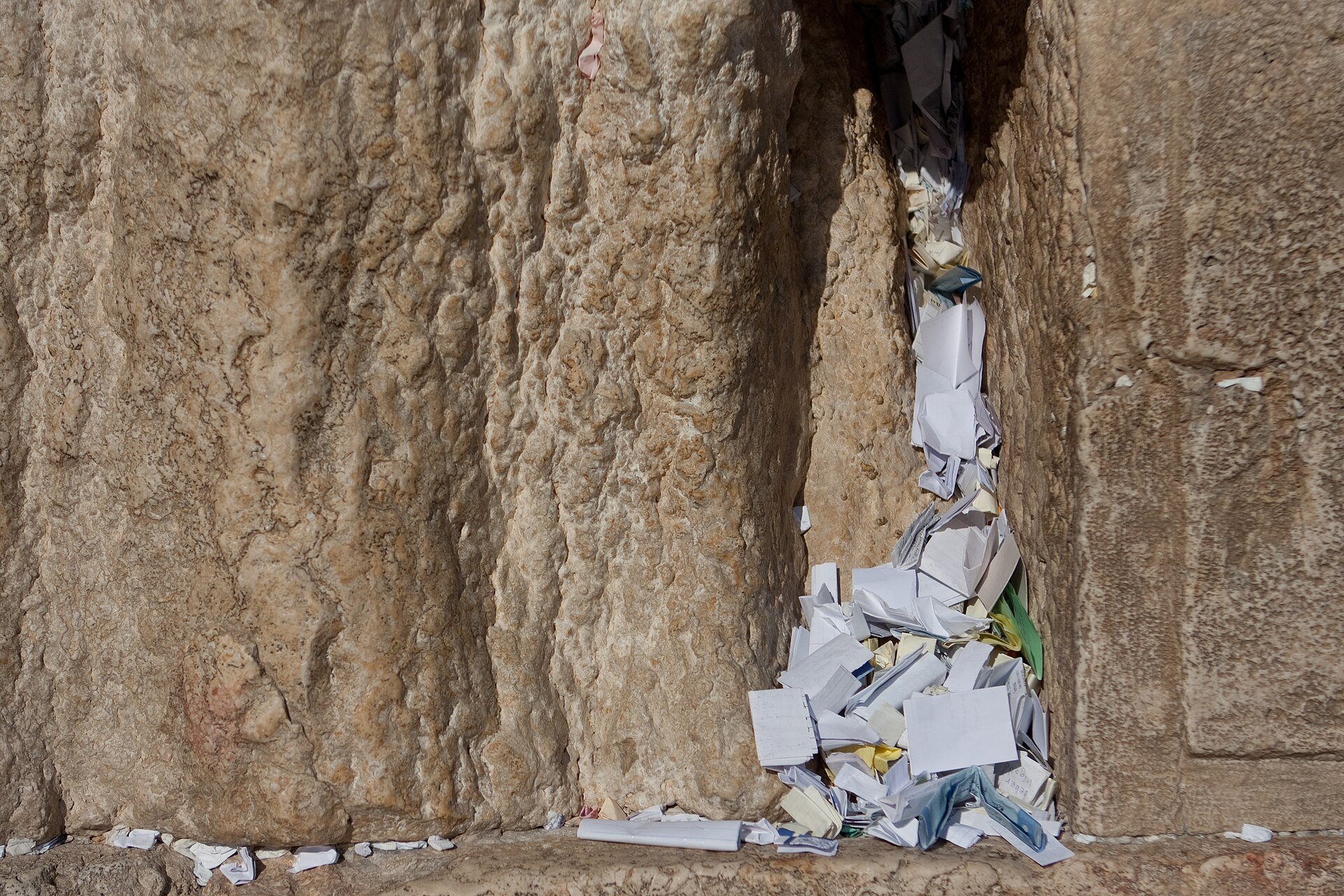
Prayer notes packed into a crack in the Western Wall: Jerusalem IMG 6759 (6190627444) by Brian Jeffery Beggerly from S’pore (Singapore), Singapore, CC BY 2.0, via Wikimedia Commons.