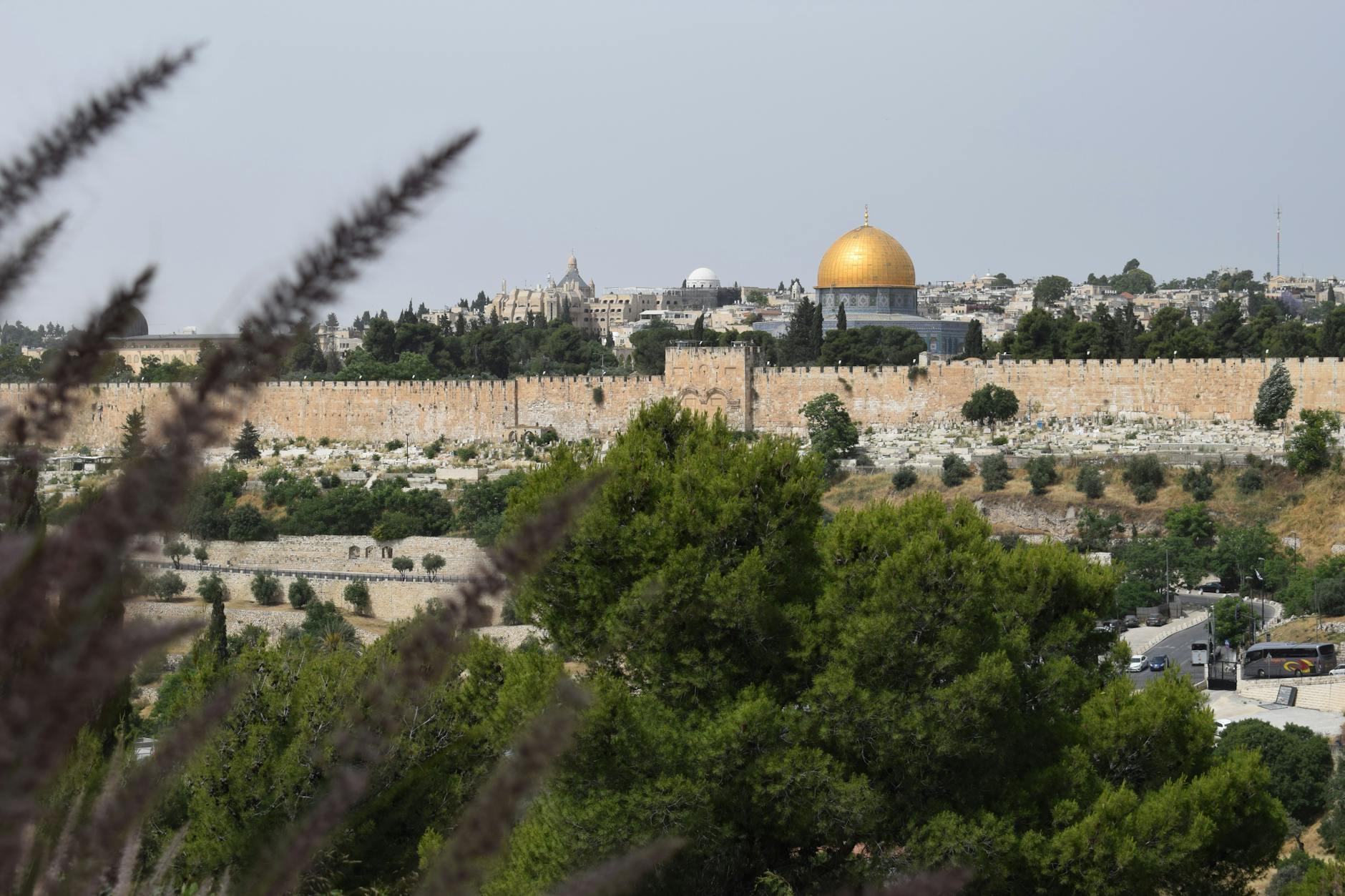
The Dome of the Rock in Jerusalem is one of the most recognizable buildings in the world — the golden-domed 7th-century Islamic shrine that has crowned the Temple Mount since 691 CE. Sacred to all three Abrahamic religions, it sits at the literal and symbolic center of the Old City and dominates Jerusalem’s skyline. While the shrine itself is closed to non-Muslims, the surrounding esplanade is open to visitors during specific hours, offering one of the most extraordinary architectural and historical experiences in the world.
This complete visitor’s guide to the Dome of the Rock in Jerusalem and the broader Temple Mount / Haram al-Sharif covers history, visiting hours and rules, what you can and cannot see, dress code, security, and what to expect. Pair this with our guide to Jerusalem holy sites and Al-Aqsa Mosque guide.

What Is the Dome of the Rock?
The Dome of the Rock (Arabic: Qubbat al-Sakhrah) is an Islamic shrine built by the Umayyad Caliph Abd al-Malik in 691 CE — making it the oldest extant Islamic monument and one of the oldest standing Islamic buildings in the world. It sits at the center of the Temple Mount esplanade (known in Arabic as Haram al-Sharif, “The Noble Sanctuary”).
The shrine encloses the Foundation Stone (al-Sakhrah), a large rock that holds deep religious significance:
- In Islam: The rock from which the Prophet Muhammad ascended to heaven during the Night Journey (Isra and Mi’raj).
- In Judaism: The location of the Holy of Holies in the First and Second Temples; the rock where Abraham bound Isaac.
- In Christianity: Associated with multiple Old Testament events and a place Jesus visited.
Visiting Hours for Non-Muslims
Non-Muslims may visit the Temple Mount esplanade (the open plaza around the Dome of the Rock) during specific hours, but cannot enter the Dome of the Rock or Al-Aqsa Mosque themselves.
- Sunday-Thursday only (closed Friday/Saturday).
- Morning: ~7:30 AM – 11:00 AM (summer; shorter in winter).
- Afternoon: ~1:30 PM – 2:30 PM.
- Closed during Muslim prayer times and major Muslim holidays.
- Hours change frequently; verify same day with the Western Wall Heritage Foundation or local tourist info.
How to Enter
- Walk to the Western Wall plaza.
- Look for the Mughrabi Bridge — a wooden ramp at the south end of the plaza (not the Dung Gate side).
- Pass through the security checkpoint at the foot of the bridge.
- Walk up the ramp onto the Temple Mount esplanade.
- Exit through any of several northern or eastern gates (you cannot exit back through the Mughrabi Bridge).
Queue Strategy at the Mughrabi Gate
The Mughrabi Gate ramp is the single entry point for non-Muslim visitors, and the queue is the only genuinely unpleasant part of the experience. The line forms along the fence at the southern end of the Western Wall plaza, in full sun, and on busy mornings it eats 30–60 minutes of your visiting window — which, remember, closes at 11 AM sharp.
- Be in line by 7:00–7:15 AM, before the gate opens. The first half hour moves fast; by 9 AM the wait can exceed the time you’ll spend on top.
- Bring your passport. Security checks it along with an airport-style bag scan.
- Travel light. Large backpacks slow your inspection, and anything resembling a religious item of another faith will be held at the entrance.
- During Ramadan the esplanade is closed to visitors entirely, and it shuts at short notice on days of tension — have a backup plan for your morning. Our Jerusalem travel tips cover how to check same-day status.
- Pair it with the Wall. You are already standing in the Western Wall plaza, so visit the Western Wall first at 6:30, then join the Mughrabi line — the most efficient morning in Jerusalem.
Strict Dress Code
- Shoulders and knees covered. No exceptions.
- No revealing or tight clothing.
- No visible religious symbols of other faiths (crosses tucked away, no Jewish prayer items).
- No religious texts visible (Bible, Torah).
- Wraps available at the entrance if needed, but easier to come prepared.
Strict Visitor Rules
- No prayer by non-Muslims on the Temple Mount.
- No religious gestures (kneeling, praying, prostration).
- Stay on stone walkways. Don’t step on cordoned-off areas.
- Photography is generally allowed of the architecture; do not photograph worshippers or security personnel.
- Quiet voices.
- Do not enter the Dome of the Rock or Al-Aqsa Mosque interior — strictly forbidden for non-Muslims.
- Tour groups may be asked to be more circumspect; some guides face restrictions.
What to See on the Esplanade
- Dome of the Rock — admire from the outside; the 8-sided structure features blue Iznik tiles, mosaics, and gold leaf on the dome (re-gilded 1993).
- Al-Aqsa Mosque — the silver-domed mosque at the southern end of the esplanade. Exterior viewing only.
- Dome of the Chain — small companion structure to the east of the Dome of the Rock.
- Sebil/Fountain of Qaitbay — Mamluk-era fountain.
- The Cradle of Jesus mosque (small chapel-like structure).
- Various smaller domes and shrines.
- Views of the Mount of Olives to the east.
A Shrine, Not a Congregational Mosque
One thing worth getting straight before you go up: the Dome of the Rock is not a mosque in the working sense of the word. It is a shrine — a covered, centrally planned canopy raised over a single outcrop of bedrock. Congregational prayer on the Temple Mount / Haram al-Sharif happens at the far end of the esplanade, inside the silver-domed Qibli Mosque that most visitors know as Al-Aqsa, and that is where the sermon is delivered on Fridays. Our companion guide to Al-Aqsa explains how the two buildings divide the work between them.
The difference is written into the floor plan. A congregational mosque is a wide, shallow hall of columns in which everyone faces the same wall, laid out so that thousands can stand shoulder to shoulder in rows pointing at Mecca. The Dome of the Rock is the opposite shape: concentric rings around a centre, with two ambulatories built for people to move around the rock rather than line up in front of it. The building exists to frame something, the way a reliquary church frames a relic.
What Abd al-Malik meant by it is still argued over. Historians have read the shrine as a monument marking the site of the Prophet Muhammad’s ascension, as a declaration of Islam’s arrival in a city whose skyline in 691 was entirely Christian, and as a dynastic statement by a caliph who was fighting a civil war at the time. A medieval claim that he built it to draw pilgrimage away from Mecca appears in some early sources but is rejected by most modern scholars. The honest answer is that the building carries all of those readings at once.
For a visitor the distinction pays off in two small ways. Even if you could see inside, you would not find anything resembling a prayer hall — no ranks of carpet facing a mihrab wall, just a walkway circling a rock. And the odd rhythm of the esplanade makes sense once you know the prayer life happens elsewhere: mid-morning, when non-Muslim visitors are admitted, the raised platform around the Dome is often close to empty while the southern end of the compound is busy.
Architectural Highlights
- Octagonal base in classic Byzantine-influenced Islamic style.
- Iznik tiles covering the exterior, made in Ottoman Turkey and added in the 16th century to replace earlier mosaics.
- Gilded dome with copper plate; the gold leaf was added 1962 and re-applied 1993.
- Diameter: ~20 meters; height ~35 meters.
- Inscriptions in Arabic Kufic script from the Qur’an run around the structure.
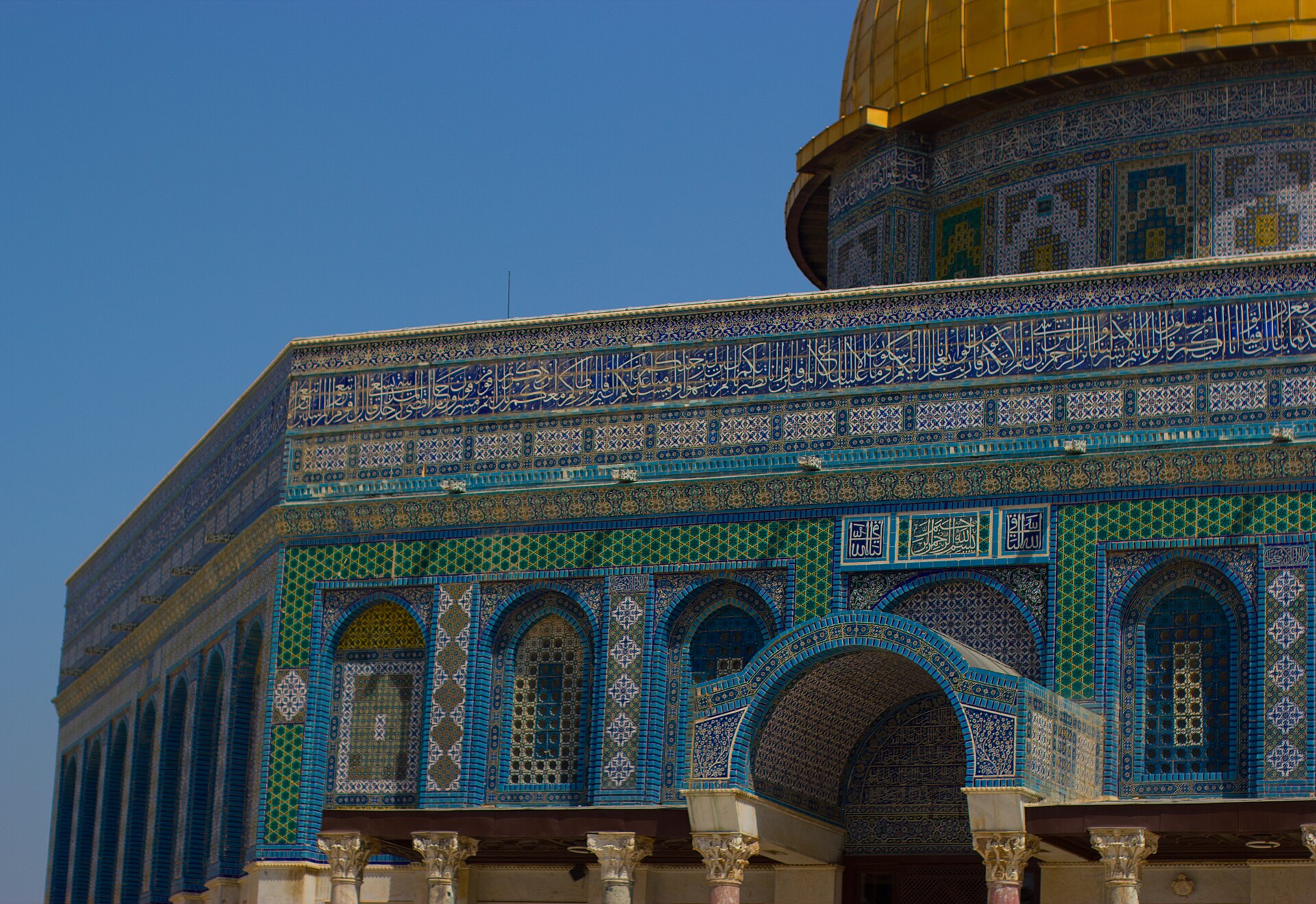
One detail worth squinting at from the esplanade: the 240-meter band of Kufic inscription circling the octagon is the earliest dated Quranic text in monumental form anywhere, and much of it addresses Christians directly — a 7th-century theological statement written in gold tile. Bring binoculars or a zoom lens if epigraphy is your thing; the southeast face keeps the best morning light.
Reading the Octagon: How the Geometry Works
Walk one full circuit of the shrine and the geometry starts to declare itself. There are four doors, set roughly at the compass points, and eight identical faces between them — no front, no back, no facade that matters more than the others. That is deliberate. The octagon you are looking at is only the outermost of three concentric rings.
Inside, an octagonal arcade of piers and columns wraps a circular arcade of twelve columns and four piers, and it is that inner circle which carries the drum and the timber double-shell dome — roughly 20 metres across, rising about 30 metres above the rock. The proportions are tied to each other: the dome’s radius effectively sets the distance out to the octagon walls, which is why the building looks resolved from every angle rather than posed for one.
None of this was invented on the spot. A domed rotunda with an ambulatory ring, built over a holy spot rather than for a congregation, was the standard Byzantine form for a martyrium. The rotunda of the Church of the Holy Sepulchre, a few hundred metres west, spans almost exactly the same diameter. The Church of the Ascension on the Mount of Olives was another circular shrine over a rock. And when archaeologists excavated the Kathisma church on the old Bethlehem road in the 1990s they found an octagonal building wrapped around an outcrop of stone; several have since proposed it as the closest structural parallel to the Dome of the Rock. The Umayyads were not copying Byzantine architecture by accident — they were answering it in its own vocabulary.
The materials are older still. Many of the columns and capitals inside are Roman and Byzantine spolia lifted from earlier buildings, which is why no two capitals quite match. Reuse on that scale was ordinary building practice and also a form of argument. If you want the full sequence of who built what on this hill and in what order, our run through Jerusalem’s layered history sets it out.
From outside, the easiest place to read the whole structure is the top of the southern staircase. From there you get the octagon face-on, the windowed drum sitting above it and the curve of the dome over that — three rings stacked in one glance, which is the entire design in a single view.
The Mosaics and What the Inscription Actually Says
The blue exterior tiles get all the photographs. The mosaics inside are the more remarkable thing, and they are the part non-Muslim visitors will never see in person — which is a reason to know what is behind the wall you are standing next to. Above the arcades run glass mosaics in gold, green and mother-of-pearl: acanthus scrolls, trees, vases, and, unusually, jewelled crowns and breastplates. There are no human or animal figures anywhere. Scholars including Oleg Grabar read the crowns and regalia as Byzantine and Sasanian royal insignia, hung up like trophies taken from two defeated empires; other readings treat them as paradise imagery. Both interpretations are still in circulation.
Running along both faces of the inner octagonal arcade is a band of Kufic script roughly 240 metres long, gold letters on a dark ground. It is the earliest dated monumental text from the Qur’an known anywhere in the world, set in place when the building was completed in the year 72 of the Islamic calendar — 691 or 692 CE.
The content is unusually pointed. Alongside the bismillah and the shahada, long stretches address “People of the Book” directly, including the passage from Qur’an 4:171 that begins “O People of the Book, do not go to excess in your religion, and say nothing but the truth about God,” followed by verses affirming Jesus as messenger and prophet rather than son of God. Written in a city that was overwhelmingly Christian in 691, within sight of the Holy Sepulchre, the band reads less like decoration than like a carefully drafted theological position paper executed in gold tile.
One detail delights historians. On the eastern stretch, the founder’s name was later altered to that of the Abbasid caliph al-Ma’mun, who reigned more than a century after the shrine went up. Whoever made the substitution neglected to change the date, which still reads 72 — and that is how the alteration was caught.
The exterior is a different story. Abd al-Malik’s outdoor mosaics did not survive the weather. Suleiman the Magnificent replaced them with ceramic tile in the sixteenth century, and most of what you photograph today is twentieth-century replacement tile following the Ottoman scheme. Handsome, but not original — the Ottoman fingerprint on the Old City is far bigger than most visitors realise, as our account of Ottoman-era Jerusalem spells out.
A Short History, 691 CE to Today
The shrine was commissioned by the Umayyad caliph Abd al-Malik ibn Marwan and completed in 691/692 CE, with two officials from the region — Raja ibn Haywa and Yazid ibn Salam — overseeing the work. The mathematics are elegant: the building is an octagon inscribed around the rock, with the dome’s diameter (about 20 meters) almost exactly matching its height, proportions borrowed from Byzantine churches like the nearby Holy Sepulchre rotunda, which the Umayyads were quite consciously answering.
- 691/692 CE: Completed under Abd al-Malik — the oldest surviving Islamic monument in the world.
- 1099–1187: Crusaders convert it into a church, the Templum Domini, topping the dome with a golden cross. Knights Templar imagery of the building spread across Europe and still appears on their seals.
- 1187: Saladin retakes Jerusalem, removes the cross, and restores the shrine to Islam.
- 1545–1566: Suleiman the Magnificent replaces the deteriorating exterior mosaics with the Persian-style ceramic tiles that define its look today; the current tiles are largely 20th-century replacements following his scheme.
- 1964: The lead dome is replaced with a gold-colored aluminum-bronze covering.
- 1993: The dome is re-gilded with 80 kilograms of gold leaf, financed by Jordan’s King Hussein — who reportedly sold one of his London houses to cover the roughly $8 million cost.
How the Dome Got Its Gold: Restoration After Restoration
The gold is recent. The shrine has been repaired, re-skinned and in places rebuilt so many times that almost nothing on the outside is Umayyad work: the shape is seventh century, the surface is not. Knowing the sequence changes what you are looking at.
- The dome has come down at least once. An earthquake in the mid-1010s brought it in, and it was rebuilt in the early 1020s under the Fatimid caliph al-Zahir, whose restoration is recorded in an inscription inside. Early sources describe the original covering as gilded brass or lead.
- 1545–1566: Suleiman the Magnificent strips the failing exterior mosaic and replaces it with glazed tile, setting the colour scheme the building has kept ever since.
- 1720s, 1817 and 1874: successive Ottoman repair campaigns renew tiles and stonework, the later ones under Mahmud II and Abdulaziz.
- 1920s: the Supreme Muslim Council runs a major survey and repair programme, much of it led by the Turkish architect Kemalettin Bey, after the dome’s timbers were found to be in poor condition.
- 1959–1964: a Jordanian-led restoration funded by contributions from Arab and Muslim states replaces the lead with plates of aluminium bronze made in Italy — gold in colour rather than gold in fact.
- 1993: the alloy had expanded and contracted through Jerusalem’s temperature swings, the roof leaked, and water was reaching the interior mosaics. King Hussein of Jordan financed a full regilding, reportedly selling a house in London to raise around $8 million; roughly 80 kilograms of gold went on, beaten into leaf thin enough to cover thousands of plates. That is the surface you photograph today.
The Islamic Waqf keeps a permanent restoration department on the compound, with its own stone and tile workshops, and panels are replaced in batches as they fail. The exterior is therefore a rolling repair project rather than a finished object. If part of the octagon is under scaffolding on the morning you visit, that is normal and nobody will be able to tell you when it comes down.
It also explains an oddity people notice from the Mount of Olives: the dome reads as a flat disc of gold from a distance but shows seams and slight colour variation up close. Those are the individual plates. A building this old that is still in daily religious use is never finished, which is true of nearly every one of the city’s major sanctuaries.
The Foundation Stone and the Well of Souls
Inside — visible only to Muslims, but worth understanding from outside — the building exists to shelter a single exposed slab of Jerusalem bedrock roughly 13 by 17 meters. Beneath the rock is a natural cave known in Arabic as Bir al-Arwah, the Well of Souls, reached by a staircase and used as a small prayer space. Medieval traditions, both Muslim and Jewish, layered the spot with meaning: souls of the dead gathering to pray, the echo of the waters of Eden, the resting place of the Ark. None of it is archaeology; all of it explains why a rock got the most beautiful roof in the Levant.
Religious Significance
In Islam
The third-holiest site in Islam after Mecca and Medina. Site of the Night Journey (Isra) and Ascension (Mi’raj) of the Prophet Muhammad, who is believed to have ascended to heaven from the Foundation Stone.
In Judaism
The Temple Mount is Judaism’s holiest site. The Foundation Stone is identified with the Even ha-Shtiyah, the rock at the center of the Holy of Holies in the First and Second Temples. Most Orthodox Jews do not enter the Temple Mount for religious reasons related to ritual purity.
In Christianity
Site of Old Testament events. Jesus is recorded as preaching at the Temple. Christians today have no exclusive rights to the area but visit as part of broader pilgrimage to Jerusalem.
Photography on the Esplanade: What Works, What Is Off Limits
Photographing the architecture is permitted and entirely normal — phones are out everywhere during visiting hours. The restrictions are about people and doorways, not buildings, and they are enforced by both Waqf staff and police.
- Do not photograph worshippers. Be especially careful with women, children and anyone praying; if you would not take the shot in a church mid-service, do not take it here.
- Do not photograph Waqf guards, Israeli police or the security equipment at the gates.
- Do not shoot into the doorways of the Dome of the Rock or the Qibli Mosque, even from a distance. The interiors are closed to non-Muslims and aiming a lens through the door is read as an attempt to get round that.
- No tripods, and no drones — drone flight over the Old City is prohibited regardless.
- A long lens draws attention; a phone draws none. If a guard asks to see what you have taken, show them and delete it without arguing. Handled that way it ends there.
- Do not stage anything that could be read as prayer — hands raised, eyes closed, kneeling for a photograph. It will end your visit, and it is the single most common way visitors get escorted off.
For the shot itself, the southeast face takes the morning sun, so roughly 08:00 to 09:30 in summer is the strong window, with the light behind you if you stand on the eastern side of the raised platform. The eight staircases up to that platform are each crowned by a free-standing arcade, and framing the dome through one of those arches is the composition most visitors walk straight past. The northern approach gives you cypresses in the foreground; the eastern edge gives you the dome with the Mount of Olives behind.
One thing worth doing with the camera down: stand still for two minutes at the eastern parapet, where the platform looks across the Kidron Valley. On a quiet morning you can hear the compound rather than just see it — sweeping, birds in the cypresses, someone reciting under an arcade — and that is the part of the visit nobody’s photographs come home with.
Where to See It Best From Outside
Plenty of visitors never go up at all and still leave with the Dome filling half their camera roll. The classic shot is from the Mount of Olives observation terrace, looking west over the Kidron Valley with the golden dome front and center — go at sunrise, when the light hits the eastern Old City walls, rather than in the washed-out afternoon. Inside the Old City, the rooftop of the Austrian Hospice on El-Wad Street (5 ILS entry, excellent strudel downstairs) puts the dome at eye level over the Muslim Quarter rooftops. From the south, the Haas Promenade in Talpiot gives the full panorama with the dome as a gold point in the skyline. We rank all of these in our guides to the best viewpoints in Jerusalem and the city’s top photography spots.
Who Runs the Site? The Status Quo, in Plain Terms
The arrangement that governs your visit dates, in its current form, to 1967. The Jordanian-administered Islamic Waqf manages the compound’s religious life — the mosques, the staff, who may pray — while Israeli police control the perimeter and the entry gates, including the Mughrabi Gate used by tourists. Under this “status quo,” non-Muslims may visit during set hours but may not pray anywhere on the esplanade; visible prayer by non-Muslims is treated as a violation and will end your visit quickly. The site sits at the center of one of the world’s most sensitive political disputes, which is exactly why the rules are enforced so literally. Follow them, keep commentary to yourself while on the Mount, and the visit is calm and rewarding.
Fitting the Dome Into Your Morning
The hardest part of this visit is not the queue or the rules. It is that the window is short, seasonal, and shared with everyone else in Jerusalem who wants to go up on the same day.
As of August 2026 the non-Muslim visiting window typically runs Sunday to Thursday, roughly 07:30–11:00 and 13:30–14:30 in summer, and about an hour earlier through the winter months — commonly quoted as 07:30–10:30 and 12:30–13:30. Both slots close on Fridays and Saturdays, on Muslim holidays, and during Ramadan, and the compound can shut at no notice. Treat every published timetable, this one included, as provisional and confirm on the morning itself before you walk down.
A summer morning that works, allowing for the queue:
- 06:30 — the Western Wall plaza, which is open around the clock and is cool and near-empty at this hour.
- 07:00 — join the Mughrabi line with your passport in hand, before the gate opens.
- 07:45–08:15 — through security and up the ramp. Allow 45 minutes on top: one unhurried circuit of the Dome, the raised platform, the southern end and the eastern parapet.
- 09:00 — exit by the Chain Gate or the Cotton Merchants’ Gate, both of which drop you straight into the lanes of the Muslim Quarter.
- 09:15 — breakfast on El-Wad Street, where the hummus places open early.
- 10:00 — pick up the Via Dolorosa and walk it westward while the Christian Quarter is still quiet.
Guards generally stop admitting new visitors before the posted closing time, so treat the end of the window as a hard cut-off rather than a target. If you are still in the line at 10:15 on a summer morning, you may not get in at all.
The afternoon slot is a fallback, not a plan. It is an hour long at best, the queue is usually shorter, but the light is flat, the pavement is radiating heat, and it is the first thing dropped when the compound closes early. If your trip contains only one workable morning, spend it here and move everything else around it.
One last piece of sequencing: whatever you wear has to clear the strictest checkpoint of the day, and on this itinerary that is the Mughrabi ramp. Dress for the Mount and everything afterwards takes care of itself — our what-to-wear guide for Jerusalem covers the differences between the compound, the Wall and the churches.
Practical Visiting Tips
- Arrive at 7:30 AM when the gates open. The line builds quickly.
- Allow 30-60 minutes on the esplanade.
- Don’t bring backpacks if avoidable; security inspections are extensive.
- No food or drink while on the esplanade.
- Verify hours same-day — closed during Muslim holidays and prayer times.
- Photography tip: the morning sun catches the Dome’s gold beautifully from the east side.
- Hire a licensed Israeli guide for context; many tours include Temple Mount on day 1.
Final Word: One of the World’s Most Significant Buildings
Even from the exterior alone, the Dome of the Rock in Jerusalem is one of the most spectacular and historically significant structures on earth. Visit early, dress respectfully, and absorb a site sacred to billions across all three Abrahamic faiths. Pair this with our Al-Aqsa Mosque guide, guide to Jerusalem holy sites, and Old City Quarters guide.
Photo Credits
Tilework and the gilded dome of the Dome of the Rock: Dome of the Rock Jerusalem Victor 2011 -1-6 by Victorgrigas, CC BY-SA 3.0, via Wikimedia Commons.
{"@context": "https://schema.org", "@type": "FAQPage", "mainEntity": [{"@type": "Question", "name": "Can I enter the Dome of the Rock?", "acceptedAnswer": {"@type": "Answer", "text": "Only Muslims may enter the interior. Non-Muslims may walk the surrounding esplanade and photograph the exterior."}}, {"@type": "Question", "name": "What are the hours for non-Muslim visitors?", "acceptedAnswer": {"@type": "Answer", "text": "Typically Sunday-Thursday, 7:30-11:00 AM and 1:30-2:30 PM. Closed Friday, Saturday, and Muslim holidays. Verify same day."}}, {"@type": "Question", "name": "Is there an entrance fee?", "acceptedAnswer": {"@type": "Answer", "text": "No — free entry to the esplanade. The Dome of the Rock interior is closed to non-Muslims regardless."}}, {"@type": "Question", "name": "Can I take photos?", "acceptedAnswer": {"@type": "Answer", "text": "Yes, of the architecture. Do not photograph worshippers, security personnel, or specific religious moments without permission."}}, {"@type": "Question", "name": "What if I'm Muslim and want to enter the shrine?", "acceptedAnswer": {"@type": "Answer", "text": "Muslim visitors have full access during prayer times. The interior contains the Foundation Stone, the Cave (Well of Souls beneath), and significant religious calligraphy. Hours of access vary by day."}}, {"@type": "Question", "name": "Why can't non-Muslims enter the shrine?", "acceptedAnswer": {"@type": "Answer", "text": "Modern policy under the Jordanian Waqf (Islamic religious trust that administers the site) restricts the interior to Muslims out of respect for the religious significance and to manage crowds."}}, {"@type": "Question", "name": "Is it safe to visit?", "acceptedAnswer": {"@type": "Answer", "text": "Yes, generally — the site is heavily monitored. Always check current travel advisories before visiting and avoid the area during major political tensions."}}, {"@type": "Question", "name": "Is the Dome of the Rock a mosque?", "acceptedAnswer": {"@type": "Answer", "text": "Not in the everyday sense. It is a shrine built over the Foundation Stone, with an ambulatory for walking around the rock rather than a hall for congregational prayer; the Friday sermon and the main communal prayers take place at the Qibli Mosque, the silver-domed building known as Al-Aqsa at the southern end of the same compound."}}, {"@type": "Question", "name": "Do the visiting hours change in winter?", "acceptedAnswer": {"@type": "Answer", "text": "Yes. As of August 2026 the non-Muslim window is typically 07:30–11:00 and 13:30–14:30 in summer and about an hour earlier in winter, commonly quoted as 07:30–10:30 and 12:30–13:30; the changeover does not reliably track Israel’s clock change, so confirm on the day rather than relying on a printed timetable."}}, {"@type": "Question", "name": "What do the inscriptions on the Dome of the Rock say?", "acceptedAnswer": {"@type": "Answer", "text": "The 240-metre Kufic band inside the shrine carries the earliest dated monumental Qur’anic text known, including the shahada and passages addressed to \"People of the Book\" that affirm the oneness of God and describe Jesus as a prophet and messenger."}}]}