The Al-Aqsa Mosque in Jerusalem is the third-holiest site in Islam after Mecca and Medina, and the southern anchor of the Temple Mount esplanade in the Old City. While the Dome of the Rock gets most of the visual attention, the silver-domed Al-Aqsa Mosque is the larger active mosque and the destination of the Prophet Muhammad’s Night Journey according to Islamic tradition. For Muslim visitors, this is one of the most spiritually significant destinations on earth.
This complete visitor information for the Al-Aqsa Mosque in Jerusalem covers history, religious significance, who can enter, visiting hours and rules for non-Muslims, security procedures, dress code, and how to plan a respectful visit. Pair this with our Dome of the Rock guide and guide to Jerusalem holy sites.
What Is the Al-Aqsa Mosque?
The Al-Aqsa Mosque (Arabic: Al-Masjid al-Aqsa, “The Farthest Mosque”) is a congregational mosque on the southern end of the Temple Mount (Haram al-Sharif) in Jerusalem. The current structure dates primarily from the early 8th century, though it has been rebuilt and renovated many times.
Important note: “Al-Aqsa” in Islamic tradition refers to the entire 144,000 square meter esplanade (the Noble Sanctuary / Haram al-Sharif) — not just the silver-domed mosque. When Muslims speak of praying at “Al-Aqsa,” they generally mean the entire sacred precinct including the Dome of the Rock.
Al-Aqsa Means Two Things: Sorting Out the Names
More confusion attaches to this place than to any other site in Jerusalem, and almost all of it comes from one word doing two jobs. It is worth ten minutes of your attention before you go, because it affects how you read signage, guides and news coverage alike.
- Al-Masjid al-Aqsa — in Islamic usage, the entire walled sanctuary: about 14.4 hectares, roughly 37 acres, or something close to a sixth of the walled Old City. Every structure inside the walls, the open pavement, the arcades and the underground halls are all part of it.
- Al-Jami’ al-Aqsa or al-Masjid al-Qibli — the silver-domed building at the southern end, the one non-Muslims photograph and call “the Al-Aqsa Mosque”. Qibli comes from qibla, the direction of prayer: it sits on the Mecca-facing edge.
- Al-Haram al-Sharif — “the Noble Sanctuary”, the term that came into common use under the Mamluks and Ottomans for the same walled compound.
- The Temple Mount (Hebrew Har HaBayit) — the standard name for the same ground in Jewish and Israeli usage, and the one printed on Israeli signage and used by the police at the entry gate.
So a headline reading “clashes at the Al-Aqsa Mosque” almost always means somewhere on the 37 acres rather than inside the silver-domed building, and a Waqf guard telling you that you are standing in Al-Aqsa is being precise, not loose. The gold-domed shrine at the centre of the platform is a separate building within the same sanctuary — it is not “the other half of Al-Aqsa”, and it is not a mosque in the congregational sense at all.
Practically, use whichever name your listener uses. Ask an Israeli police officer at the Mughrabi ramp for the Temple Mount; ask a shopkeeper on El-Wad Street for al-Haram or al-Aqsa. Both names describe the same walled enclosure, both are in everyday use by the people who live around it, and this guide uses both for that reason. Nothing about your visit requires you to choose one.
Religious Significance
The Al-Aqsa Mosque is the third-holiest site in Islam after the Masjid al-Haram in Mecca and the Prophet’s Mosque in Medina. Its significance is rooted in:
- The Night Journey (Isra and Mi’raj): The Quran describes the Prophet Muhammad traveling miraculously from Mecca to “the farthest mosque” (Al-Masjid al-Aqsa) and then ascending to heaven.
- The first Qibla: Early Muslims faced Jerusalem (not Mecca) in prayer.
- Prayer multiplier: A prayer at Al-Aqsa is traditionally worth 500 prayers elsewhere (compared to 100,000 at Mecca and 1,000 at Medina).
The Night Journey and Why Jerusalem Is Islam’s Third Holy City
The claim rests on a single verse. Qur’an 17:1, which gives the chapter its name — Surat al-Isra, “The Night Journey” — describes God taking His servant by night from the Sacred Mosque to al-Masjid al-Aqsa, “the farthest mosque”, whose surroundings He has blessed. The verse does not name Jerusalem. The identification of the farthest mosque with this hill comes from the hadith literature and was established very early in Islamic tradition; it has been the standard reading for well over a thousand years.
In the fuller narrative, the Prophet Muhammad travels from Mecca on a mount called Buraq, leads the earlier prophets in prayer at Jerusalem, and then ascends through the heavens — the Mi’raj — where the five daily prayers are prescribed. Tradition places the point of ascent at the rock now sheltered under the golden dome, which is precisely why the two buildings on this compound are bound to one another in Muslim devotion.
Two further things anchor the site. For roughly sixteen or seventeen months after the migration to Medina, Muslims prayed facing Jerusalem before the direction was changed to Mecca — this was the first qibla, and the memory of it is why the compound’s congregational mosque sits at the southern edge, on the Mecca-facing side. And a widely cited hadith names three mosques worth setting out on a journey to visit: Mecca, Medina and this one. That is the basis of the ranking you will see quoted everywhere as “third holiest”.
The same few acres hold Judaism’s holiest ground. In Jewish tradition the rock beneath the golden dome is the Even ha-Shtiyah, the Foundation Stone, identified with the innermost chamber of the First and Second Temples; many observant Jews do not walk on the compound at all for reasons of ritual purity, and pray at the retaining wall below the platform instead. Two traditions place their deepest associations on the same ground, and this guide describes each on its own terms rather than weighing one against the other. Our survey of the city’s sacred places sets both in the wider picture.
Who Can Enter the Al-Aqsa Mosque?
Only Muslims may enter the interior of the Al-Aqsa Mosque. Non-Muslims can:
- Walk the Temple Mount esplanade during specific hours.
- Photograph the exterior of the mosque.
- Observe from the surrounding plaza.
The same access rules apply to the Dome of the Rock — see our Dome of the Rock guide for full visiting details.
Non-Muslim Visiting Hours (Esplanade)
- Sunday-Thursday only; closed Friday-Saturday.
- Morning: ~7:30 AM – 11:00 AM (summer; shorter winter hours).
- Afternoon: ~1:30 PM – 2:30 PM.
- Closed during Muslim prayer times and major Muslim holidays (Ramadan, Eid).
- Hours change frequently. Verify same day.
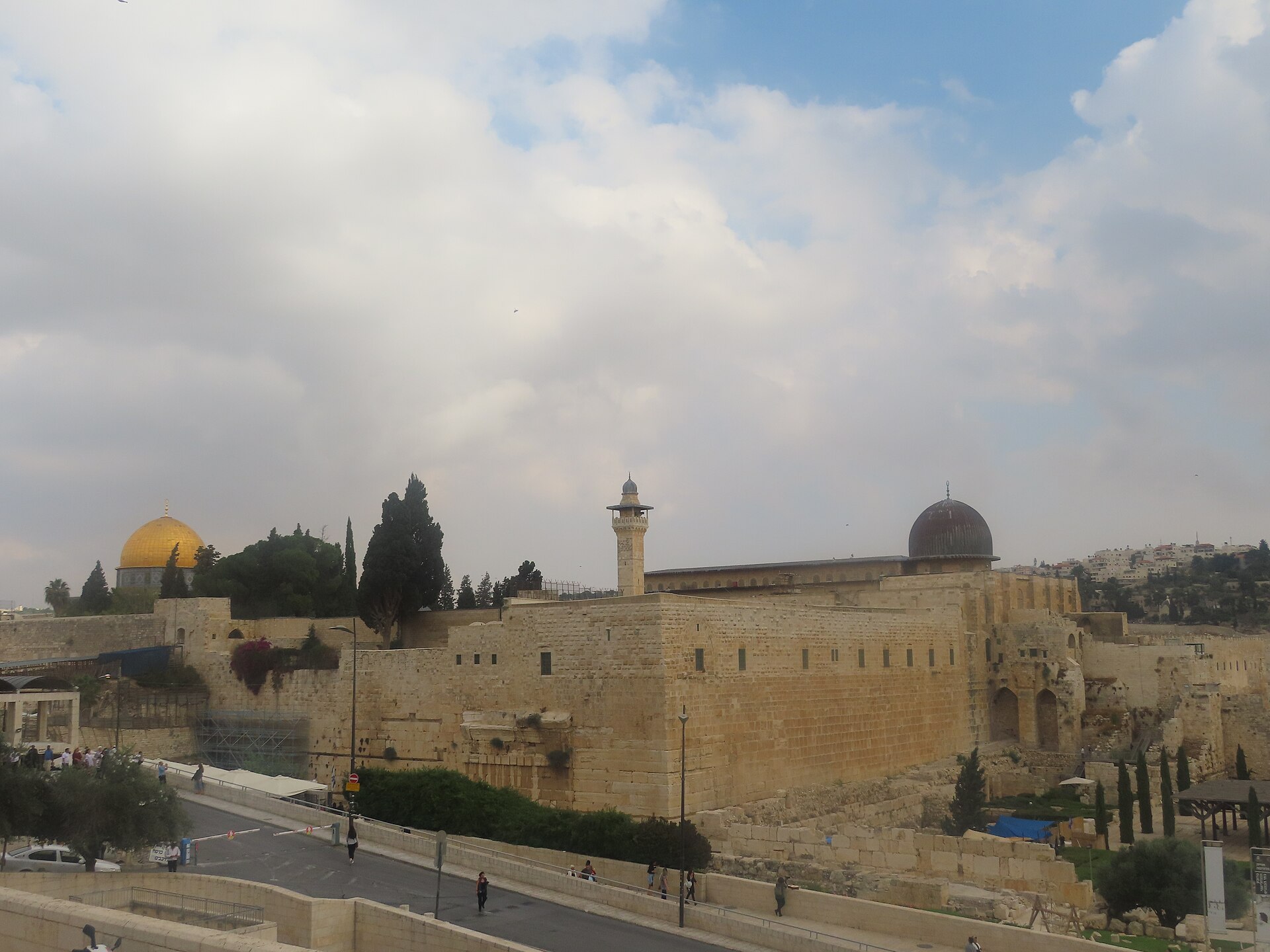
How to Enter the Esplanade
- Walk to the Western Wall plaza.
- Locate the Mughrabi Bridge — wooden ramp at the south end (only non-Muslim entry point).
- Pass through the security checkpoint.
- Walk up the ramp onto the esplanade.
- Exit through any of several northern gates of the esplanade — you cannot return via the Mughrabi Bridge.
Entry for Muslim Visitors
Muslim visitors may enter through several gates of the Haram al-Sharif itself (including Bab al-Asbat, Bab Hitta, and Bab al-Silsila), with access through several gates inside the Old City directly to the esplanade. Muslim worship is permitted; Friday prayers especially fill the mosque to capacity.
Strict Dress Code (For All Visitors)
- Shoulders and knees covered.
- No revealing or tight clothing.
- No visible religious symbols of other faiths.
- No religious texts visible (Bibles, Torah).
- Modesty is required for all genders.
Conduct on the Esplanade
- No prayer by non-Muslims on the esplanade.
- No religious gestures (kneeling, prostration).
- Quiet voices.
- Stay on marked walkways.
- Do not photograph worshippers or security personnel without permission.
- Do not attempt to enter the mosques.
- Respect tour group leaders’ guidance.
A practical note on the security layers: expect your passport to be checked at the Mughrabi ramp by Israeli police, and your conduct on the esplanade to be watched by Waqf guards in addition to police — two separate authorities, both of whom take the no-prayer rule for non-Muslims literally. Guides who are not licensed for the Mount may wait outside; if you want interpretation up top, arrange it when booking. Water fountains exist near the ablution areas but bottled water in your bag is smarter on a summer morning, when the white stone pavement turns the plaza into a reflector oven by 9 AM.
Architecture and History
- 705 CE: Umayyad Caliph Al-Walid I completes the first Al-Aqsa Mosque.
- 746 CE: Major earthquake damages structure.
- Multiple rebuilds over centuries by Umayyad, Abbasid, Fatimid, Crusader (used as royal palace), Ayyubid, Mamluk, and Ottoman dynasties.
- 1187 CE: Saladin returns mosque to Muslim worship.
- Current structure: Combines elements from multiple eras.
- Capacity: ~5,000 worshippers inside; 400,000+ on the full esplanade during major holidays.
The list compresses a complicated building biography. The first mosque on this spot was reportedly a simple timber structure raised within a few years of the Muslim conquest of Jerusalem in 638 CE — the pilgrim Arculf described it around 670. The monumental Umayyad mosque came two generations later, and then the earthquakes began: the structure you see today owes its core to the Fatimid rebuild completed in 1035 under Caliph al-Zahir, making the standing building roughly a thousand years old even before counting its older foundations.
The Crusader century left the oddest fingerprints. After 1099 the mosque became first a royal palace, then the headquarters of the Knights Templar, who knew it as the Templum Salomonis — the Temple of Solomon — and took their name from it. The Templars added the vaulted annexes on the western side and used the underground halls as stables. When Saladin restored the mosque in 1187, he kept some Crusader stonework; look closely at the facade’s central bays and you are looking at 12th-century European arches on an Umayyad floor plan, capped by Mamluk and Ottoman repairs. Few buildings anywhere wear nine centuries of ownership changes this legibly. For the wider arc, see our Jerusalem history guide.
Inside the Qibli Mosque
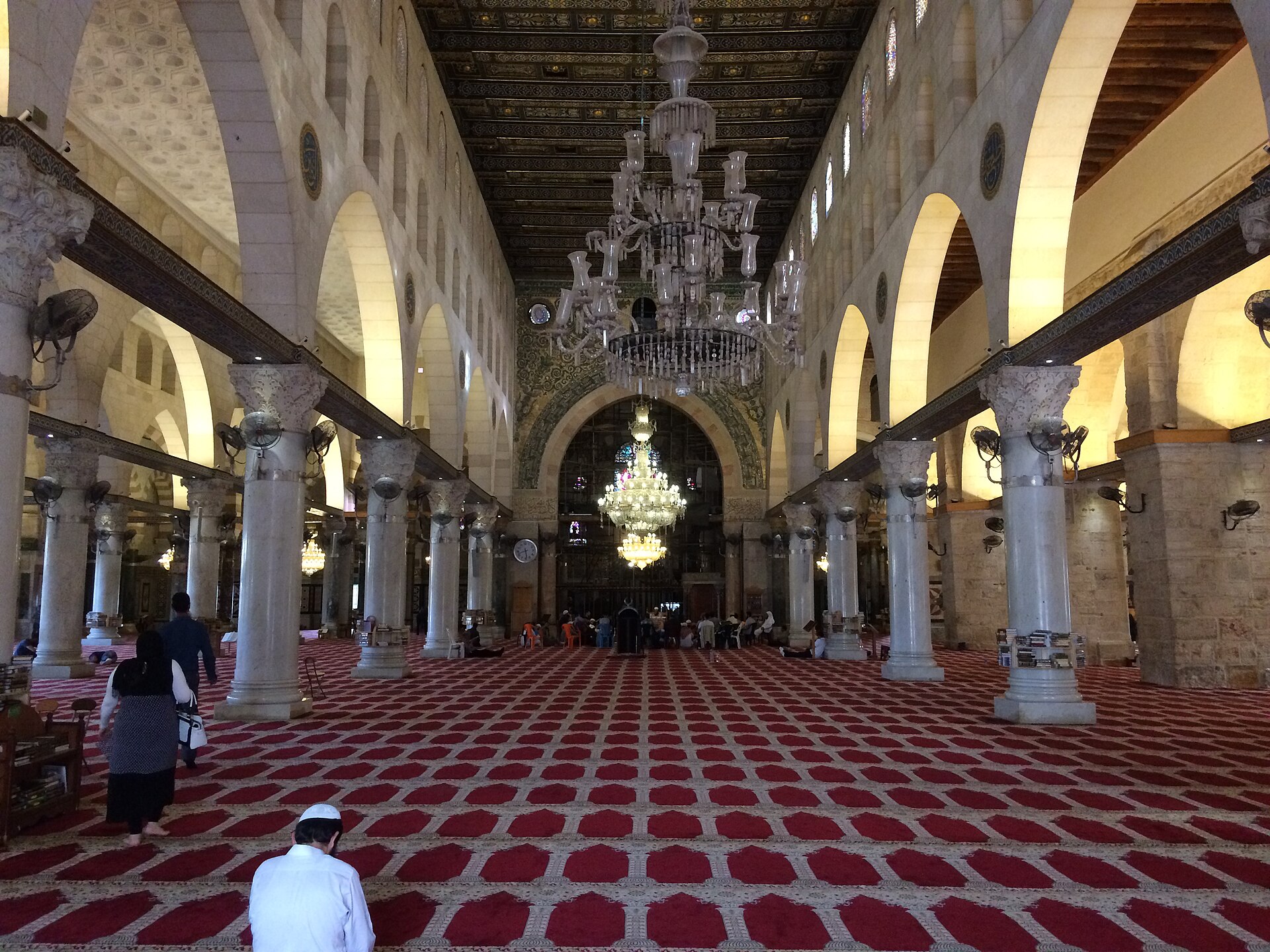
The silver-domed building itself is properly called the Qibli Mosque (from qibla, the direction of prayer, since it stands at the southern, Mecca-facing edge of the sanctuary). Inside — accessible to Muslims only — seven aisles of marble columns and piers run toward a mihrab beneath the silver dome, whose interior carries gilded mosaics from Saladin’s 12th-century restoration. The prayer hall holds around 5,000 worshippers, with carpets running wall to wall and Mamluk-era stained glass filtering the light.
The most storied object inside is the minbar (pulpit) of Saladin. The original was commissioned in Aleppo by Nur al-Din in the 1160s, decades before Jerusalem was retaken, as a promise of return — Saladin installed it in 1187. It stood for eight centuries until 1969, when an Australian arsonist named Denis Michael Rohan set fire to the mosque and destroyed it, an attack that shocked the Muslim world and led to the founding of the Organisation of Islamic Cooperation. A meticulous replica, built in Jordan using the original joinery techniques (no nails, no glue), was installed in 2007.
The Marwani Prayer Hall (Solomon’s Stables)
Beneath the southeastern corner of the esplanade lies a vast vaulted underground space — rows of stone piers supporting the platform above, built in the Umayyad period on Herodian-era foundations. The Crusaders stabled their horses here, which produced the name “Solomon’s Stables” that stuck for centuries. In 1996 the Waqf converted the space into the Marwani Prayer Hall, an underground mosque with room for several thousand worshippers, used mainly on Fridays, in winter weather, and during Ramadan. Like the other interiors on the Mount, it is closed to non-Muslim visitors, but knowing it exists changes how you read the esplanade: the flat plaza you walk across is a roof.
The Rest of the Sanctuary: What Else Stands on the 37 Acres
Most visitors photograph two domes and leave. There are more than a hundred structures inside these walls, and several of them are worth the detour on a single 45-minute circuit.
- The Dome of the Chain — the small open canopy immediately east of the gold-domed shrine, a ring of columns under a modest dome and one of the oldest structures on the compound. Its original purpose is genuinely unknown; proposals include a treasury, a full-scale model for the larger building beside it, and a place associated with judgement. It is used as a prayer space today.
- The mawazin — eight free-standing arcades, one at the head of each staircase up to the raised platform, built piecemeal between roughly the tenth and fifteenth centuries. Mawazin means scales: tradition holds that the balances for weighing souls will hang from these arches on the Day of Judgement. They are also called simply qanatir, arches.
- Al-Kas — the large round ablution fountain on the pavement between the platform steps and the Qibli Mosque, where worshippers wash before prayer. It is fed from cisterns cut into the rock beneath the esplanade.
- The Sabil of Qaitbay — a Mamluk drinking fountain of 1482, its carved stone dome often described as the finest work of its kind outside Cairo. Stand close and look up at the arabesque cut into the stone.
- The Islamic Museum — in the southwestern corner beside the Qibli Mosque, moved to its present building in 1929 and run by the Waqf. The collection covers Umayyad woodwork, Qur’an manuscripts, Mamluk metalwork, ceramics and the old iron grille from around the rock. Opening to non-Muslim visitors has been inconsistent for years, so do not build a plan around it — if the door is open, go in.
- Smaller domes and mihrabs — the Dome of Yusuf, the Dome of the Prophet, the structure known as the Cradle of Jesus in the southeastern corner, and dozens of open-air prayer niches scattered across the pavement.
The compound’s edges reward attention too. Along the western and northern boundaries, Mamluk madrasas and pilgrim hostels were built directly onto the sanctuary wall, which is why the street outside — the one running to the Cotton Merchants’ Gate — has some of the best fourteenth-century facades in the city; our walk through the Muslim Quarter picks them out. The sealed double gateway in the eastern wall is the Golden Gate, Bab al-Rahma, blocked up for centuries and loaded with eschatological expectation in both Jewish and Muslim tradition. And the walls themselves are largely Suleiman’s, part of the sixteenth-century rebuilding covered in our guide to Ottoman Jerusalem.
The Four Minarets
Four minarets ring the sanctuary, all built between 1278 and 1367 under the Mamluks — none on the eastern wall, a gap tradition explains in various ways. The most prominent, the Ghawanima minaret at the northwest corner, rises nearly 39 meters and is the one you hear most clearly from the Via Dolorosa below. The call to prayer from these four towers, layered against the church bells of the Christian Quarter and, on Friday evenings, the Shabbat siren, produces the soundscape that no photograph of Jerusalem captures. Stand on a rooftop at sunset — the Austrian Hospice works well — and you get all three at once.
Who Administers Al-Aqsa: The Waqf, in Practice
The body that runs the religious life of the compound is the Jerusalem Islamic Waqf, an administration operating under Jordan’s Ministry of Awqaf, Islamic Affairs and Holy Places. It is not a ceremonial arrangement: the Waqf employs the imams and muezzins, the guards you will see on the pavement, the cleaners and gardeners, a restoration department with its own stone and tile workshops, the manuscript library and the museum staff. Several hundred people work inside these walls.
Jordan’s role has a documentary basis. Article 9 of the 1994 peace treaty between Israel and Jordan records Israel’s respect for the Hashemite Kingdom’s special role in the Muslim holy shrines in Jerusalem, and a 2013 agreement between Jordan and the Palestinian Authority reaffirmed the custodianship. Israeli police control the outer gates and security, including the Mughrabi ramp that non-Muslim visitors use. That division — Waqf inside, police at the perimeter — is the practical core of what people mean by the Status Quo.
The parties disagree about what the arrangement permits, and its application has shifted at various points; the compound has been a flashpoint for decades and remains one. Reporting that accurately is not the same as taking a position on it, and a visitor does not need to hold one to visit well.
What it means on the ground is simpler than the politics. Two separate authorities can end your visit, and they enforce different things. The police decide whether you get through the gate, check your passport and your bag, and hold anything they consider a religious item of another faith. The Waqf guards watch conduct on the esplanade — dress, noise, where you walk, and above all the rule that non-Muslims do not pray here. Comply with both, keep any opinions to yourself while you are up top, and the visit is calm.
What Friday Prayers Actually Involve
Jumu’ah, the Friday congregational prayer, replaces the ordinary midday prayer and is the one moment of the week when you can see what this compound is for. The sanctuary begins filling from mid-morning. Worshippers perform ablution at al-Kas and at the tap lines along the western edge, then take a place inside the Qibli Mosque if they arrive early enough, and out on the open pavement if they do not.
The order is fixed. A khatib appointed by the Waqf delivers the sermon in Arabic from the minbar, usually in two parts with a short pause between them, and the imam then leads two cycles of prayer. Loudspeakers carry the sermon across the whole enclosure, which is what allows people to pray in rows out on the pavement, up on the raised platform, under the arcades and, when the compound is full, in the streets outside the gates. In winter or heavy rain the crowd moves indoors, into the Qibli Mosque and down into the Marwani hall.
The scale is hard to picture until you see it. The Jerusalem Islamic Waqf, which counts attendance, reported around 80,000 worshippers on the first Friday of Ramadan in February 2026 and roughly 100,000 the following week; larger Ramadan Fridays in earlier years have been reported at 200,000 and above. Access for Palestinians from the West Bank depends on Israeli permit rules that change from week to week, so the totals reflect the access arrangements of the moment as much as the size of the congregation.
None of this is open to non-Muslim visitors — the esplanade is closed to you on Fridays — but you can still hear it. The loudspeakers carry far enough that the sermon is often audible from the plaza below, and the flow of people through the Old City’s gates and lanes either side of midday is a spectacle of its own. Watch it from a cafe rather than from the middle of the crowd, keep your camera lowered as people pass, and use the same window to walk the route of the Stations of the Cross, which is unusually quiet at exactly that hour.
Fridays and Ramadan: What Changes
Friday noon prayers are the weekly high tide. Tens of thousands of worshippers converge on the sanctuary, the surrounding streets of the Old City fill with foot traffic, and police sometimes apply entry restrictions at the gates during tense weeks. For non-Muslim travelers the practical takeaway is simple: the esplanade is closed to you on Fridays anyway, and between about 11 AM and 2 PM the routes near the compound’s gates are slow going. Plan the Western Wall or the Christian Quarter for that window instead.
During Ramadan, the scale multiplies: on the last Friday and on Laylat al-Qadr, attendance across the sanctuary has reached the hundreds of thousands, with the esplanade, the Marwani hall, and the surrounding streets all functioning as overflow prayer space. Tourist visits to the Mount are suspended for the entire month. If your trip overlaps Ramadan, treat that as a feature: evenings in the Muslim Quarter after the fast breaks — lantern-strung streets, qatayef pancakes from stalls near Damascus Gate for a few shekels — are one of the best atmospheres the city offers. Our travel tips guide covers the holiday calendar in detail.
After Your Visit: The Muslim Quarter on Foot
Non-Muslim visitors exit through the northern and western gates of the sanctuary, which deposit you straight into the Muslim Quarter’s market streets — conveniently, the best cheap-eating territory in the Old City. Two minutes from the Cotton Merchants’ Gate, Abu Shukri on El-Wad Street has been ladling out hummus since 1948 (around 35–45 ILS a plate). Jafar Sweets near Damascus Gate sells knafeh by the slab for about 15–20 ILS, and the bakeries along Khan ez-Zeit hand over sesame ka’ek bread rings for pocket change. We map the full circuit in our street food walking guide and the Old City guide.
If this is your first morning in the city, the natural sequence is: Western Wall at opening, Temple Mount esplanade via the Mughrabi ramp, exit north, eat, then walk the Via Dolorosa westward. That single loop covers three faiths’ holiest ground before lunch — our first-time visitor guide builds a full day around it.
Combine Your Visit With
- Dome of the Rock (just north of Al-Aqsa on the same esplanade).
- Western Wall (just below the esplanade).
- Davidson Center Archaeological Park.
- Old City Muslim Quarter and souks.
The access rules above tighten considerably for one month a year. Non-Muslim visiting hours to the compound are routinely suspended for all or much of Ramadan, and the Fridays of that month bring very large numbers and heavy policing to the surrounding lanes. If your trip falls in February or March in the late 2020s, read our guide to Ramadan in Jerusalem before planning a visit here — and assume you will not get in.
Final Word: One of Islam’s Most Sacred Sites
Muslim pilgrims come here to pray at one of their faith’s three holiest places; everyone else comes to stand outside and take the measure of it. Either way, the Al-Aqsa Mosque in Jerusalem deserves to be approached with reverence. Plan around the visiting hours, dress conservatively, and remember that this is one of the most spiritually significant places on earth for over 1.8 billion Muslims. Pair this with our Dome of the Rock guide and guide to Jerusalem holy sites.
Photo Credits
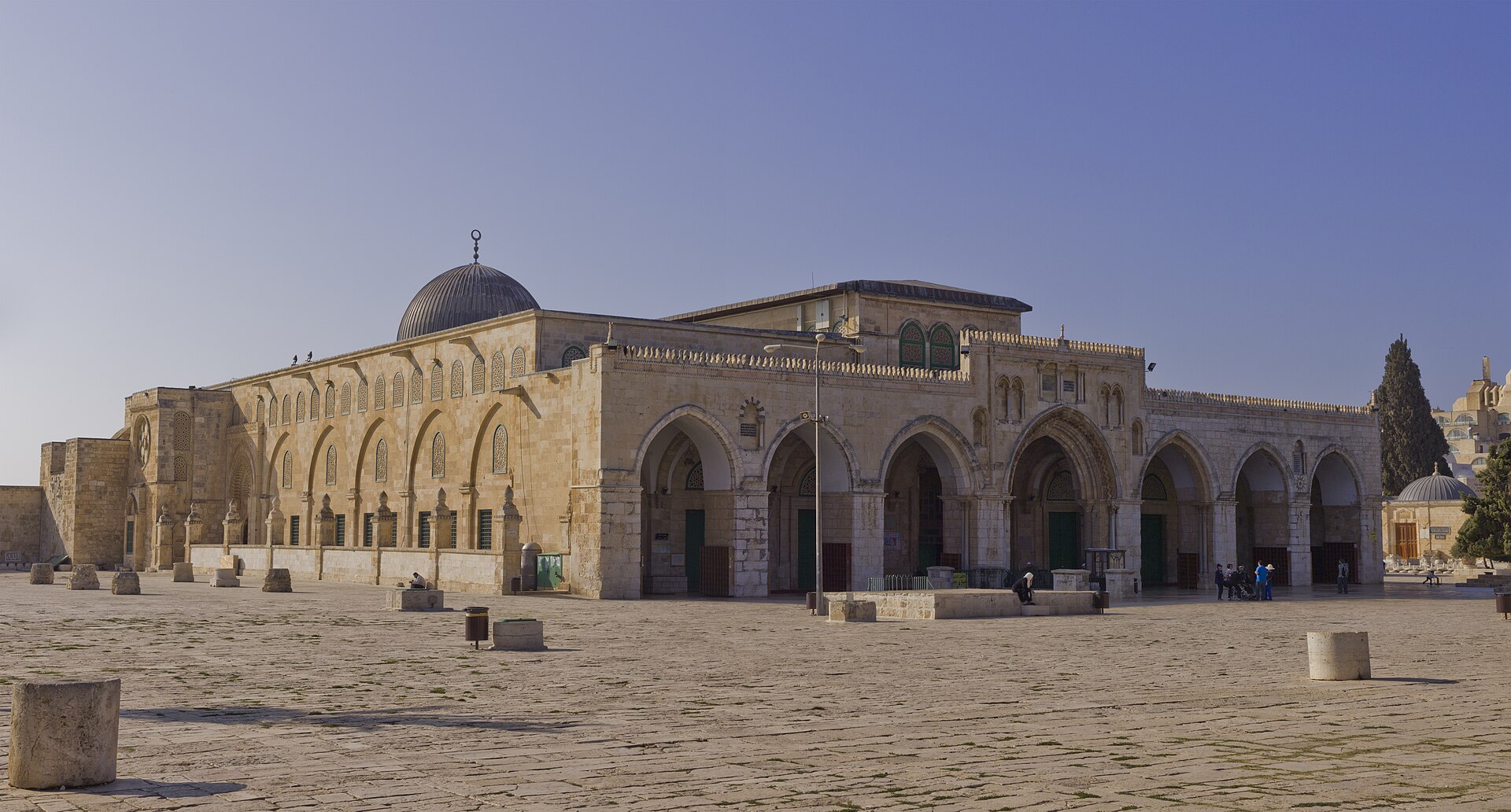
The Al-Aqsa Mosque seen from the north-east across the esplanade: Jerusalem-2013-Temple Mount-Al-Aqsa Mosque (NE exposure) by Godot13, CC BY-SA 4.0, via Wikimedia Commons.
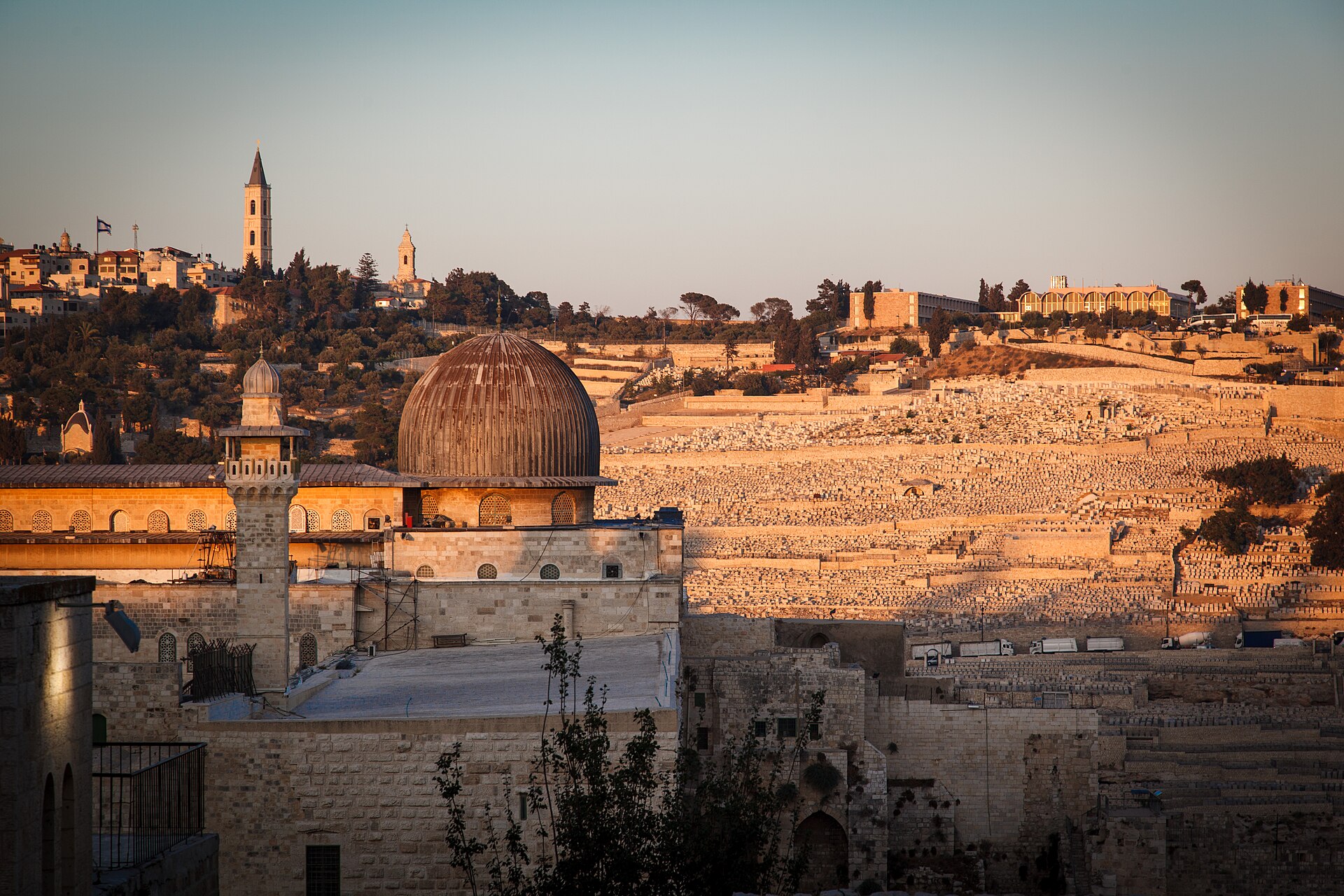
The dome of the Al-Aqsa Mosque and the Fakhriyya minaret below the Mount of Olives: Al-Qibli Chapel 20140816-IMG 0159 by Ruby1619, CC BY-SA 3.0, via Wikimedia Commons.
The south-western corner of the Temple Mount / Haram al-Sharif, with the Al-Aqsa Mosque and the Dome of the Rock: Holy Land 2019 (2) P189 Jerusalem Temple Mount by Fallaner, CC BY-SA 4.0, via Wikimedia Commons.
The central nave of the Al-Aqsa Mosque: Al-Aqsa Mosque, Jerusalem – Interior – panoramio by Eassa, CC BY-SA 3.0, via Wikimedia Commons.
{"@context": "https://schema.org", "@type": "FAQPage", "mainEntity": [{"@type": "Question", "name": "Can non-Muslims enter the Al-Aqsa Mosque?", "acceptedAnswer": {"@type": "Answer", "text": "No — the mosque interior is restricted to Muslims only. Non-Muslims can walk the surrounding esplanade and photograph the exterior."}}, {"@type": "Question", "name": "Is the Al-Aqsa Mosque the same as the Dome of the Rock?", "acceptedAnswer": {"@type": "Answer", "text": "No. They are two separate structures on the same esplanade. The Dome of the Rock has the gold dome and is to the north; Al-Aqsa Mosque has the silver dome and is to the south. Both are sacred Islamic sites."}}, {"@type": "Question", "name": "What are the visiting hours?", "acceptedAnswer": {"@type": "Answer", "text": "For non-Muslims walking the esplanade: Sun-Thu, ~7:30-11:00 AM and 1:30-2:30 PM. Closed Friday, Saturday, and Muslim holidays."}}, {"@type": "Question", "name": "Is admission free?", "acceptedAnswer": {"@type": "Answer", "text": "Yes — free for both Muslims and non-Muslims on the esplanade. Only the interior of the mosque is restricted (to Muslims)."}}, {"@type": "Question", "name": "Why is it called \"the farthest mosque\"?", "acceptedAnswer": {"@type": "Answer", "text": "\"Al-Aqsa\" means \"the farthest\" — referring to the Quranic account of the Prophet Muhammad's Night Journey from Mecca to \"the farthest mosque\" (Jerusalem) and his ascension to heaven from this site."}}, {"@type": "Question", "name": "What should Muslim pilgrims expect?", "acceptedAnswer": {"@type": "Answer", "text": "Multiple entry gates, full prayer facilities, ritual ablution areas. Friday and Ramadan prayers fill the esplanade; expect crowds and security checks."}}, {"@type": "Question", "name": "How long does a non-Muslim visit take?", "acceptedAnswer": {"@type": "Answer", "text": "30-60 minutes on the esplanade is typical, combining photos of both Al-Aqsa Mosque exterior and the Dome of the Rock."}}, {"@type": "Question", "name": "Is Al-Aqsa the same thing as Haram al-Sharif or the Temple Mount?", "acceptedAnswer": {"@type": "Answer", "text": "In Islamic usage yes — al-Masjid al-Aqsa is the whole walled sanctuary of about 37 acres, which is also called al-Haram al-Sharif in Arabic and the Temple Mount in Hebrew and Israeli usage; the silver-domed building is more precisely the Qibli Mosque, one structure inside that sanctuary."}}, {"@type": "Question", "name": "Who is in charge of the Al-Aqsa compound?", "acceptedAnswer": {"@type": "Answer", "text": "The Jerusalem Islamic Waqf, operating under Jordan’s Ministry of Awqaf, administers the religious life of the compound — imams, guards, restoration, the museum — while Israeli police control the outer gates and security, an arrangement generally referred to as the Status Quo."}}, {"@type": "Question", "name": "Can non-Muslims visit during Ramadan?", "acceptedAnswer": {"@type": "Answer", "text": "Generally no: tourist access to the esplanade is normally suspended for the month, and arrangements have varied from year to year, so if your trip overlaps Ramadan check the position shortly before you travel rather than assuming either outcome."}}, {"@type": "Question", "name": "What should I wear to visit the esplanade?", "acceptedAnswer": {"@type": "Answer", "text": "Shoulders and knees covered for everyone, nothing tight or sheer, no visible religious symbols or texts of other faiths; women are not required to cover their hair on the open esplanade, though many visitors carry a scarf, and light long sleeves beat a borrowed wrap on a hot morning — our Jerusalem dress guide has the detail."}}]}