The town of Mitzpe Ramon ends abruptly. You walk past a petrol station, a row of apartment blocks and a children’s playground, and then the ground simply stops, and below you is a bowl of rock, sand and old lava so wide that the far wall is a blue line on the horizon. Nothing in Jerusalem prepares you for it. That is the case for making the trip to Mitzpe Ramon from Jerusalem: it is one of the most dramatic landscapes in Israel, it is a morning’s drive from the Old City, and almost nobody who goes there regrets staying the night.
This guide covers the central Negev as an overnight trip: how to get there by car or bus, what to see in Makhtesh Ramon and on the way at Sde Boker and Avdat, where the stargazing is, where to sleep, and how to stay safe in a real desert. Prices and hours were checked in October 2026 against the Israel Nature and Parks Authority (INPA) and the operators’ own sites; check them again before you travel, because the desert sites change their hours with the seasons.
The Negev and Mitzpe Ramon at a Glance
| What | The short version |
|---|---|
| Where | The central Negev, south of Beersheba; about 136 km from the Old City in a straight line, considerably more by road |
| Getting there | Car via Beersheba and Route 40; or Egged 470 to Beersheba, then a Metropoline bus |
| Time to allow | One night minimum, two if you want to hike |
| Headline sights | Makhtesh Ramon, Ben-Gurion’s hut at Sde Boker, the Ein Avdat canyon, the Nabataean city of Avdat |
| National park entry | ₪31 adult, ₪16 child at each of Ein Avdat, Avdat and the Ramon Visitors Center |
| Night sky | An International Dark Sky Place; guided stargazing from ₪175 adult |
| Best months | October to April for hiking; summer means dawn starts and serious water |
Not the Judean Desert: Why This Is a Different Trip
Visitors often lump every desert in Israel together, and tour leaflets don’t help. The Judean Desert begins at Jerusalem’s eastern edge: it is the rain-shadow wilderness of chalk hills and gorges that falls away to the Dead Sea, home to Masada, Ein Gedi, Qumran and the monasteries of Wadi Qelt. You can be in it within half an hour, and it works beautifully as a day out.
The Negev is something else. It is the big desert of southern Israel, a great triangle of plateaus, wadis and mountains running south from Beersheba to Eilat on the Red Sea. It is higher, emptier and further away, and its signature landscapes, the makhteshim, have no equivalent near Jerusalem. The light is different too: on a clear evening at Mitzpe Ramon, the crater turns from bone-white to rust to violet in the space of half an hour.
So if you have one day and want desert, go east to the Dead Sea; our Dead Sea day trip guide and our Masada guide cover that. If you have a night or two and want to feel genuinely far from the city, go south.
Getting to Mitzpe Ramon from Jerusalem
By car
Driving is the best way to do this trip, because the sights are strung out along Route 40 and the crater floor itself is best explored with your own wheels. The usual route leaves Jerusalem towards Beersheba, then follows Route 40 south through Sde Boker and past Avdat to Mitzpe Ramon. It is quicker than the bus, but the time depends heavily on traffic out of Jerusalem, so check a live route planner on the day and add time for stops. Fill up in Beersheba or Mitzpe Ramon before heading onto the crater floor; there is very little out there.
Route 40 continues south from Mitzpe Ramon, dropping into the makhtesh in a series of hairpins and running on through the empty heart of the Negev towards Eilat. If you are carrying on to the Red Sea, our Jerusalem to Eilat guide covers that leg and the alternative route via the Dead Sea.
By bus
It is entirely possible without a car, with one change in Beersheba. In the October 2026 timetable:
- Jerusalem to Beersheba: Egged route 470 runs from the third floor of Jerusalem Central Bus Station to Beersheba Central Bus Station in about an hour and a half, with around 40 departures on an ordinary weekday from about 05:50.
- Beersheba to Mitzpe Ramon: Metropoline runs several routes. Line 65 is the quickest at about 1 hour 18 minutes and has departures through the day; lines 64 and 60 take longer, at about 1 hour 27 and 1 hour 50.
- Door to door: with the change, plan on more than three hours.
Once you arrive, the town itself is walkable, and the visitor centre and the rim promenade are a short stroll from the bus stops. The crater floor is a different matter: without a car you need a jeep tour or a local guide. There is no direct train; rail to Beersheba from Jerusalem means changing in Tel Aviv, and the bus is simpler. Our Jerusalem transport guide explains the Rav-Kav card and how to reach the Central Bus Station.
Shabbat
Plan around it. The last Friday buses from Jerusalem to Beersheba leave in mid-afternoon, and the service restarts after dark on Saturday. On the Beersheba–Mitzpe Ramon leg only a few buses run at the weekend, on lines 60 and 64: a handful of Friday departures until the afternoon, then nothing until Saturday evening. The national parks, by contrast, are open on Saturday, so a weekend in the desert works perfectly if you are driving. Our guide to Shabbat in Jerusalem explains what stops in the city.
On a tour
Organised tours from Jerusalem to the Negev exist, but most are long single days that spend more time on the road than in the desert. If you take one, look for an overnight version that includes the stars. Our round-up of the best Jerusalem tours explains what to look for.
Makhtesh Ramon
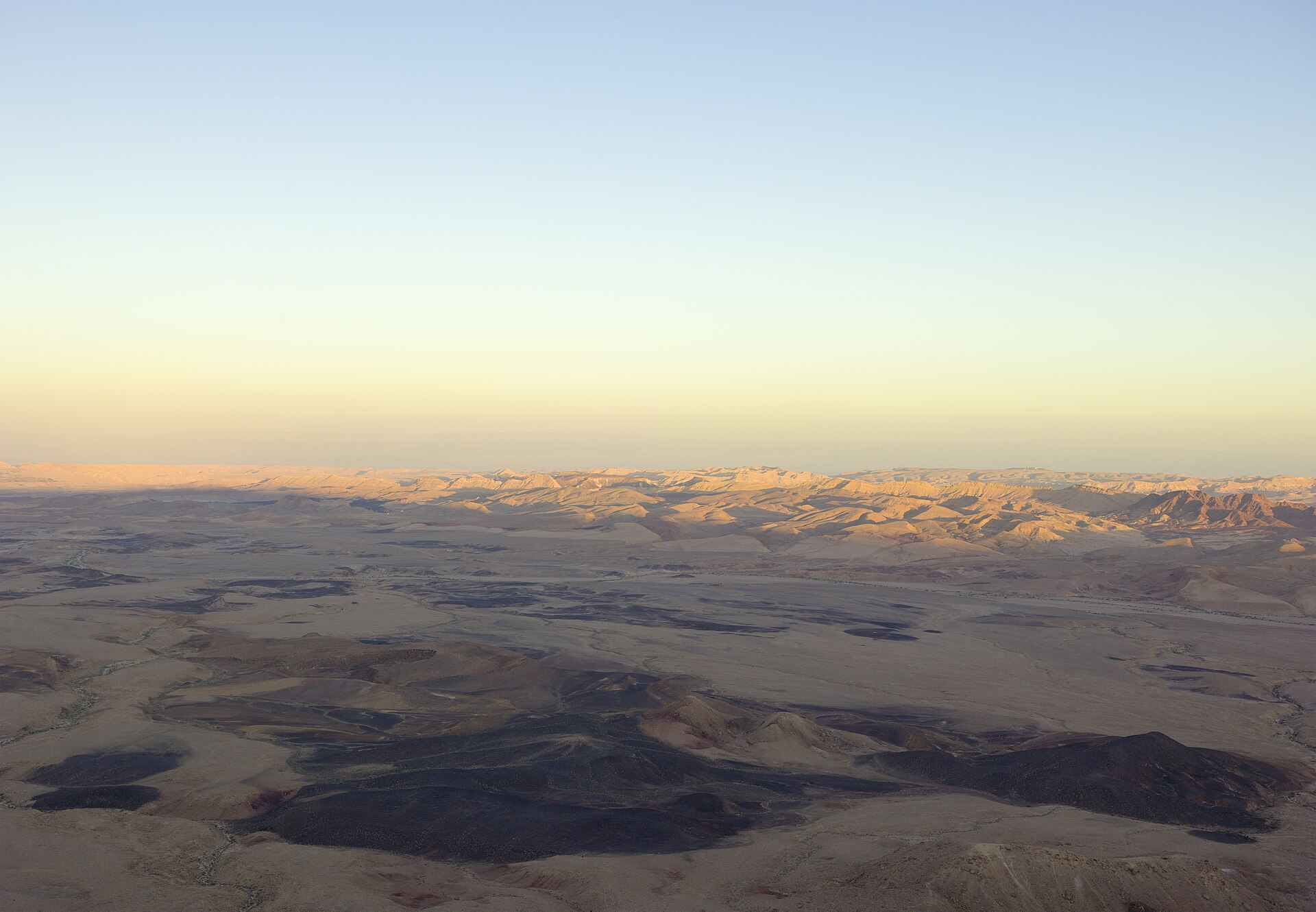
A makhtesh is not a crater in the usual sense. It was not made by a volcano or a meteorite. Geologists use the Hebrew word for a landform found mainly in the Negev and Sinai: a deep valley eroded from the inside out, with steep walls on every side and a single outlet where water drains away. Makhtesh Ramon is the largest, about 40 km long, and Mitzpe Ramon sits on its northern lip at around 860 metres above sea level. The rock layers exposed in its walls and floor are a geology textbook in the open air: sandstones in reds and yellows, black basalt and volcanic cones, and fossil beds.
The Ramon Visitors Center
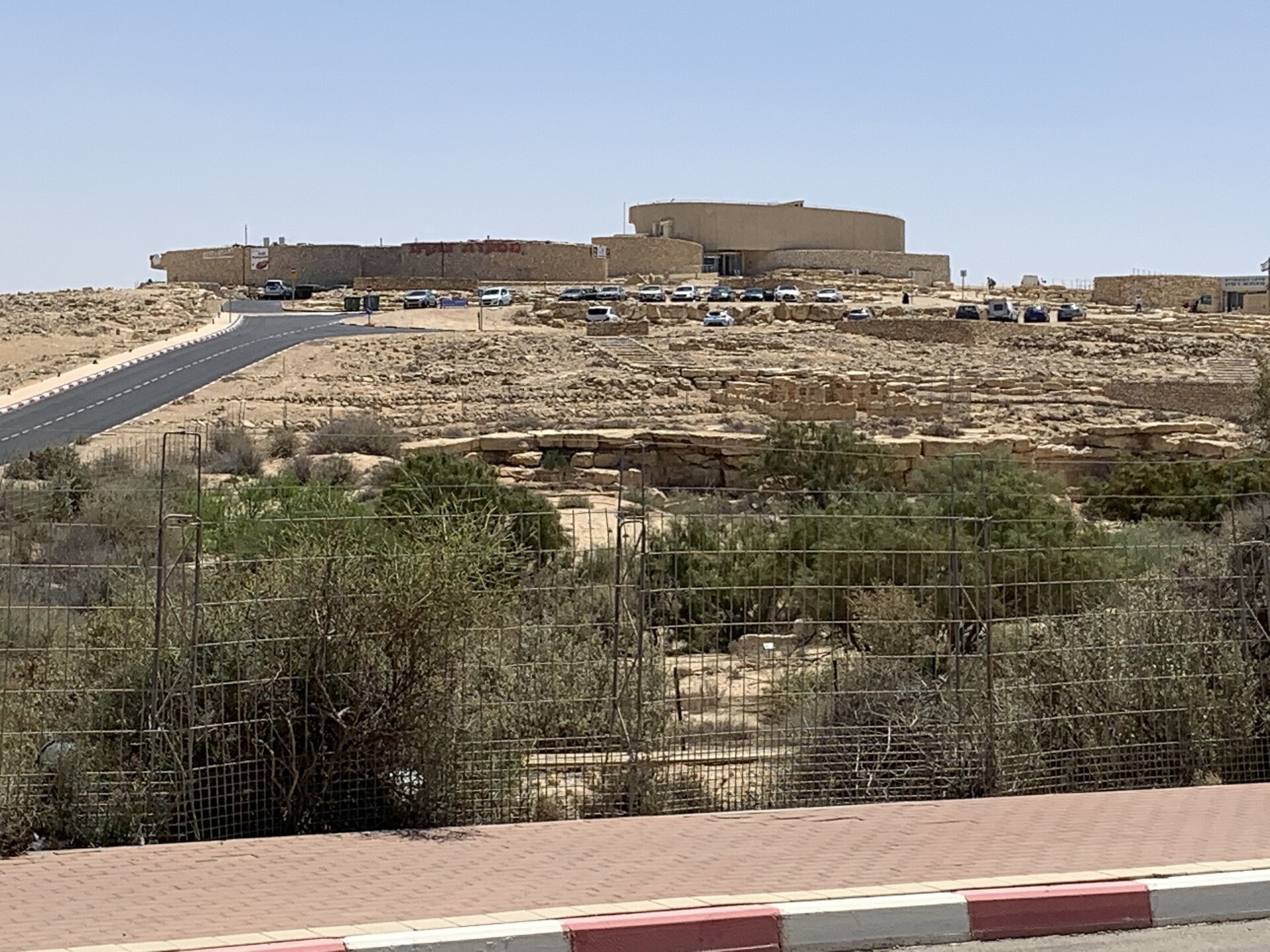
Start here. The INPA visitors centre stands on the very edge of the cliff, and its exhibition covers both the makhtesh and Ilan Ramon, Israel’s first astronaut, who was killed in the Columbia shuttle disaster in 2003. The view from its terrace is the best introduction to what you are about to drive into.
- Entry: ₪31 adult, ₪16 child, ₪26 student.
- Booking: entry is by reservation only, through INPA’s site.
- Hours: 08:00 to 16:00 in winter, 15:00 on Fridays and 13:00 on holiday eves; an hour later in summer. The museum’s entrance closes an hour before closing time.
- Parking: the car park at the centre charges a fee; INPA points drivers to the free car park at the nearby Hai Ramon lot.
The rim promenade
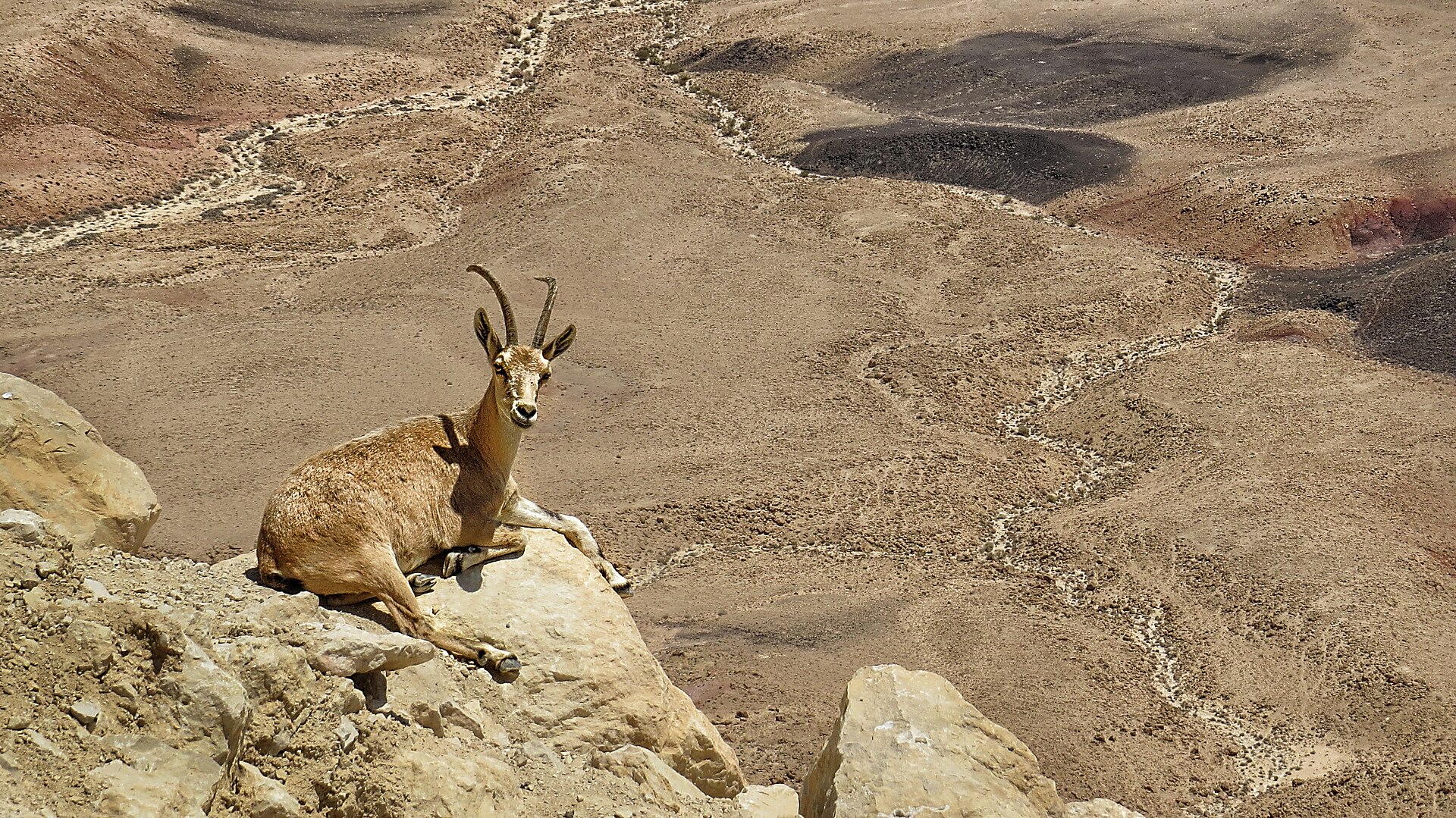
Free to walk and our pick of the sights in Mitzpe Ramon. A path runs along the edge of the cliff from the visitors centre, with benches and lookouts, and at sunset half the town seems to wander out to watch the crater change colour. Come back at dawn, when the floor is still in shadow and the far walls catch the first light. Nubian ibex are often seen on the rocks along the rim, and sometimes in the streets; keep your distance and never feed them.
Down on the crater floor
Route 40 descends into the makhtesh just south of town, and a handful of marked stops on and off it are the classic half-day drive. The best known are the Carpentry, where the sandstone has fractured into prism-shaped columns that look like stacked timber; the Ammonite Wall, a rock face studded with fossil ammonites; the coloured sands, where layers of different-coloured sandstone are exposed; and the area around Ein Saharonim, a spring with the ruins of a Nabataean caravan stop on the old Incense Route. Some of these need a short walk on dirt tracks, and a few need a four-wheel drive. Ask at the visitors centre for the current trail conditions and which tracks are open to ordinary cars before you set off.
INPA also runs a campsite on the crater floor, Khan Be’erot, with tent places at ₪75 for adults and ₪65 for children: the simplest way to sleep inside the makhtesh rather than above it.
Stargazing in the Ramon Crater
Makhtesh Ramon is an International Dark Sky Place, recognised by DarkSky International as the first such designation in the Middle East and managed by INPA. Away from the town lights, on a moonless night, the Milky Way is bright enough to cast a faint glow.
You can simply drive a little way out of town, switch off your lights and look up. A guided session adds telescopes and someone who knows the sky. Final Frontier Astronomy runs roughly two-hour group sessions in the crater at ₪175 for adults and ₪125 for children aged 4 to 10, with under-4s free. You make your own way to a meeting point about fifteen minutes’ drive south of town, which is sent after booking; read the cancellation terms: the operator refunds in full if it cancels for weather, and otherwise a full refund applies up to a week before.
Check the moon before you book. Around full moon the sky is washed out and the stars are a fraction of what they are a week either side. Bring warm layers, too: at 860 metres the desert gets cold after dark from autumn to spring, far colder than visitors expect.
Sde Boker and Ben-Gurion’s Desert Home
On the way down from Beersheba, Route 40 passes Kibbutz Sde Boker, where David Ben-Gurion, Israel’s first prime minister, chose to live in retirement and where he is buried. It is a short stop that tells you a lot about how the founders saw the Negev.
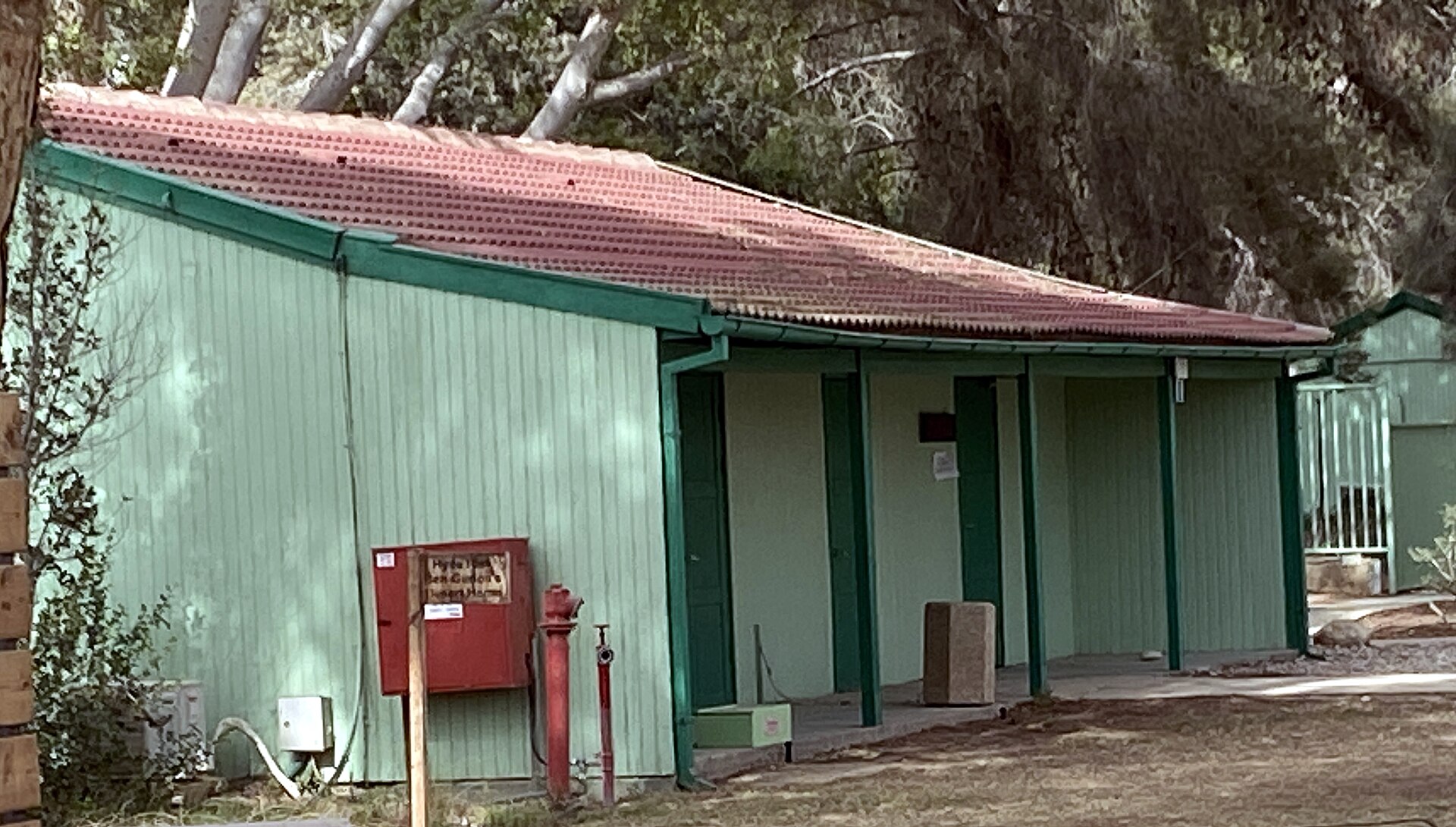
- Ben-Gurion’s Hut is the modest wooden house he and his wife Paula lived in, kept as it was in 1973, down to the books by the bed. It is run by the Council for Conservation of Heritage Sites and opens Sunday to Thursday 08:30 to 16:00, Friday and holiday eves 08:30 to 14:00, and Saturday and holidays 10:00 to 16:00, with guidance in Hebrew and English. Phone 08-656-0469 for the current admission price.
- Ben-Gurion’s grave lies a few kilometres south, in a small national park at Midreshet Ben-Gurion, on the edge of the Zin canyon. The view down into the gorge from the graves is one of the finest in the Negev, and it is worth stopping even if you have no interest in the history. Visitors who have seen the Great Leaders plot on Mount Herzl in Jerusalem will notice the difference: Ben-Gurion chose the desert instead.
Ein Avdat: The Canyon Walk
Just below the graves, the Zin stream has cut a narrow white canyon with a spring-fed pool, a waterfall and, after the rains, surprising green. The Ein Avdat walk is one of the best short hikes in the central Negev, and in hot weather the shade and water are a relief.
- Entry: ₪31 adult, ₪16 child.
- Hours: in winter 08:00 to 16:00, Friday 15:00; an hour later in summer. Park entry closes 90 minutes before closing time.
- Last entry for the trails: in summer, 14:30 for the long trail and 15:30 for the short one, an hour earlier on Fridays and an hour earlier again in winter. Arrive late in the day and you will be turned away from the long route.
- Two entrances: the lower one near Ben-Gurion’s grave and Midreshet Sde Boker, and an upper one about 5 km south. The long trail links them, so if you are driving, plan how you will get back to the car.
- Booking: INPA runs a reservation system at busy times; book online before a weekend or holiday visit.
Is it worth it? Yes, if you do the walk. Ein Avdat is not a viewpoint stop; the pleasure is in walking up the gorge with the walls closing in.
Avdat: A Nabataean City on the Incense Route
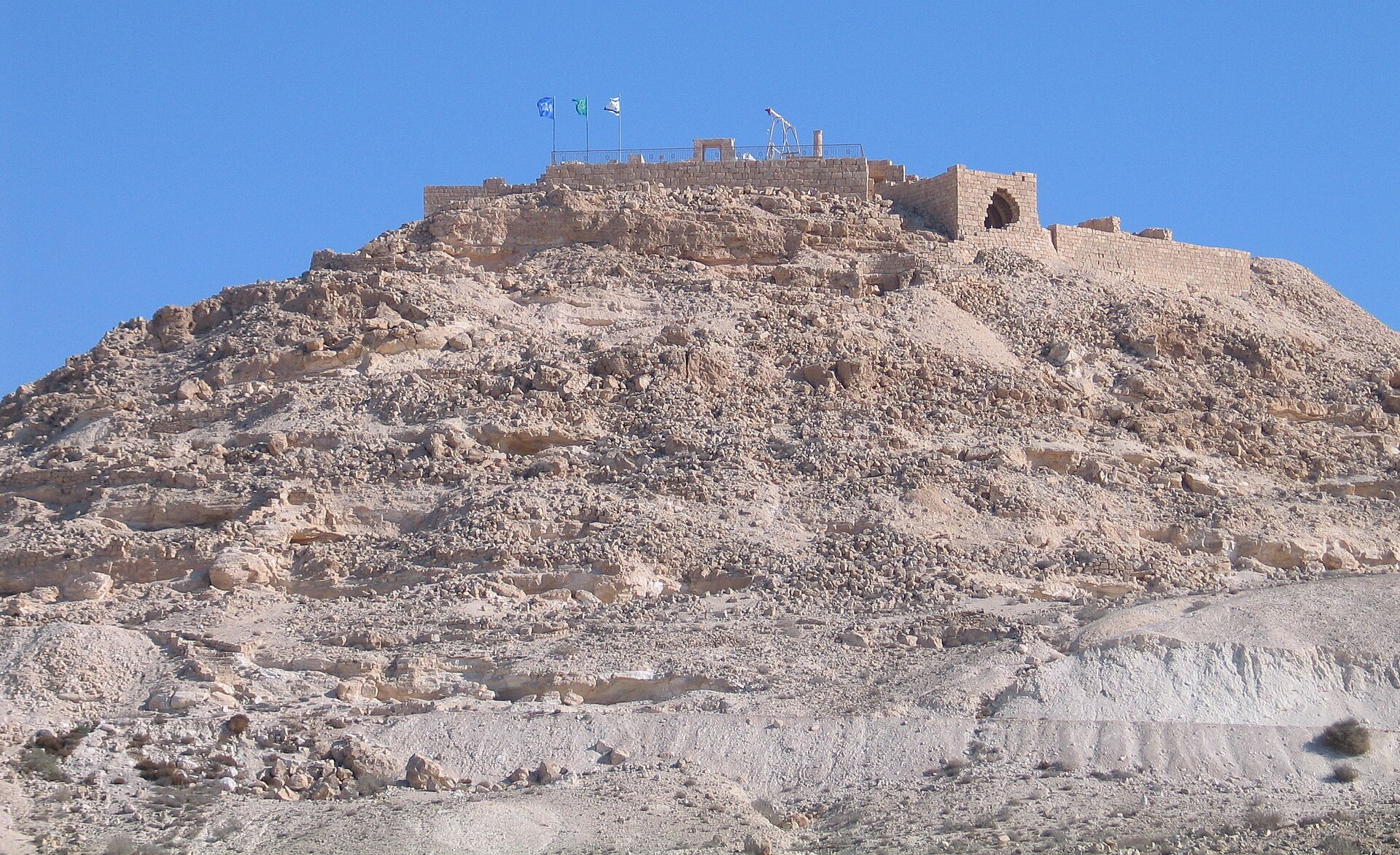
On a hilltop above Route 40, Avdat was founded by the Nabataeans, the same Arab traders who built Petra, as a station on the caravan road that carried incense and spices from Arabia to the Mediterranean. It was later rebuilt under Roman and Byzantine rule, and what survives on the summit is a mix of all three: temples turned into churches, a Roman burial cave, a bathhouse at the foot of the hill and the outline of streets and houses. UNESCO lists Avdat with Haluza, Mamshit and Shivta as the Incense Route desert cities of the Negev.
- Entry: ₪31 adult, ₪16 child.
- Hours: the same seasonal hours as Ein Avdat, with entry closing 30 minutes before closing time.
- At the entrance: a short film, available in 15 languages, sets the scene before you climb.
Come in the late afternoon if you can, when the low sun picks out the stonework and the view west over the plateau. If you are heading to Jordan later in your trip, Avdat is a good primer for Petra: smaller and far quieter, but built by the same people.
If you plan to see all three parks plus Masada or Ein Gedi on the same trip, look at INPA’s Israel Pass, which covers three, six or all of its sites over two weeks from first entry; check the current price on INPA’s site and compare it with paying at each gate.
Where to Sleep
Staying the night is the point of this trip, and Mitzpe Ramon has a wider range than a town its size suggests.
- Beresheet Hotel is the luxury option: a resort of villas and rooms on the very edge of the crater, some with their own pool. Expensive, but the setting is extraordinary.
- Desert Shade offers eco-tents on the crater cliff, a halfway house between camping and a hotel, with a small winery attached.
- INPA’s Khan Be’erot campsite, down on the crater floor, is the simplest and the most atmospheric if you don’t mind a sleeping bag.
- In town, there are guesthouses and small hotels.
Book ahead for Friday nights and the Jewish holidays, when half of Israel seems to head south. Weeknights outside school holidays are quieter and often cheaper.
Heat, Cold and Staying Safe
The Negev is a real desert, and the most common mistake visitors make is to treat it like a park.
- Water. Follow INPA’s guidance on how much water to carry for any proper hike, and take plenty even in cooler months. Our guide to hiking near Jerusalem covers the basics of desert walking.
- Start early. In summer, walk at dawn and be back in the shade by late morning. The trail last-entry times exist for a reason.
- Cold nights. Between late autumn and early spring, nights on the rim are cold. Pack a warm jacket, as our packing guide explains.
- Flash floods. Winter rain, even far away, can send water roaring down a dry wadi in minutes. Check the forecast, never camp or walk in a wadi bed when rain is possible, and follow park closures.
- Driving. Keep to marked roads and tracks, and don’t take an ordinary hire car on routes signed for four-wheel drive.
- Travel advice. Read the current UK and US travel advice for southern Israel before you travel; our page on whether Jerusalem is safe to visit explains how to read it.
When to Go
Autumn and spring are the best seasons: warm days, cool nights and comfortable hiking. Winter is excellent for clear skies and has the occasional dramatic storm, but you need warm clothes for the evenings. Summer is hot by day and only for early risers; the stargazing is still superb, and the nights are mild. Our guide to the best time to visit sets the Negev against the seasons in Jerusalem.
Two Ways to Plan It
One night
- Day one: leave Jerusalem by about 08:00. Stop at Ben-Gurion’s hut and grave, walk Ein Avdat late in the morning, and see Avdat in the afternoon. Reach Mitzpe Ramon for sunset on the rim, then go stargazing.
- Day two: sunrise on the promenade, the visitors centre when it opens, then a half-day drive on the crater floor. Head back to Jerusalem in the afternoon.
Two nights
Do the same, but give the crater a full day in the middle: a longer guided hike or jeep tour, a picnic at one of the crater-floor stops, and a second night under the stars. Or keep driving south on day three to Eilat and the Red Sea, and return to Jerusalem via the Dead Sea for a loop that sees the whole south. Our guide to trips beyond Jerusalem shows how the Negev fits alongside Petra, the Galilee and the coast.
Final Word on Mitzpe Ramon and the Negev
Most visitors to Jerusalem never get further south than the Dead Sea, and they miss one of the country’s great landscapes. Give the Negev a night: walk Ein Avdat, stand on the rim at sunset, and spend an hour under a sky with more stars than you knew existed. If you have only a day for the desert, the Ein Gedi trip or a Wadi Qelt hike is the better choice; if you have longer, combine the Negev with a night on the northern coast and the full range of day trips from Jerusalem to see how different one small country can be.
Photo Credits
Ibex above Makhtesh Ramon: Desert ibex in Mitzpe Ramon Israel. (cropped) by Dani Lavi 0007, CC BY-SA 4.0, via Wikimedia Commons.
Makhtesh Ramon at dawn: Israel-2013-Makhtesh Ramon 01 by Godot13, CC BY-SA 4.0, via Wikimedia Commons.
Ramon Visitors Center: Bio Ramon IMG 7334 by סבתא דינה מקסטינה, CC BY-SA 4.0, via Wikimedia Commons.
Ben-Gurion’s hut, Sde Boker: 111778 ben-gurion barracks in sde boker PikiWiki Israel by Shlomo Rodad, CC BY 2.5, via Wikimedia Commons.
Avdat acropolis: Avdat-169 by Bukvoed, CC BY 4.0, via Wikimedia Commons.