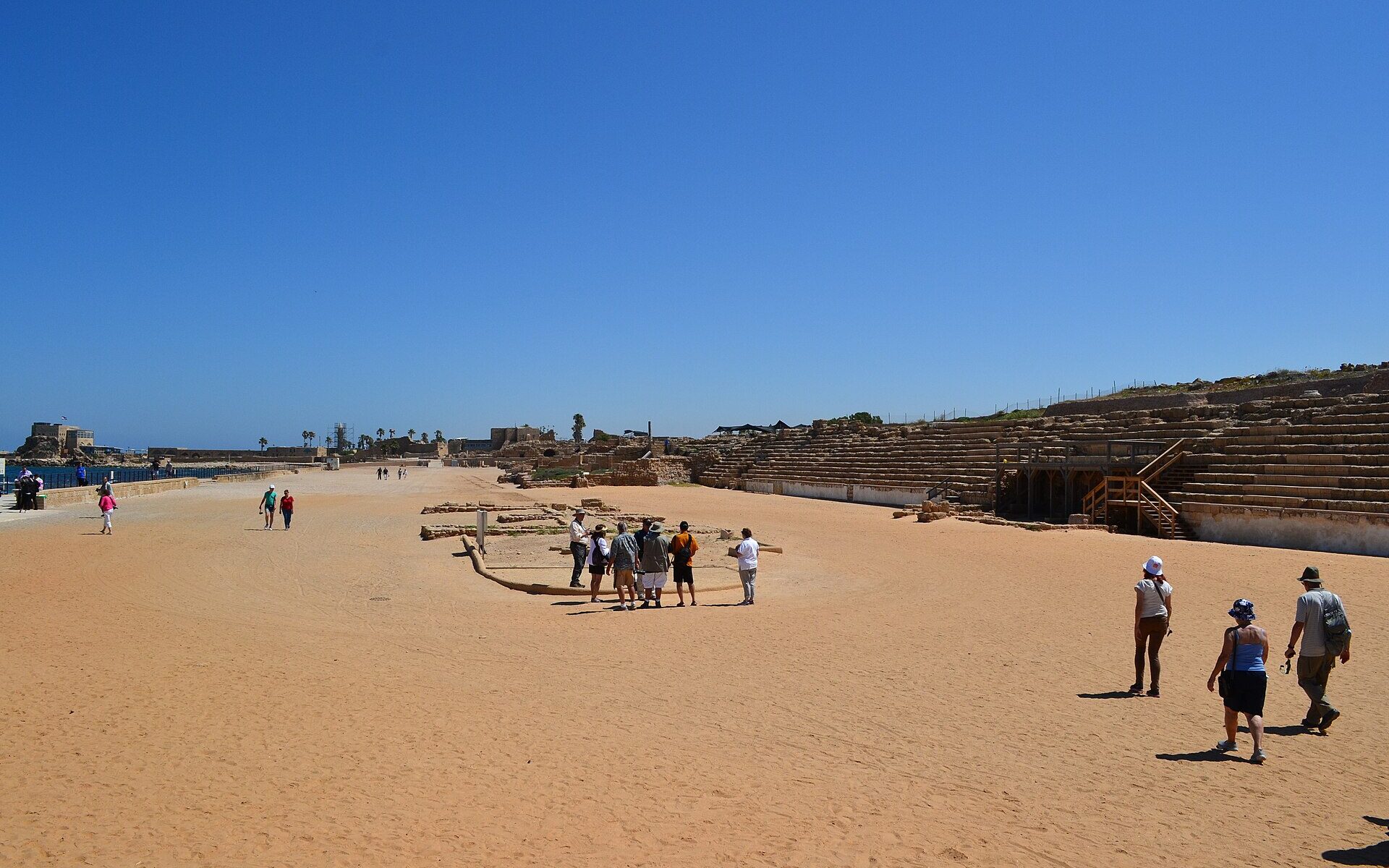
Stand on the sand at Caesarea’s hippodrome and the first thing you notice is not the ruins but the sea, right there behind the starting gates, close enough to hear. Herod built a racetrack beside the surf because he could, and two thousand years later the setting still does most of the work. It is also the moment many visitors realise how far they have come: the Mediterranean is a different country in mood from the Judean hills, and getting to Caesarea from Jerusalem, then on to Haifa and Akko, takes you the length of Israel’s northern coast.
This guide is about doing that coast properly. It covers the three places in turn, what each is good for and what you can skip, how to get there by car, train, bus or tour, and why the honest answer to “can I do all three in a day?” is no. Hours and prices were checked in October 2026 against the Israel Nature and Parks Authority, Old Akko’s own site and the Bahá’í Gardens’ visitor pages; check them again before you travel, especially around the Jewish holidays.
Caesarea, Haifa and Akko at a Glance
| Caesarea | Haifa | Akko (Acre) | |
|---|---|---|---|
| Distance from Jerusalem (straight line) | About 87 km | About 115 km | About 128 km |
| What it is | Herod’s port city, later a Crusader town, now a national park on the beach | A big working city climbing Mount Carmel above the port | A walled Ottoman port town built on top of a Crusader capital |
| The headline sight | Theatre, hippodrome, harbour and the aqueduct on the beach | The terraced Bahá’í Gardens and the Shrine of the Báb | The Knights’ Halls, the Templar Tunnel and the sea walls |
| Entry (October 2026) | ₪46 adult, ₪27 child | Bahá’í Gardens free | ₪55 all-inclusive Old Akko ticket |
| Time you need | Two to three hours | Half a day to a full day | Half a day, better with an evening |
| Open on Saturday? | Yes, entry subject to space | Gardens yes; some city buses run | Yes, all the main sites |
One Day or Two? The Honest Verdict
Tour companies in Jerusalem sell Caesarea, Haifa and Akko as a single day, and on paper it works: three famous names, one coach, back in time for a late dinner. In practice it is a long, tiring day with several hours of driving and short stops at each place. You see the theatre at Caesarea but not the harbour. You see the Bahá’í Gardens from the top viewpoint and not much else of Haifa. You arrive in Akko as the light is going and leave before the fish restaurants have filled.
Our verdict is simple. If this coast is a box to tick, take the tour and enjoy the views from the window. If it is something you actually want to see, give it one night and ideally two. Sleep in Haifa or in Akko, and the geography suddenly makes sense: Caesarea on the way up, Haifa and Akko on either side of the same bay, and the drive back to Jerusalem done once rather than twice.
Two nights let you do it at walking pace. One day for Caesarea and Haifa, one for Akko, with Rosh Hanikra or the Bahá’í shrine at Bahji as optional extras. That is the version we would recommend to anyone with a week or more in the country, and it slots neatly in front of a Galilee stay if you are heading on to Nazareth and the lake. Our guide to trips beyond Jerusalem sets out how the northern overnight trips fit together, and the day trips page covers the places that genuinely do work there and back in a day.
Who should still do it in a day? Anyone with only one free day and a burning wish to see Caesarea, who should go to Caesarea alone, give it the time it deserves, and add Zikhron Ya’akov or the beach rather than racing on to Akko. A single site done well beats three done in a blur.
Getting There from Jerusalem
By car
A car is the easiest way to string the three together, because Caesarea sits a few kilometres off the coastal highway and is awkward to reach any other way. The quickest route north leaves Jerusalem on Route 1 and picks up Route 6, the toll motorway, before cutting west to the coast; the alternative is Route 1 to Tel Aviv and the coastal Route 2, which is free but suffers from the Tel Aviv traffic. Neither is a scenic drive. Time it for mid-morning, after the commuter rush, and check Waze on the day rather than trusting any fixed figure.
Parking is easy at Caesarea and at the edge of Akko’s Old City, harder in central Haifa. If you are staying in Akko, leave the car outside the walls; the lanes inside are narrow, and the Old City is compact enough to explore on foot.
By train
There is no direct train from Jerusalem to the north coast. Every journey starts at Jerusalem Yitzhak Navon and changes once. The simplest change is at Ben Gurion Airport, twenty minutes from Navon, where the Modi’in–Nahariya line calls on its way up the coast. In the October 2026 timetable that train runs roughly hourly and reaches:
- Binyamina, the nearest main-line station to Caesarea, about 56 minutes after Ben Gurion. The national park is roughly 6 km away, so you need a taxi from the station.
- Haifa Hof HaCarmel after about 1 hour 14 minutes, and Haifa Center HaShmona, nearest the lower city and the German Colony, after about 1 hour 25.
- Akko after about 1 hour 54 minutes. The station is in the new town, a walk or short taxi ride from the Old City walls.
Add the 20 minutes from Jerusalem and the wait for the connection, and Haifa is a little over two hours by rail, Akko around two and a half. Pay with a Rav-Kav card or a contactless bank card, and check the Israel Railways journey planner for the day you travel. As with all trains in Israel, nothing runs from Friday afternoon until Saturday night, or on Jewish holidays.
By bus
Egged route 960 is the direct bus between Jerusalem Central Bus Station and Haifa’s Merkazit HaMifratz terminal, timetabled at 1 hour 40 minutes. On an ordinary weekday in October 2026 there were 22 departures from Jerusalem, the first at about 06:20 and the last at about 22:30. It is the simplest way to Haifa, and from Merkazit HaMifratz, Akko is a short onward hop by train or local bus. For Caesarea the bus is not a good option; you would need a connection and a taxi at the far end. Our guide to getting around Jerusalem explains how to reach the bus station and how the Rav-Kav card works.
On a tour
Organised day tours from Jerusalem are the easiest way to see all three without driving, and some readers will prefer that trade-off despite everything above. Before you book, check exactly what the price includes: whether the Caesarea and Old Akko entry fees are covered, whether the Bahá’í stop is the upper viewpoint only, and what time you get back. Our round-up of the best Jerusalem tours explains how to weigh guided days against going independently.
Caesarea: Herod’s Port on the Beach
Caesarea Maritima was Herod the Great’s showpiece, built between about 22 and 10 BCE as a Roman city with a deep-water harbour made from scratch on an open coast. It became the seat of the Roman governors of Judea, which is why one of the best-known finds here is a limestone block naming Pontius Pilate, discovered in 1961 and now in the Israel Museum in Jerusalem. Centuries later the Crusaders fortified a smaller town on the same spot; the walls and dry moat you walk through at the entrance were built by Louis IX of France in 1251.
The national park strings all of this along a few hundred metres of shore, and the pleasure of the place is that it never feels like a museum. Children run along the hippodrome, people swim off the rocks, and there are restaurants around the old harbour.
What to see
- The theatre. Restored and still used for concerts, with the sea behind the stage. Start here; it gives you the scale of Herod’s ambition.
- The promontory palace. The remains of a palace built out into the sea, with a pool cut into the rock. Stand at the end and look back at the city.
- The hippodrome. The long racetrack along the shore, with rows of seating on the landward side. The sand underfoot makes it easy to imagine the chariots.
- The harbour and Crusader town. Much of Herod’s harbour now lies underwater, but the inner harbour, the Crusader walls and the moat are on land, and the restaurants are here.
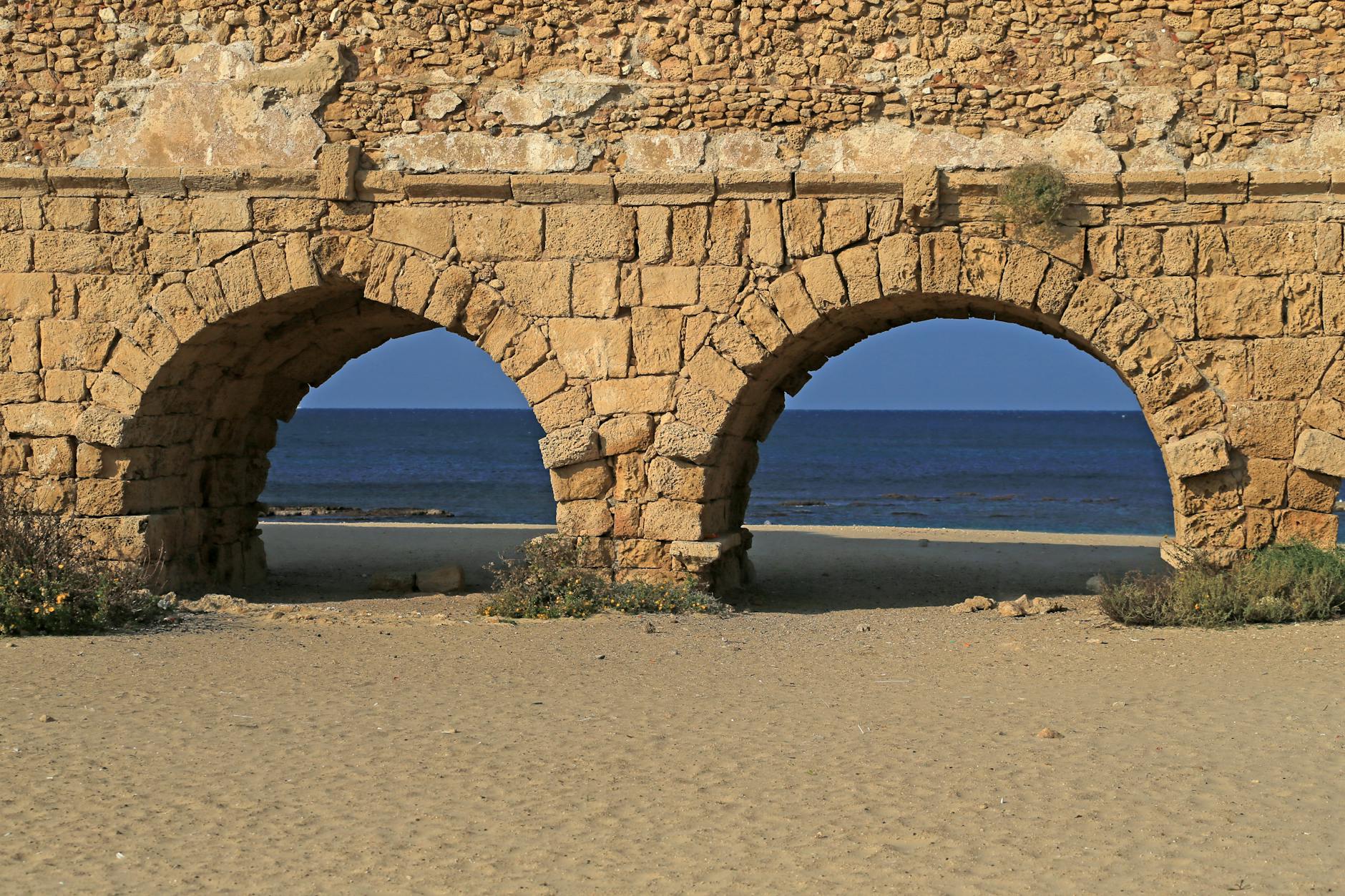
- The aqueduct. On the beach just north of the national park, a long run of Roman arches carried water to the city. It is the photograph everyone wants, and it is best in late afternoon light.
Practical details
- Entry. ₪46 for adults and ₪27 for children in October 2026, with group, student and Israeli senior rates. The Israel Nature and Parks Authority sells tickets online and at the gate.
- Hours. In winter, 08:00 to 16:00, to 15:00 on Fridays and to 13:00 on holiday eves; in summer an hour later on Sundays to Fridays. Entry closes an hour before closing time, and on Saturdays and holidays admission depends on space. The park’s own page gives the current season.
- Time. Two hours for the main sights, three if you want lunch at the harbour and a look at the aqueduct.
- Bring. A hat and water, even in October; there is little shade between the theatre and the hippodrome.
Is it worth it? Yes, without much hesitation. Caesarea is a stop that rewards even a short visit, and if you only have a day, this is the place to spend it.
Haifa: Gardens, Port and Mount Carmel
Haifa is a working city rather than a sight, and that is part of its appeal after Jerusalem. Jewish and Arab neighbourhoods sit close together, the port is busy, and the whole place tilts down Mount Carmel to the bay. Most visitors come for one thing, and it does not disappoint.
The Bahá’í Gardens
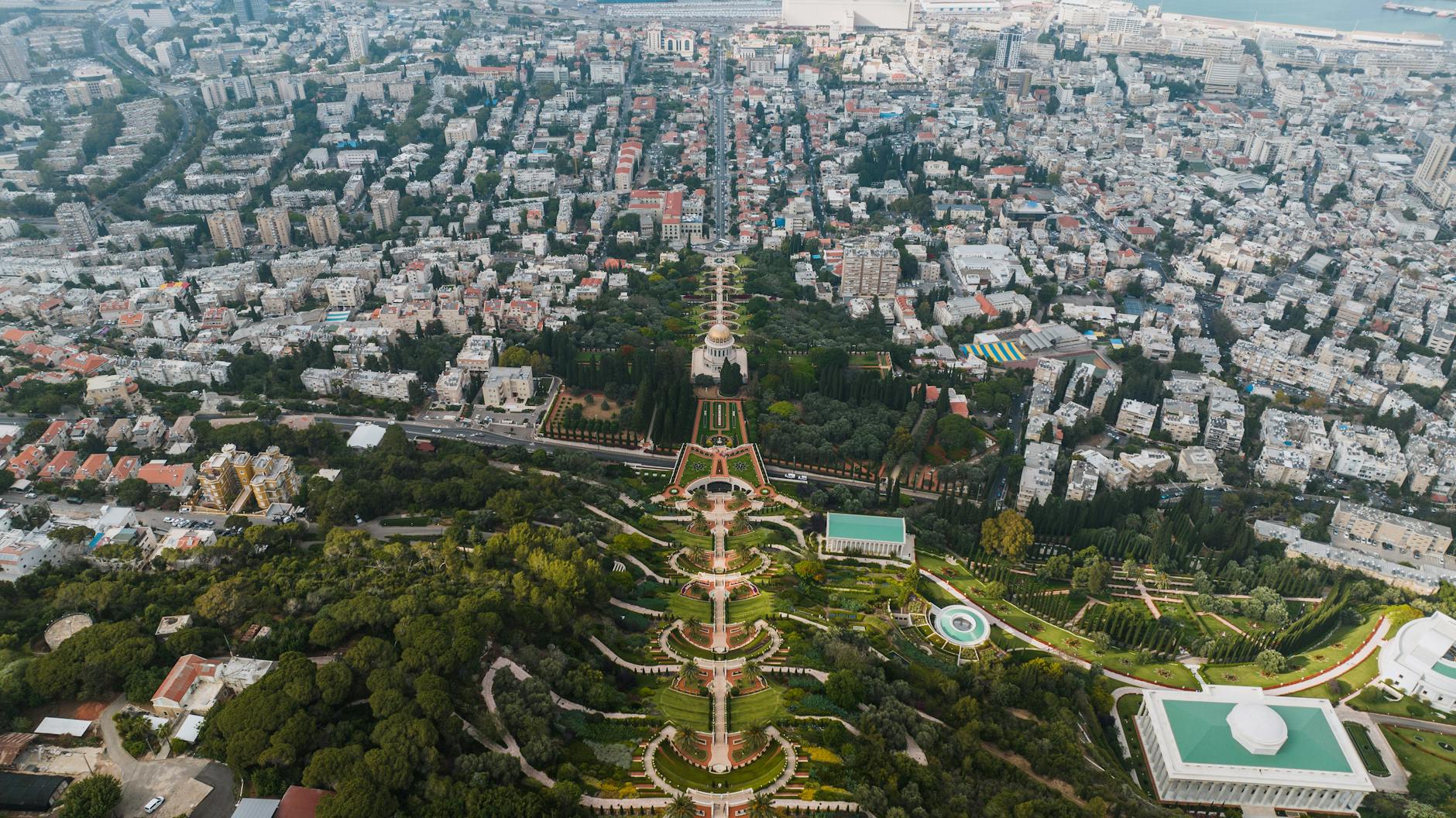
Nineteen terraces fall down the north face of Mount Carmel in a single line, with the gold-domed Shrine of the Báb at their centre. It is the spiritual and administrative heart of the Bahá’í faith, and with the Bahá’í holy places in Western Galilee it was inscribed on the UNESCO World Heritage List in 2008. The gardens are immaculate in a way that can feel almost unreal, and they are free.
- Upper terraces (61 Yefe Nof Street): open daily 09:00 to 17:00 for the famous view down the gardens to the port.
- Main entrance (80 HaTzionut Avenue): the Shrine of the Báb and the inner gardens are open 09:00 to 12:00, and the outer gardens 09:00 to 17:00.
- Guided tours are by reservation only, through the gardens’ own site, and they ask for at least seven business days’ notice. Self-guided visits to the viewpoints need no booking.
- Closures. The gardens close on Bahá’í holy days and on Yom Kippur, and occasionally on other days at short notice, so check the gardens’ visitor page the day before.
- Dress. Shoulders covered and clothing to the knee: no shorts, short skirts, tank tops or beachwear. Our dress code guide covers the same rules for Jerusalem’s holy sites.
If you only have an hour, go to the upper terrace for the view and then walk down Yefe Nof, the panoramic promenade along the ridge. If you have a morning, go to the main entrance first, while the shrine is open.
The rest of Haifa
At the foot of the gardens, Ben Gurion Avenue runs straight down to the port through the German Colony, founded by the Templers, a German Protestant movement, in the 1860s. Its stone houses with their German inscriptions over the doors are now restaurants and cafés, and the avenue lines up perfectly with the terraces above. It is the obvious place for lunch.
Next door, Wadi Nisnas is the old Arab neighbourhood, with a small market, bakeries and murals. Out on the western tip of the Carmel, the Carmelite monastery of Stella Maris sits above the sea; the Christian Information Centre lists it as open Monday to Saturday, 07:40 to 12:00 and 15:00 to 18:00, and on Sunday 10:00 to 12:00 and 15:00 to 18:00. Below it, Elijah’s Cave is venerated by Jews, Christians, Muslims and Druze alike. A short cable car has long linked the Bat Galim seafront with Stella Maris; check that it is running before you build a day around it.
Haifa also gets a lot of cruise traffic, and if you are arriving by sea rather than from Jerusalem, our guide to Haifa port to Jerusalem weighs up whether the long drive south is worth it on a port day.
Akko: The Crusader Capital Under an Ottoman Town
If Caesarea is the most impressive of the three and Haifa the most pleasant, Akko is the most atmospheric. The Old City of Acre was inscribed by UNESCO in 2001, and what makes it remarkable is that there are two towns here, one on top of the other. Above ground is an Ottoman walled port, with mosques, markets, caravanserais and a fishing harbour. Below it lies the Crusader city, which after the fall of Jerusalem became the capital of the Second Crusader Kingdom, from 1191 until the city fell in 1291. Much of it was simply built over, and it has been excavated in stages since.
Anyone who has read our guide to Crusader Jerusalem will find the story picks up here. The kingdom that lost Jerusalem in 1187 governed from Akko for another century.
What to see
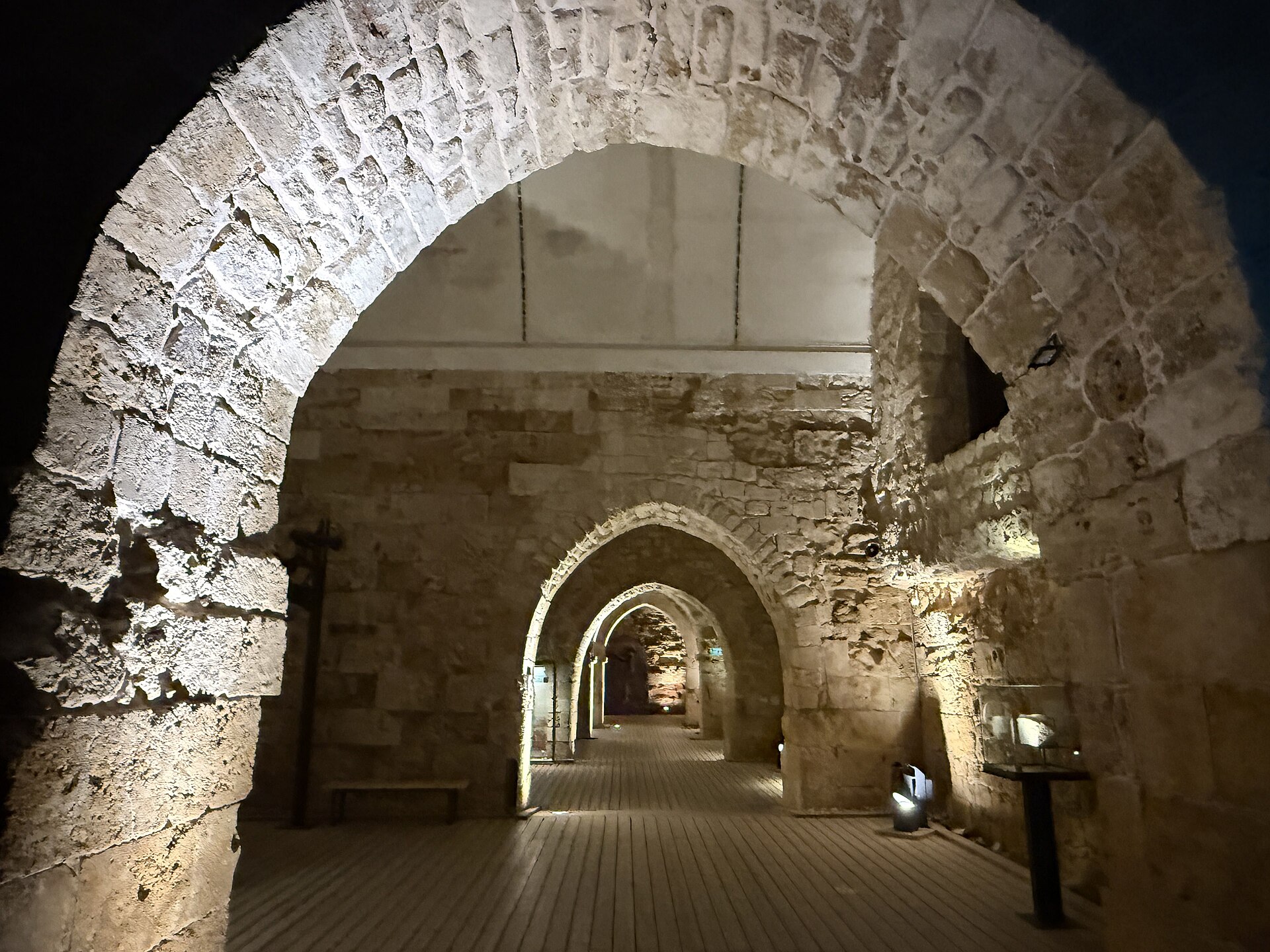
- The Knights’ Halls. The fortress of the Hospitaller order, their headquarters through the Crusader century. The vaulted halls, the refectory and the courtyard are vast and cool, and the ticket includes an electronic guide in ten languages. Allow an hour.
- The Templar Tunnel. About 150 metres of Crusader tunnel running under the town towards the sea, found by chance in 1994 and open along its full length since 2007. You walk it bent slightly at the knees in places. Old Akko’s site has carried a notice that the tunnel’s lift is out of service, so be ready for steps and check the site before you go.
- The Turkish bath. Hammam al-Basha, the Ottoman bathhouse built by al-Jazzar in the late 18th century, now open to visitors.
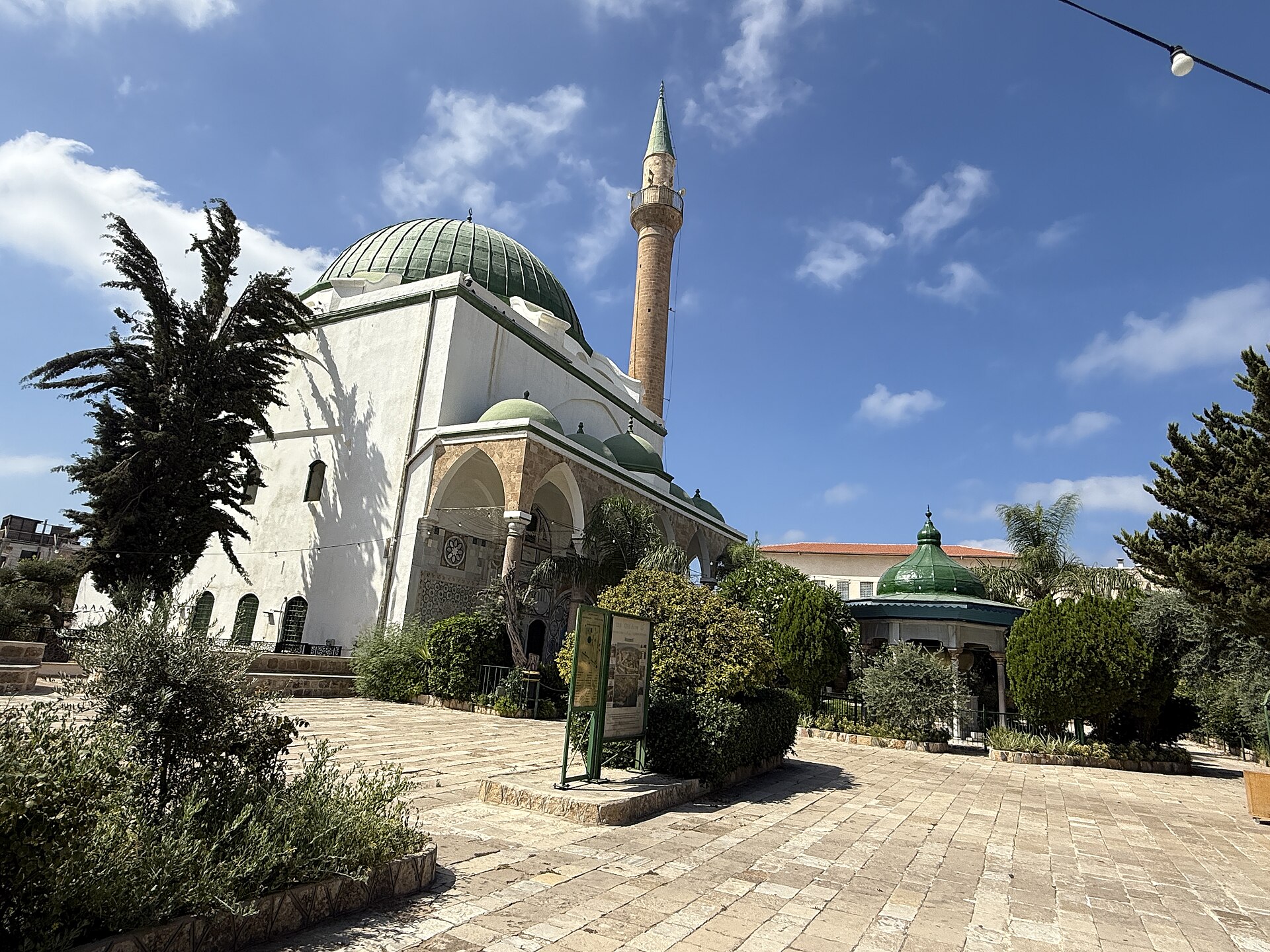
- The Al-Jazzar Mosque. The great white mosque with the green dome, ordered by the Ottoman governor Ahmad Pasha al-Jazzar in 1781. Its courtyard is one of the loveliest spaces in the town. Dress modestly, and expect it to close to visitors at prayer times.
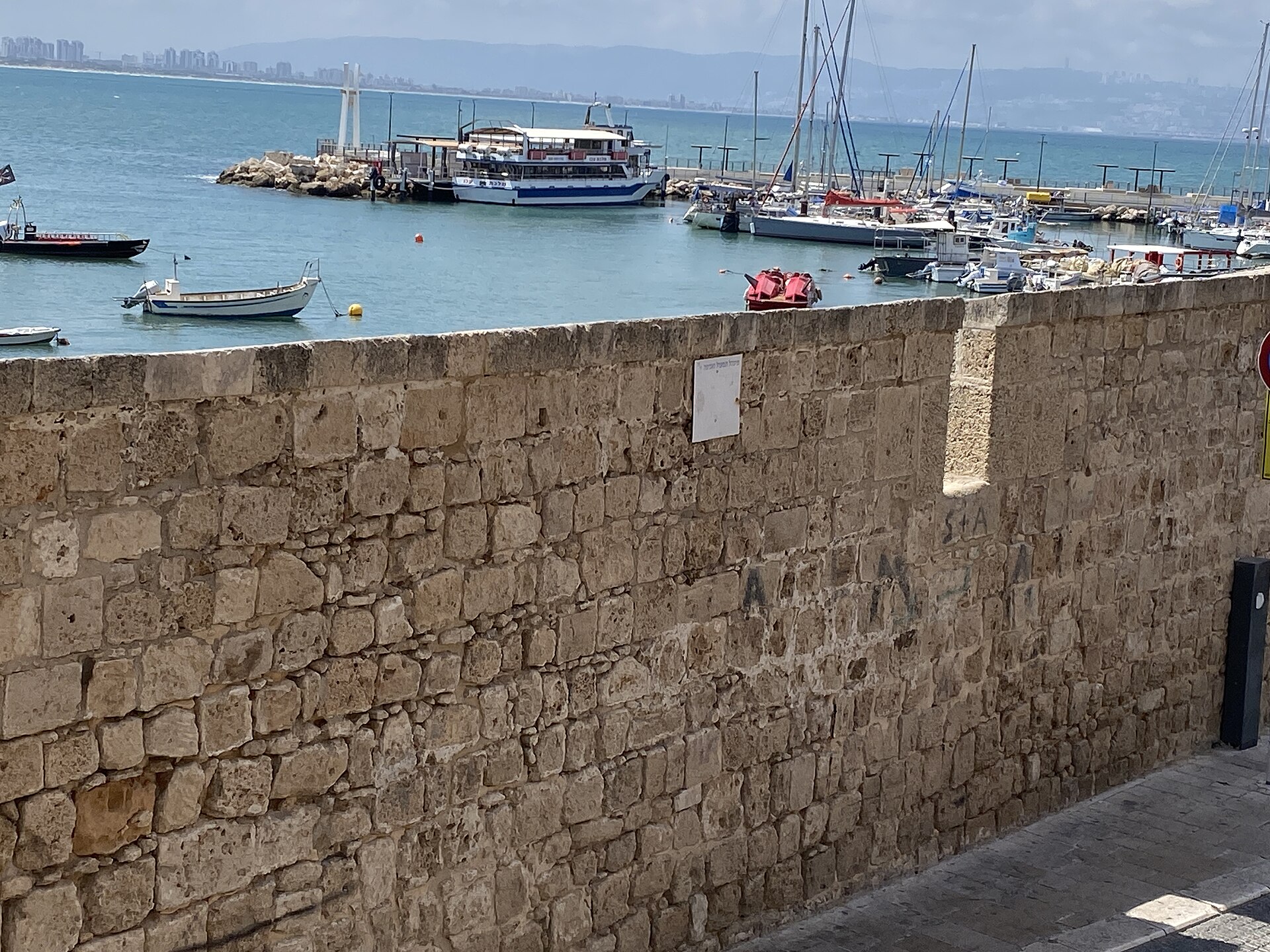
- The sea walls and the harbour. Free, and the best thing in Akko at the end of the day. Walk along the southern walls to the lighthouse, watch the local boys jumping into the sea, and look across the bay to Haifa.
- Khan al-Umdan and the market. The caravanserai of the pillars, with its clock tower, and the covered market streets behind it, where the fishmongers and spice sellers are busy in the morning.
Tickets and hours
Old Akko sells an all-inclusive ticket at ₪55 per person that covers the Knights’ Halls, the Templar Tunnel, the Turkish bath and the ethnographic museum. The main sites open 09:00 to 17:00, and to 16:00 on Fridays and holiday eves, with the ticket office closing an hour before. Old Akko’s own site lists the same hours for the winter schedule that starts on 25 October 2026, but notes that hours can change during festivals and holidays. Unlike Jerusalem’s Jewish sites, Akko’s attractions are open on Friday and Saturday; only the Ramchal Synagogue closes on Shabbat and holidays.
Eating
Akko is famous for fish, and much of the best of it is around the harbour and the lighthouse. Uri Buri, which describes its home as a 400-year-old Ottoman building on the lighthouse plaza, is one of the best known and says it opens seven days a week; book ahead for dinner. For hummus, the Old City’s small hummus places are a lunchtime habit rather than an evening one, so go earlier rather than later.
Bahji, just outside town
A few kilometres north of Akko, the Shrine of Bahá’u’lláh at Bahji is the holiest place in the Bahá’í faith and part of the same UNESCO listing as the Haifa gardens. The outer gardens open daily 09:00 to 17:00, and the shrine itself Friday to Monday, 09:00 to 12:00. It is quieter and more contemplative than Haifa, and worth half an hour if you are driving.
Rosh Hanikra and the Northern Border
Rosh Hanikra, the white chalk cliffs and sea grottoes on the Lebanese border, is the traditional add-on to an Akko day. In October 2026 the operator was selling tickets for the cable car and the grottoes, including an all-inclusive combined ticket with Old Akko.
Before you go, read the official travel advice, because this is where it bites. The UK Foreign Office advises against all travel to areas north of Route 89 between Nahariya and Dalton, near the Lebanese border, and the US advisory warns against travel within 4 km of the Lebanese border. Rosh Hanikra sits right on that border. Check the latest FCDO map and the US State Department page before you decide, and check whether your travel insurance covers you there. Akko and Haifa themselves are well south of these zones. Our page on whether Jerusalem is safe to visit explains how to read the advice for the rest of the country.
Shabbat on the Coast
This is one trip that works better than most on a Saturday, with one big exception. Caesarea is open, Akko’s Old City is busy and almost everything is open, and in Haifa the Bahá’í Gardens are open and some city buses keep running. The exception is getting there: no trains run from Friday afternoon until Saturday night, and the Jerusalem buses stop. If you want a Saturday on the coast, you need a car, or you need to arrive on Friday morning and stay the night. Our guide to Shabbat in Jerusalem explains what stops and what keeps going in the city itself.
Three Ways to Plan It
The single day, done well
Leave Jerusalem by car at about 08:00. Spend the morning at Caesarea, eat at the harbour, see the aqueduct, then drive to Haifa for the upper terrace of the Bahá’í Gardens in the afternoon. Skip Akko. Back in Jerusalem by early evening, tired but not destroyed.
Two days, one night
- Day one: Caesarea in the morning, Haifa in the afternoon, with the gardens, the German Colony and dinner in Wadi Nisnas or the German Colony. Sleep in Haifa.
- Day two: Akko by mid-morning, after the morning market and before the coach groups. The Knights’ Halls and the tunnel, lunch by the harbour, the sea walls, then the drive or train back to Jerusalem.
Three days, into the Galilee
Do the two-day version, but sleep in Akko on the second night so you can walk the walls at sunset. On day three, drive inland to Nazareth and the Sea of Galilee rather than straight back to Jerusalem. Our Galilee trip guide and our Nazareth guide pick up the story from there, and the Holy Land pilgrimage itinerary shows how the north fits into a longer trip.
Where to sleep? Haifa has the widest choice and the best value, with business hotels on the Carmel and smaller places around the German Colony. Akko’s Old City has a handful of boutique hotels and guesthouses in restored Ottoman houses, more expensive but far more memorable. For a sense of how the costs add up against a Jerusalem stay, see our guide to what a trip to Jerusalem costs.
Final Word on Caesarea, Haifa and Akko
The northern coast is one of the best things you can do from Jerusalem, and one of the worst-served by a single rushed day. Give it a night, start with Herod’s harbour at Caesarea, spend an afternoon looking down the Bahá’í terraces, and finish on Akko’s sea walls with the lights of Haifa coming on across the bay. If time is short, the Tel Aviv day trip is the easier coast day; if you have more, our week in Jerusalem plan shows where an overnight trip north fits. For the bigger picture of the city’s past that these ports were part of, start with our history of Jerusalem.
Photo Credits
Hippodrome at Caesarea: Caesarea – King Herod’s Hippodrome (13) (37172712451) by Larry Koester, CC BY 2.0, via Wikimedia Commons.
Knights’ Halls, Akko: Knights Halls Acre Avney Moreshet 3f38123b by Shlomo Rodad, CC BY 2.5, via Wikimedia Commons.
Al-Jazzar Mosque, Akko: 138093 acre – al-jazzar mosque PikiWiki Israel by Shlomo Rodad, CC BY 2.5, via Wikimedia Commons.