Walk down Emek Refaim on a weekday morning and at first it looks like any comfortable Jerusalem high street: café tables on the pavement, a queue at the bakery counter, buses nosing past the roadworks. Then you notice the houses. Some of them are plainly not from here, with the tiled roofs, shutters and plain stone fronts of a south German farming village, and over a few doorways a Bible verse is carved in German, in the spiky Fraktur lettering of nineteenth-century Germany. This is the German Colony Jerusalem residents call simply “the Moshava”, the colony: a farming settlement founded in the Refaim Valley in 1873 by a Protestant sect that had come to the Holy Land to prepare for the Messianic age, and today one of the most relaxed corners of the city.
This guide covers the Templers and what became of them, how to read the houses they left behind, the Templer Cemetery, Emek Refaim Street and its Friday-morning café ritual, the Saturday shutdown that catches so many visitors out, a short walk, and how to get there now that light rail works are under way on the main street. Details were checked in November 2026 against the city’s official tourism site, the First Station’s own pages, Hebcal’s calendar and the Ministry of Transport’s bus data; cafés change their hours often, so check before you set out.
The German Colony at a Glance
| Details | |
|---|---|
| Where | South-west of the Old City, along Emek Refaim Street, with the First Station and Liberty Bell Park at its northern entrance |
| Founded | 1873, by Templers from Württemberg in south-west Germany |
| Why go | Templer houses, the Templer Cemetery, a café-lined main street, a slow morning away from the crowds |
| Best time | Friday morning for the buzz; a weekday evening for dinner |
| Shabbat | Most cafés and shops close from Friday afternoon to Saturday night, and the buses stop |
| Time needed | An hour for a walk; half a day with a long lunch and the First Station |
| Cost | Free to walk around; the cemetery visit has to be arranged in advance |
| Getting there | About 2.1 km on foot from Jaffa Gate, or by bus; no light rail yet |
Who Were the Templers?
The Templers had nothing to do with the medieval Knights Templar. They were a breakaway Protestant movement, the Temple Society, founded in Württemberg in 1861 by Christoph Hoffmann and others after a split with the region’s Lutheran church. Their idea was that believers should settle in the Holy Land, to prepare there for the coming of the Messianic age. Within a decade they had acted on it. The first colony went up in Haifa in 1868, Jaffa followed a year later, then Sarona near Jaffa in 1871, and in 1873 a fourth group settled on a large tract of land in the Refaim Valley, outside the Old City walls on the road south towards Bethlehem.
The land was bought by one of the colonists, Matthäus Frank, from the Arab villagers of Beit Safafa. The settlers farmed and worked at the trades they had brought with them, carpentry and blacksmithing among them, and they built in the way they knew, only in Jerusalem stone rather than the timber and brick of home. Their houses ran along two parallel roads, which became today’s Emek Refaim Street and Bethlehem Road. One of the early settlers, a butcher called Friedrich Kübler, raised livestock and built a slaughterhouse on his property, and his son went on to supply meat to the city’s hotels, monasteries, hostels and hospitals.
How the Templer Story Ended
The colony’s fortunes rose and fell with Germany’s. As German citizens, the Templers found themselves on the wrong side of the British in both world wars. In the summer of 1918 the British sent 850 Templers to an internment camp at Helwan, near Cairo, and the cemetery on Emek Refaim has a monument to 47 Templer soldiers who were killed in the First World War. In the 1930s the community was drawn into the new German nationalism: by 1938, 17% of the Templers in Palestine were members of the Nazi Party, and the city’s own tourism office describes them as German nationals who were not shy about their Nazi sympathies.
When the Second World War began in 1939, the British authorities declared the Templers enemy nationals and placed them under arrest. On 31 July 1941, 661 Templers and other Germans in Palestine were deported to Australia by way of Egypt; in Australia they were interned at Tatura, in Victoria, until 1946 and 1947. Others were exchanged during the war for Jews held in German-controlled territory. After 1948 the Templers could not return, and those who had stayed had to leave. In 1962 the State of Israel paid DM54 million in compensation to owners whose property had been nationalised. Most Templer families ended up in Australia and Germany.
After the Templers
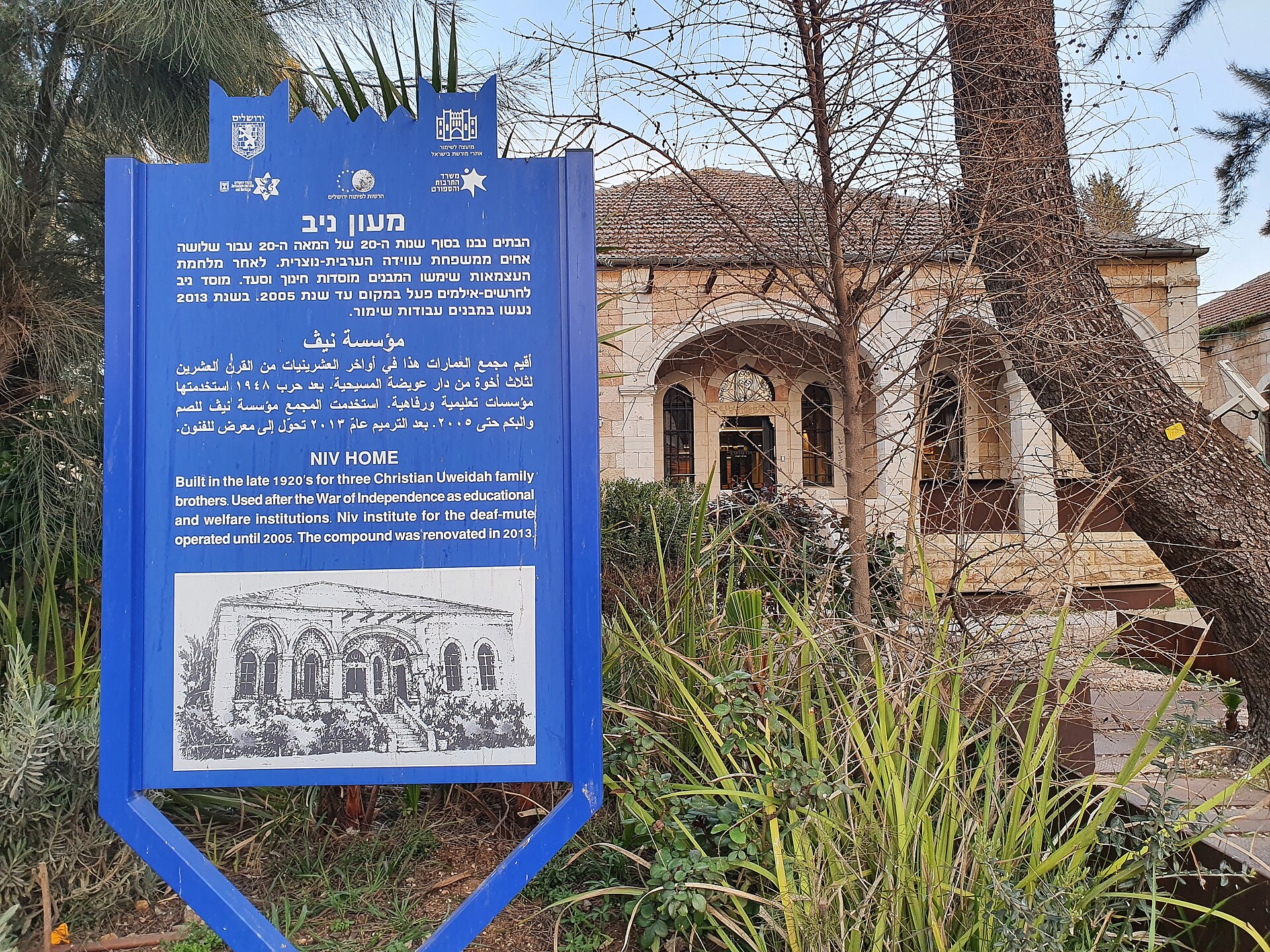
The colony did not stay purely German anyway. As it spread south along the valley, many of the plots were bought by well-to-do Christian Arab families, drawn by a location between the Bethlehem road and the growing districts of Katamon, Talbiya and Baka, home to some of Jerusalem’s wealthiest Arab families. Their villas are part of the streetscape too; the Niv Home, further along Emek Refaim at No. 47, is one. Many of those families fled during the fierce fighting for the area in 1948, and the empty houses were afterwards used to house new immigrants to Israel.
From the end of the twentieth century the neighbourhood gentrified steadily, and today it is an upscale part of the city with a large English-speaking population. The street names tell their own story: many of the side streets are named after foreign supporters of Zionism, among them the British prime minister David Lloyd George, the Czech president Tomáš Masaryk, the South African prime minister Jan Smuts, the French novelist Émile Zola, the Labour MP Josiah Wedgwood and Colonel John Henry Patterson, who commanded the Jewish Legion in the First World War. For the city’s wider story, our history of Jerusalem and our guide to Ottoman Jerusalem fill in the background.
Reading the Templer Houses
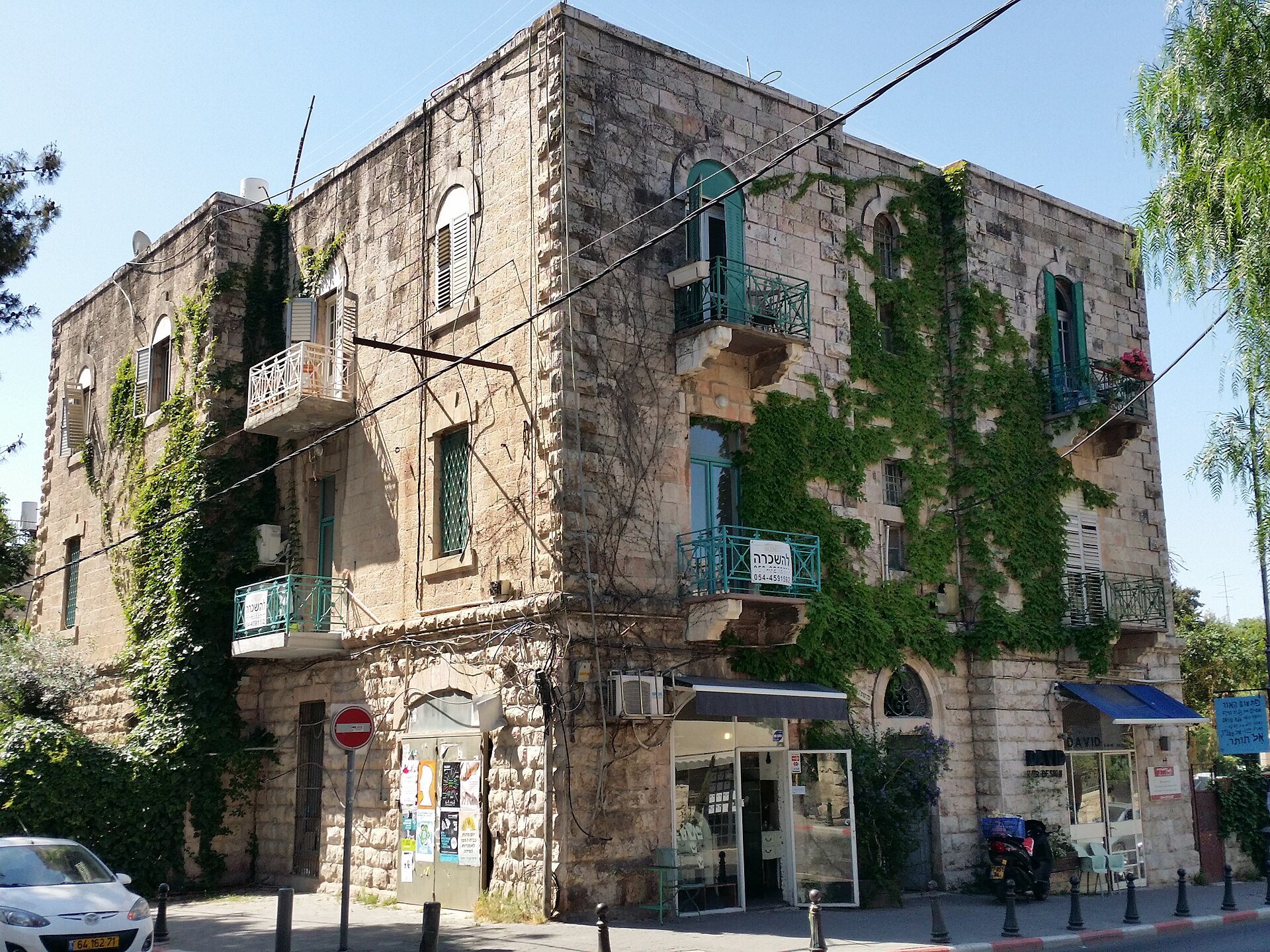
You don’t need to be an architecture buff to pick out a Templer house once you know the signs. They were built as farmhouses, mostly one or two storeys high, with tiled roofs, shuttered windows and solid, plain walls of Jerusalem stone, and many sit back from the street behind small gardens. Next to the ornate villas that came later, they look almost severe, which is exactly what gives them away.
The detail to look for is above the door. Some Templer houses still have a biblical inscription in German on the lintel, carved in Fraktur, the Gothic script of the period. They are easy to walk past, so slow down and look up. The neighbourhood is a mixture, which is part of the pleasure: Swabian-style homes from the Templer years stand within a few steps of late Ottoman houses and Art Deco buildings from the British Mandate, and at least one old lintel carries an Arabic inscription dated 1925.
Houses Worth Finding
- The Gemeindehaus, 1 Emek Refaim Street: the colony’s communal hall, at the northern end of the street.
- The Matthäus Frank House, 6 Emek Refaim Street: named after the colonist who bought the land for the settlement.
- The Friedrich Aberle House, 10 Emek Refaim Street: another of the original Templer homes on the main street.
- The Convent of the Borromean Sisters, 12 Lloyd George Street: a religious house on one of the quieter side streets.
- The Kübler house, Adolphe Crémieux Street: the butcher’s family home, which still has a water trough in the yard.
- The Lev Smadar Theatre building, Lloyd George Street: formerly the Orient Cinema, and once a gathering place for the city’s artists.
Almost all of these are private homes or working buildings. Look from the street, keep your voice down and don’t wander into gardens or courtyards; people live here, and the nicest houses are the ones most often photographed.
The Templer Cemetery
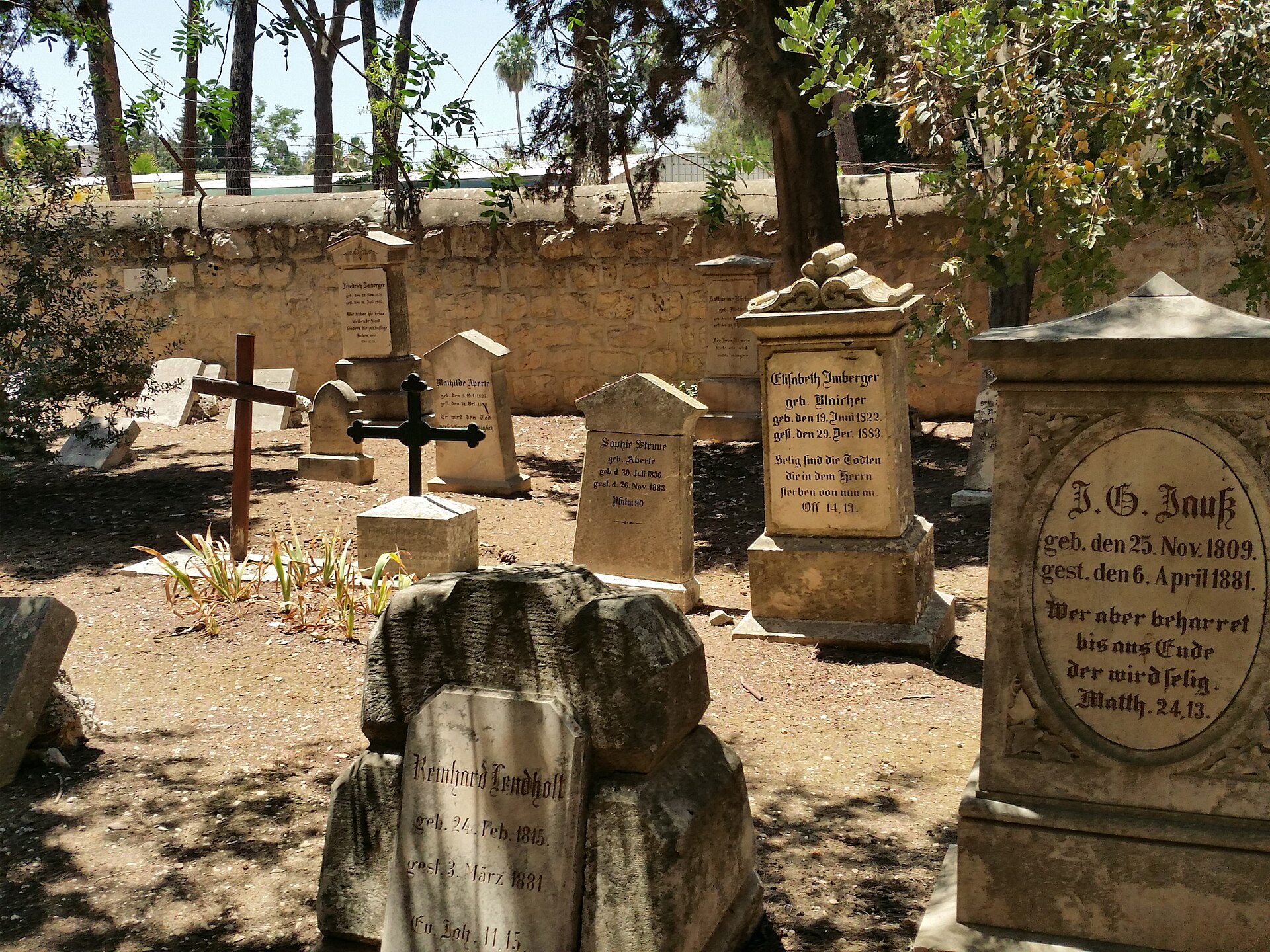
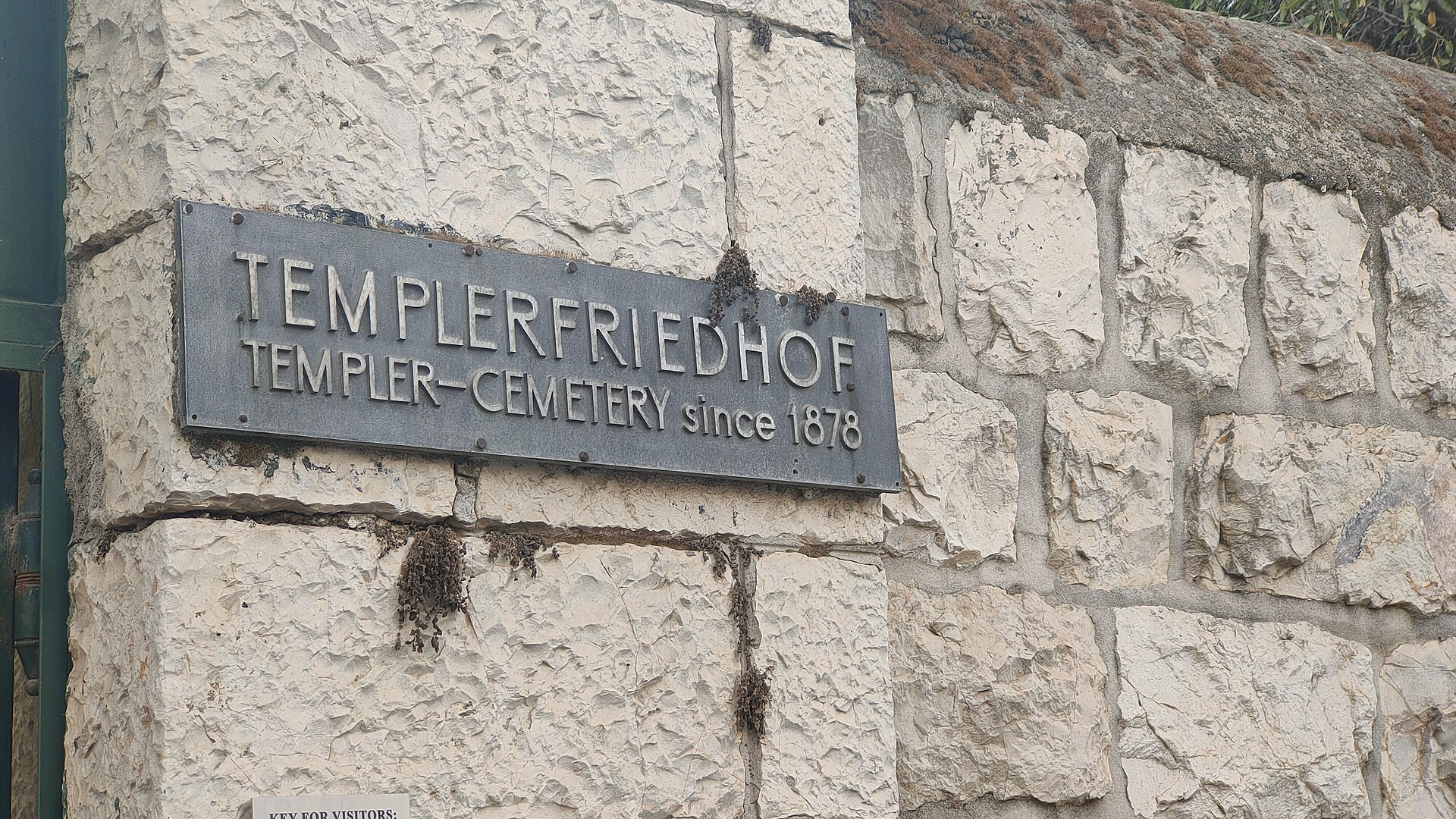
Behind a stone wall on Emek Refaim Street, the Templer community opened its own cemetery in 1878, and the plaque on the gatepost still reads “Templerfriedhof”, Templer cemetery, in German and English. Inside, shaded by old trees, are gravestones carved in German with names, dates and verses from the Bible, the monument to the 47 Templer soldiers killed in the First World War, and, at the back, a mass grave holding the remains of people first buried in the German colonies at Jaffa, Sarona and Wilhelma, which were moved here between 1952 and 1970.
The cemetery isn’t a drop-in attraction. The city’s tourism office says a visit has to be coordinated in advance, so don’t count on finding the gate open if you just turn up. Even from outside, the plaque on the gatepost is worth the stop: it is a direct link to the people who built the colony.
Emek Refaim Street Today
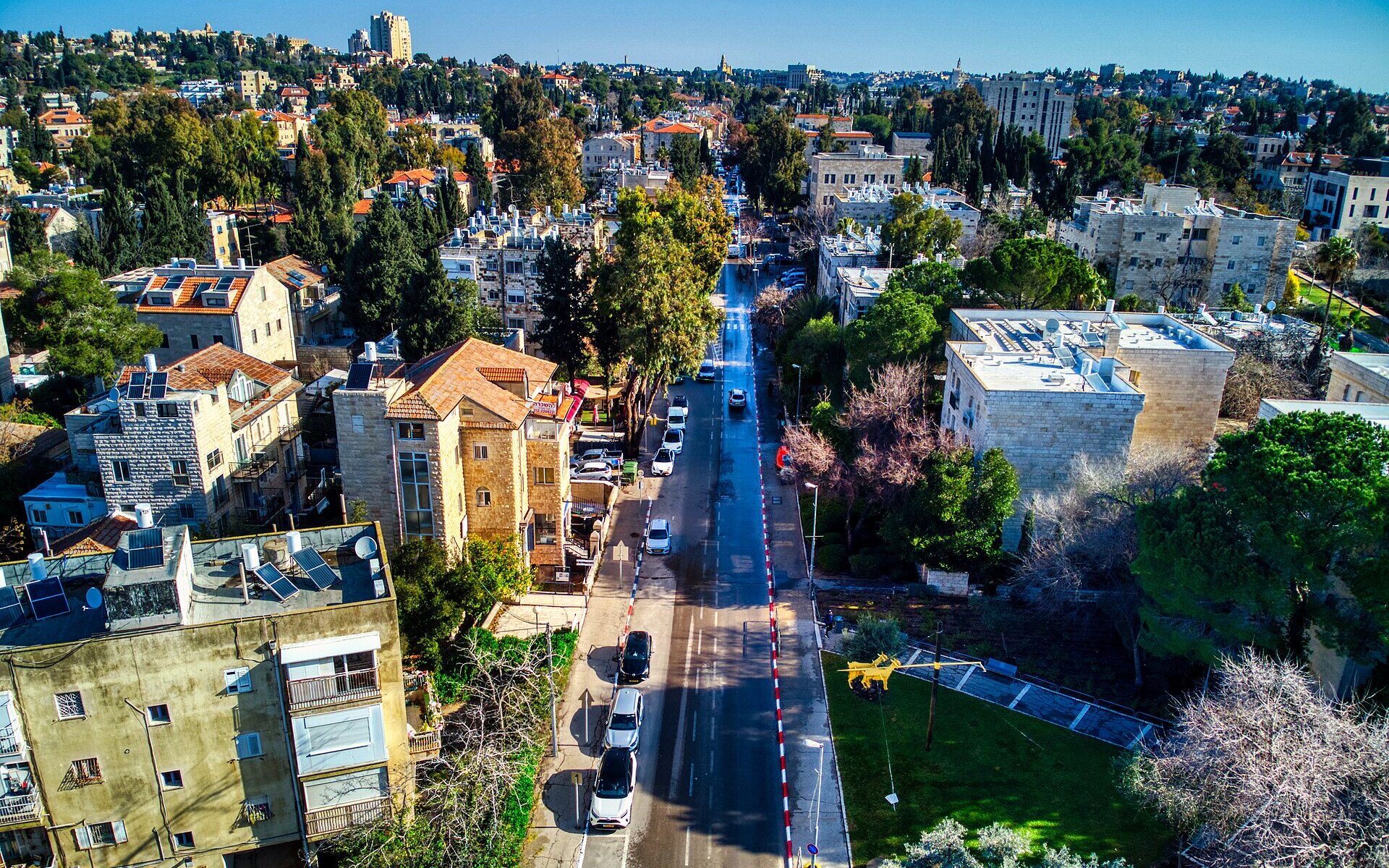
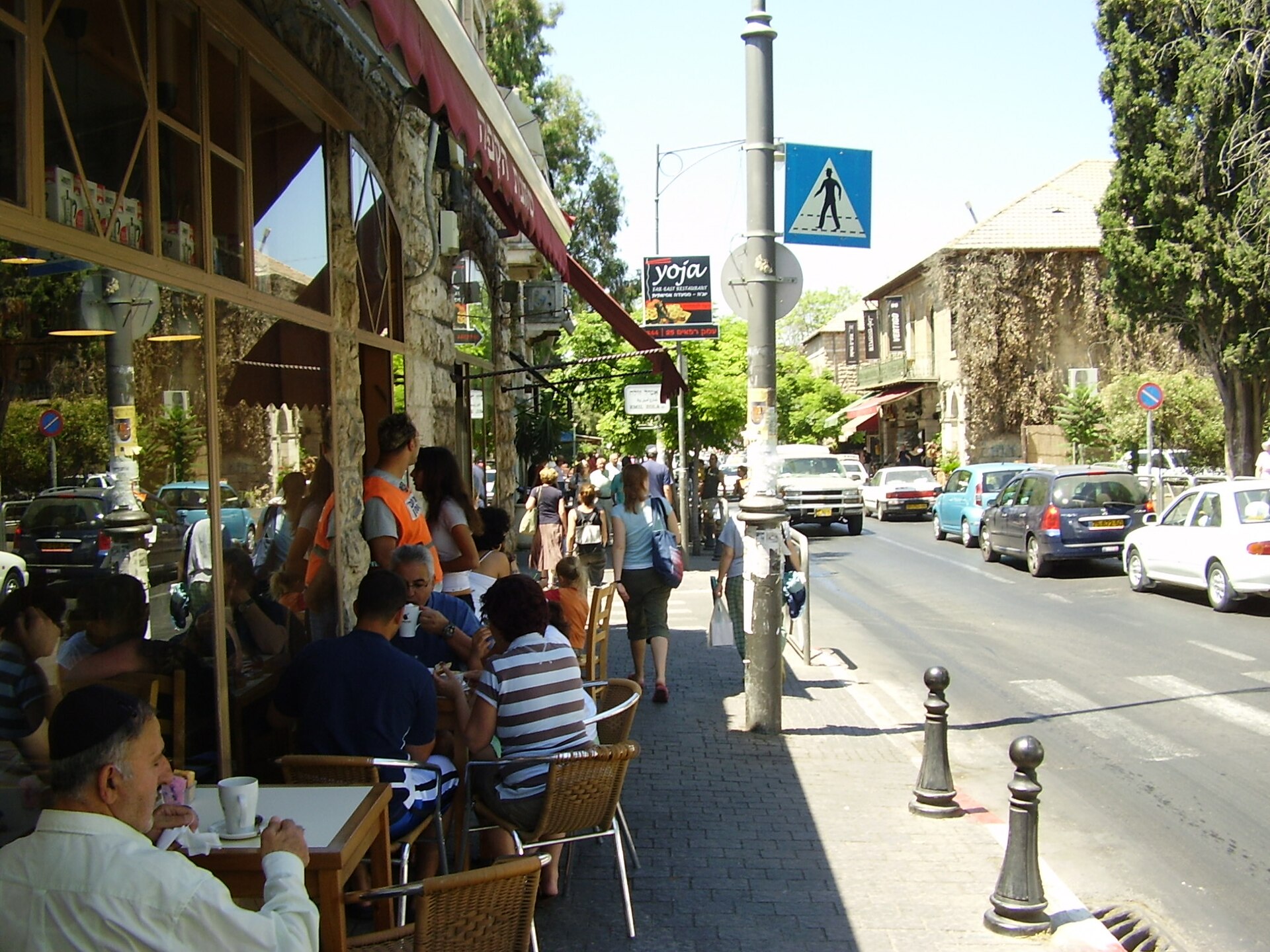
Emek Refaim is the spine of the neighbourhood and the reason most people come: a long, straight street of cafés, restaurants, bakeries and small shops, more local in feel than the city centre. Many of the places along it are kosher, which shapes the rhythm of the week, and with so many English speakers in the neighbourhood you will often hear English at the next table.
A few long-standing names to look for:
- Caffit, 36 Emek Refaim: a kosher café that the city’s tourism office calls one of the original German Colony cafés, with tables inside and out, seats at the bar and a long menu of salads, pastas, fish and sandwiches. It’s a place to settle in rather than grab and go.
- Focaccia Moshava, 35 Emek Refaim: a kosher restaurant, and the one to know about on a Friday (more below).
- The Coffee Mill, 23 Emek Refaim: a small café that sells whole and ground coffee beans by weight, with sandwiches and salads, and a good spot to sit with a book.
For more of the street’s restaurants, our guides to the best restaurants in Jerusalem and kosher restaurants in Jerusalem cover the German Colony alongside the rest of the city, and our Jerusalem food guide explains what to order.
One thing to know before you go: Emek Refaim is also a building site. Work on the light rail’s Blue Line began on the street on 7 July 2025; when it started, the street was made one-way for traffic, and the project was planned to take several years. Expect barriers, diversions and noise along stretches of the pavement. The cafés carry on behind the barriers, but the street is not as pretty as it looks in older photos, and it won’t be for a while.
Friday Mornings
If you can choose your day, choose Friday morning. The Israeli working week runs from Sunday to Thursday, so Friday morning is the start of the weekend, and on Emek Refaim it has a feel of its own: café tables fill up, friends meet for a long breakfast, and people shop for the Shabbat table before everything closes. Focaccia Moshava turns part of its space into a Friday-afternoon market, according to the city’s tourism office: a big spread of salads, dips, meat and fish dishes and desserts, sold by weight for people to take home for their Shabbat meals.
The energy is real but it doesn’t last. Kosher places have to close before Shabbat begins, and in winter that comes early: Hebcal gives candle-lighting in Jerusalem at 15:55 on Friday 27 November 2026 and 15:54 on Friday 4 December. In winter, then, the street winds down through the early afternoon. Arrive by about ten, linger over breakfast, walk the side streets, and be finished by lunchtime.
The Saturday Shutdown
This is the part that catches visitors out. From Friday afternoon until Saturday night the German Colony goes quiet. Most cafés and shops are kosher and close for Shabbat, and the city’s tourism office warns that the buses don’t run from Friday afternoon until Saturday night. It’s easy to plan a Saturday stroll and lunch on Emek Refaim, arrive to find the street shuttered, and go hungry.
Shabbat follows the sun, so the times change every week. These are Hebcal’s times for Jerusalem for late November and December 2026; Hebcal lists the times for any week if you’re travelling later.
| Shabbat | Candle-lighting (Friday) | Shabbat ends (Saturday) |
|---|---|---|
| 27–28 November 2026 | 15:55 | 17:14 |
| 4–5 December 2026 | 15:54 | 17:14 |
| 11–12 December 2026 | 15:55 | 17:16 |
| 18–19 December 2026 | 15:58 | 17:18 |
None of this makes Saturday a write-off, as long as you plan for it:
- Walk. The neighbourhood is at its most peaceful on Saturday morning, with families walking to synagogue and far less traffic. It’s the best time to look at the houses without dodging buses.
- Eat at the First Station. The old railway terminus at the northern end of the German Colony says it is open all week, including Saturday, and its restaurants include some that are open on Shabbat. Our First Station guide has the details.
- Bring a picnic. Buy it on Friday morning, Shabbat-style, and take it to the Train Track Park or Liberty Bell Park.
- Come back on Saturday night. Once Shabbat ends, the street wakes up again as some places reopen for the evening.
Our guide to Shabbat in Jerusalem explains how the whole city works from Friday to Saturday, and which areas stay open.
A Short Walk Through the German Colony
An hour is enough to see the essentials at a gentle pace, longer if you stop for coffee, which you should. The walk runs north to south down Emek Refaim, with two detours into the side streets.
- Start at the northern entrance, across from Liberty Bell Park, close to the First Station. The Gemeindehaus, the colony’s old communal hall, is at No. 1.
- Walk south past Nos. 6 and 10, the Matthäus Frank and Friedrich Aberle houses, two of the original Templer homes. Look for shutters, tiled roofs and any German lettering over the doors.
- Turn off into Lloyd George Street for the Convent of the Borromean Sisters at No. 12 and the Lev Smadar building, formerly the Orient Cinema, then find Adolphe Crémieux Street and the Kübler house with its water trough.
- Back on Emek Refaim, stop at The Coffee Mill at No. 23, or carry on to Focaccia Moshava at No. 35 and Caffit at No. 36.
- Carry on to the Templer Cemetery, behind its wall on Emek Refaim, and read the plaque on the gatepost.
- Look for the blue heritage sign at No. 47, outside the Niv Home, a group of houses built in the late 1920s for three brothers of a Christian Arab family, a reminder of the neighbourhood’s second chapter.
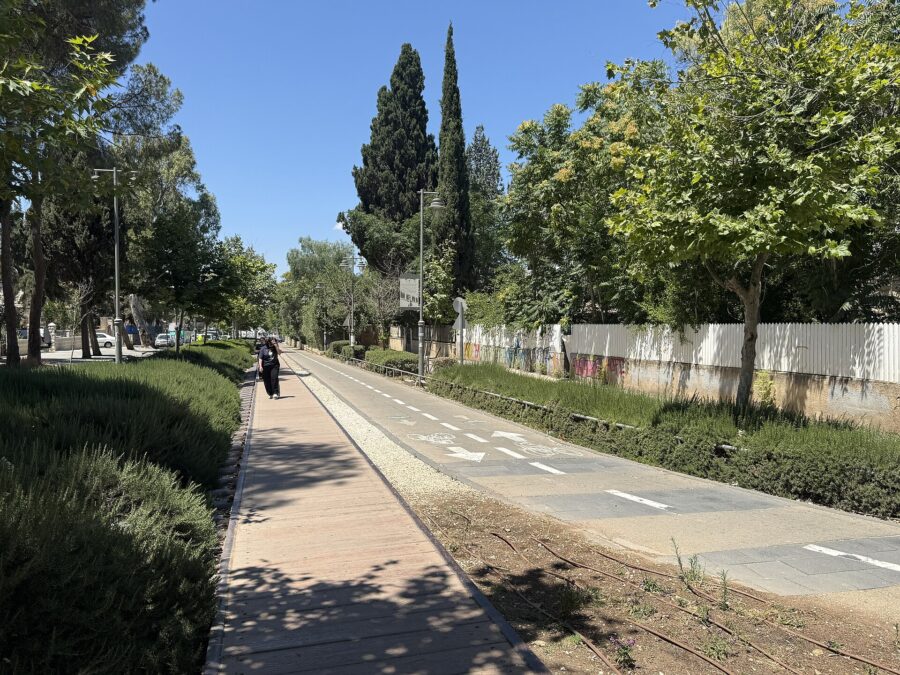
- Finish at the Train Track Park, which runs along the southern edge of the German Colony where it meets Baka. The stretch here is landscaped and good for an easy stroll in either direction.
If you want to keep going, the self-guided routes in our Jerusalem walking tour guide link the German Colony with the First Station and the area around the Cinematheque, and our guide to Jerusalem’s parks covers the green spaces nearby.
Getting There
There is no light rail to the German Colony yet. Our light rail guide explains where the existing lines go. The Blue Line is planned to run along Emek Refaim, and when the works began the municipality said there would be three stops on the street, at the Rachel Imeinu corner, at the Oranim junction and near the First Station. On the plans published then, the first section was due to open in 2028 and the whole line in 2030; large rail projects slip, so treat those years as targets.
Until then, you have three options:
- On foot. From Jaffa Gate it’s about 2.1 km to the middle of the German Colony, roughly half an hour’s walk. It’s one of the easier walks out of the Old City, and the First Station makes a natural stop near the end of it.
- By bus. Several city bus lines stop along Emek Refaim, at stops including Rachel Imenu/Emek Refaim and Emek Refaim/Uzziah, but the light rail works have changed routes since 2025, so check the current line on Moovit or the Ministry of Transport’s bus.gov.il before you travel. At the northern end, the First Station’s own directions list lines 7, 18, 34 and 77, among others, to the Gan HaPa’amon stop, and lines 30, 38, 71 and 78, among others, to the David Remez/Khan stop.
- By taxi. A short ride from the city centre or the Old City gates, and the simplest choice on a Saturday night or with small children.
Our Jerusalem transport guide covers tickets, the Rav-Kav card and taxis.
Is the German Colony Worth Visiting?
It depends on what you want from it. As a sight, the German Colony is modest. There are no museums, the houses are private, the cemetery needs arranging in advance, and the main street will be part building site until the light rail is in. If you have two days in Jerusalem, the Old City deserves almost all of them, and you won’t have missed anything essential by skipping it.
But Jerusalem is an intense city, and the German Colony is one of the best places to come down from it. It’s where to spend a slow morning over breakfast, walk streets where people actually live, and see a strange, surprising layer of the city’s history: a German farming village, an Arab villa suburb and an Israeli neighbourhood, all on one street. It works especially well for families, for anyone staying a week or more, and for people who like architecture more than monuments. Come on a Friday morning or a weekday evening, combine it with the First Station and Yemin Moshe, and it makes a lovely half-day. Come on a Saturday afternoon expecting lunch, and you’ll wonder what the fuss was about.
If you’re thinking about staying in the area, our guide to the best neighbourhoods to stay in Jerusalem compares it with the alternatives.
Nearby
- The First Station: the city’s original railway terminus at the northern end of the colony, now restaurants, events and children’s activities, and open on Saturdays.
- The Train Track Park: about 7 km of walking and cycling path on the old railway line, running from the First Station to Teddy Stadium in Malha through the German Colony, Baka and Katamon. Cyclists will find more routes in our cycling and mountain biking guide.
- Liberty Bell Park: the green space facing the colony’s northern entrance.
- Baka: the neighbourhood to the south, which grew up in the late nineteenth century after the railway station opened, with streets of 1920s villas built by families from the Old City.
- St Andrew’s Church and the Scottish Hospice: a nearby example of British-era building, completed in 1927 and decorated with Armenian tilework.
Families will find the area easy going, with parks at both ends and plenty of places to eat; our guide to Jerusalem with kids has more ideas.
Coming from the Old City, you can make a half-day of it by walking through Yemin Moshe first; our Yemin Moshe guide covers the windmill and the lanes facing the walls.
Final Word on the German Colony
The German Colony is the place to see a side of Jerusalem that has nothing to do with pilgrims or politics: a Swabian village in Jerusalem stone, layered over by Arab villas and Israeli family life, held together by a street that runs on coffee. Go on a Friday morning, look up at the lintels, and leave before the shutters come down. Then carry on with our guide to Jerusalem’s neighbourhoods, our First Station guide and our list of free things to do in Jerusalem.
Photo Credits
Gravestones in the Templer Cemetery: PikiWiki Israel 65968 jerusalem german colony by יהודית גרעין-כל, CC BY 2.5, via Wikimedia Commons.
An ivy-covered building in the German Colony: PikiWiki Israel 65930 the german colony in jerusalem by יהודית גרעין-כל, CC BY 2.5, via Wikimedia Commons.
The Templer Cemetery plaque: Batimibifnim2021-Templerfriedhof-jerusalem01 by נדב ס, CC BY-SA 4.0, via Wikimedia Commons.
Pavement cafés on Emek Refaim Street: PikiWiki Israel 4150 emek refaim str. jerusalem by אבישי טייכר, CC BY 2.5, via Wikimedia Commons.
The Niv Home heritage sign on Emek Refaim: A sign near two houses at 47 Emek Refaim Street, Jerusalem by Korenn, CC BY-SA 4.0, via Wikimedia Commons.
Emek Refaim Street from the air (featured image): EmekRefaimStreetJerusalemFeb102023 01 by Hagai Agmon-Snir حچاي اچمون-سنير חגי אגמון-שניר, CC BY-SA 4.0, via Wikimedia Commons.