Jerusalem sits in dry hills with no river, yet it has been continuously inhabited for thousands of years and survived siege after siege. The reason is water, or more precisely the ingenuity people poured into capturing, hiding, and storing it. From the Gihon Spring that first drew settlers to the ridge, through Hezekiah’s astonishing rock-cut tunnel, the Roman aqueducts, and the great Ottoman cisterns, Jerusalem ancient water systems are among the most rewarding things to explore for anyone curious about how an ancient city actually worked. This guide traces them in order, explains what survives, and shows you how to see them today.
Much of this engineering is genuinely accessible, and some of it you can walk through. To go deeper on the two highlights, pair this with our Hezekiah’s Tunnel guide and our in-depth look at the City of David.
Why water shaped the city
Unlike most great ancient cities, Jerusalem was not built on a river. Its single reliable natural source was the Gihon Spring, low in the Kidron Valley and, crucially, outside the line of the earliest walls. That created both an opportunity and a vulnerability: settle near the spring, but find a way to reach its water from safety when an enemy came. Every major chapter of the city’s water history is, in effect, a response to that problem, which is why following the water also means following the story of how Jerusalem defended itself across three thousand years.
The Gihon Spring and the earliest systems
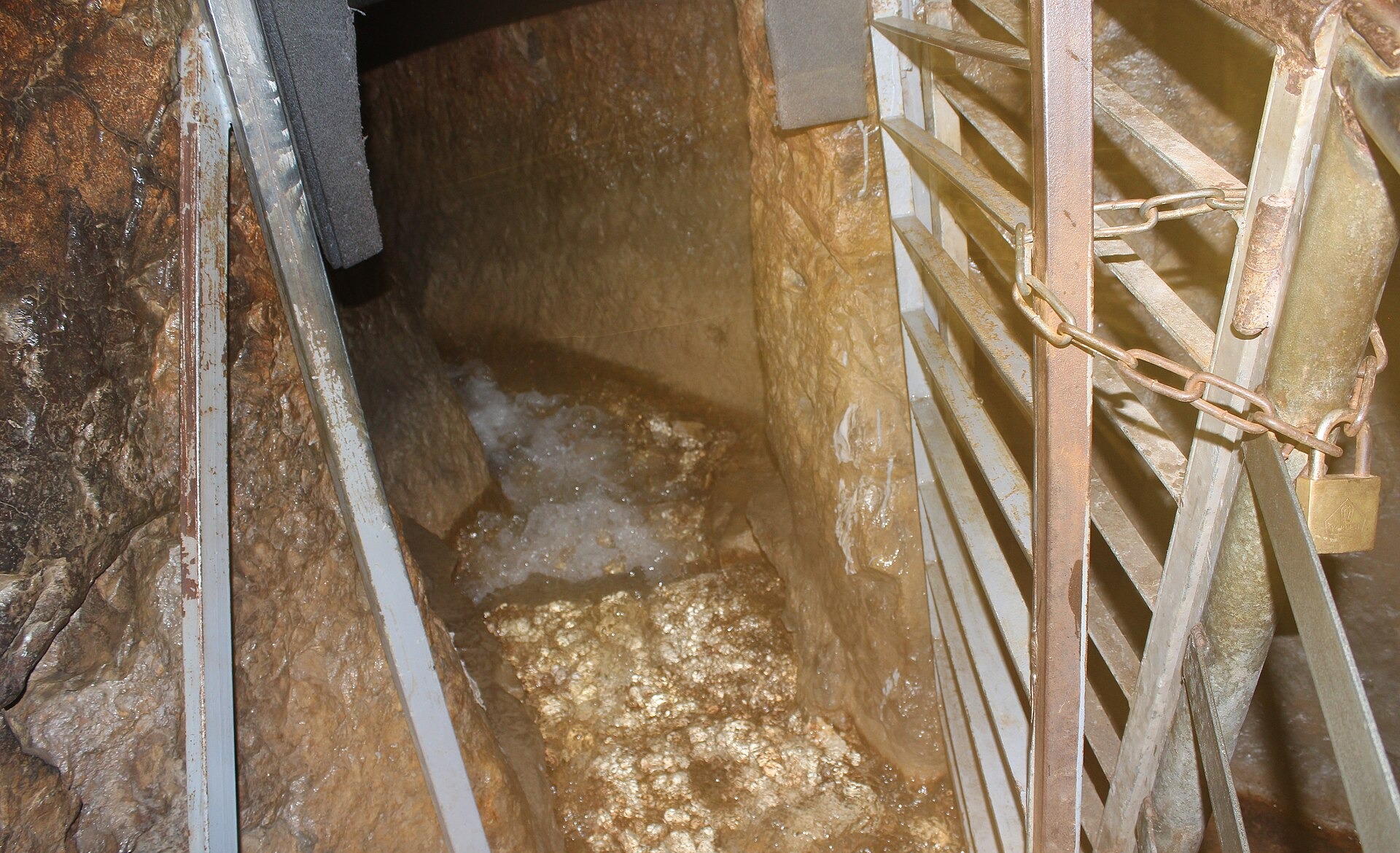
The Gihon Spring, just east of the City of David ridge, has been used since the Bronze Age and remains the symbolic origin of the city. The biblical narrative even sets Solomon’s anointing as king at the spring (1 Kings 1). It still flows today, and you can see it as part of the City of David park.
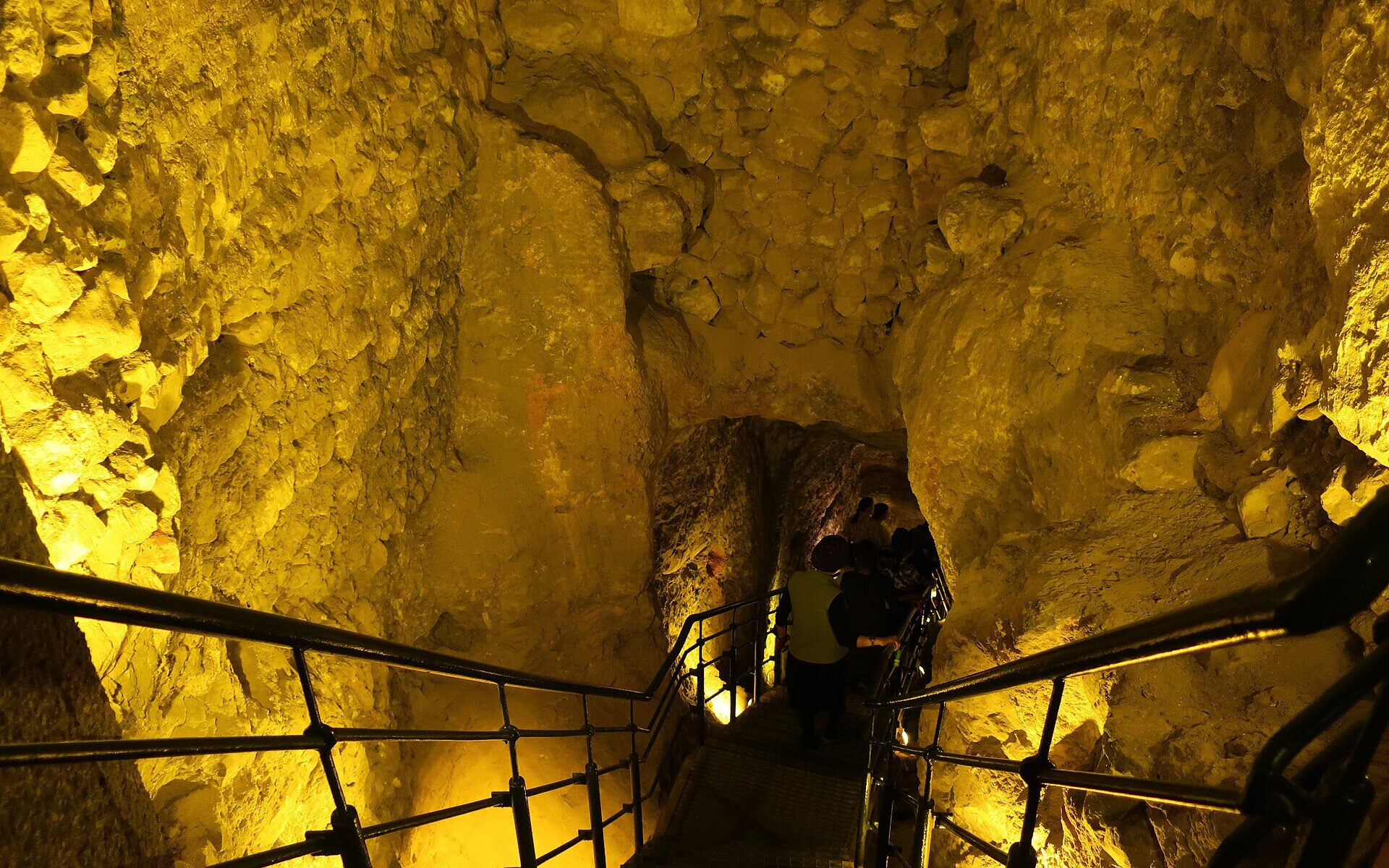
To reach the spring securely, the city’s early inhabitants engineered access from within the walls. Warren’s Shaft, named after the British engineer Charles Warren who explored it in 1867, is part of a Canaanite-era system that let residents draw water without exposing themselves outside. It is sometimes connected, speculatively, with the biblical account of David’s men entering the Jebusite city through a water conduit (2 Samuel 5). You can walk this older system inside the City of David, a useful contrast to Hezekiah’s later, more ambitious work.
Hezekiah’s Tunnel and the Pool of Siloam
The masterpiece is Hezekiah’s Tunnel, cut around 701 BCE to carry the Gihon’s water 533 meters through bedrock to a pool safely inside the walls, ahead of the Assyrian siege (2 Kings 20; 2 Chronicles 32). Two teams dug from opposite ends and met in the middle, and the Siloam Inscription, found in 1880, records that breakthrough in ancient Hebrew. Today you can wade the full length by flashlight in cool, shin- to thigh-deep water, or take the dry, lit Canaanite tunnel alongside if you prefer to stay dry. Our Hezekiah’s Tunnel guide covers the walk in detail.
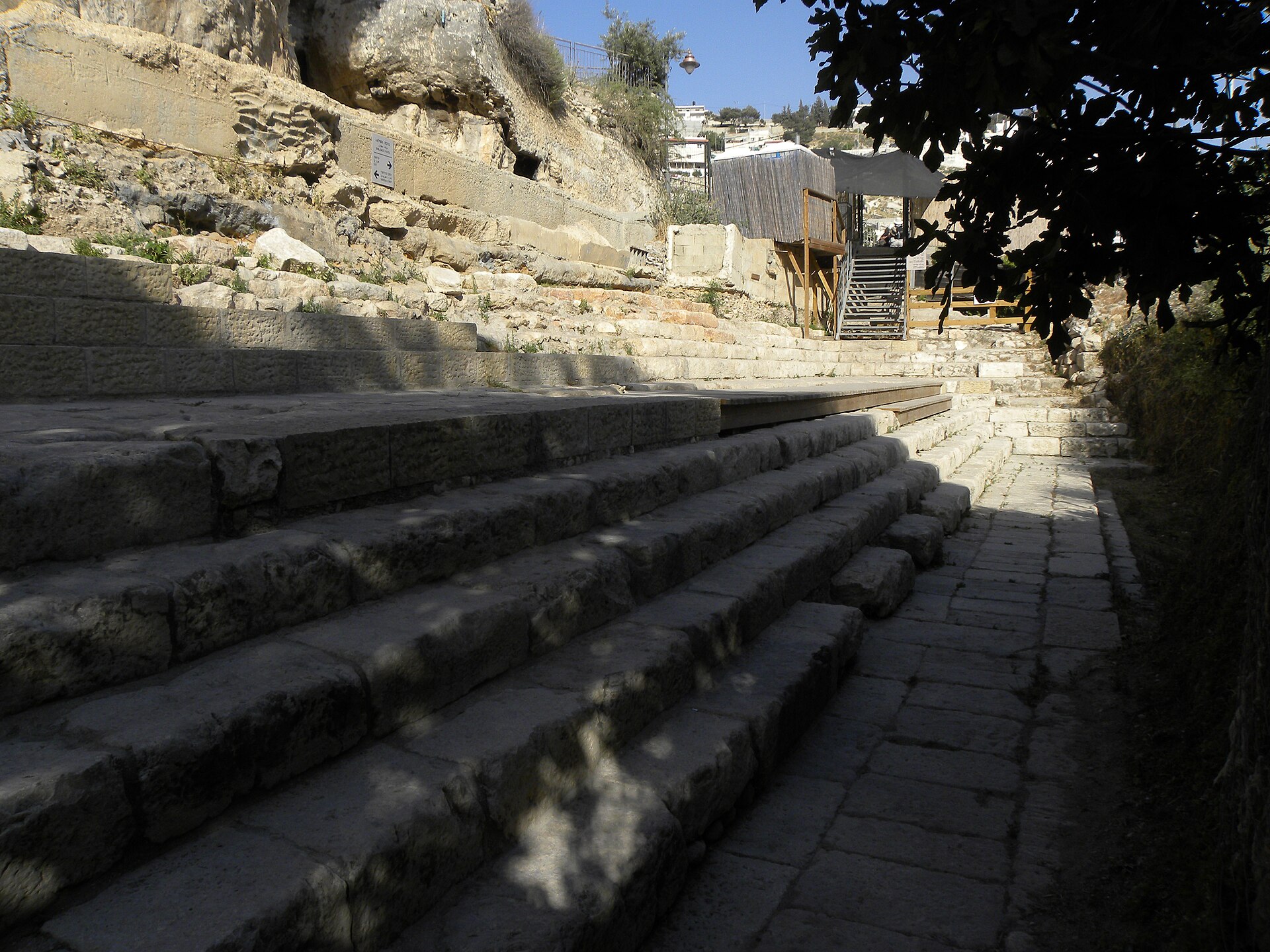
The tunnel ends at the Pool of Siloam, the reservoir that received its water and, in the Second Temple period, served as a stepped immersion pool for pilgrims. The Gospel of John (chapter 9) identifies it as where Jesus healed a man born blind. Excavation in recent years has uncovered more of the original stepped pool, so the visible extent has grown.
The Pools of Bethesda
North of the Temple Mount, inside the Lions’ Gate beside the Crusader Church of St. Anne, the excavated Pools of Bethesda were a substantial twin reservoir by the first century CE. The Gospel of John (chapter 5) places a healing here. You can walk among the deep, layered ruins of the pools and the later Byzantine church built above them, and the adjacent St. Anne’s is worth entering for its remarkable acoustics. The site features in our biblical sites guide.
Reservoirs and pools across the city
Beyond the famous sites, Jerusalem is dotted with historic reservoirs that once stored rainwater and aqueduct flow, many now hidden beneath later building.
- Sultan’s Pool (Birkat al-Sultan): a large reservoir in the valley below Yemin Moshe, restored under Suleiman and now an open-air concert venue.
- Mamilla Pool: an ancient open reservoir west of the Old City that fed water toward Jaffa Gate.
- Pool of the Patriarch (Hezekiah’s Pool): a walled reservoir tucked within the Christian Quarter, largely surrounded by buildings today.
- Pool of Israel: a once-vast reservoir just north of the Temple Mount, now mostly filled in.
These are of varying accessibility, with some visible from the street or nearby rooftops and others effectively buried, but together they show how seriously the city took water storage in every era.
Roman aqueducts and Solomon’s Pools
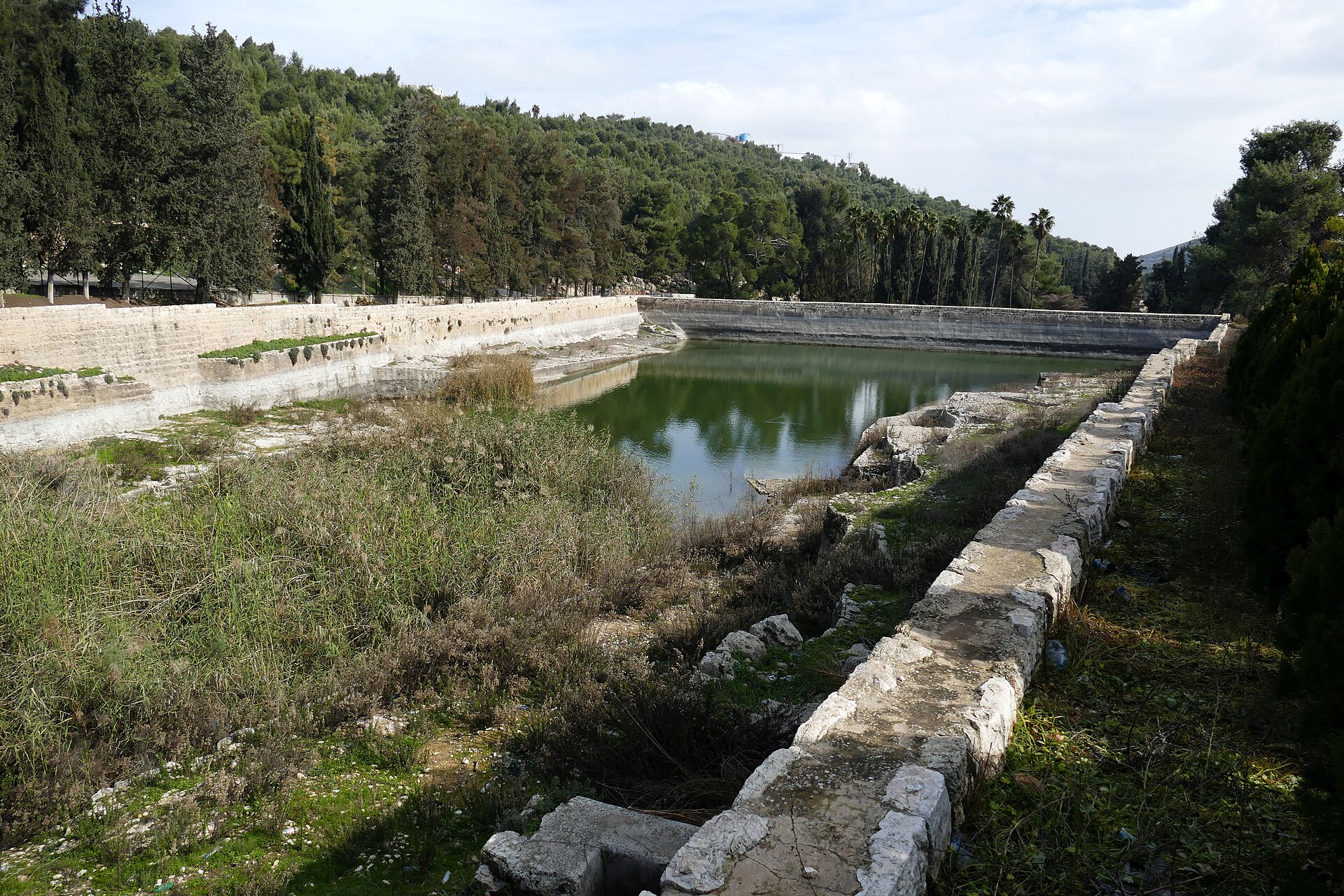
By the Roman period, local springs and reservoirs were not enough, so engineers brought water in from the south. Two aqueducts, an upper and a lower line, ran for many kilometers from the area of Solomon’s Pools, three great reservoirs near Bethlehem, to Jerusalem and the Temple Mount, following the contours of the hills. Sections of the aqueduct have been excavated and can be seen in and around the city, for example in the Armon HaNetziv area, and the route is a reminder that supplying a growing pilgrimage city was a regional undertaking. Solomon’s Pools themselves lie in the West Bank near Bethlehem; visiting that area is a separate day trip with its own logistics, covered in our day trips guide.
Ottoman cisterns and public fountains
The Ottoman centuries added their own layer. Suleiman the Magnificent repaired older channels and the city relied heavily on cisterns, underground tanks that captured rainwater for use through the dry season. The Temple Mount platform alone sits above a remarkable network of large rock-cut cisterns holding vast quantities of water. Above ground, wealthy patrons endowed sabils, ornate public drinking fountains, as acts of charity; several survive along the approaches to the Temple Mount, with their carved marble and inscriptions. To see them in their wider architectural context, our Ottoman Jerusalem guide maps the era’s building program.
A full-day water tour
You can string the most accessible systems into a satisfying archaeological day. Wear shoes you can soak if you plan to wade the tunnel, and dress modestly for the churches.
- Morning: the City of David, taking in the Gihon Spring, Warren’s Shaft, and Hezekiah’s Tunnel down to the Pool of Siloam.
- Midday: climb back via the Pilgrimage Road and break for lunch in the Jewish Quarter.
- Afternoon: the Pools of Bethesda and St. Anne’s near the Lions’ Gate.
- Late afternoon: a stroll past Ottoman sabils in the Muslim Quarter and a look down at the Sultan’s Pool below Yemin Moshe.
- Optional second day: the aqueduct remains, or a Bethlehem-area trip to Solomon’s Pools.
For getting between sites, our transportation guide covers the Light Rail Red Line and buses, and the broader sweep of the city’s past is in our Jerusalem history guide. Remember that the City of David and other Jewish-run sites close Friday afternoon through Saturday for Shabbat, so build the water day around Sunday to Thursday.
From ancient springs to modern taps
Modern Jerusalem long ago outgrew its springs and cisterns. Today the city draws on national infrastructure, historically water carried from the Sea of Galilee and, increasingly, desalinated water from the coast, piped up into the hills. Yet the old systems have not entirely fallen silent: the Gihon still flows, the cisterns still hold rain, and walking these tunnels and reservoirs makes vivid just how much human effort it once took simply to keep a hilltop city alive. That long arc, from a shepherd’s spring to a national grid, is part of what makes the water story so compelling.
The engineering up close
Part of what makes these systems so absorbing is that the engineering is legible once you know what you are looking at. In Hezekiah’s Tunnel, the floor maintains a barely perceptible slope across more than half a kilometer, just enough to keep the water flowing downhill toward the pool, and near the midpoint the walls change direction in the telltale S-curves where the two digging teams hunted for each other through solid rock. In Warren’s Shaft you can see how an earlier generation solved the same access problem with a vertical shaft and stepped tunnel. At the Pools of Bethesda, the sheer depth of the cuttings shows the scale on which the city stored water by the Roman era.
Reading the systems side by side also reveals a clear progression. The Canaanite approach reached out cautiously to the spring; Hezekiah’s engineers boldly rerouted the water itself inside the walls; the Romans imported it across the landscape; and the Ottomans banked rainwater in cisterns and shared it through charitable fountains. Each solution reflects the technology and the politics of its time, and seeing them within a single day turns abstract history into something you can trace with your own feet.
Tips for visiting the water sites
- Footwear matters: bring water sandals or old trainers with a heel strap if you intend to wade Hezekiah’s Tunnel, plus a small towel and dry socks.
- Bring a light: the wet tunnel has no lighting, so a flashlight or headlamp is essential; the dry Canaanite tunnel is lit.
- Mind the calendar: the City of David and other Jewish-run sites close from Friday afternoon through Saturday, and Christian sites such as St. Anne’s often close on Sunday and over the midday break.
- Dress modestly for the churches and the surrounding neighborhoods, and carry water and sun protection for the exposed stretches.
- Book ahead in peak season for the tunnel, as timed slots fill up in spring and autumn and around holidays.
On accessibility, be realistic: most of these systems are underground, reached by stairs and uneven passages, and the tunnels in particular are not wheelchair accessible. Some viewpoints and above-ground reservoirs can be seen with less effort, and staff at the City of David can point out the more manageable routes. Our accessibility guide covers gentler alternatives, and families weighing the wet tunnel with children will find the dry route the easier option.
Photo Credits
The rock-cut descent into the Warren’s Shaft system in the City of David: Entrance to Warren’s Shaft by Davidbena, CC BY-SA 4.0, via Wikimedia Commons.
Water welling up at the Gihon Spring: Gihon Spring IMG 5895 by Deror_avi, CC BY-SA 3.0, cropped, via Wikimedia Commons.
Steps of the excavated Second Temple-period Pool of Siloam: Pool of Siloam (3734427511) by Ian Scott, CC BY-SA 2.0, via Wikimedia Commons.
One of Solomon’s Pools, the reservoirs south of Bethlehem that fed Jerusalem’s aqueducts: Solomons-Pools-892 by Bukvoed, CC BY 4.0, via Wikimedia Commons.