Armenian ceramics in Jerusalem are a living craft just over a century old, brought from the Anatolian pottery town of Kütahya in 1919 and now woven into the visual fabric of the city, from hand-painted street signs to the tiles that line famous buildings. The distinctive cobalt-blue, turquoise, and green floral and geometric patterns appear on plates, tiles, bowls, mezuzah cases, and ornaments made in a handful of family studios. This guide covers the real history, where to find the workshops, what pieces cost in 2026 shekels (ILS), how to tell genuine hand-painted work from printed imitations, and how to get a fragile plate home in one piece.
Buying Armenian ceramics in Jerusalem rewards a little background, because the cheap “mimics” sold from souk tables look nothing like the real thing once you know what to check. Read this with our Armenian Quarter guide and the wider Jerusalem souvenirs guide.

A Century-Old Tradition
The craft arrived through a specific commission. In 1919, the British Mandate authorities wanted to restore the deteriorating exterior tiles of the Dome of the Rock, and the ceramicist David Ohannessian, a refugee from Kütahya who had run a pottery there, was brought to Jerusalem to lead the work. He recruited fellow artisans from Kütahya, among them the potter Neshan Balian and the master painter Mgrditch Karakashian. The grand tile restoration ultimately did not proceed as planned, but the artisans stayed, and a new Jerusalem craft was born.
In 1922, Balian and Karakashian left to found their own studio, traditionally known as Palestine Pottery, working under a division of labor in which the Balian side handled the potting and glazes and the Karakashian side did the drawing and painting. Over the following decades the families weathered the British, Jordanian, and Israeli periods, and newer studios such as the Sandrouni workshops opened in the early 1980s. Today the tradition is carried on by descendants and later artisans, some now in the fourth generation, and the style has become one of Jerusalem’s most recognizable art forms.
The Signature Style
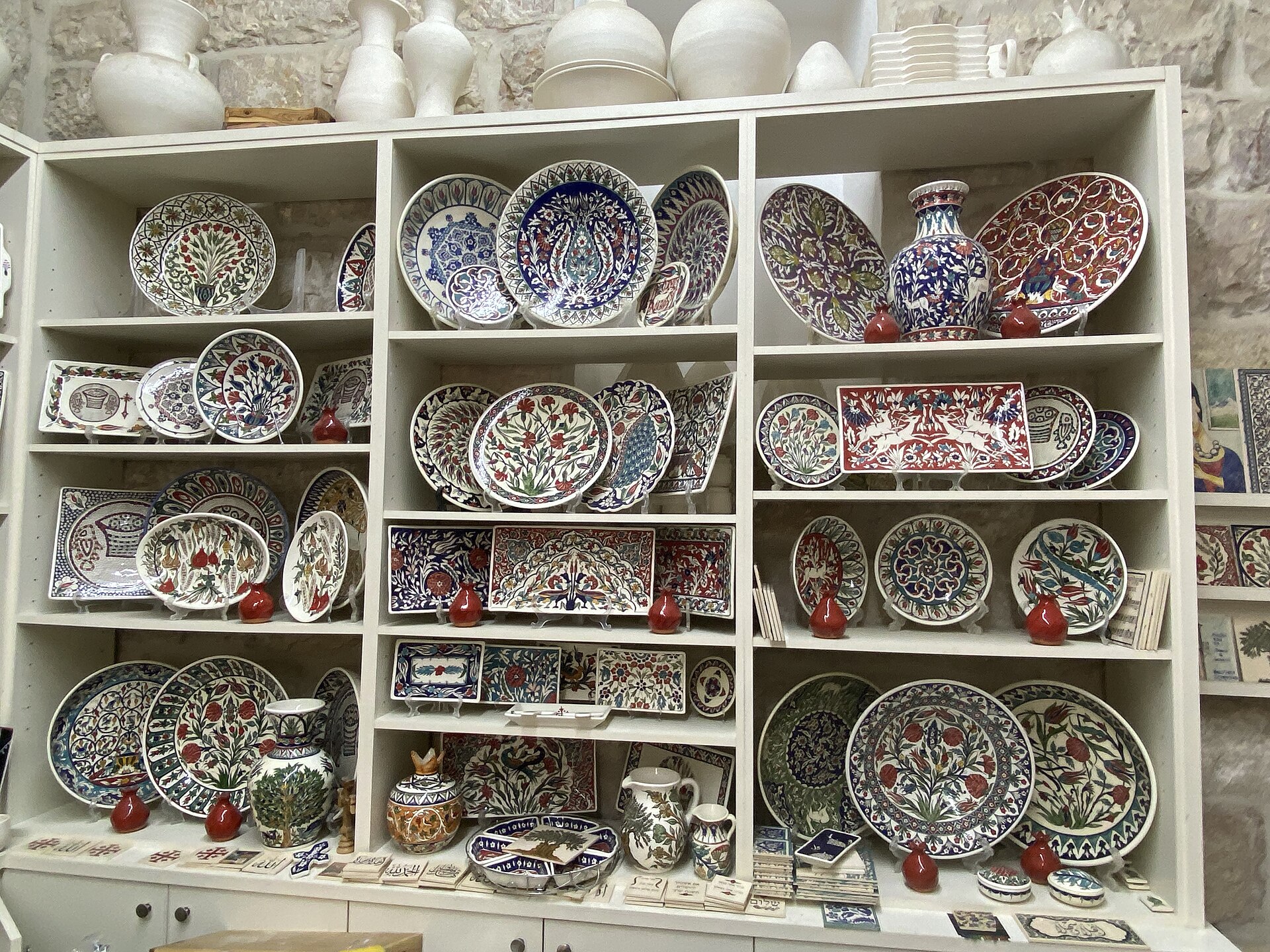
What ties the studios together is a shared visual language rooted in the Iznik and Kütahya tradition. Cobalt blue is the signature color, joined by turquoise, manganese green, and accents of yellow and red. Patterns range from dense floral motifs and the tree-of-life to geometric arabesques, peacocks and gazelles, biblical scenes, and stylized Jerusalem skylines. The pieces are hand-painted in mineral pigments on a white earthenware body, then glazed and fired, so finished work shows the subtle variation, visible brush direction, and small irregularities that machine printing cannot reproduce.
The Main Workshops
A few established family studios produce the bulk of authentic work, and most welcome visitors. Because the craft is small and family-run, hours can vary, so it is worth confirming ahead, especially for a guided visit. Note that several studios close for the relevant religious calendar, and Friday afternoons and Sundays can affect Old City hours.
Balian (Armenian Ceramics of Jerusalem)
Descended from founding artisan Neshan Balian, this studio sits on Nablus Road north of the Old City, not far from Damascus Gate, with a showroom and working studio. It is known for large platters, tile panels, custom commissions, and ornaments, and it sometimes runs pottery-painting sessions. Confirm the exact address and opening hours before you go, as the family has long operated from Nablus Road.
Karakashian
The Karakashian line, descended from master painter Mgrditch Karakashian, continues the painting tradition that has long defined the studio’s work, including tiles, religious pieces, and custom orders. Examples of Jerusalem Armenian ceramics from these founding families have ended up in notable institutional and ecclesiastical collections over the decades, a reflection of the craft’s reputation.
Sandrouni
The Sandrouni brothers established their workshops in the early 1980s, with a studio near the entrance to the Armenian Convent inside the Armenian Quarter of the Old City. Their work blends the traditional palette with some contemporary designs, and they produce plates, tiles, trays, vases, bowls, and hanging ornaments. The Old City location makes it the most convenient studio to combine with a walk through the quarter.
What to Buy and What It Costs
There is something at almost every budget, from a small coaster to a museum-grade platter. Prices below are typical 2026 ranges and vary with size, the complexity of the painting, and the studio. Because this is genuine handwork, expect to pay more than for printed pottery, and far more than for the souk imitations.
| Item | Typical price (ILS) | Notes |
|---|---|---|
| Coasters, small tiles, magnets | 40–150 | Easy gifts; pack flat |
| Decorative tiles (10–20 cm) | 80–300 | Single tiles or sets |
| Plates and bowls | 100–500 | Wall display or functional |
| Mezuzah cases | 150–400 | Ceramic doorpost cases |
| Ornaments | 80–200 | Hung pieces, seasonal designs |
| Large platters / vases | 300–800+ | Statement pieces |
| Custom / signed master work | 500–3,000+ | Allow weeks for commissions |
Custom orders, including names, dates, or a specific design, are widely available but take time, often several weeks, so plan a commission early in a longer trip or arrange shipping. Collectors occasionally pay well into the thousands for signed pieces by established hands.
How to Recognize Authentic Pieces
Telling hand-painted Armenian ceramics from mass-produced copies is easier than it sounds once you look closely. Genuine work shows visible brush direction and slight texture in the glaze, and no two pieces are identical, so a set will have small, charming variations. Reputable studios sign or stamp their work, and the painting carries through cleanly rather than blurring at the edges the way transfer prints do. The surest method is to buy at the studio or a named shop, ideally where you can watch painting in progress.
The red flags are equally clear. Be skeptical of “Armenian ceramics” at suspiciously low prices from general souk stalls, where colors look perfectly uniform and identical pieces are stacked in quantity; these are usually printed imports. If the seller cannot tell you which studio made the piece, treat the claim of authenticity with caution.
Armenian Ceramics Around the City
Once you start noticing the style, you see it everywhere in Jerusalem. Many of the city’s blue-and-white ceramic street signs were made in the Armenian tradition, and hand-painted tile panels decorate doorways, churches, and institutions across the city. Pieces by the founding families have been collected by museums and ecclesiastical bodies over the years. Seeing these public examples is a good primer before you shop, because it trains your eye for the real palette and brushwork. If you are spending a day on Jerusalem’s markets, the craft pairs naturally with a visit to the Mahane Yehuda Market.

Visiting the Workshops
Most studios welcome visitors during business hours and there is generally no pressure to buy; browsing is part of the experience. You can often watch artisans painting, glazing, or loading the kiln, and photography is usually fine if you ask first. Booking ahead helps if you want a guided explanation or a pottery-painting session where these are offered. Building a little rapport pays off, since a friendly conversation often leads to a custom order or careful packing for a piece you love.
Logistically, the Sandrouni studio inside the Armenian Quarter pairs naturally with an Old City walk, while the Balian studio on Nablus Road is a short trip just north of the walls. Keep in mind the city’s rhythm: many shops close or shorten hours on Friday afternoon and Saturday for Shabbat, and Sunday timing around Christian services can affect the Old City.
Getting Ceramics Home Safely
Ceramics are fragile but very travelable with a little care. Studios will wrap purchases well, usually in bubble wrap and a sturdy box. Small flat pieces ride fine in carry-on; larger plates and bowls are safest packed in the middle of soft clothing in checked luggage, with the box kept intact. For big or valuable pieces, the studios can arrange international shipping, and insurance is worth it given the value. Ask for a written shipping quote, since freight on a heavy platter can approach the price of the piece. Ordinary personal souvenirs clear customs duty-free in most countries, but check your home country’s limits if you are buying several high-value items.
How the Pieces Are Made
Understanding the process explains why authentic pieces cost what they do. A blank earthenware form, whether a thrown bowl or a flat tile, is first bisque-fired to harden it. An artist then traces or draws the design and paints it freehand in mineral pigments, a slow stage where a complex platter can take many hours. The piece is coated in a transparent glaze and fired again at high temperature, which fuses the colors and gives the surface its glassy depth. Because each color and each firing carries risk, a flawed piece is simply discarded, and the painter’s individual hand shows in every finished item. This is the opposite of a printed transfer applied in seconds, and it is the reason two “identical” plates from the same studio will never be exactly the same.
Buying Well: A Short Plan
If you want to shop with confidence rather than on impulse, a simple approach works. Start by looking at public examples around the city, the ceramic street signs and tile panels, so your eye learns the genuine palette. Then visit at least one studio without buying, ask which family or workshop made the pieces, and handle a few items to feel the weight and see the brushwork up close. Decide on a budget and a use, since a wall plate, a functional bowl, and a set of coasters are very different commitments. Buy your smaller pieces to carry, and if you fall for a large platter, arrange shipping and insurance on the spot rather than risking it in a suitcase.
A few extra tips smooth the experience. Bring a card and some cash, as studios generally take cards but a small purchase may be simpler in shekels. If you are comparing a souk stall’s “bargain” against a studio price, remember you are usually comparing a printed import against genuine handwork, not the same product at two prices, and that studio prices are largely fixed even where the wider souk invites bargaining. And if a particular piece moves you, ask the artist about the motif; many designs carry meaning, and the story becomes part of what you bring home. For the wider context of shopping the Old City lanes, see our Old City market and souk guide.
A Craft Worth Bringing Home
Few souvenirs carry as much of Jerusalem’s story as a hand-painted Armenian ceramic, a craft that arrived in 1919 and is still made by family studios today. Visit a workshop, buy the genuine article, and pack it carefully for the trip home. Continue with our Armenian Quarter guide, the broader Jerusalem souvenirs guide, our city-wide shopping overview, and the Old City market guide for everything else in the souk.
Photo Credits
Hand-painted Armenian ceramics in an Old City workshop near New Gate: 114793 jerusalem – the old city – PikiWiki Israel by שלמה רודד, CC BY 2.5, via Wikimedia Commons.