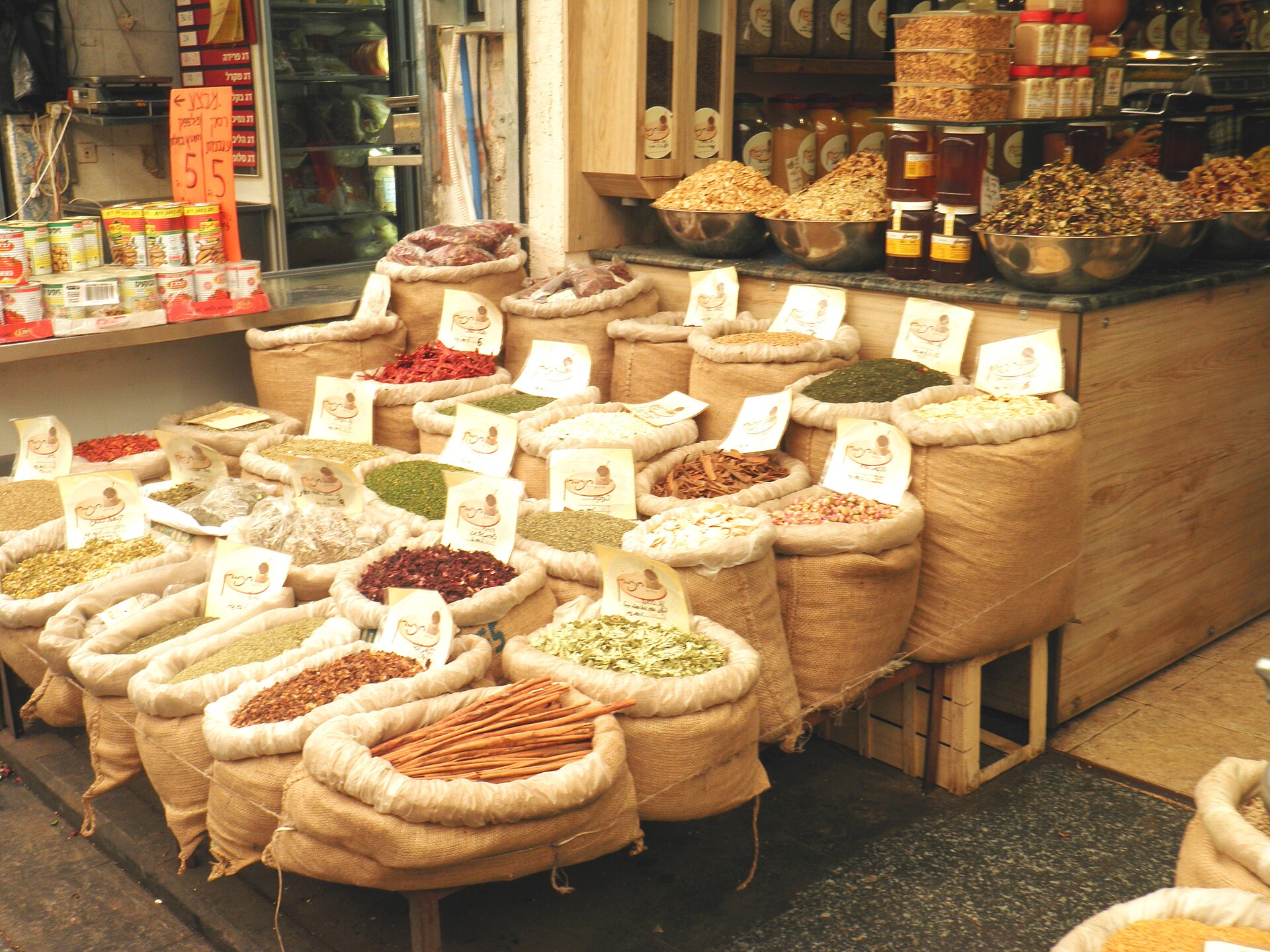
Shopping in Jerusalem is unlike shopping anywhere else in the world. Where else can you haggle for za’atar spices in a 1,000-year-old souk, browse hand-painted Armenian ceramics crafted using techniques passed down through generations, and sample artisanal olive oil pressed from trees that may have been growing since biblical times — all in the same afternoon? From the electric energy of Mahane Yehuda Market to the ancient lanes of the Old City bazaar, Jerusalem offers shopping experiences that are as much about culture and storytelling as they are about the purchases themselves.
This comprehensive guide covers every major shopping destination in Jerusalem, from traditional markets to modern shopping centers. You will find practical tips on haggling, the best souvenirs to buy, where to find authentic local crafts versus tourist trinkets, and how to navigate the unique rhythms of Jerusalem commerce — including the Shabbat closures that catch many visitors off guard. For a broader overview of the city, start with our complete guide to things to do in Jerusalem.
Mahane Yehuda Market (The Shuk)
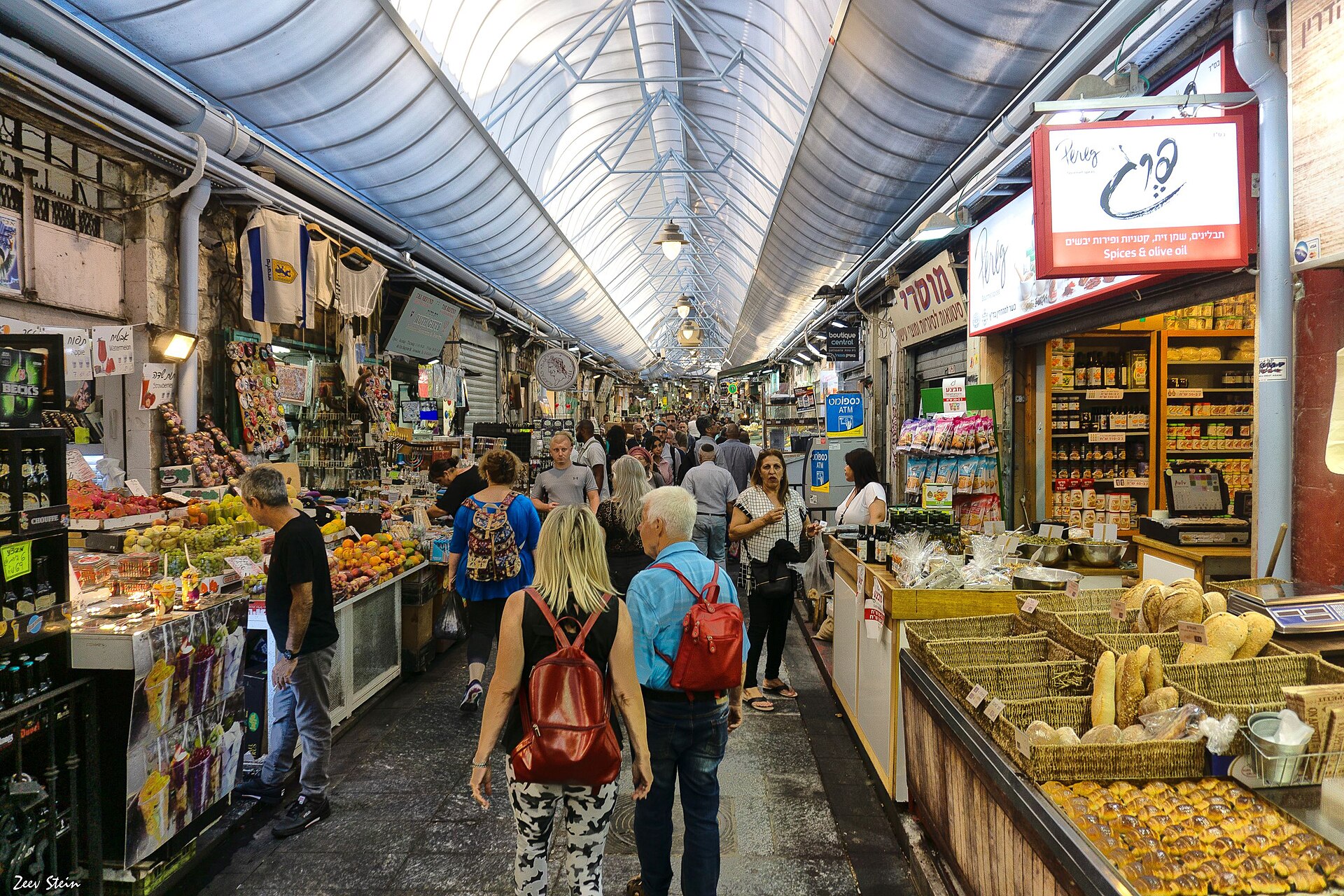
Mahane Yehuda Market is the soul of modern Jerusalem. Established in the late Ottoman period, this covered market stretches across several blocks between Jaffa Road and Agrippas Street, housing over 250 vendors selling everything from fresh produce and spices to artisanal cheeses, baked goods, and household items. Locals call it simply “the shuk” (the market), and no visit to Jerusalem is complete without experiencing its intoxicating energy. Our complete Mahane Yehuda Market guide covers opening hours, the stalls worth queuing for, and how to time a visit around Shabbat.
What to Buy at Mahane Yehuda
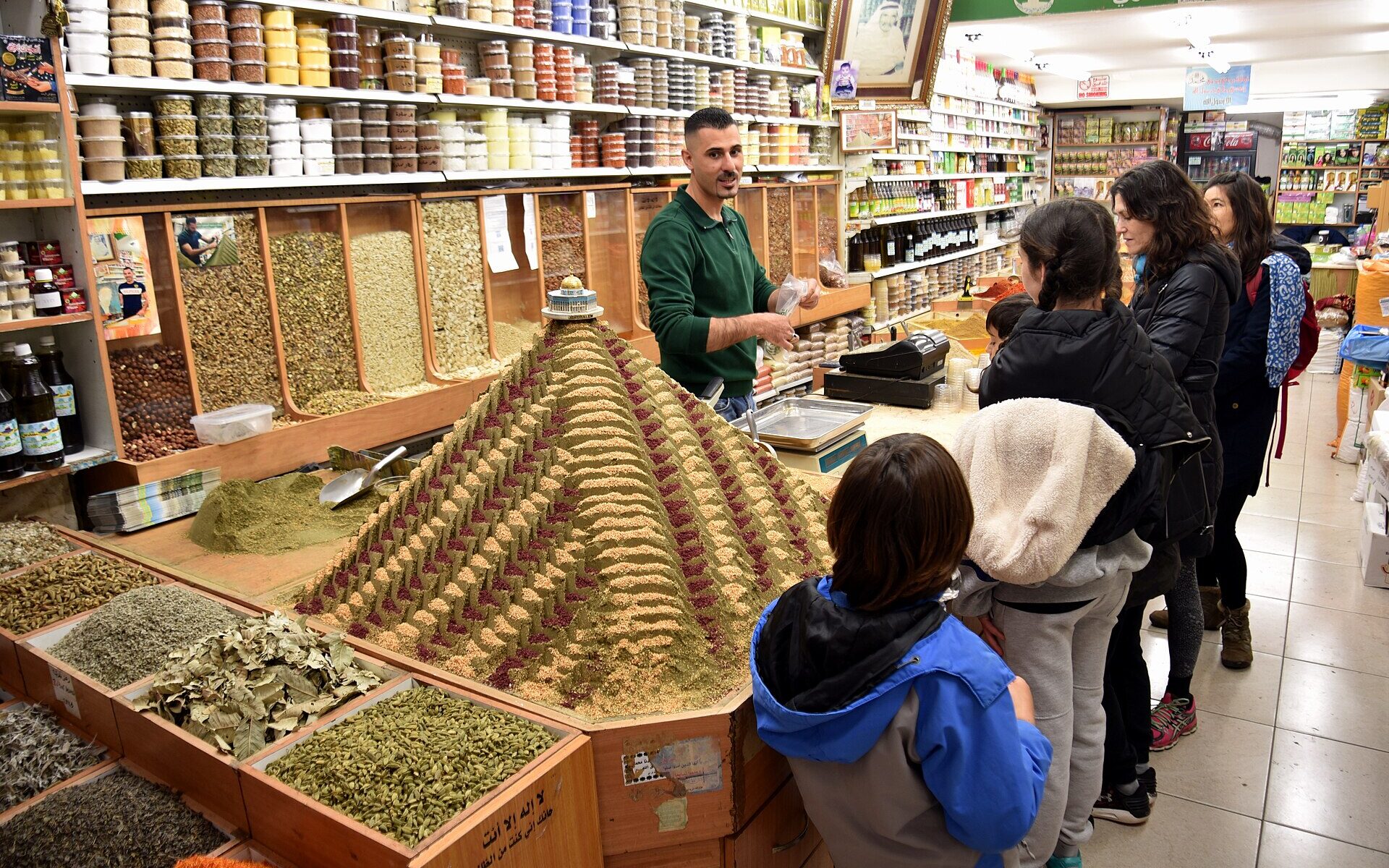
Spices and za’atar: Multiple spice vendors sell pre-mixed za’atar (the quintessential Middle Eastern herb blend of thyme, sesame, and sumac), baharat, ras el hanout, and individual spices at a fraction of what you’d pay abroad. The quality is exceptional. Pereg, Basher Fromagerie, and several family-run stalls in the market’s interior offer the best selection. Our guide to Jerusalem’s spice market explains what belongs in a good za’atar, sumac or baharat blend and how to check that stock is fresh.
Halva and tahini: Halva Man (HaHalva) has been making halva in the market since 1947. Their dozens of flavors — from classic sesame to pistachio, chocolate, and espresso — make perfect gifts. They offer generous samples, so taste before you buy. High-quality tahini (sesame paste) from brands like Al Arz or Har Bracha is another excellent purchase.
Dried fruits, nuts, and sweets: Vendors display mountains of dates (Medjool dates from the Jordan Valley are legendary), dried figs, apricots, and an array of roasted nuts. Turkish delight (lokum), baklava, and other Middle Eastern sweets are available in gift boxes perfect for bringing home.
Olive oil: Israeli and Palestinian olive oils are among the best in the Mediterranean. Look for cold-pressed, extra-virgin varieties from local producers. Several vendors offer tastings so you can compare single-estate oils. Prices are significantly lower than exported versions.
Wine and spirits: Israeli wine has undergone a remarkable renaissance, and several Mahane Yehuda shops specialize in boutique Israeli wines. Arak, the anise-flavored spirit beloved across the Middle East, is another excellent purchase — Thibarine, a date liqueur from the Judean Hills, makes a unique gift.
Mahane Yehuda After Dark
As the sun sets and produce vendors close their shutters, Mahane Yehuda undergoes a remarkable transformation. The market’s narrow lanes become one of Jerusalem’s hottest nightlife destinations, with bars, restaurants, and live music venues occupying the same spaces that sold vegetables hours earlier. Casino de Paris, Shuka, and Beer Bazaar are among the most popular evening spots. The market’s street art — murals on the metal shutters of closed shops — becomes visible only after dark, creating a completely different atmosphere. For more evening options, see our Jerusalem culture and entertainment guide.
Practical Tips for Mahane Yehuda
Best times to visit: Tuesday through Thursday mornings offer the best combination of full stalls and manageable crowds. Friday mornings are the most intense experience — locals rush to complete Shabbat shopping, creating an electric atmosphere. Avoid Friday afternoons (most vendors close by 2pm for Shabbat) and Saturdays (market is closed). The night market operates Thursday evenings.
Haggling: Generally not expected at Mahane Yehuda for food items — prices are reasonable and mostly fixed. Haggling is more appropriate at non-food stalls and when buying in larger quantities.
Old City Souks and Markets
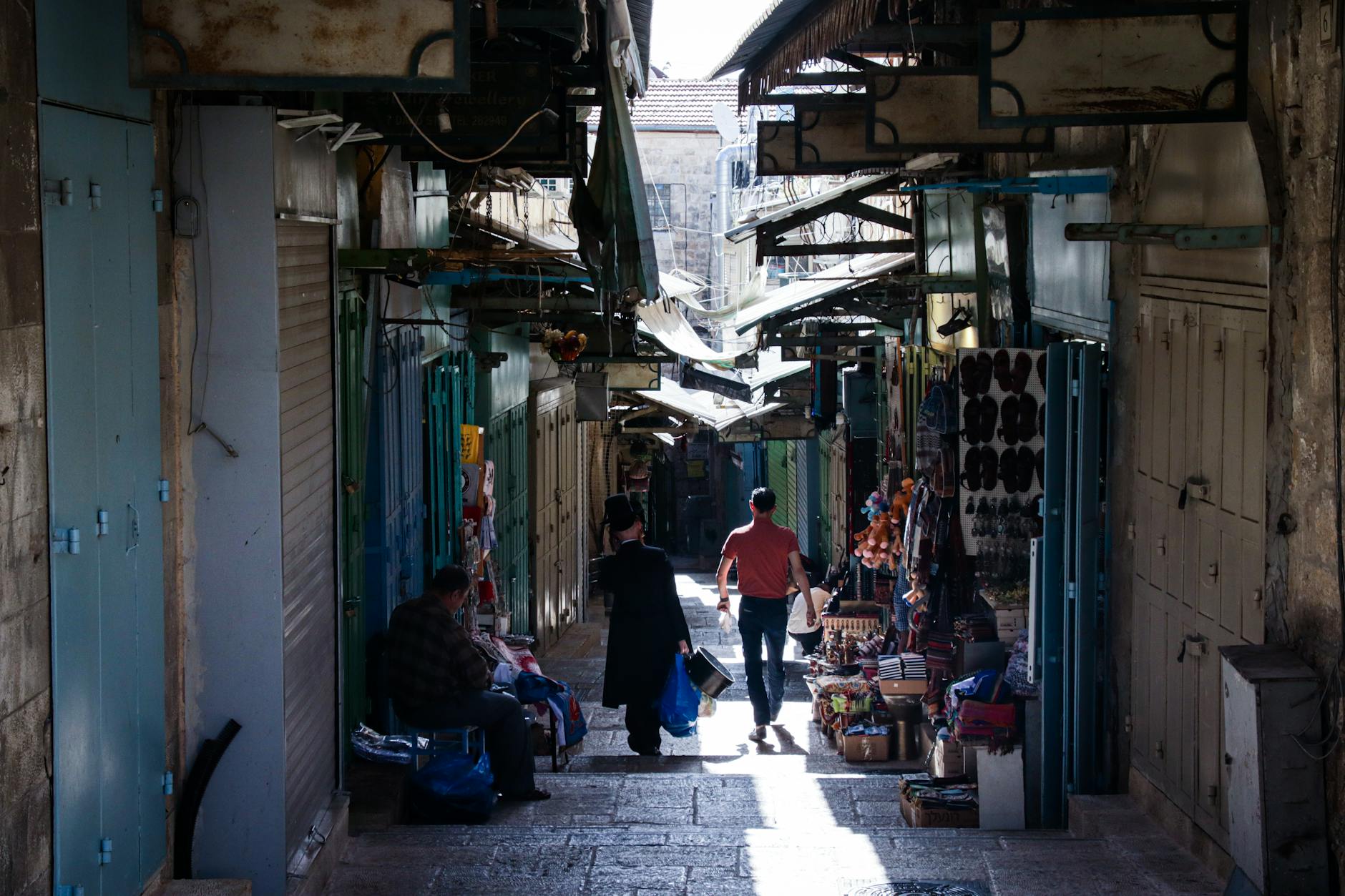
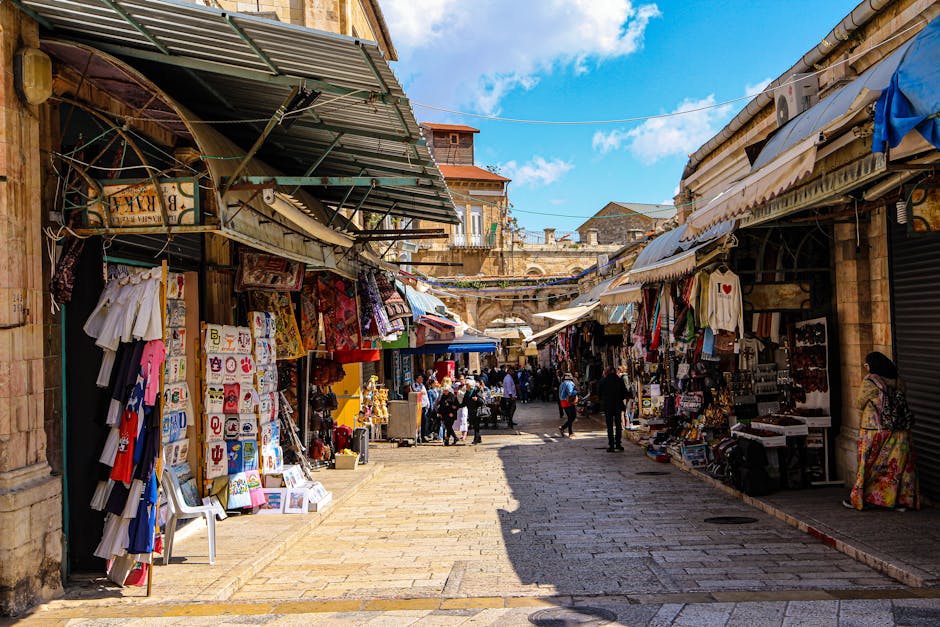
The Old City souks are among the oldest continuously operating markets in the world. Entering through the Damascus Gate or Jaffa Gate, you step into a labyrinth of narrow covered lanes where commerce has flourished for over a thousand years. The main market streets — David Street, the Chain Gate Road, and the Muslim Quarter bazaar — divide into specialized sections just as they did in medieval times.
Muslim Quarter Bazaar
The Muslim Quarter contains the largest and most vibrant section of the Old City market. The main bazaar stretches from Damascus Gate south toward the Western Wall, with narrow side alleys branching in every direction. Here you will find everything from handmade leather goods and embroidered textiles to copper coffee sets, hookahs (nargilas), and mountains of aromatic spices. The atmosphere is intense — vendors call out to passersby, the scent of cardamom coffee mingles with incense, and the stone vaulted ceilings echo with centuries of commerce.
Haggling is expected and essential here. Never accept the first price offered. A good starting point is to offer about 40-50% of the asking price and negotiate from there. Keep the interaction friendly, maintain eye contact, and be prepared to walk away — often the best deals come when you start leaving. If a vendor invites you for tea, accept — it’s a genuine hospitality tradition, not an obligation to buy. For the full negotiating script, from opening offer to the walk-away, see our guide to haggling in Jerusalem’s souks.
Christian Quarter Shops
The Christian Quarter shops along Christian Quarter Road and the streets surrounding the Church of the Holy Sepulchre specialize in religious items: olive wood nativity scenes, crosses, rosaries, icons, and religious artwork. Quality varies enormously — from mass-produced imports to exquisite handcrafted pieces. The best olive wood shops will show you how to distinguish hand-carved pieces (look for natural grain patterns and smooth finishes) from machine-made ones.
Jewish Quarter Galleries
The reconstructed Jewish Quarter features upscale galleries and Judaica shops selling menorahs, mezuzahs, kiddush cups, and Jewish ceremonial art. The Cardo, a restored section of the ancient Roman main street, houses several art galleries and jewelry shops. Prices here are higher than in the Muslim Quarter, but quality and authenticity are more consistent.
How to Bargain in Jerusalem — and When Not To
Bargaining here is not one custom that applies everywhere. It belongs in specific places, and using it in the wrong shop marks you out instantly. The working rule: where a price is printed on a label, you pay it; where there is no label and the number arrives verbally, that number is an opening position rather than a price.
Where Haggling Is Expected
The covered souks are the main arena — David Street, the Muslim Quarter bazaar, the lanes running north toward Damascus Gate. Anything without a price tag is negotiable: scarves and keffiyehs, leather bags, brass and copper coffee sets, nargilas, rugs, embroidered textiles, unbranded ceramics, silver jewelry, and the tourist-facing end of the olive wood trade. The same applies on Salah al-Din Street in East Jerusalem and at the souvenir shops inside Jaffa Gate and Damascus Gate that live on passing trade. Expect a wide spread: two near-identical scarves three alleys apart can be quoted at 120 shekels and 40 shekels on the same morning. That is not dishonesty — the first number is a test of how much homework you have done.
Where Haggling Is Rude
You do not bargain for food anywhere in Israel. Not at Mahane Yehuda, not for a kilo of Medjool dates or a scoop of za’atar in the Old City, not at a bakery counter. Food is priced by weight or portion, margins are thin, and asking a produce vendor to take 30% off earns a flat refusal. The one soft exception is genuine bulk, or a stall clearing its last crates before Friday closing, when a vendor may round down unprompted. Our stall-by-stall guide to Mahane Yehuda explains how pricing works inside the shuk.
Fixed-price retail is the other no-go: Mamilla, the chains on Ben Yehuda Street, Malha, supermarkets, pharmacies and museum shops. The established Armenian ceramics studios also work at set prices, because a signed hand-painted piece is sold as studio work rather than bazaar stock — the family workshops behind the city’s ceramic tradition will discuss commissions and shipping, not discounts. Church and monastery shops, and workshops attached to charities, publish their prices and often fund social programs with the margin. Negotiating there is both futile and graceless.
How to Actually Do It
- Do not buy on the first pass. Price the same item in four shops, then come back — first-pass purchases are almost always your most expensive.
- Fix your own number before you speak, and treat it as a ceiling, or you end up negotiating against the seller’s anchor rather than your budget.
- Open at roughly half. Countering at about 50% is normal and not an insult; on inflated tourist goods the deal often lands near 40–60% of the opening quote.
- Slow down. Ask where the piece was made and by whom. If tea or cardamom coffee is offered, accept — it is hospitality, not a contract.
- Bundle and pay cash. Three items from one shop beat three items from three shops, and producing exactly 180 shekels and no more is stronger than any speech.
- Be willing to leave. Walking away is the most effective tactic in the market: if the price was reachable you will be called back before the corner.
- Know when to stop. Grinding a family shop over the last 10 shekels costs you goodwill and them a chunk of the day’s profit.
Two things are genuinely bad form: bargaining hard on something you have no intention of buying, and backing out after your own number is accepted — at that point you have bought the item. Our walkthrough of negotiating in the souks scripts the exchange from opening quote to handshake.
Armenian Ceramics
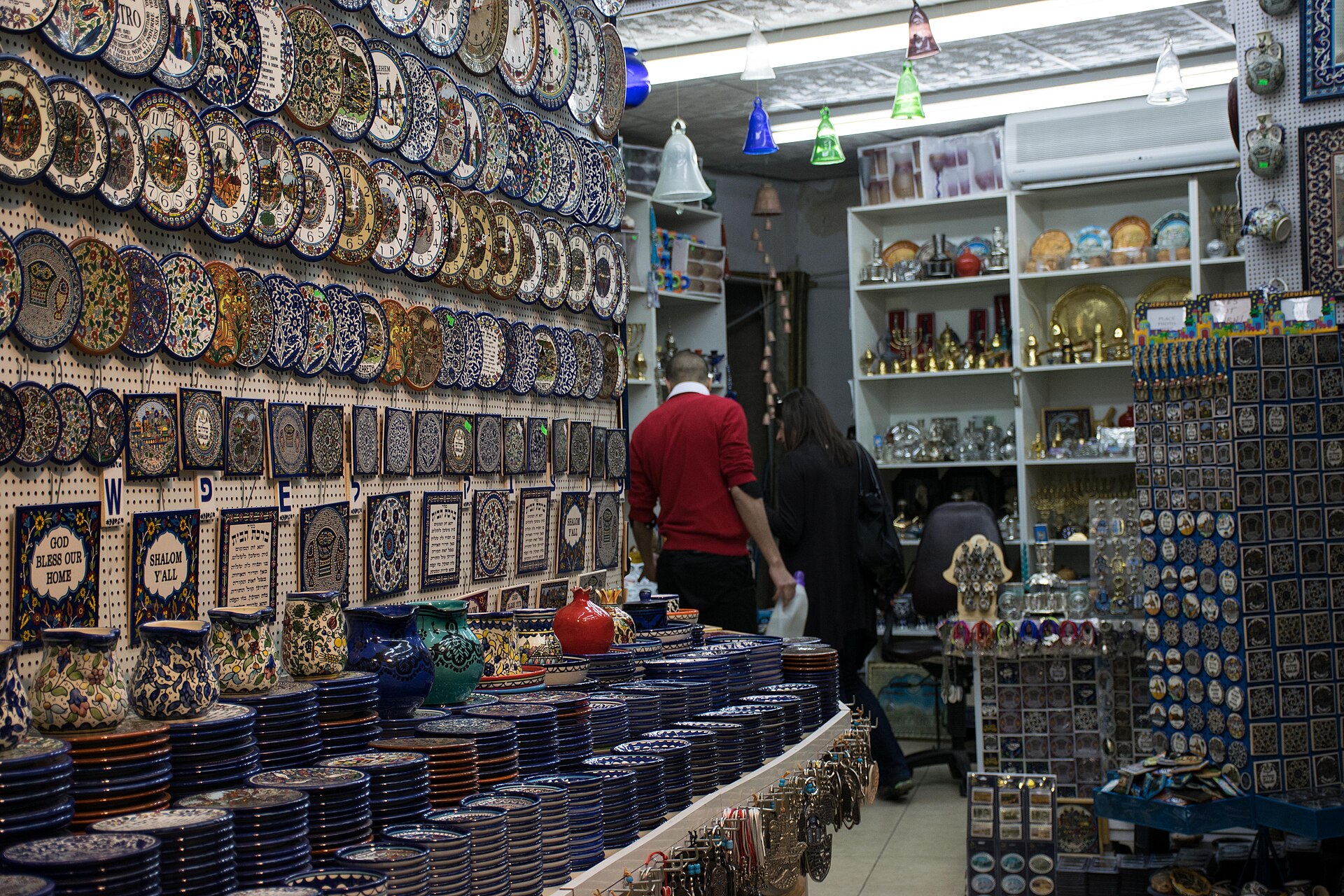
Armenian ceramics are Jerusalem’s signature craft, with a tradition dating back to the early 20th century when Armenian artisans first arrived in the city. The distinctive style features hand-painted floral and geometric designs in vibrant cobalt blue, turquoise, yellow, and green on white backgrounds. Peacock motifs, symbolizing eternal life, are especially characteristic.
The finest Armenian ceramics are produced by a handful of family workshops, many located in or near the Armenian Quarter. Sandrouni Armenian Art Centre, Balian Ceramics, and Hagop Antreassian are among the most respected names. Lepejian Armenian Ceramics has been operating since 1975, using traditional metallic oxide glazes that produce the deep, lustrous colors that distinguish authentic Armenian work from cheaper imitations. Our Armenian ceramics buying guide profiles the main family studios and traces the craft back to the potters who arrived in the city in 1919.
What to buy: Decorative tiles (single tiles make affordable, packable gifts), serving bowls, plates, house number plaques, and ornamental pieces. Prices range from 30 NIS for a small tile to several thousand for large, elaborate pieces. Authentication tip: Genuine Armenian ceramics will have the artist’s or workshop’s mark on the bottom. The glaze should be smooth and deeply colored, with designs that show the slight irregularities of hand-painting.
Olive Wood Crafts
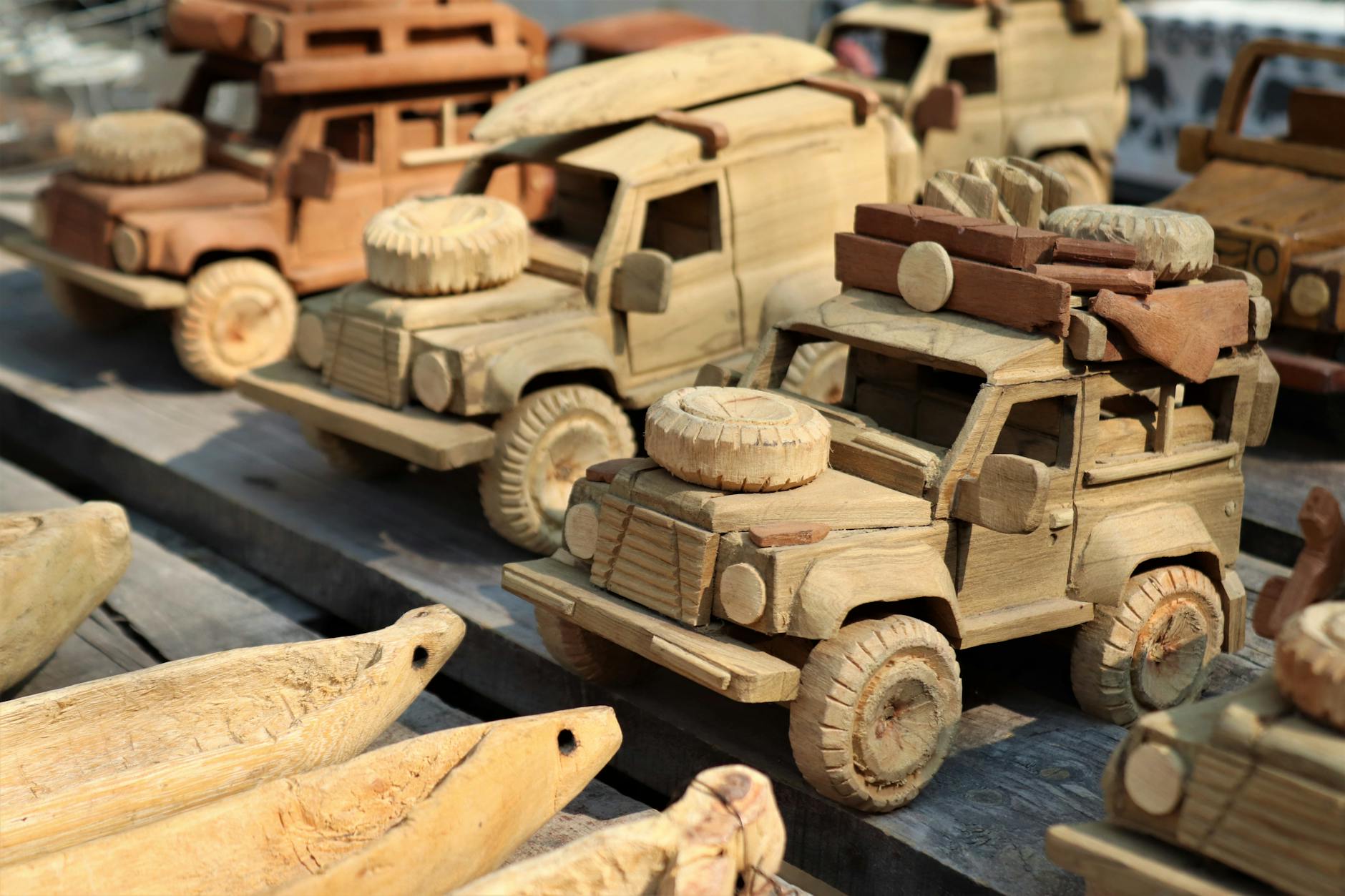
Olive wood carving is one of the Holy Land’s oldest continuous craft traditions, practiced in the Bethlehem area for over 300 years. The wood, prized for its beautiful grain patterns and natural durability, is carved into religious figures, nativity scenes, crosses, bowls, cutting boards, kitchen utensils, and decorative items.
Quality indicators: Premium olive wood has rich, varied grain patterns and a smooth, warm finish. Hand-carved pieces show subtle tool marks and natural imperfections that distinguish them from machine-made products. The best shops will explain the wood’s origin — genuine olive wood comes from pruned branches of productive trees, not from felled trees, making it a sustainable craft.
Where to buy: Old City shops in the Christian Quarter and near Jaffa Gate offer extensive selections. For factory-direct prices, consider a day trip to Bethlehem, where workshops in the old town offer both retail and wholesale purchasing. See our olive wood shopping guide for workshop recommendations and advice on caring for carved pieces once you get them home.
Dead Sea Products
Dead Sea mineral products — cosmetics, bath salts, mud masks, and skincare creams — are among the most popular purchases for tourists in Jerusalem. The Dead Sea’s unique mineral composition (magnesium, calcium, potassium, and bromine) forms the basis for a multi-million-dollar cosmetics industry. Major brands like AHAVA, Premier, and Seacret have shops throughout Jerusalem.
Buying tips: Avoid aggressive salespeople in tourist zones who offer “free samples” then pressure-sell expensive packages. Instead, visit the AHAVA flagship store on Ben Yehuda Street or purchase products at Mahane Yehuda Market or supermarkets for better prices. Airport duty-free shops also offer competitive prices on major brands. Our breakdown of Dead Sea brands and where to buy them compares AHAVA, Premier and Seacret and flags the pressure-selling tactics worth avoiding.
How to Spot Fakes and Avoid Being Ripped Off
Jerusalem has outstanding craftspeople and a parallel industry of imported goods sold as local ones. None of the checks below require expertise — only the willingness to slow down and ask a direct question before the money changes hands.
Saffron and Spices
Saffron is the most commonly adulterated thing sold in Middle Eastern markets. Buy whole threads, never powder — ground saffron is trivially bulked out with turmeric, paprika or dyed starch and cannot be inspected. Real threads are trumpet-shaped at one end, deep red and brittle.
The water test settles arguments. Drop a few threads into cool water: genuine saffron releases a golden-yellow color gradually over roughly 10 to 15 minutes while the threads stay red, whereas dyed safflower — the usual substitute, an unrelated thistle — dumps color within seconds, turning the water red or orange while the threads go pale. Price is the other tell, since a fat pouch of “saffron” for 20 shekels is not saffron. For blends, a good za’atar smells strongly of thyme and sumac and feels light in the hand; a heavy, salty, sandy mix has been padded with salt or grain. Buy from open sacks you can smell rather than sealed tourist tins, and ask for a taste — refusal is informative, as our guide to buying spices in the city explains.
Armenian Ceramics
Hand-painted and transfer-printed pieces look alike in a dim shop and nothing alike in daylight. On hand-painted work the brushstrokes vary in thickness, glaze pools where the brush lifted, and motifs repeat closely rather than exactly; machine decoration gives uniform lines, a faint dot pattern in the color fields and identical repeats. Check the base, too, since established studios sign or stamp their work. Prices in the Armenian Quarter studios run well above souk stalls because a large hand-painted platter represents days of work — if a shop three lanes away sells “the same” platter for a third of the price, it is not the same platter.
Olive Wood
Olive wood is dense, heavy for its size and marked with dark, irregular streaks no two pieces share. Lift the object: light for its bulk usually means a cheaper hardwood stained to imitate olive. Look at the end grain and the inside of bowls, where fakers rarely bother with the finish. Carving quality is separate — hand-carved figures show tool marks in the recesses and small asymmetries in faces and hands, while machine-turned pieces are perfectly regular. Serious buyers head for the workshops around Bethlehem, where prices are closer to source; see our olive wood buying advice and the practicalities of a day trip over to Bethlehem.
Dead Sea Cosmetics
The Dead Sea name is not exclusively controlled, so the label alone tells you nothing about where the minerals came from — turn the jar over and look for a named manufacturer, an address, a batch number and an expiry date. The bigger risk is the sales technique. The kiosk routine, in which a free sample and a hand-buffing demonstration are followed by a price falling from 900 shekels to 300 as you edge toward the exit, is designed to make a nonsensical opening number feel like a bargain. The same brands at a Super-Pharm branch, a supermarket or airport duty free are duller and almost always cheaper, as our comparison of the main Dead Sea skincare brands sets out.
Everything Labeled “Holy Land”
Much of the crosses, rosaries and “Jerusalem” magnets in the tourist lanes is imported, which is not a scandal — but you should pay cheap-souvenir prices for cheap souvenirs. The question that sorts this out in five seconds is “who made this, and where?” A shop selling genuine local craft answers with a name, a family or a town; a shop selling imports changes the subject. Our roundup of which souvenirs are genuinely made locally separates the two item by item.
Buying Antiquities: What Is Legal and What Is Not
Israel is unusual in permitting a legal retail trade in antiquities, which surprises visitors who assume any 2,000-year-old oil lamp on a shelf must be stolen. The trade is legal — but only through dealers licensed by the Israel Antiquities Authority, and the rules on taking an object out of the country are stricter than the rules on buying one.
Licensed dealers pay an annual fee, file an inventory of their stock with the Authority and must display the license in the shop. Asking to see it is normal, and any legitimate dealer will point at the wall. Exporting a genuine antiquity then requires a separate export permit from the Authority. The permit is free, it is usually requested by the dealer by email or obtained in person at the Authority’s office at the Rockefeller Museum on Sultan Suleiman Street, and it takes a few working days — so it is not something to start on the morning of your flight. Permits are issued only for objects bought from licensed dealers.
Two hard limits apply. It is illegal to export antiquities discovered after 1978, whatever their price or provenance, and certain categories never leave the country at all, including large architectural elements, stone and clay ossuaries, and anything the Authority judges to carry an important or unique inscription. The Biblical Archaeology Society explainer on the legal antiquities trade walks through how the system works in practice.
The practical takeaway: no displayed license and no export permit means the object is either a modern reproduction or cannot legally leave with you, and undeclared antiquities can be seized at the airport. Souk trays of “Roman glass” fragments and “widow’s mite” coins at 30 shekels are almost universally replicas — enjoyable as objects, worthless as antiquities. If it is the history you are after rather than the ownership, the city’s archaeology collections put the real material in front of you for the price of a ticket.
Modern Shopping in Jerusalem
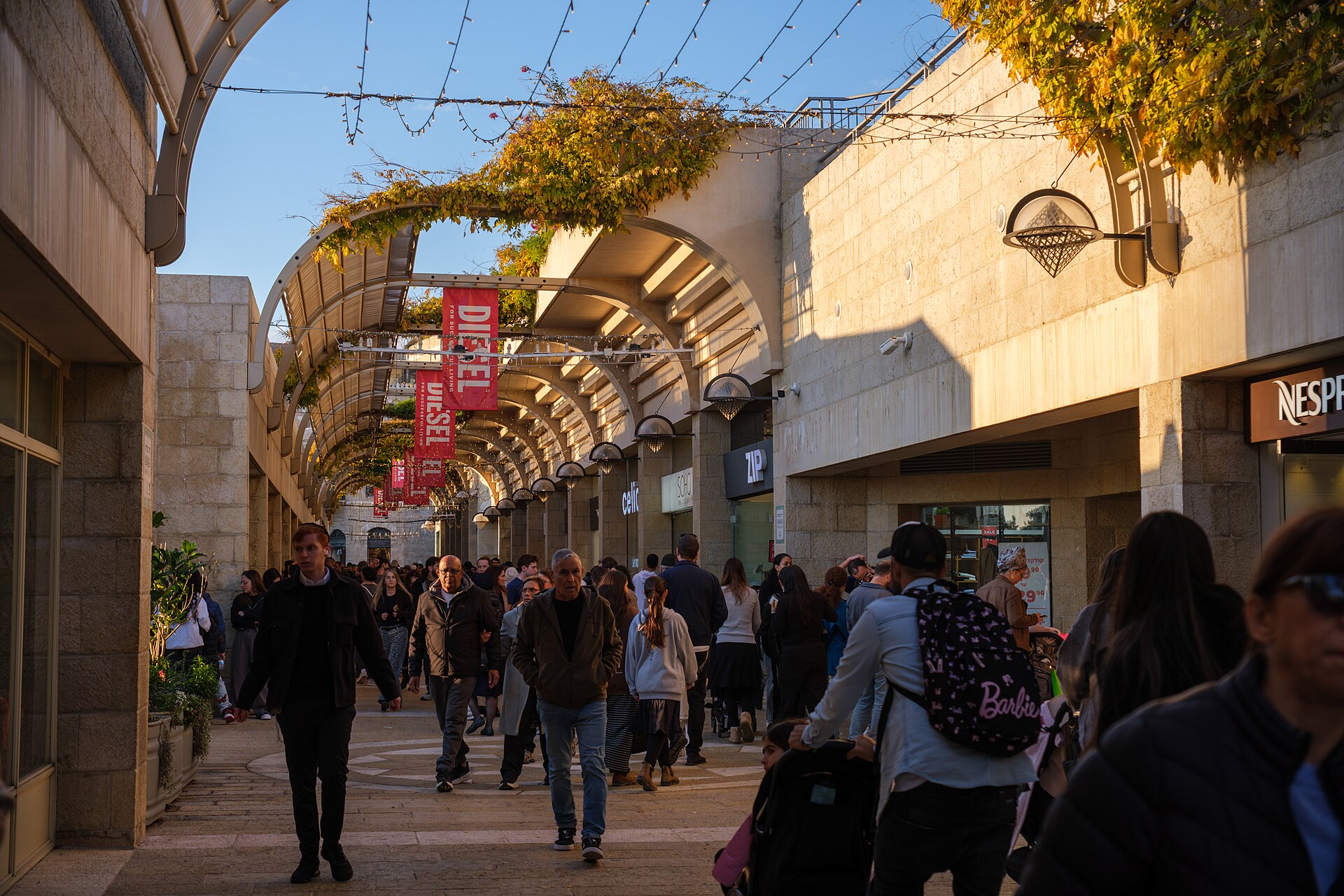
Mamilla Mall (Alrov Mamilla Avenue)
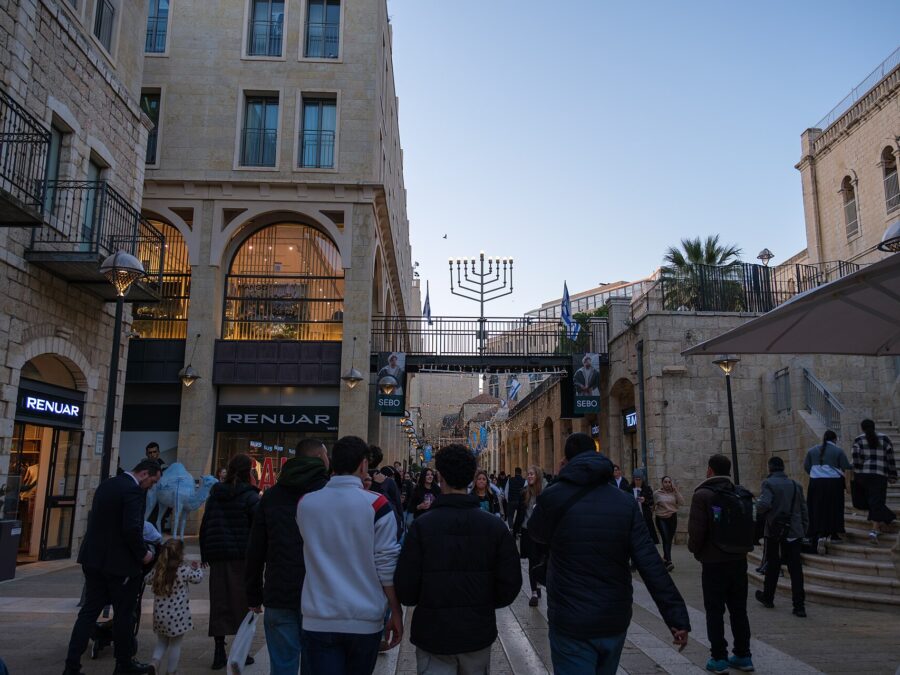
Mamilla is Jerusalem’s most upscale shopping promenade, an open-air pedestrian boulevard stretching from Jaffa Gate to the Mamilla neighborhood. International fashion brands, Israeli designer boutiques, jewelry shops, and upscale restaurants line the beautifully designed street. The mall also features the innovative integration of historic Ottoman-era building facades into its modern architecture. Open late most evenings except Friday. Our Mamilla Mall visitor guide runs through the main shops and restaurants, parking, and the walking route through to Jaffa Gate.
Ben Yehuda Street and Nahalat Shiva
The Ben Yehuda pedestrian mall and adjoining Nahalat Shiva neighborhood form Jerusalem’s main outdoor shopping and entertainment district. Street performers, souvenir shops, cafes, and restaurants create a lively atmosphere, especially on warm evenings. While much of the merchandise is tourist-oriented, the area is worth exploring for its energy and people-watching.
Malha Mall and Other Shopping Centers
For conventional shopping needs, the Malha Mall (Kanyon Malha) near the Biblical Zoo is Jerusalem’s largest indoor shopping center with over 200 stores. The Jerusalem Mall (Kanyon Yerushalayim) and Hadar Mall in Talpiot offer additional options. These malls cater primarily to locals and offer a different — more typically Israeli — shopping experience.
Where to Buy What: A Neighborhood-by-Neighborhood Map
Jerusalem’s shopping districts are genuinely specialized, and walking twenty minutes to the right one saves both money and disappointment. The shops in each area are ordinary family and chain businesses; what differs is the merchandise mix, the price level and whether prices are fixed.
- Mahane Yehuda: spices, za’atar, halva, tahini, dates, nuts, olive oil, cheese, boutique Israeli wine, arak, coffee. Fixed prices and the best value in the city on edible gifts — see our full market walkthrough.
- Muslim Quarter bazaar and David Street: textiles, keffiyehs, leather, copper and brass, nargilas, lanterns, inexpensive ceramics, general souvenirs. Bargaining expected; quality ranges from excellent to imported filler within one lane. Our walkthrough of the Old City markets maps the layout.
- Christian Quarter Road and around the Holy Sepulchre: olive wood carvings, nativity sets, crosses, rosaries, icons, mother-of-pearl work, candles. Many shops are fixed-price or church-affiliated.
- Armenian Quarter and the nearby studios: hand-painted ceramics — tiles, bowls, platters, house-number plaques, commissions. Fixed prices, shipping usually available.
- Jewish Quarter and the Cardo: Judaica, silver, menorahs, mezuzahs, kiddush cups, contemporary Israeli art and jewelry. Higher prices, more consistent provenance.
- Salah al-Din Street, East Jerusalem: everyday shopping — textiles, gold jewelry, sweets, spices, household goods — at local rather than tourist prices, and open on Saturdays.
- Mamilla: international and Israeli fashion, design, cosmetics, gifts, air conditioning and clean bathrooms, all at fixed prices; see our rundown of the Mamilla promenade.
- Ben Yehuda Street and Nahalat Shiva: souvenir shops, jewelry, Judaica, casual clothing, cafes. Prices sit between the souk and the mall.
- Malha and Talpiot: mainstream chains, electronics, sportswear, groceries, and pharmacy prices on Dead Sea brands. Where locals actually shop.
With only one shopping afternoon, the highest-yield combination is Mahane Yehuda for edible gifts and the Old City for craft — two very different price cultures within a fifteen-minute light rail ride of each other.
Best Souvenirs to Bring Home
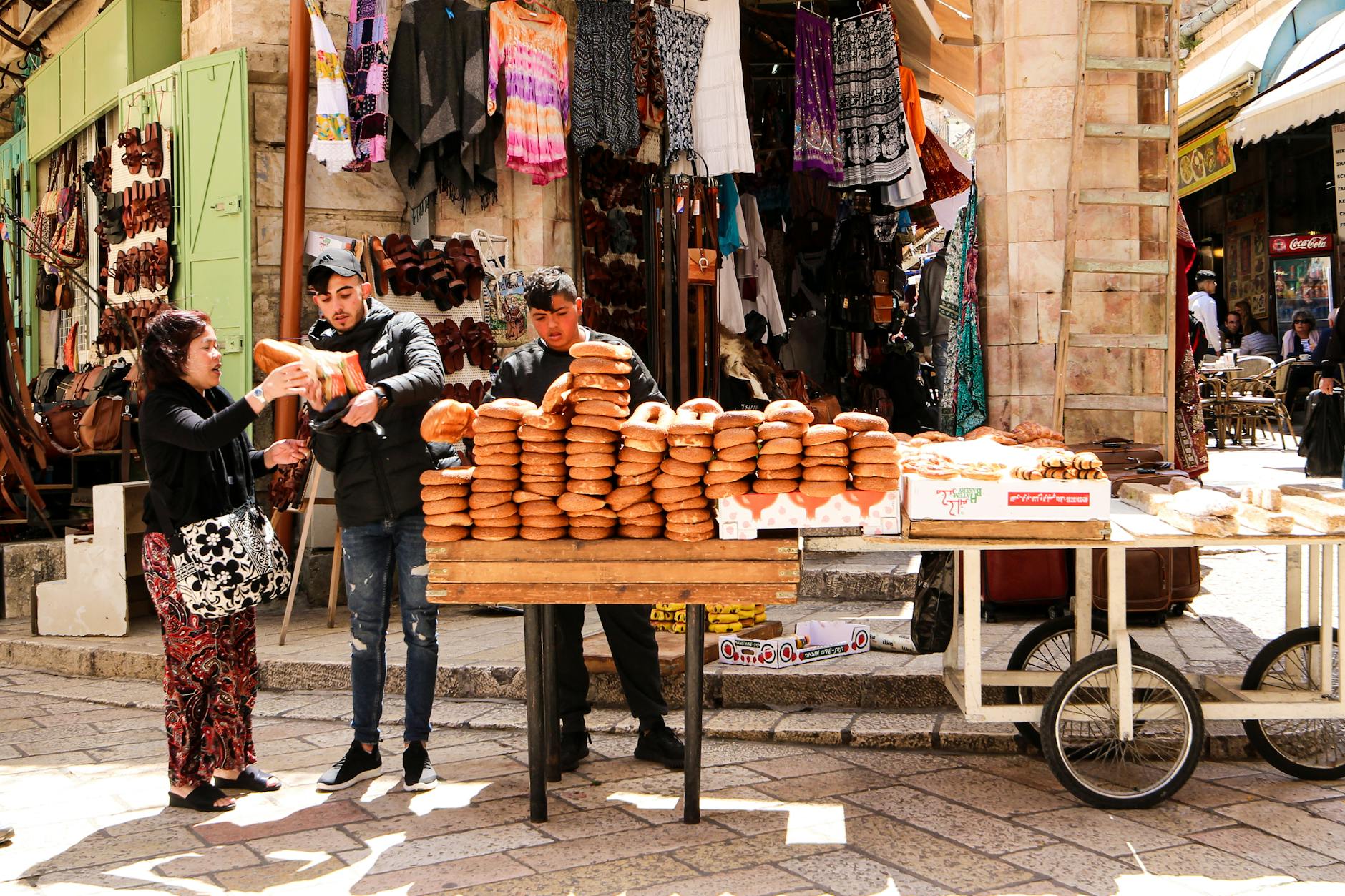
The prices below are typical market rates rather than fixed ones, and our roundup of the ten most authentic things to buy in Jerusalem goes further on which of them are genuinely made locally and which are mass-produced imports.
Under 50 NIS: Za’atar spice blend, single Armenian ceramic tile, Dead Sea bath salts, Turkish coffee with cardamom, small olive wood cross or ornament, handmade soap from Nablus, dried fruit selection.
50-200 NIS: Quality halva gift box, olive wood cutting board, Armenian ceramic bowl, boutique Israeli wine, hand-painted mezuzah, embroidered Palestinian textile, keffiyeh (traditional scarf), Israeli design items from Mamilla shops.
200+ NIS: Large Armenian ceramic piece, hand-carved olive wood nativity scene, antique coins (ensure they come with a certificate of authenticity from the Israel Antiquities Authority), fine Judaica pieces, premium Dead Sea skincare sets.
Shopping Hours, Shabbat and the Weekly Rhythm
Jerusalem effectively runs three overlapping weekends, and no single day closes the whole city. Working out which district rests when is the difference between a productive shopping day and a walk past shuttered doors.
West Jerusalem
The trading week runs Sunday to Thursday, with most shops open from around 09:00 or 10:00 until 19:00 or 20:00 and malls later. Friday is a half day, with closures from roughly 13:00 to 15:00 and earlier in winter when Shabbat begins mid-afternoon. Mahane Yehuda generally trades from about 08:00 to 19:00 Sunday to Thursday and closes around 15:00 on Friday, though individual stalls vary.
From Friday sunset until nightfall on Saturday, Jewish-owned retail is closed, the produce halls are shuttered and public transport in West Jerusalem stops. Saturday night is the compensation — shops, malls and the market’s bars reopen an hour or two after dark, making Saturday evening one of the busiest retail slots of the week. Our guide to how the city works over Shabbat covers what stays open and how to get around.
The Old City and East Jerusalem
The Old City keeps a different clock. Muslim Quarter shops generally open mid-morning to early evening seven days a week, with a lull around midday prayers on Friday when many shutters come down for an hour or two. That makes Saturday the best day to shop the souk. Christian Quarter shops are the reverse — many close on Sunday, particularly in the morning, as do shops run by Armenian families, and hours go unpredictable around the major feasts and through Holy Week. Jewish Quarter galleries close for Shabbat. Everywhere inside the walls winds down earlier than you expect, so plan serious shopping in the walled city for daylight hours.
Shops on and around Salah al-Din Street and Nablus Road trade Monday to Saturday and are the obvious answer if you need something practical on Shabbat. Friday is the quiet day there, with many businesses closed or opening late around midday prayers, and East Jerusalem buses run seven days a week, so the district stays reachable when West Jerusalem transport stops.
Holidays and Ramadan
Jewish festivals compress the week hard: the days before Rosh Hashanah, Yom Kippur and Passover bring frantic morning trading followed by complete closure for a day or two, and during Passover many food shops restrict what they sell. During Ramadan, Muslim Quarter shops often open later, close through the afternoon, then trade energetically after iftar. Both calendars move each year against the Gregorian one, so check the dates against your travel plans — our practical notes for planning a trip explain how the holiday calendar reshapes opening hours.
Practical Shopping Tips
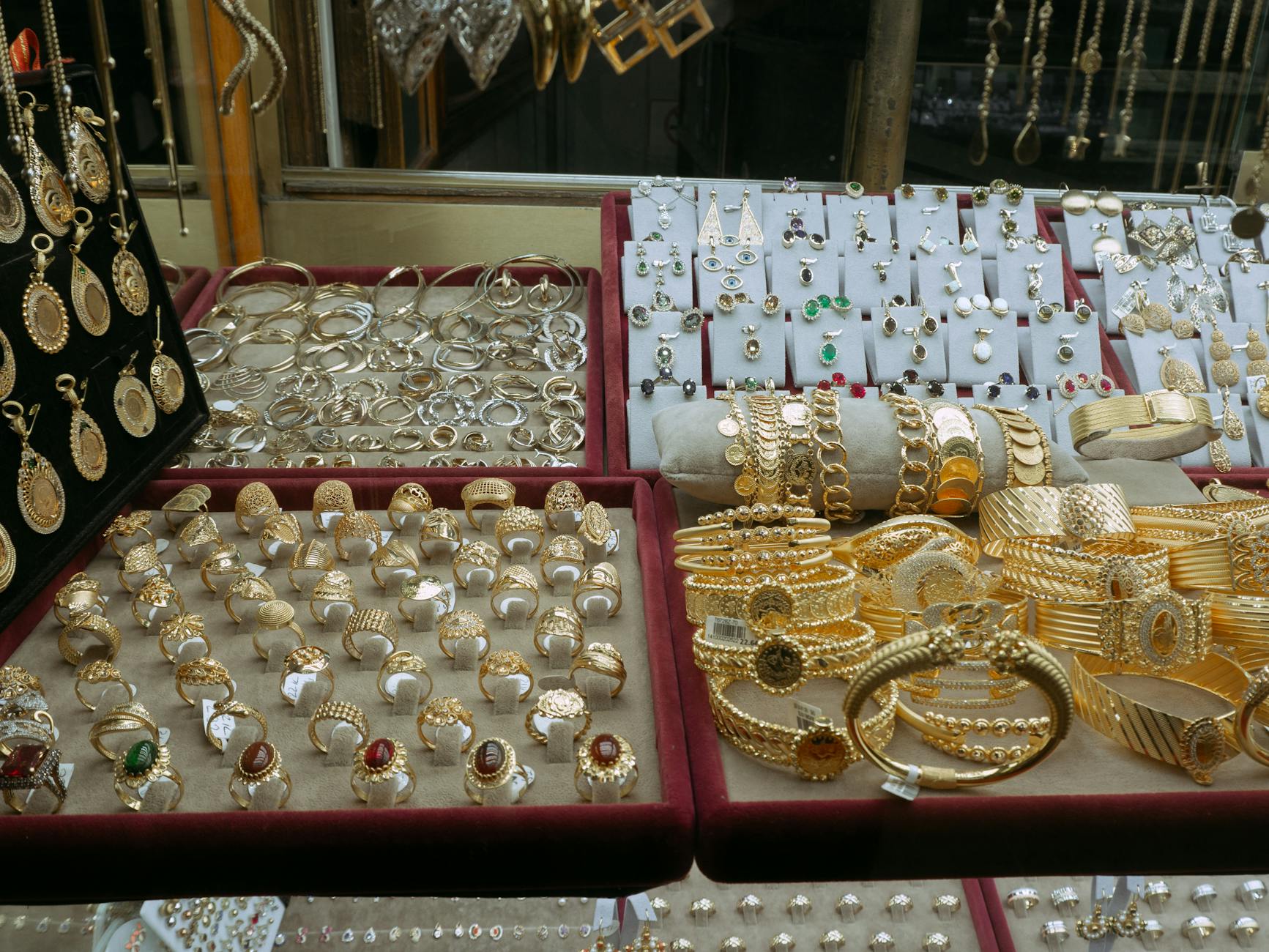
Shabbat closures: Most Jewish-owned shops and all of Mahane Yehuda close from Friday afternoon (around 2-3pm) through Saturday evening. Old City shops in the Muslim and Christian Quarters remain open during Shabbat but close on Fridays for Muslim prayer. Plan accordingly — see our Jerusalem travel tips for detailed Shabbat timing.
Payment: Credit cards are widely accepted in established shops and malls. Old City souk vendors and some market stalls may prefer cash (Israeli shekels). ATMs are available throughout the city.
VAT refund: Tourists can claim a VAT refund (18% as of August 2026) on purchases over 400 NIS from shops displaying the “Tax Refund” sign. Get the form stamped at the shop and present it at Ben Gurion Airport before departure.
Customs and antiquities: Items certified as genuine antiquities require an export permit from the Israel Antiquities Authority. Reputable dealers will provide the necessary documentation. Without proper permits, ancient items may be confiscated at the airport.
Best strategy: Spend your first day exploring the Old City and window-shopping to get a sense of prices and quality before buying. Compare similar items at multiple shops. Save large purchases for your last days to avoid carrying them around. Many shops offer shipping services for bulky items like ceramics.
Claiming Your VAT Refund
Israel’s standard rate of value added tax rose from 17% to 18% on 1 January 2025 and remains 18% as of August 2026. Visitors who are not Israeli citizens can reclaim most of that on qualifying goods leaving the country with them — but only if it is set up at the point of sale.
The mechanics start in the shop. Buy from a retailer participating in the tourist VAT scheme (they display a tax refund sign), spend at least the minimum on a single invoice — currently 400 shekels including VAT — and ask the shop to issue the designated tax invoice and seal the goods in the refund bag. Keep that bag sealed. Refunds cannot be claimed retroactively for an earlier trip, and no shop can add you to the scheme after the sale, so ask before you pay.
At Ben Gurion Airport the refund is handled by Milgam. For goods going into checked baggage, present the documents and the goods at the VAT counter on the third floor of the check-in hall, opposite the information desk, before you check in and pass security; you then present the stamped document again at the refund desk in the duty free hall to collect the money. Full details are on the Israel Airports Authority VAT refund page and in the Israel Tax Authority guidance for tourists.
Three honest caveats. The operator deducts a commission, so you never see the full 18% back, and the effective return is worse on small invoices. Food, drink, tobacco and some electrical goods are generally excluded. And the counters queue badly at peak departure times, so add half an hour to your buffer on top of the already generous check-in window for the run out to Ben Gurion.
Getting Your Purchases Home
The two things that go wrong after a good day’s shopping are breakage and customs, and both are easier to handle if you buy the fragile and heavy things at the end of your trip rather than on day one.
Fragile pieces. Established ceramics studios pack for travel as routine and most will ship internationally — usually a fair trade against carrying a platter through three airports, though on a large piece the quote adds a meaningful percentage to the price, so ask before you commit. If you carry pieces yourself, put them in hand luggage rather than the hold, in the center of the bag surrounded by soft clothing with nothing hard touching the rims. Tiles travel well stacked flat with cardboard between them; bowls and vases do not survive being wedged against a laptop.
Liquids and food. Olive oil, tahini, halva, arak and Dead Sea mud count as liquids or pastes and must go in checked baggage above 100ml; wrap oil and tahini in two sealed plastic bags, because cabin pressure and jar lids are not reliable friends. Pack ground spices in resealable bags rather than paper twists. Security screening at Ben Gurion is thorough and questions about purchases are routine rather than suspicious, so keep receipts accessible and do not gift-wrap anything before you fly.
Customs allowances. Commercially packaged, shelf-stable food — spices, halva, packaged dates, sealed olive oil, wine within your allowance — is generally straightforward to bring into the US, UK and EU, while fresh produce, meat and dairy are restricted or prohibited. Declare food if you are in any doubt: declaring costs nothing and failing to declare can cost a fine. On value, US residents returning after at least 48 hours abroad have a personal exemption of $800 per person on goods for personal use or gifts, and travelers entering Great Britain have an allowance of £390 of other goods, above which duty is charged on the total value rather than only the excess. Both figures change periodically, so confirm with US Customs and Border Protection and the UK duty-free allowances — a large Armenian platter or a hand-carved nativity scene can clear those thresholds on its own.
Frequently Asked Questions About Shopping in Jerusalem
Is it rude to haggle in Jerusalem?
Only in the wrong place — haggling is normal for unlabeled goods in the Old City souks and in East Jerusalem, and rude for food anywhere in Israel, in fixed-price shops and malls, in the established ceramics studios and in church and charity shops. The test is simple: if a price is printed on a tag, you pay it.
How much should I offer when bargaining?
Counter at roughly half the opening price and expect to settle near 40–60% of it on tourist-facing goods, having first checked the same item in three or four other shops so you are negotiating against a real market price rather than the seller’s anchor.
What is open in Jerusalem on Shabbat?
The Old City souks in the Muslim and Christian Quarters trade normally on Saturday, as do shops on Salah al-Din Street in East Jerusalem, while Jewish-owned shops, Mahane Yehuda and the West Jerusalem malls close from Friday afternoon until after nightfall on Saturday, when the city reopens for one of its busiest retail evenings of the week.
Can tourists claim a VAT refund in Israel?
Yes — non-Israeli visitors can reclaim VAT on qualifying goods from participating shops on invoices of at least 400 shekels including tax, provided the shop issues the designated invoice and seals the goods and the claim is processed at the Milgam counters at Ben Gurion before departure. A commission is deducted, and food, drink and tobacco are excluded.
How do I know if Armenian ceramics are genuine?
Look for brushstrokes that vary in thickness, slight asymmetry between repeated motifs, glaze pooling where the brush lifted, and a workshop signature on the base. Perfectly uniform lines and exactly matching repeats point to transfer-printed decoration rather than hand painting.
Is it legal to buy antiquities in Jerusalem and take them home?
Buying is legal only from dealers licensed by the Israel Antiquities Authority, who must display that license, and exporting a genuine antiquity requires a free permit from the Authority that takes a few working days. Items discovered after 1978 cannot be exported at all, and categories such as ossuaries and inscribed pieces never leave the country.
How can I tell real saffron from fake?
Buy whole threads rather than powder and test them in cool water — genuine saffron colors the water golden-yellow slowly over about 10 to 15 minutes while the threads stay red, whereas dyed safflower releases red or orange color within seconds and its threads turn pale.
Do shops in Jerusalem accept credit cards?
Malls, chain stores, supermarkets and established Old City shops take cards routinely, but market stalls and smaller souk traders often prefer shekels in cash — which also gives you leverage when bargaining. Carry small notes, since large ones are hard to break early in the day.
When is the best time of day to shop in Jerusalem?
Mid-morning to early afternoon from Sunday to Thursday gives you full stalls, daylight in the covered lanes and unhurried shopkeepers. Friday mornings are the most atmospheric and most crowded at Mahane Yehuda, and Saturday is the calmest day to browse the Old City.
Photo Credits
A vendor serving customers in a Suq Khan al-Zeit spice shop: Pyramid of spice in Suk Khan Az-Zait, 2019 (02) by Bahnfrend, CC BY-SA 4.0, via Wikimedia Commons.
Sacks of spices at the Rosemary spice shop, Mahane Yehuda Market: Mahane Yehuda Market ap 022 by Ariel Palmon, CC BY-SA 3.0, via Wikimedia Commons.
Bread, fruit and spice stalls in a covered lane of Mahane Yehuda Market: 106964 mahane yehuda market PikiWiki Israel by זאב שטיין, CC BY 2.5, via Wikimedia Commons.
The canopied arcade on Mamilla Avenue: Jerusalem, 21 December 2025 280 by מקף־עברי, CC BY-SA 4.0, via Wikimedia Commons.
A souvenir shop in the Old City market: Jerusalem (13319227674) by Mark Nakasone from Haifa, Israel, Israel, CC BY 2.0, via Wikimedia Commons.
{"@context": "https://schema.org", "@type": "FAQPage", "mainEntity": [{"@type": "Question", "name": "Is it rude to haggle in Jerusalem?", "acceptedAnswer": {"@type": "Answer", "text": "Only in the wrong place — haggling is normal for unlabeled goods in the Old City souks and in East Jerusalem, and rude for food anywhere in Israel, in fixed-price shops and malls, in the established ceramics studios and in church and charity shops. The test is simple: if a price is printed on a tag, you pay it."}}, {"@type": "Question", "name": "How much should I offer when bargaining?", "acceptedAnswer": {"@type": "Answer", "text": "Counter at roughly half the opening price and expect to settle near 40–60% of it on tourist-facing goods, having first checked the same item in three or four other shops so you are negotiating against a real market price rather than the seller's anchor."}}, {"@type": "Question", "name": "What is open in Jerusalem on Shabbat?", "acceptedAnswer": {"@type": "Answer", "text": "The Old City souks in the Muslim and Christian Quarters trade normally on Saturday, as do shops on Salah al-Din Street in East Jerusalem, while Jewish-owned shops, Mahane Yehuda and the West Jerusalem malls close from Friday afternoon until after nightfall on Saturday, when the city reopens for one of its busiest retail evenings of the week."}}, {"@type": "Question", "name": "Can tourists claim a VAT refund in Israel?", "acceptedAnswer": {"@type": "Answer", "text": "Yes — non-Israeli visitors can reclaim VAT on qualifying goods from participating shops on invoices of at least 400 shekels including tax, provided the shop issues the designated invoice and seals the goods and the claim is processed at the Milgam counters at Ben Gurion before departure. A commission is deducted, and food, drink and tobacco are excluded."}}, {"@type": "Question", "name": "How do I know if Armenian ceramics are genuine?", "acceptedAnswer": {"@type": "Answer", "text": "Look for brushstrokes that vary in thickness, slight asymmetry between repeated motifs, glaze pooling where the brush lifted, and a workshop signature on the base. Perfectly uniform lines and exactly matching repeats point to transfer-printed decoration rather than hand painting."}}, {"@type": "Question", "name": "Is it legal to buy antiquities in Jerusalem and take them home?", "acceptedAnswer": {"@type": "Answer", "text": "Buying is legal only from dealers licensed by the Israel Antiquities Authority, who must display that license, and exporting a genuine antiquity requires a free permit from the Authority that takes a few working days. Items discovered after 1978 cannot be exported at all, and categories such as ossuaries and inscribed pieces never leave the country."}}, {"@type": "Question", "name": "How can I tell real saffron from fake?", "acceptedAnswer": {"@type": "Answer", "text": "Buy whole threads rather than powder and test them in cool water — genuine saffron colors the water golden-yellow slowly over about 10 to 15 minutes while the threads stay red, whereas dyed safflower releases red or orange color within seconds and its threads turn pale."}}, {"@type": "Question", "name": "Do shops in Jerusalem accept credit cards?", "acceptedAnswer": {"@type": "Answer", "text": "Malls, chain stores, supermarkets and established Old City shops take cards routinely, but market stalls and smaller souk traders often prefer shekels in cash — which also gives you leverage when bargaining. Carry small notes, since large ones are hard to break early in the day."}}, {"@type": "Question", "name": "When is the best time of day to shop in Jerusalem?", "acceptedAnswer": {"@type": "Answer", "text": "Mid-morning to early afternoon from Sunday to Thursday gives you full stalls, daylight in the covered lanes and unhurried shopkeepers. Friday mornings are the most atmospheric and most crowded at Mahane Yehuda, and Saturday is the calmest day to browse the Old City."}}]}