Few cities reward the upward gaze the way Jerusalem does. Built on a series of ridges, surrounded by deep biblical valleys, and framed against the rolling Judean Hills, the Holy City offers panoramic views that have shaped how three world religions imagined heaven. Whether you are a photographer chasing golden hour, a first-time visitor wanting that one perfect skyline shot, or simply a traveler who wants to understand Jerusalem’s geography by seeing it laid out, the right viewpoint at the right time of day will give you the city’s most lasting memory.
This guide ranks the best viewpoints in Jerusalem for 2026, organized from most iconic to most underrated. Every entry includes practical access information, the optimal time of day to visit, photographer’s notes on lens choice and lighting, and any required tickets. Most are completely free. Use this guide alongside our Jerusalem attractions map to plan a viewpoint-rich itinerary that captures the entire city.
Why Jerusalem Has So Many Great Views
Jerusalem sits at roughly 800 meters above sea level, perched on a series of ridges separated by the dramatic Kidron, Hinnom, and Tyropoeon valleys. The Mount of Olives rises to the east, the Mount of Zion to the south, the Mount Scopus ridge to the northeast, and the Judean Desert opens beyond. Add the British Mandate-era law requiring all buildings in central Jerusalem to be faced in honey-colored Jerusalem stone, and the result is a city whose views are uniquely warm-toned, framed by valleys, and almost always pointed back at the iconic walled Old City and its golden Dome.
The best viewpoints split into three categories: natural ridges and promenades (Mount of Olives, Haas Promenade, Mount Scopus), built-up rooftops and towers (Austrian Hospice, Lutheran bell tower, Tower of David), and hidden street-level vistas (the Cardo rooftop, the steps from Jewish Quarter to the Kotel). The list below covers all three.
1. Mount of Olives Viewpoint — The Iconic Panorama
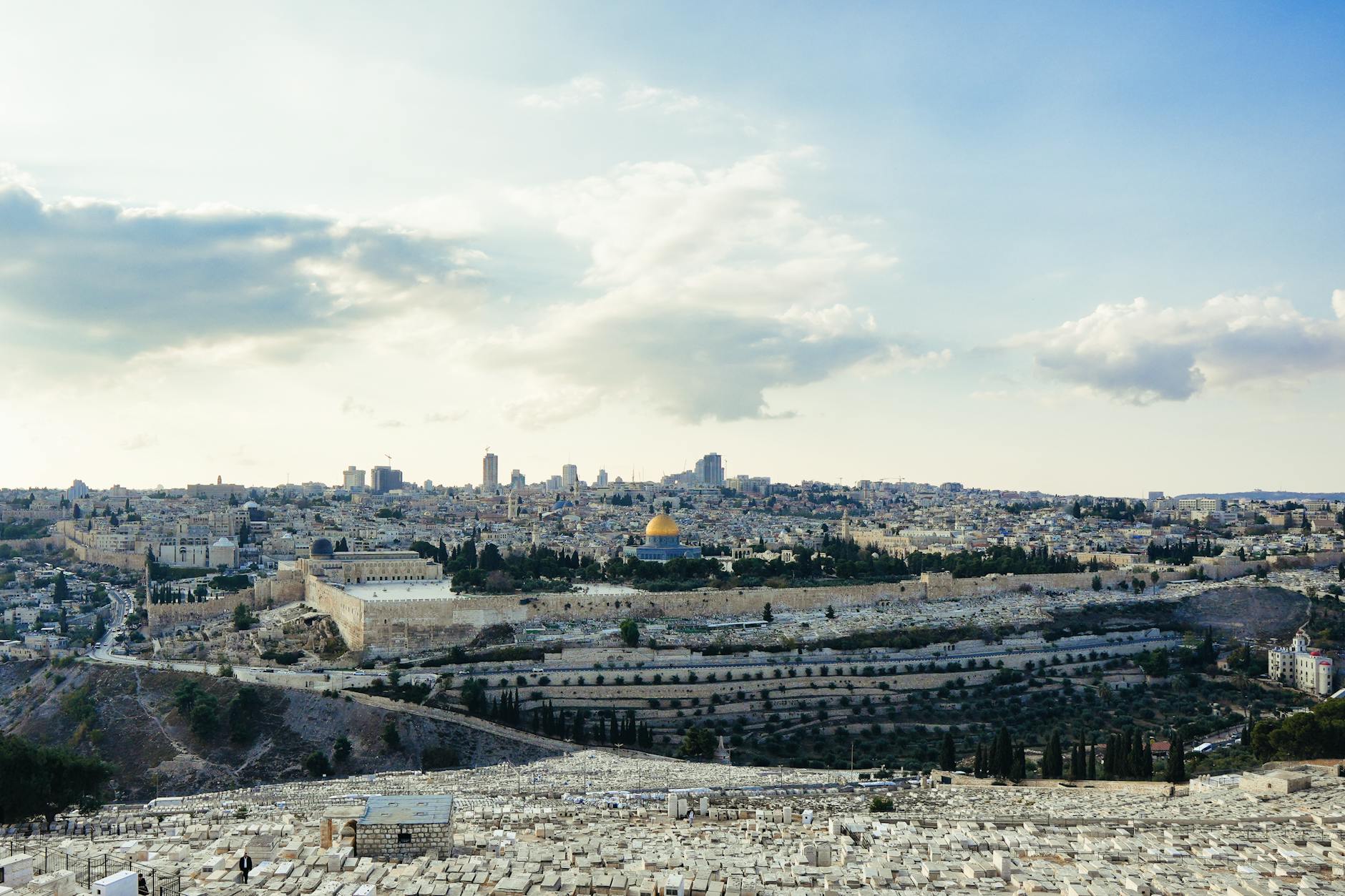
The Mount of Olives Viewpoint, near the Seven Arches Hotel, is the single most photographed vantage point in Israel — and rightly so. From here you see the entire walled Old City, the golden Dome of the Rock, the densely packed Jewish Cemetery cascading down the slope to the Kidron Valley, and the rooftops of the Christian, Muslim, and Jewish Quarters as one unified panorama.
Best time: sunrise (the Dome of the Rock catches first light and turns into a literal golden orb) or just before sunset. Cost: free. Access: taxi to the top (~30 NIS from city center), then walk down through the cemetery into the Old City via Lions’ Gate. Photo tip: bring a 24–70 mm zoom for the wide panorama plus tighter compositions of the Dome.
2. Haas Promenade (Tayelet) — The Cinematic Stretch
The Haas Promenade, locally known as the Tayelet, is a 2-kilometer landscaped ridge in the Armon HaNetziv neighborhood that delivers what may be Jerusalem’s most cinematic view: the Old City framed against the Judean Hills, with the desert opening behind it. The light is famously soft here, and the promenade is full of locals jogging, picnicking, and hanging out with families. Bring a bottle of wine for sunset.
Best time: sunset and twilight. Cost: free, 24/7. Access: Bus 78 from city center, or 25–35 NIS taxi. Photo tip: the very western end of the Tayelet aligns the Dome of the Rock with the city skyline best.
3. Tower of David Roof — 360° From the Citadel
Climb to the top of the Tower of David citadel (a paid attraction inside Jaffa Gate) for one of the only true 360-degree views in Jerusalem. To the east: Dome of the Rock and Mount of Olives. To the west: Mishkenot Sha’ananim, Yemin Moshe, and Jaffa Road. To the north: Christian Quarter rooftops. To the south: Mount Zion. Multi-level access lets you compose photos from different heights.
Best time: mid-afternoon for full multi-directional light. Cost: ~50 NIS adults. Photo tip: a 50mm prime captures the Dome of the Rock crisply at this distance; an ultra-wide for the citadel courtyard itself.
4. Austrian Hospice Rooftop — The Free Christian Quarter Panorama
One of Jerusalem’s best-kept secrets, the rooftop terrace of the Austrian Hospice of the Holy Family on the Via Dolorosa is open to anyone who walks into the building. The view stretches across the Christian and Muslim Quarter rooftops, with the Holy Sepulchre’s bell tower in the foreground and the Dome of the Rock and Al-Aqsa visible behind. Order a strudel and Viennese coffee in the on-site café and admire the panorama at your own pace.
Best time: mid-afternoon to sunset. Cost: free entry; coffee and strudel ~50 NIS. Access: Via Dolorosa, near Station 3. Photo tip: a 70–200mm zoom isolates the Holy Sepulchre tower against the Dome of the Rock beautifully.
5. Church of the Redeemer Bell Tower — The Cheapest 360°
For under 15 NIS, climb the 178 spiral steps inside the bell tower of the Lutheran Church of the Redeemer in the Christian Quarter. From 40 meters up, the entire Old City sits below you, and you’ll usually have the platform to yourself. This is hands-down the best price-to-view ratio in Jerusalem.
Best time: late morning when the eastern Dome of the Rock is fully lit. Cost: 15 NIS. Access: Lutheran Redeemer Church, Christian Quarter (Muristan). Photo tip: the spiral staircase itself is photogenic on the way up.
6. The Stairs from Jewish Quarter to the Western Wall
This is one of the most spectacular and overlooked free vistas in the city. As you descend the stone steps from the Jewish Quarter toward the Western Wall plaza, there’s a moment where you see the Western Wall, the Dome of the Rock, Al-Aqsa, and the Mount of Olives all framed in a single composition. There’s a small platform with benches where you can pause. Most tourists rush past on their way to the prayer plaza.
Best time: early morning or late afternoon. Cost: free, 24/7. Photo tip: a 24–35mm wide lens captures all four landmarks in one frame.
7. The Hidden Cardo Rooftop
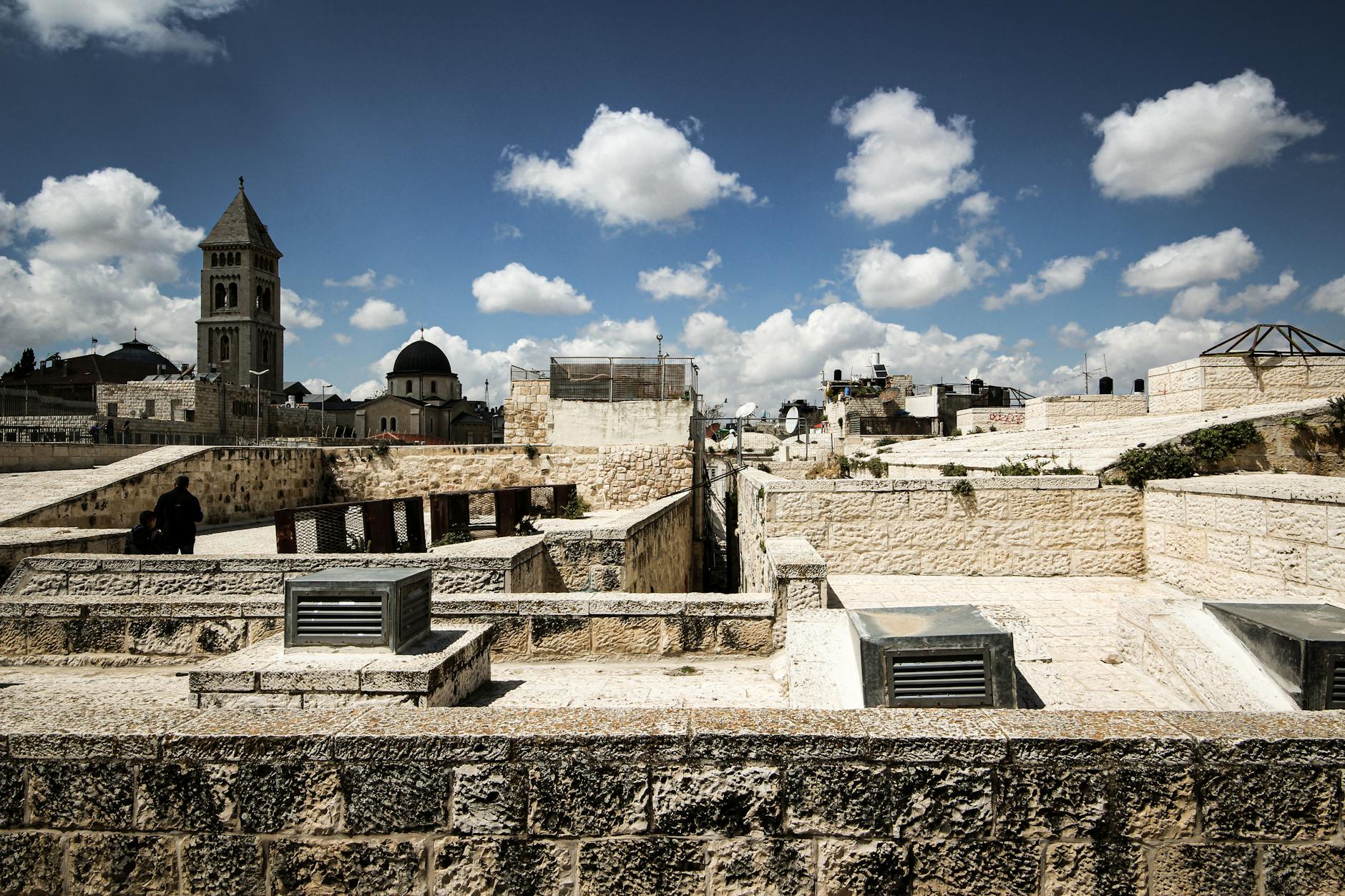
An unmarked metal staircase near the Jewish Quarter’s St. Mark’s Road leads up to a publicly accessible rooftop lookout known to locals simply as “the rooftop.” From here you can see the Dome of the Rock, the Lutheran Redeemer’s tower, the Holy Sepulchre, and the rooftops of three quarters of the Old City. There are no signs, no fees, and rarely more than a handful of visitors.
Best time: golden hour (about an hour before sunset). Cost: free. Access: Jewish Quarter, near St. Mark’s Road. Ask a local shopkeeper for “the rooftop.” Photo tip: ultra-wide 16mm captures the layered rooftops at their most dramatic.
8. Mount Scopus — The Northern Panorama
The Hebrew University Mount Scopus campus sits north of the Old City and offers a less-photographed but equally dramatic panorama, with the Old City to the south and the Judean Desert dropping toward the Dead Sea on the other side. The university’s Botanical Garden lookout and the platform near the Truman Institute are both free and offer excellent perspectives.
Best time: mid-morning to early afternoon. Cost: free. Access: Light Rail to Mount Scopus or bus 19 from city center. Photo tip: a 70–200mm zoom isolates the Dome of the Rock from this angle nicely.
9. Tabachnik Garden — Two Views in One
Located near Mount Scopus, the Tabachnik Garden has two distinct lookouts: one looking east to the Dead Sea and Judean Desert, and the other facing west toward the Temple Mount. This dual orientation makes it a unique photo location — you can capture both desert and city panoramas from a single short walk.
Best time: early morning for desert views, evening for city. Cost: free. Photo tip: bring a tripod for the dawn desert shot.
10. Ramparts Walk — The Walls Themselves
The Ramparts Walk on top of the Old City walls (Suleiman’s 1530s ramparts) lets you walk on the structure itself. The northern route from Jaffa Gate to Lions’ Gate (1.5 hours) offers consistently dramatic views of both the Old City and surrounding modern Jerusalem; the southern route (45 minutes) is shorter but includes views of the Western Wall plaza and Mount Zion.
Best time: twilight (the walls glow gold). Cost: ~20 NIS, valid 2 days. Photo tip: bring a wide and a normal prime; switch as the light changes.
11. YMCA Bell Tower — The Forgotten 152-Step Climb
The Jerusalem International YMCA, completed in 1933 by the same architect who designed the Empire State Building, has a beautiful Art Deco bell tower open to climbers for a small fee. The view from the top covers the King David Hotel, Yemin Moshe, the Old City walls, and the city center. Almost no tourists go up; you’ll usually have it to yourself.
Best time: mid-afternoon. Cost: ~10 NIS. Access: King David Street, opposite the King David Hotel.
12. Bloomfield Garden — From the West
The Bloomfield Garden below the Montefiore Windmill in Yemin Moshe gives you the Old City framed from the west. The angle is unusual — most viewpoints face the Old City from east or south — and the foreground of cypress trees and the Hinnom Valley adds depth that the more famous viewpoints lack.
Best time: sunrise. Cost: free, 24/7. Access: Yemin Moshe / King David Street area.
13. Temple Mount Esplanade — A View From Inside
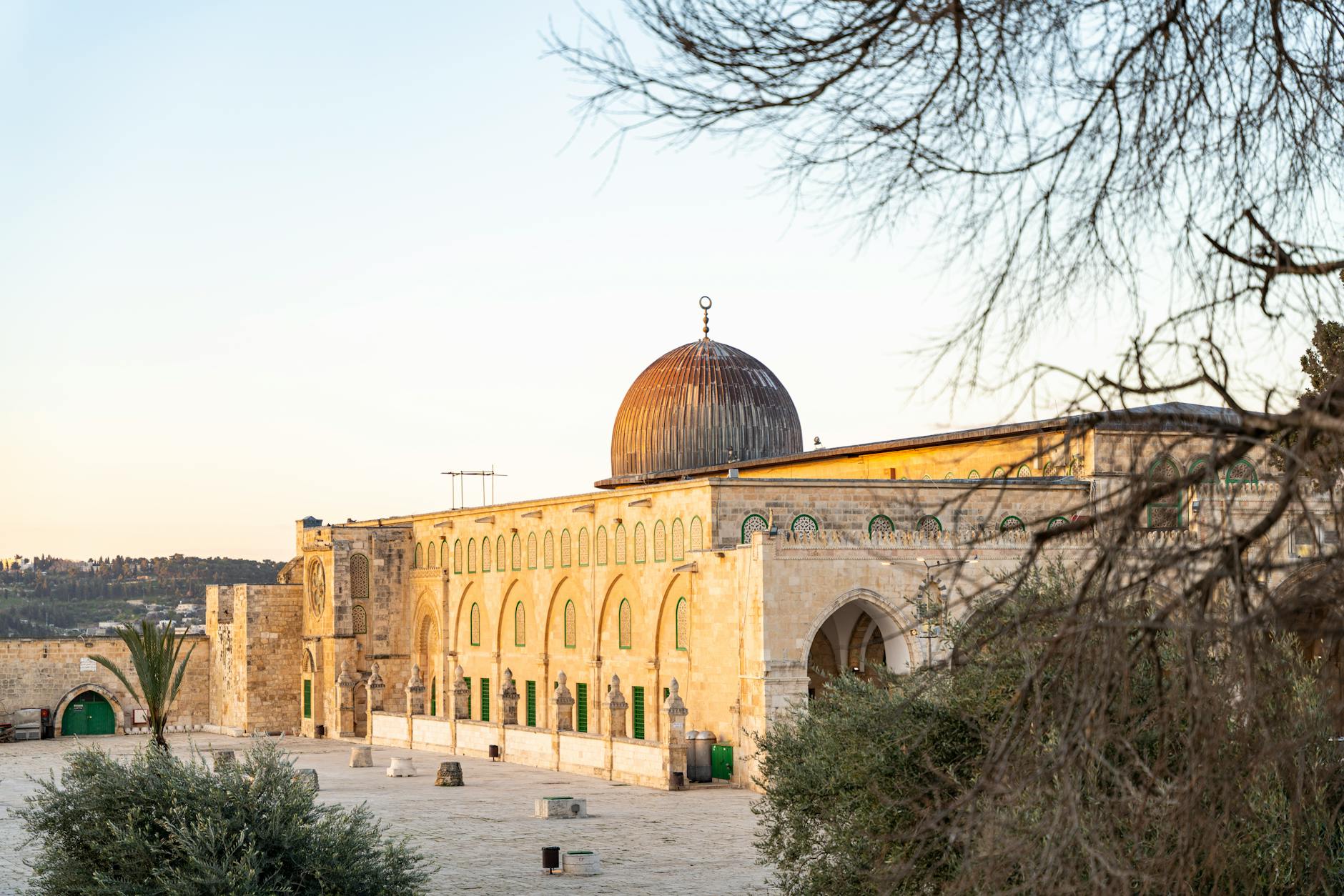
For a completely different perspective, walk onto the Temple Mount esplanade during non-Muslim visiting hours (Sun-Thu, ~7:30–11:00 AM and 1:30–2:30 PM). From here you can photograph the exterior of the Dome of the Rock and Al-Aqsa Mosque up close. Non-Muslims cannot enter the buildings themselves but can walk the wide stone plaza around them. Modest dress required; security checks at Mughrabi Bridge entrance from the Western Wall plaza.
Best time: just after the morning gates open at 7:30 AM. Cost: free. Photo tip: a wide prime works for the architecture; respect signage about photographing visitors.
14. Seven Arches Terrace — The Classic Postcard
The Seven Arches Hotel terrace, just below the Mount of Olives panorama, is the precise viewpoint that appears on the most “Jerusalem” postcards. The lower elevation provides a slightly different framing than the upper Mount of Olives lookout, with more of the Kidron Valley visible in the foreground. Free to access from the public path.
Best time: dawn. Cost: free.
15. Roof of the Hurva Synagogue Plaza
The Hurva Synagogue plaza in the Jewish Quarter is at higher elevation than the Western Wall, and the small roofed observation deck around it offers an unusual 270-degree view of the Old City — the Dome of the Rock, Mount Zion, and the Christian Quarter all at once.
Best time: early afternoon. Cost: free.
16. Givati Parking Lot Overlook
The Givati Parking Lot at the City of David offers a free elevated view back toward the Old City walls, plus a unique downward view into the Kidron Valley and the City of David archaeological excavations. This is one of the best places to photograph the topography that defined biblical Jerusalem.
Best time: golden hour. Cost: free.
17. Dormition Abbey Rooftop Walk
The Dormition Abbey on Mount Zion sometimes opens its rooftop walk to visitors during the cooler months. From the top, you get a striking close-up of the Old City walls and a fresh angle on the Dome of the Rock. Check the Abbey’s website for current opening status. Cost: small donation suggested.
18. Rooftop Bars and Restaurants
Several elevated dining spots double as exceptional viewpoints: The Rooftop at Mamilla Hotel (8th floor, Old City wall views), The Terrace at Waldorf Astoria (fountain garden with city skyline), Jerusalem Cinematheque rooftop café (Hinnom Valley + Old City), and the King David Hotel bar terrace. Order a drink and stay as long as you like.
19. Mount Zion Outer Walls
Walking along the outer base of the walls on Mount Zion (between Zion Gate and Dung Gate), you get a low-elevation view that emphasizes the massive scale of the Ottoman walls and the neighboring Mount of Olives across the Kidron. Free, almost always empty of tourists.
20. Pater Noster Abbey Garden
The Pater Noster Church on the Mount of Olives has a small garden courtyard with a tightly framed view of the Old City through cypress trees. Different from the wide-open viewpoint above; quieter and more contemplative. Small entry fee.
Photographer’s Timing Cheat Sheet
- Sunrise (5:30–6:30 AM in summer, 6:30–7:30 AM in winter): Mount of Olives, Bloomfield Garden — east-facing views with the Dome of the Rock catching first light.
- Mid-morning (9:00–11:00 AM): Lutheran bell tower, Mount Scopus — Old City fully lit from above.
- Mid-afternoon (1:00–4:00 PM): Tower of David, Austrian Hospice rooftop — multi-directional sun.
- Golden hour (1 hour before sunset): Haas Promenade, Cardo Rooftop — long warm shadows, soft light.
- Sunset: Haas Promenade, Mamilla rooftop — Old City silhouettes against sky.
- Twilight/blue hour (20 minutes after sunset): Ramparts Walk near Jaffa Gate — walls floodlit, sky still blue.
- Night: Tower of David, Mahane Yehuda rooftops — see our Jerusalem at Night guide.
Practical Tips for Viewpoint-Hunting
- Most viewpoints are free. Save your budget for the few paid ones (Tower of David, Lutheran tower) that genuinely earn it.
- Wear sturdy shoes. Many viewpoints involve uneven stone steps and slopes.
- Check sunset times — Jerusalem sunset varies from ~4:30 PM in winter to ~7:45 PM in summer.
- Tripod policies are generally relaxed at outdoor public viewpoints; restricted at religious sites and most paid attractions.
- Drone use is illegal over the Old City and most central neighborhoods. Don’t try.
- Modesty is required at religious-site viewpoints (Temple Mount esplanade, Mount Zion).
- Avoid Friday afternoons for Mount Zion sites and the Ramparts (early closures for Shabbat).
Frequently Asked Questions
What is the single best view of Jerusalem?
The Mount of Olives Viewpoint at sunrise is the consensus answer — and it has been since at least the 4th century, when Byzantine pilgrims first walked the same path. For a paid alternative, the Tower of David roof offers the only true 360-degree view in the city.
Are these viewpoints accessible to people with mobility issues?
The Haas Promenade, Bloomfield Garden, and Mount of Olives main viewpoint are accessible by car drop-off and have flat or near-flat surfaces. The Tower of David and Austrian Hospice have stairs but partial elevator access. Bell towers (Lutheran, YMCA) and the Cardo rooftop require stair climbing only.
Where can I shoot Jerusalem at sunrise without crowds?
The Mount of Olives in summer (5:30 AM) is reliably uncrowded. Bloomfield Garden and Haas Promenade are also extremely quiet at dawn. Pair sunrise with a coffee at the Austrian Hospice rooftop afterward.
Can drones be used for aerial views?
No. Drone flights over the Old City and most of central Jerusalem are strictly prohibited by Israeli civil aviation law and security regulations. Penalties are severe. Use ground-level viewpoints only.
What lens should I bring for Jerusalem photography?
A 24–70mm zoom covers most situations: wide enough for panoramas, tight enough for the Dome of the Rock from across the city. Add a 35mm or 50mm prime for the Old City alleys and a 70–200mm zoom if you want to compress and isolate distant subjects. Smartphones produce excellent results from most viewpoints in good light.
How long should I budget for a viewpoint-focused day?
A full sunrise-to-sunset day can comfortably cover 4–5 viewpoints: Mount of Olives at dawn, Lutheran bell tower mid-morning, Austrian Hospice rooftop for lunch, Tower of David in the afternoon, and Haas Promenade at sunset. Build in walking time and food breaks.
Final Word: The Best Photos Come With Patience
The classic Jerusalem panorama from the Mount of Olives has been photographed millions of times — and yet the best photographs of the city are still those taken by visitors who waited 30 extra minutes for the light to land just right. Build at least one or two of the viewpoints above into your trip, give yourself time at each, and the city will reward you with the kind of picture you hang on your wall.
Plan a complete viewpoint route with our Jerusalem attractions map, see our Jerusalem at Night guide for after-dark vantage points, and the Things to Do pillar for context on each location.
Leave a Reply